The Evolution of Clinical Skin Typing in Medical Aesthetics: Moving Beyond the Fitzpatrick Scale for Enhanced Efficacy, Safety, and ROI
In the highly competitive landscape of medical aesthetics, the precision of clinical assessment directly dictates patient outcomes, safety profiles, and ultimately, the commercial viability of a practice. For dermatologists, plastic surgeons, and medical spa owners, understanding how human tissue interacts with photothermal energy is not just a clinical requirement—it is the foundational metric of risk management. At the core of this assessment protocol lies the Fitzpatrick Skin Typing Scale.
As a premier supplier of professional medical laser equipment, Cocoon Laser recognizes that technological superiority must be paired with rigorous clinical protocols. Modern aesthetic clinics face a complex demographic reality where relying solely on outdated assessment models can lead to adverse events, diminished patient trust, and financial liability. This comprehensive white paper dissects the clinical utility, inherent limitations, and modern evolution of the Fitzpatrick Scale, providing a data-driven blueprint for integrating advanced diagnostic frameworks with next-generation energy-based devices (EBDs).
Through structural analysis and clinical physics, we will explore why modernizing skin assessment is a critical vector for aesthetic clinic procurement strategies and long-term business growth.
1. The Clinical Imperative: Deconstructing Selective Photothermolysis
Before analyzing the Fitzpatrick Scale, it is necessary to establish the physical principles that make skin typing mandatory in medical aesthetics. The fundamental mechanism driving almost all aesthetic laser technology is selective photothermolysis.
Formulated in the 1980s, this principle dictates that specific wavelengths of light are absorbed by specific chromophores (targets) in the tissue—primarily melanin, hemoglobin, and water. When these chromophores absorb photons, the light energy converts into thermal energy, destroying the target without causing collateral damage to the surrounding epidermis.
However, melanin is not only present in the target (such as a hair follicle or a benign pigmented lesion) but is also distributed throughout the epidermal junction. Therefore, when utilizing advanced laser hair removal machines or skin resurfacing platforms, the laser beam must pass through the melanin-rich epidermis to reach the dermis. If the epidermis contains high concentrations of melanin, it will act as a competing chromophore, absorbing the energy prematurely. This leads to epidermal overheating, blistering, and severe post-inflammatory hyperpigmentation (PIH).
This is the exact juncture where the Fitzpatrick Scale becomes an operational necessity. It provides a baseline heuristic to estimate basal epidermal melanin concentration, dictating the maximum safe fluence (J/cm2) and the optimal pulse duration (measured in milliseconds) that a practitioner can deploy.
2. The Fitzpatrick Scale: A Foundational Diagnostic Matrix
Developed in 1975 by Harvard dermatologist Dr. Thomas Fitzpatrick, the scale was initially designed to categorize the erythemal (burn) response of skin to ultraviolet (UV) light for photochemotherapy (PUVA) dosing. Over the decades, it transitioned into the gold standard for predicting skin reactivity to aesthetic treatments, including chemical peels, microneedling, and particularly, laser therapeutics.
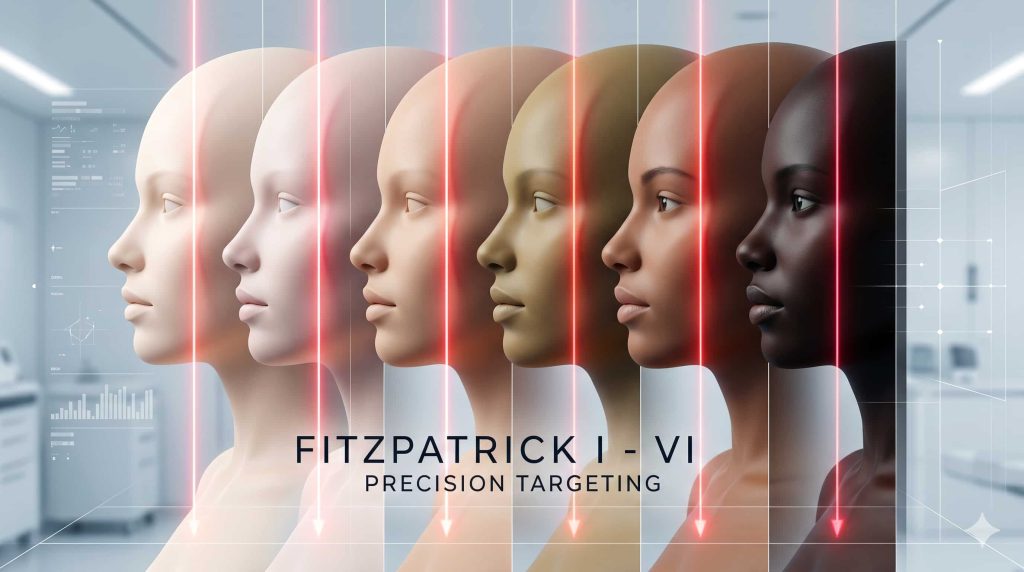
The system classifies human skin into six distinct phototypes based on constitutive pigmentation (baseline genetic skin color) and facultative pigmentation (tanning response to UV exposure).
The Six Classifications and Their Clinical Implications
To maximize the efficacy of Cocoon Laser platforms, practitioners must map device parameters strictly to these six phototypes:
- Type I: Very Fair Skin
- Characteristics: Often characterized by pale white skin, blue or green eyes, and blond or red hair. Freckles are common.
- UV Response: Always burns, never tans.
- Laser Compatibility: Highly compatible with a broad spectrum of wavelengths, including highly absorbed visible light and near-infrared spectrums (e.g., 755nm Alexandrite). Risk of PIH is exceptionally low. The primary clinical concern is ensuring adequate target melanin exists (e.g., in hair removal) to absorb the energy.
- Type II: Fair Skin
- Characteristics: Light skin, light-colored eyes, and light to medium hair.
- UV Response: Usually burns, tans minimally and with difficulty.
- Laser Compatibility: Similar to Type I, Type II skin tolerates aggressive parameters well. Practitioners can utilize shorter pulse durations and higher fluences to achieve rapid clinical endpoints without significant risk of epidermal thermal necrosis.
- Type III: Light Olive Skin
- Characteristics: Medium skin tones, often associated with Mediterranean or Central European descent. Hair and eyes are typically dark.
- UV Response: Sometimes burns, tans gradually to a light brown.
- Laser Compatibility: Represents a transition zone. While still highly treatable, the competing epidermal melanin requires the practitioner to begin adjusting parameters. Epidermal cooling mechanisms (such as the contact cooling systems integrated into Cocoon Laser devices) become essential to protect the surface tissue.
- Type IV: Medium Brown Skin
- Characteristics: Olive or light brown skin, common in populations of Hispanic, Asian, or Middle Eastern descent.
- UV Response: Rarely burns, tans easily to a moderate brown.
- Laser Compatibility: The risk of PIH and paradoxical hypertrichosis escalates significantly. Shorter wavelengths (like 755nm) begin to pose a high risk of epidermal damage. Practitioners must shift toward longer wavelengths (e.g., 810nm Diode or 1064nm Nd:YAG) that penetrate deeper and bypass epidermal melanin.
- Type V: Dark Brown Skin
- Characteristics: Dark brown skin, common in populations of Indian, African, or Indigenous descent.
- UV Response: Very rarely burns, tans deeply and profusely.
- Laser Compatibility: Requires strict adherence to safety protocols. The 1064nm Nd:YAG wavelength is the absolute gold standard here due to its low melanin absorption coefficient, allowing it to safely bypass the heavy epidermal pigment layer. Pulse durations must be extended beyond the thermal relaxation time (TRT) of the epidermis to allow heat dissipation.
- Type VI: Deeply Pigmented Skin
- Characteristics: Deep dark brown to black skin.
- UV Response: Never burns, deeply pigmented baseline.
- Laser Compatibility: Highest risk category for adverse events if treated improperly. Fractional non-ablative technologies or long-pulsed 1064nm Nd:YAG lasers from Cocoon Laser are required. Aggressive cooling before, during, and after the pulse is non-negotiable.
3. The Economics of Risk Management in B2B Procurement
For clinic owners and B2B investors, understanding the Fitzpatrick Scale is not merely an exercise in dermatology; it is the cornerstone of clinical risk management and procurement strategy.
When establishing or scaling a medical aesthetic practice, the demographic composition of the clinic’s target market must dictate the technological investments. A clinic situated in a demographic primarily composed of Fitzpatrick Types I-III will require an entirely different portfolio of EBDs compared to a clinic serving a diverse urban population with high concentrations of Types IV-VI.
Demographic Mapping and Equipment ROI
Attempting to treat Type V skin with an aggressively pulsed Alexandrite laser designed for Type II skin is not just a clinical error; it is a profound business liability. Adverse events such as permanent hypopigmentation, severe blistering, and keloid scarring inevitably lead to malpractice litigation, reputational destruction, and the loss of patient lifetime value (LTV).
Strategic aesthetic clinic procurement necessitates sourcing versatile platforms that can safely navigate the entire Fitzpatrick spectrum. This is where dual-wavelength systems provide exceptional ROI. By integrating platforms that house both 755nm and 1064nm wavelengths, or highly tunable 810nm diodes with advanced continuous cooling, a clinic can confidently market its services to 100% of the demographic catchment area, effectively doubling its addressable market while mitigating liability.
| Clinical Requirement | Ideal Wavelength / Modality | Target Fitzpatrick Range | Cocoon Laser Procurement Strategy |
|---|---|---|---|
| High-Contrast Target (e.g., Dark Hair / Light Skin) | 755nm Alexandrite / 810nm Diode | Types I – III | Standard configuration for rapid ROI in temperate demographic zones. |
| Deep Dermal Heating / Vascular Lesions | 1064nm Nd:YAG | Types I – VI | Essential for diverse patient bases; highest safety profile for melanin-rich skin. |
| Skin Resurfacing (Low Downtime) | Non-Ablative Fractional (e.g., 1565nm) | Types I – V | Safe collagen induction without removing the epidermal layer, reducing PIH risks. |
| Skin Resurfacing (Aggressive) | Ablative CO2 (10,600nm) / Erbium (2940nm) | Types I – III (Proceed with caution on IV) | High-margin treatments requiring strict patient selection and post-care protocols. |
4. The Limitations of the Legacy Fitzpatrick System
While universally adopted, the Fitzpatrick Scale is showing its age. Modern aesthetic medicine, driven by data and clinical rigor, demands a higher degree of precision than a subjective questionnaire designed nearly fifty years ago. Practitioners relying solely on the legacy Fitzpatrick model operate with significant blind spots.
4.1 Historical Bias and the “Skin of Color” Deficit
The most profound limitation of the Fitzpatrick Scale is its origin. Dr. Fitzpatrick developed the scale based on observations of exclusively white patients in the Northern Hemisphere, focusing primarily on their erythemal response to UV radiation. The categories for darker skin (Types V and VI) were added retroactively and lack the granular nuance applied to lighter skin types.
Consequently, the scale homogenizes vast populations. Millions of individuals of African, Asian, Hispanic, and Middle Eastern descent are grouped into broad categories that fail to account for unique dermal characteristics. For example, two patients might both be classified as Type IV based on their tan-to-burn ratio, but one may possess a fibroblastic density that makes them highly prone to hypertrophic scarring, while the other does not.
4.2 Ignorance of Healing Responses and Inflammatory Cascades
The Fitzpatrick Scale measures melanogenesis (the production of melanin in response to UV light). It does not measure the skin’s inflammatory cascade, fibroblast activity, or wound-healing response.
In medical aesthetics, we are fundamentally inflicting controlled trauma to stimulate regeneration. A patient’s tendency to tan is only a fraction of the clinical picture. The scale fails to predict:
- Post-Inflammatory Hyperpigmentation (PIH): The overproduction of melanin as a response to thermal or physical trauma.
- Post-Inflammatory Erythema (PIE): Prolonged redness caused by capillary damage.
- Fibroplasia and Scarring: The overactive collagen production leading to keloids.
4.3 Subjectivity and Patient Misreporting
The scale relies heavily on subjective patient history. “How does your skin react to the first sun exposure of the summer?” In modern, urbanized populations where SPF 50 is used daily and prolonged sun exposure is avoided, patients frequently misreport their tanning and burning history. A patient with a constitutive Type III skin might report never tanning simply because they avoid the sun, leading an inexperienced practitioner to mistakenly classify them as Type I or II, and consequently over-treat them with dangerous laser fluences.
5. Next-Generation Diagnostics: The Future of Skin Assessment
To maintain the highest standards of clinical safety and align with the data-driven methodology championed by advanced aesthetic frameworks, the industry is transitioning from subjective questionnaires to objective, algorithmic diagnostics. Cocoon Laser advocates for a multi-modal approach to patient assessment, leveraging technology to eliminate human error.
5.1 The Colorimetric Scale and Objective Phototyping
To address the shortcomings of the Fitzpatrick scale in diverse populations, researchers have developed colorimetric assessments. Using spectrophotometers or tristimulus colorimeters, clinicians can measure the exact Individual Typology Angle (ITA∘), which calculates the concentration of melanin and hemoglobin in the skin based on light reflection.
This provides an objective, quantifiable metric of epidermal melanin concentration, completely removing patient subjectivity. By utilizing tools that measure the melanin index directly, practitioners can calibrate professional medical laser equipment with absolute mathematical precision, adjusting fluences down to the micro-joule based on the patient’s immediate baseline, rather than an arbitrary category.
5.2 AI-Driven Sensors and Generative Treatment Protocols
The future of energy-based devices lies in intelligent integration. Modern laser platforms are beginning to feature live melanin readers built directly into the handpieces. These optical sensors emit a low-level diagnostic pulse, read the reflection to determine the melanin index, and automatically lock out unsafe energy parameters.
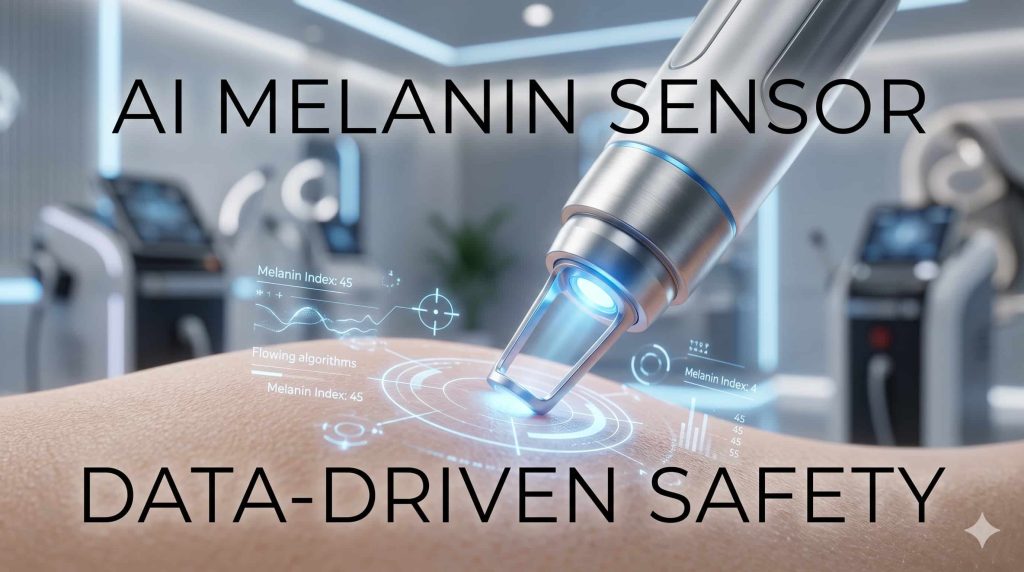
This technological leap is fundamentally transforming clinical operations. By leveraging AI to restrict parameters based on real-time epidermal melanin, clinics can drastically reduce the training curve for new technicians and effectively eliminate the risk of operator-induced thermal burns.
Furthermore, machine learning algorithms are currently analyzing thousands of clinical outcomes to predict healing responses. By inputting a patient’s genetic background, objective melanin index, and the specific parameters of Cocoon Laser platforms, predictive models can forecast the exact likelihood of PIH, allowing practitioners to pre-treat with tyrosinase inhibitors (like hydroquinone) weeks before the laser session.
6. Integrating Assessment Protocols with Cocoon Laser Technologies
For B2B partners and clinical directors, adopting advanced EBDs requires establishing standard operating procedures (SOPs) that integrate the Fitzpatrick Scale with modern protective measures. When utilizing high-powered systems from Cocoon Laser, the following protocols ensure maximal efficacy and zero-liability operation:
Step 1: Multi-Factorial Consultation
Never rely on a single data point. The consultation must include the traditional Fitzpatrick questionnaire, augmented by ethnic background analysis (to predict scarring tendencies) and a thorough review of the patient’s current active skincare (e.g., retinol use, which thins the stratum corneum and mimics a lighter Fitzpatrick type’s vulnerability).
Step 2: Objective Measurement
Whenever possible, utilize handheld melanin readers before adjusting the laser interface. If a patient presents with a residual tan (facultative pigmentation), their functional Fitzpatrick type has temporarily increased. A Type III patient with a fresh tan must be treated as a Type IV or V until the melanocytes return to baseline.
Step 3: Epidermal Protection Mechanics
Understanding skin typing is useless if the device cannot protect the tissue. Cocoon Laser’s engineering focuses heavily on advanced cooling technologies—such as continuous contact sapphire cooling and cryogen spray mechanisms. By actively drawing heat out of the epidermis at a rate faster than the thermal relaxation time of the melanocytes, our devices allow practitioners to deliver higher therapeutic energy to the dermal targets while artificially preserving the safety profile of a lighter skin type.
Step 4: Wavelength Selection Over Fluence Adjustment
A common clinical error is attempting to treat Type V skin with a 755nm laser by simply lowering the fluence. Lowering the fluence reduces efficacy but does not change the physics of photon absorption; the 755nm wavelength will still be disproportionately absorbed by the epidermal melanin. The correct protocol, integrated into our dual-wavelength platforms, is to switch to the 1064nm Nd:YAG wavelength. This safely bypasses the epidermis, allowing the practitioner to maintain therapeutic energy levels deep within the tissue.
7. Conclusion: Data-Driven Dermatology and the Bottom Line
The Fitzpatrick Scale remains an indelible part of the dermatological lexicon. As a rapid, foundational tool for triaging patient risk, it is invaluable. However, for the modern aesthetic enterprise, treating it as the definitive boundary of clinical assessment is an outdated methodology that restricts revenue and invites liability.
The aesthetic market is expanding, and the demographic of the aesthetic consumer is diversifying. Clinics that can confidently, safely, and effectively treat Skin Types IV through VI possess a massive competitive advantage. Achieving this requires moving beyond subjective questionnaires. It demands objective melanin quantification, a profound understanding of optical physics, and most importantly, investment in professional medical laser equipment engineered to handle complex clinical variables.
By partnering with Cocoon Laser, clinics equip themselves not just with machines, but with advanced clinical ecosystems. Our technologies are designed to bridge the gap between human assessment and physical reality, utilizing advanced wavelengths, predictive cooling, and intuitive interfaces to ensure that every skin type receives the optimal balance of aggressive treatment and paramount safety. In the evolving landscape of medical aesthetics, precision is not just a clinical goal; it is the ultimate business strategy.
If you need more information, please click “Contact Us”.
If you want to obtain more information, please follow our official website and Facebook.