The Ultimate Buyer’s Guide to Professional Picosecond Laser Machines: Technology, Efficacy, and Clinic ROI
Executive Summary
Investing in a professional picosecond laser machine represents a critical capital expenditure for aesthetic clinics and dermatology practices. This comprehensive guide breaks down the underlying physics, clinical efficacy, and return on investment (ROI) associated with advanced picosecond technology. By transitioning from photothermal to photoacoustic destruction of chromophores, picosecond devices drastically reduce downtime and mitigate the risk of Post-Inflammatory Hyperpigmentation (PIH) across all Fitzpatrick skin types. For B2B decision-makers, evaluating peak power, targeted wavelength combinations (532nm, 755nm, 1064nm), and total cost of ownership (TCO)—including flashlamp lifespan and shots count—is essential. Furthermore, ensuring regulatory compliance such as Medical CE and FDA 510(k) guarantees patient safety. Whether optimizing for multi-color tattoo removal or non-ablative skin rejuvenation via Laser-Induced Optical Breakdown (LIOB), selecting a reliable manufacturer like Cocoon Laser ensures long-term clinical success and accelerated revenue generation.
How Picosecond Technology is Revolutionizing Aesthetic Dermatology
The evolution of laser dermatology is defined by the continuous pursuit of shorter pulse durations and higher peak power. The transition from traditional Q-Switched technologies to picosecond modalities marks a fundamental shift in how target chromophores—whether endogenous melanin or exogenous tattoo ink—are dismantled within the dermis and epidermis.
The Shift from Nanosecond to Picosecond Pulses
The fundamental difference between nanosecond and picosecond lasers lies in the duration of the laser pulse. While nanosecond lasers deliver energy in billionths of a second (10⁻⁹ s), picosecond lasers operate in trillionths of a second (10⁻¹² s). This ultra-short pulse duration alters the primary mechanism of action from a heat-based approach to a mechanical shockwave approach.
For B2B procurement, understanding this physical distinction is vital, as it directly impacts patient comfort, clearance rates, and complication risks.
| Feature | Nanosecond Laser (Q-Switched) | Picosecond Laser |
| Pulse Duration | Billionths of a second (10⁻⁹ s) | Trillionths of a second (10⁻¹² s) |
| Primary Mechanism | Photothermal (Heat generation) | Photoacoustic (Mechanical shockwave) |
| Particle Fragmentation | Breaks ink into pebble-sized fragments | Pulverizes ink into microscopic dust |
| Macrophage Clearance | Slow, requires more sessions | Highly efficient, rapid immune clearance |
| Thermal Tissue Damage | Moderate | Minimal to none |
| PIH Risk Factor | Moderate to High | Extremely Low |
Understanding the Photoacoustic Effect
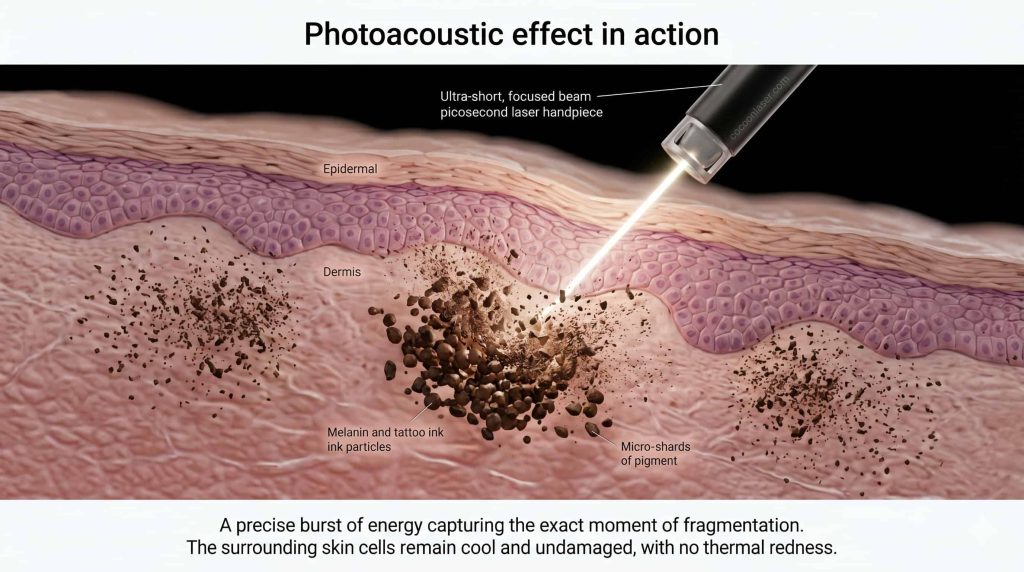
When pulse durations fall below the thermal relaxation time of the target chromophore, thermal diffusion into surrounding tissue is severely restricted. Instead of heating the target, the ultra-short picosecond pulse generates an intense acoustic wave—known as the photoacoustic effect.
This extreme pressure shatters pigment particles into exceptionally fine dust without transferring damaging heat to the surrounding epidermis. Clinically, this translates to an expanded safety profile. Dermatologists can safely treat patients with darker skin tones (Fitzpatrick Scale IV-VI) with a drastically minimized risk of triggering Post-Inflammatory Hyperpigmentation (PIH) or causing collateral thermal scarring.
Key Clinical Applications and Demonstrated Efficacy
A medical-grade device must prove its value through versatile, reliable clinical outcomes. The efficacy of a professional picosecond system is evaluated across three primary dermatological categories, driving patient throughput and clinic utilization rates.
Advanced Tattoo Removal Across the Color Spectrum
Tattoo removal remains a high-demand, high-margin procedure. However, multi-colored tattoos present a complex challenge due to the varying absorption spectra of different inks. Professional picosecond lasers utilize distinct wavelengths to target specific colors:
- 1064nm (Nd:YAG): Highly effective for dark pigments, including black, grey, and deep blue inks. Its deeper penetration depth makes it safe for all skin types.
- 532nm (KTP): The optimal wavelength for targeting warm colors, such as red, yellow, and orange inks, which are notoriously resistant to older technologies.
- 755nm (Alexandrite): The gold standard for clearing recalcitrant greens and light blues.
The photoacoustic pulverization ensures that even dense, professionally applied tattoos require significantly fewer sessions compared to Q-Switched alternatives.
Melasma and Pigmented Lesions Treatment
Treating benign pigmented lesions—ranging from solar lentigines (freckles) and Nevus of Ota to complex conditions like melasma—requires precise energy delivery. Melasma is particularly sensitive to thermal stimulation, which can exacerbate the condition. The picosecond laser’s non-thermal, acoustic shockwave breaks down aberrant melanin clusters gently. By utilizing ultra-short pulses, the system clears the hyperpigmentation with minimal downtime and an exceptionally low recurrence rate, establishing it as the preferred modality for complex dermal pigmentation.
Acne Scars and Non-Ablative Skin Rejuvenation
Beyond pigmentation, modern picosecond systems are engineered with advanced optics, such as Micro Lens Arrays (MLA) or diffractive fractional lenses. These optics concentrate energy into micro-beams, bypassing the epidermis to create localized regions of plasma in the dermis.
This process, known as Laser-Induced Optical Breakdown (LIOB), triggers a robust wound-healing cascade. Fibroblasts are stimulated to produce new collagen and elastin fibers without ablating the surface skin. The result is significant improvement in acne scar morphology, enlarged pores, and fine lines, accompanied by a downtime of mere hours rather than the days associated with traditional ablative CO2 lasers.
Critical Technical Specifications to Evaluate Before Purchasing
For procurement directors and clinic owners, navigating equipment spec sheets requires separating standard features from medical-grade engineering. The following parameters dictate whether a device is truly a “professional” unit capable of high-volume, reliable clinical performance.
Optimal Wavelength Combinations (532nm, 755nm, 1064nm)
A single-wavelength machine limits a clinic’s treatment portfolio. A comprehensive, professional-grade platform must offer multiple wavelengths to address various chromophores at different anatomical depths:
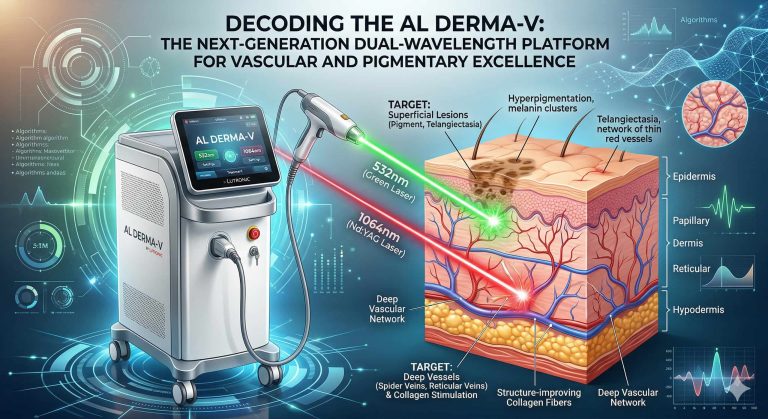
- Epidermal Targeting: The 532nm wavelength has high melanin absorption but shallow penetration, making it ideal for superficial lesions like ephelides.
- Dermal Targeting: The 1064nm wavelength penetrates deeply into the reticular dermis with lower melanin absorption, providing a safe profile for dermal pigmentation (e.g., Nevus of Ota) and deep tattoo ink in darker skin types.
- Broad Spectrum: The 755nm wavelength serves as an optimal middle ground, offering excellent clearance for specific tattoo pigments and epidermal pigmentation.
Peak Power and Energy Output Management
Peak power is calculated by dividing pulse energy by pulse duration. Because picosecond lasers have incredibly short pulse durations, their peak power reaches the Gigawatt (GW) range.
- Why it matters: High, stable peak power ensures the photoacoustic threshold is consistently breached. Inferior desktop units often suffer from energy degradation during continuous operation, leading to inconsistent clinical results and potential thermal damage. Professional systems utilize robust power supplies and advanced TEC (Thermoelectric Cooling) or water-cooling systems to maintain absolute energy stability, even during back-to-back patient sessions.
Handpiece Design and Spot Size Adjustability
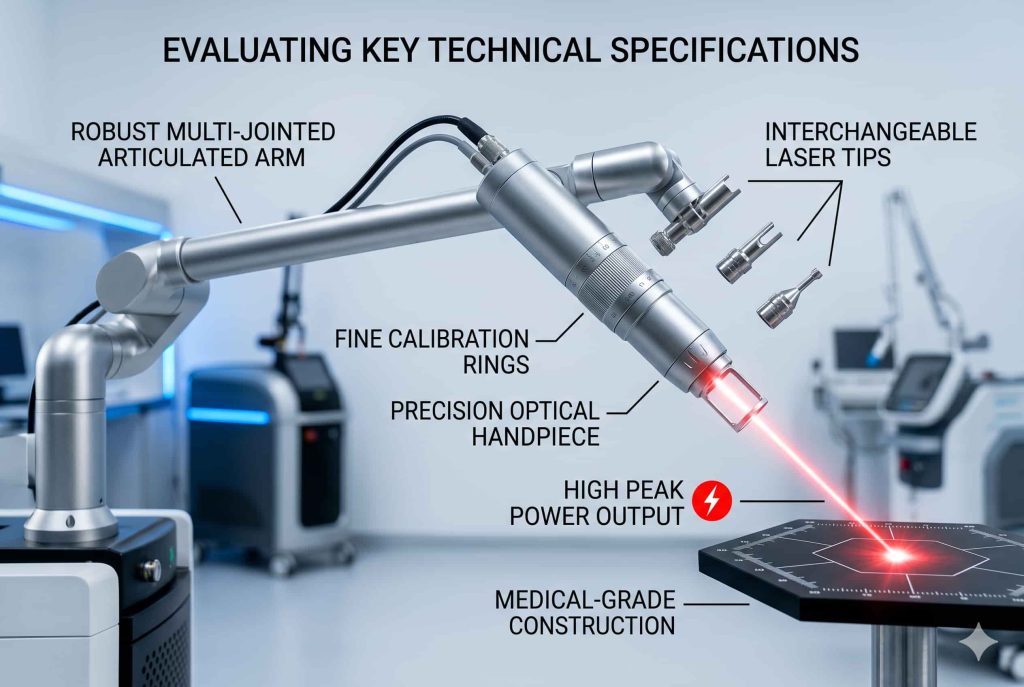
The handpiece is the clinical interface. Professional systems feature articulated arms containing highly reflective mirrors to ensure zero energy loss from the optical cavity to the skin.
- Spot Size and Fluence: A professional device allows for adjustable spot sizes (e.g., 2mm to 10mm) without compromising beam profile uniformity (a flat-top beam is mandatory to prevent hot spots). Larger spot sizes allow deeper penetration due to reduced photon scattering, speeding up treatment times for large tattoos and ensuring homogeneous energy distribution.
B2B Investment Analysis: Maximizing ROI with Picosecond Lasers
Procuring a professional medical laser is not merely a clinical decision; it is a strategic business investment. Understanding the Total Cost of Ownership (TCO) versus the revenue-generating potential is critical for clinic profitability.
Cost Per Treatment vs. Consumables Lifecycle
Unlike surgical equipment, solid-state lasers have highly predictable consumable lifecycles. The primary consumable in a picosecond system is the flashlamp within the optical cavity.
- Shots Count: A premium professional device boasts a flashlamp lifespan of tens of millions of shots.
- Maintenance Overhead: Commercial systems are built for endurance. Routine maintenance is generally limited to periodic water filtration changes and annual optical alignment checks. Consequently, the actual hardware consumable cost per treatment session drops to mere fractions of a dollar, ensuring a massive gross margin on clinical fees.
Patient Throughput and Revenue Projections
Picosecond lasers accelerate patient throughput. A standard tattoo removal session or facial rejuvenation procedure takes 15 to 30 minutes. Because the clinical efficacy is higher, patient satisfaction drives word-of-mouth referrals.
Below is a conservative ROI projection model for an aesthetic clinic operating a professional picosecond device:
| Business Metric | Conservative Estimate |
| Average Fee Per Session (Tattoo/Rejuvenation) | $300 – $600 |
| Patient Volume Per Day | 5 – 8 Patients |
| Estimated Daily Gross Revenue | $1,500 – $4,800 |
| Monthly Working Days | 22 Days |
| Estimated Monthly Gross Revenue | $33,000 – $105,600 |
| Consumable Cost Per Session | < $2.00 |
| Average Capital Payback Period | 4 – 8 Months |
Why Global Clinics Choose Cocoon Laser for Aesthetic Solutions
Selecting the right hardware is only half the equation; partnering with an elite, reliable manufacturer secures the long-term viability of the investment. Cocoon Laser professional aesthetic devices are engineered specifically for the rigorous demands of high-volume dermatological environments.
Stringent Manufacturing Standards and Certifications
In the medical device industry, compliance is non-negotiable. Cocoon Laser manufacturing standards strictly adhere to international medical device regulations. Their platforms undergo rigorous quality assurance to meet Medical CE and FDA 510(k) clearances (where applicable). This level of regulatory compliance guarantees that the energy output, electrical safety, and clinical claims have been independently verified, shielding clinic owners from liability and ensuring uncompromising patient safety.
Comprehensive After-Sales Technical Support and Training
A laser is only as effective as the practitioner operating it. Recognizing this, the Cocoon Laser clinical training infrastructure provides comprehensive protocols, parameter guidelines, and hands-on operational knowledge for physicians and laser technicians.
Furthermore, downtime equates to lost revenue. Cocoon Laser global technical support ensures rapid response times, utilizing modular internal hardware designs that allow for swift, plug-and-play component replacement. By integrating robust engineering with rapid-response logistics, Cocoon Laser picosecond technology guarantees maximum clinical uptime and operational peace of mind for B2B partners worldwide.
Frequently Asked Questions (FAQ) About Professional Pico Lasers
Q: How does a professional picosecond laser differ from desktop or portable versions?
A: Professional systems utilize articulating arms, robust internal cooling (water/TEC), and multi-kilowatt power supplies to generate stable, true Gigawatt peak power. Desktop versions lack the physical space for adequate cooling and power generation, resulting in severe thermal degradation, inconsistent energy profiles, and higher risk of thermal burns.
Q: What is the maintenance cost for a commercial picosecond machine?
A: Commercial maintenance costs are highly predictable. The primary expense is the replacement of the Xenon flashlamp after roughly 10 to 20 million shots. Regular maintenance involves inexpensive distilled water changes and standard filter replacements, keeping the operational overhead extremely low.
Q: How many sessions are typically required for professional tattoo removal?
A: Depending on the ink density, depth, and color, professional picosecond lasers typically require 4 to 8 sessions for complete clearance. This is a 40% to 50% reduction in treatment frequency compared to older nanosecond Q-Switched technologies.
If you need more information, please click “Contact Us”.
If you want to obtain more information, please follow our official website and Facebook.