
Best Face Wash for Sensitive Skin: How to Choose a Gentle Cleanser
Finding the best face wash for sensitive skin is not always easy. Some facial cleansers remove dirt and excess oil effectively but leave the skin feeling tight, dry, or irritated. Others may contain fragrances, exfoliating ingredients, or cleansing agents that do not agree with easily reactive skin.
The challenge is finding a facial cleanser that provides effective everyday cleansing without unnecessarily disrupting the skin’s natural protective barrier. This is particularly important for people who experience redness, dryness, itching, burning, or discomfort after using ordinary skincare products.
However, sensitive skin does not always mean dry skin. People with oily, combination, acne-prone, and normal skin can also experience sensitivity. The best cleanser therefore depends on both your skin type and the ingredients you tolerate.
This guide explains how to choose a gentle cleanser, which ingredients to look for, what to avoid, and how different face wash formulations compare. It also provides practical recommendations for building a cleansing routine that keeps sensitive skin comfortable.
Quick Answer: What Is the Best Face Wash for Sensitive Skin?
The best face wash for sensitive skin is generally a mild, non-abrasive facial cleanser that removes everyday impurities without leaving the skin excessively dry or uncomfortable.
For most people with sensitive skin, a fragrance-free cleanser with a gentle cleansing system is a sensible starting point. Depending on your skin type, this may be a cream cleanser, lotion cleanser, or mild gel cleanser.
When comparing facial cleansers, prioritize these characteristics:
- Fragrance-free: Helps reduce exposure to fragrance ingredients that can trigger irritation or allergic reactions in susceptible individuals.
- Gentle cleansing: Removes dirt, sweat, excess oil, and everyday impurities without excessive stripping.
- Non-abrasive: Does not rely on rough particles or aggressive scrubbing to clean the face.
- Skin-conditioning ingredients: Ingredients such as glycerin and ceramides may help support skin hydration and barrier function.
- Suitable for your skin type: A richer cream cleanser may suit dry skin, while a lightweight gel cleanser may be more comfortable for oily skin.
- Compatible with your skin: Does not repeatedly cause burning, itching, redness, or uncomfortable tightness.
There is no universally best facial cleanser for everyone. A product marketed for sensitive skin can still cause a reaction, so individual tolerance and the complete formulation matter more than marketing claims alone.
1. What Is Sensitive Skin?
Sensitive skin describes skin that reacts easily to certain skincare products, environmental conditions, or external stimuli. Common reactions include redness, itching, burning, stinging, dryness, and uncomfortable tightness.
Unlike some clearly identifiable skin conditions, sensitivity does not always have a consistent visible appearance. Some people experience redness and flaking, while others notice only a stinging sensation after applying a facial cleanser or moisturizer.
Sensitive skin is also not a single, clearly defined medical diagnosis. It can be associated with an impaired skin barrier, increased sensory reactivity, allergic contact dermatitis, eczema, rosacea, or other skin concerns.
Understanding the Skin Barrier
The skin barrier is the outer protective layer of the skin, particularly the stratum corneum. It consists of flattened skin cells surrounded by a lipid matrix containing ceramides, cholesterol, and fatty acids.
This structure performs several important functions:
- Helps prevent excessive water loss from the skin.
- Provides protection against environmental irritants.
- Helps maintain skin hydration and comfort.
- Supports the skin’s natural protective functions.
When the skin barrier is compromised, moisture can escape more easily and the skin may become more vulnerable to irritation. As a result, ordinary skincare products or environmental conditions may trigger uncomfortable reactions.
This is one reason why choosing a suitable gentle cleanser matters. An excessively harsh cleansing routine can contribute to dryness and irritation, making an already uncomfortable skin condition harder to manage.
Common Signs of Sensitive Skin
People with sensitive skin may experience one or several of the following symptoms:
- Redness: Facial skin may become visibly red after cleansing, applying skincare products, or exposure to environmental triggers.
- Burning and stinging: Certain facial cleansers, moisturizers, and cosmetics may produce uncomfortable sensations.
- Dryness and tightness: Skin may feel stretched or uncomfortable, particularly after washing.
- Itching: Some individuals experience occasional or persistent itching.
- Flaking: Dry or irritated areas may develop visible flakes.
- Product intolerance: Products that other people tolerate well may cause discomfort or irritation.
These symptoms are not exclusive to sensitive skin. Persistent redness, recurring rashes, severe itching, swelling, or burning may indicate an underlying dermatological condition. In these cases, professional assessment is more appropriate than repeatedly changing facial cleansers.
What Can Make Skin More Sensitive?
Sensitivity can have several contributing factors, and different people may react to different triggers.
1. Cleansing too aggressively
Frequent washing, excessive scrubbing, and very hot water can contribute to dryness and irritation. Using multiple exfoliating products can also make the skin less comfortable.
2. Fragrance and other product ingredients
Fragrance ingredients are a recognized source of contact allergy in some individuals. Certain preservatives, essential oils, and other formulation components can also cause reactions depending on individual susceptibility.
3. Environmental conditions
Cold weather, low humidity, wind, heat, and sudden temperature changes may aggravate skin discomfort.
4. Underlying skin conditions
Eczema, rosacea, and contact dermatitis can cause symptoms that people commonly describe as sensitive skin. These conditions may require more specific care than an ordinary skincare adjustment.
Understanding your potential triggers is an important first step toward choosing a facial cleanser that works with your skin rather than against it.
2. Best Types of Face Wash for Sensitive Skin
Not all facial cleansers work in the same way. Their textures, cleansing ingredients, and moisturizing properties can affect how your skin feels after washing. If you have sensitive skin, choosing the right cleanser type can make your daily skincare routine more comfortable.
The most common options include cream, lotion, gel, foaming, and micellar cleansers. Each has different characteristics, and the best choice depends on your skin type, cleansing needs, and individual tolerance.
2.1 Cream Cleansers
Cream cleansers have a rich, smooth consistency and are often formulated with moisturizing and skin-conditioning ingredients. They are a popular choice for people whose skin feels dry, tight, or uncomfortable after using traditional face washes.
Many cream-based facial cleansers contain ingredients such as glycerin, ceramides, and emollients. These ingredients can help maintain skin comfort while cleansing.
Why choose a cream cleanser?
- Provides a comfortable cleansing experience for dry skin.
- Often available in low-foaming or non-foaming formulas.
- Can help minimize the stripped feeling associated with some stronger cleansers.
- Suitable for many people with dry or normal sensitive skin.
Best for: Dry sensitive skin, normal sensitive skin, and people who frequently experience tightness after washing.
Potential drawback: Some richer formulas may feel too heavy for people who prefer a lightweight cleanser. Cleansing performance also varies between products.
2.2 Lotion Cleansers
Lotion cleansers generally have a thinner consistency than cream cleansers. Their lightweight texture makes them an option for people who want a gentle cleansing product without the richer feel of a traditional cream formula.
Depending on the formulation, lotion-based cleansers can remove everyday impurities while providing a comfortable skin feel.
Why choose a lotion cleanser?
- Lightweight texture that spreads easily.
- Often suitable for normal and dry sensitive skin.
- Available in fragrance-free formulations.
- Can be incorporated into a simple daily skincare routine.
Best for: Normal to dry sensitive skin and people who prefer lightweight, moisturizing cleansers.
Potential drawback: Some lotion cleansers may not remove heavy makeup or water-resistant sunscreen effectively on their own.
2.3 Gel Cleansers
Gel cleansers typically have a lightweight consistency and are commonly selected by people who prefer a refreshing cleansing experience. They can help remove sweat, excess surface oil, and everyday impurities.
However, not every gel cleanser is suitable for sensitive skin. Some formulations may contain stronger cleansing agents, fragrance, or additional ingredients that cause discomfort in susceptible individuals.
When choosing a gentle face cleanser in gel form, prioritize fragrance-free formulations with mild cleansing systems.
Why choose a gel cleanser?
- Lightweight texture that is easy to spread and rinse.
- Can be suitable for oily and combination sensitive skin.
- Some formulas provide effective cleansing without excessive dryness.
- Often preferred by people who dislike rich cream textures.
Best for: Normal, oily, and combination sensitive skin, depending on the formulation.
Potential drawback: Some gel cleansers may leave dry or sensitive skin feeling tight. The texture alone does not determine whether a product is gentle.
2.4 Foaming Cleansers
Foaming cleansers produce a lather when mixed with water. They are commonly used by people with oily or combination skin because they can remove excess surface oil and everyday impurities.
Traditional foaming cleansers may be too drying for some people with sensitive skin. However, modern formulations vary considerably, and certain mild foaming facial cleansers may be suitable for people who experience both oiliness and sensitivity.
Why choose a foaming cleanser?
- Provides a familiar lathering cleansing experience.
- Can effectively remove excess surface oil.
- Available in formulations designed for sensitive skin.
- May be suitable for oily and combination skin types.
Best for: Oily or combination sensitive skin when the formulation is sufficiently gentle.
Potential drawback: If your skin repeatedly feels tight, dry, or irritated after washing, the cleanser may be too stripping. Consider switching to a milder formulation.
2.5 Micellar Water
Micellar water is a water-based cleansing product containing surfactants that form structures known as micelles. These structures help capture oil, makeup, and surface impurities so they can be removed from the skin.
Micellar water is often used to remove light makeup or as a convenient cleansing option when a traditional face wash is not preferred.
Why choose micellar water?
- Convenient for removing light makeup and everyday impurities.
- Available in fragrance-free formulations.
- Does not require a traditional foaming texture.
- Can be useful for people who prefer a simple cleansing step.
Best for: People who need convenient makeup removal or a lightweight cleansing option.
Potential drawback: Some formulations may cause irritation or leave an uncomfortable residue. Follow the product instructions and rinse when recommended or when your skin does not tolerate leave-on use.
2.6 Oil-Based Cleansers
Oil-based cleansers are designed to dissolve oil-soluble impurities, including certain types of makeup, sunscreen, and excess sebum. They are frequently used as the first step in a double-cleansing routine.
For people with sensitive skin, an oil cleanser may be useful when removing makeup without excessive rubbing. However, the complete formulation and individual tolerance remain important.
Why choose an oil cleanser?
- Helps dissolve oil-based makeup and sunscreen.
- Can reduce the need for aggressive rubbing during makeup removal.
- Some emulsifying formulas rinse away easily with water.
- Can be used as the first step of double cleansing.
Best for: People who regularly wear makeup or water-resistant sunscreen.
Potential drawback: Double cleansing is not necessary for everyone. Using multiple cleansing products may increase dryness or irritation in some individuals.
Which Type of Facial Cleanser Should You Choose?
The following comparison can help narrow down the most appropriate cleanser for your needs.
| Cleanser Type | Typical Texture | Suitable Skin Types | Main Consideration |
|---|---|---|---|
| Cream cleanser | Rich and creamy | Dry, normal, sensitive | Comfortable cleansing feel |
| Lotion cleanser | Light and fluid | Normal, dry, sensitive | Lightweight moisturizing feel |
| Gel cleanser | Lightweight gel | Normal, oily, combination | Choose a mild formulation |
| Foaming cleanser | Foamy or lathering | Oily, combination | Avoid excessively stripping formulas |
| Micellar water | Water-like | Various skin types | Convenient light cleansing |
| Oil-based cleanser | Oil or balm | Various skin types | Makeup and sunscreen removal |
3. Best Face Wash for Different Sensitive Skin Types
Having sensitive skin does not automatically mean having dry skin. Some people experience excess oil, clogged pores, or acne while also being prone to redness and irritation.
This is why choosing the best face wash for sensitive skin requires considering both sensitivity and your underlying skin type.
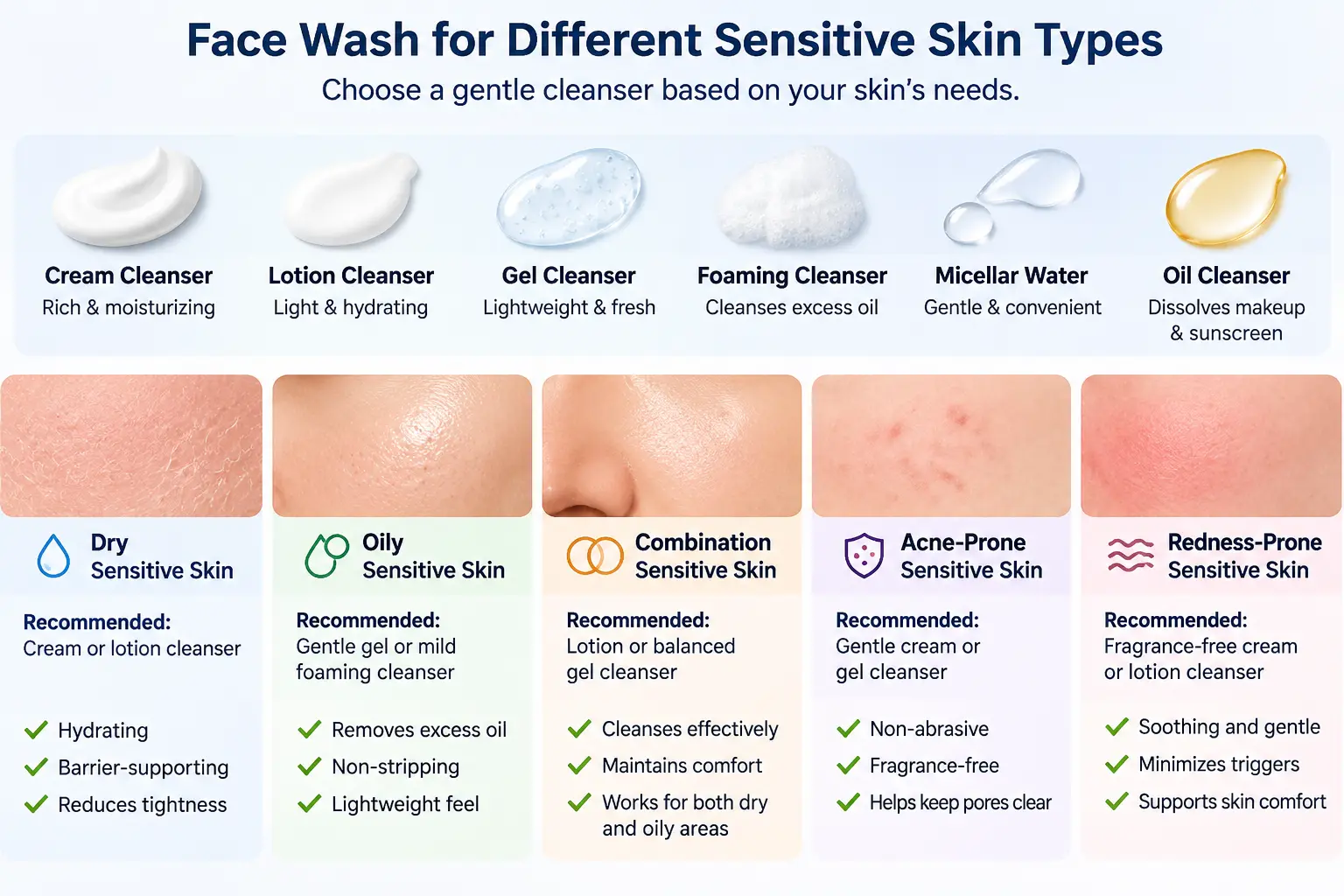
3.1 Best Face Wash for Dry Sensitive Skin
Dry sensitive skin often feels tight after cleansing and may develop rough patches, flaking, or discomfort. These symptoms can become more noticeable in cold or low-humidity environments.
A fragrance-free cream or lotion cleanser is a reasonable starting point. Look for formulations containing moisturizing ingredients such as glycerin and skin-conditioning ingredients such as ceramides.
What to look for:
- Fragrance-free formulations.
- Glycerin and other humectants.
- Ceramides and suitable emollients.
- Mild cleansing ingredients.
- Non-abrasive textures.
What to avoid: Aggressive scrubbing, very hot water, and cleansers that repeatedly leave your skin feeling excessively dry.
Recommended option: A gentle cream or lotion facial cleanser.
3.2 Best Face Wash for Oily Sensitive Skin
Oily sensitive skin can be difficult to manage because excess sebum and skin reactivity occur together. The forehead, nose, and chin may become oily, while the skin still reacts to harsh cleansing products.
Using a stronger face wash to remove every trace of oil is not necessarily beneficial. Over-cleansing can contribute to irritation and discomfort.
A mild gel cleanser or appropriately formulated foaming cleanser may be a better option.
What to look for:
- Lightweight, fragrance-free formulations.
- Mild cleansing systems.
- Non-comedogenic labeling when relevant to your acne concerns.
- Hydrating ingredients that do not leave an excessively heavy feel.
What to avoid: Frequent aggressive cleansing, rough exfoliating particles, and products that cause persistent tightness or burning.
Recommended option: A gentle gel cleanser or mild foaming face wash.
3.3 Best Face Wash for Combination Sensitive Skin
Combination skin usually has different characteristics across facial areas. The T-zone may become oily, while the cheeks remain normal or dry.
Instead of using separate cleansers for different areas, most people can start with one balanced facial cleanser that is comfortable across the entire face.
What to look for:
- Balanced cleansing performance.
- Fragrance-free ingredients.
- Lightweight cream, lotion, or gel textures.
- Moisturizing components that support skin comfort.
Recommended option: A gentle lotion or balanced gel cleanser.
3.4 Best Face Wash for Acne-Prone Sensitive Skin
Acne-prone sensitive skin requires particular attention because some acne-fighting ingredients may cause dryness or irritation.
Ingredients such as salicylic acid and benzoyl peroxide are commonly used in acne treatments, but their suitability depends on concentration, formulation, frequency of use, and individual tolerance.
For everyday cleansing, a gentle fragrance-free facial cleanser is a sensible starting point. If you need an acne-specific treatment, introduce it carefully rather than combining multiple active products at once.
What to look for:
- Gentle, non-abrasive cleansing formulas.
- Fragrance-free formulations.
- Non-comedogenic products when appropriate.
- Ingredients that help maintain skin comfort.
Recommended option: A gentle cream or gel cleanser, depending on your skin’s oiliness and dryness.
3.5 Best Face Wash for Redness-Prone Sensitive Skin
Some people experience frequent facial redness, flushing, or uncomfortable sensations after using skincare products or encountering environmental triggers.
A simple fragrance-free cleanser with a mild cleansing system may be a useful starting point. Avoid aggressive cleansing techniques and products that repeatedly trigger discomfort.
Persistent facial redness, particularly when accompanied by visible blood vessels, bumps, or burning, may be associated with rosacea or another skin condition. A dermatologist can help identify the underlying cause.
Recommended option: A gentle fragrance-free cream or lotion cleanser.
Quick Comparison: Best Face Wash by Sensitive Skin Type
| Skin Type | Suggested Cleanser | Selection Priority |
|---|---|---|
| Dry sensitive skin | Cream or lotion cleanser | Minimize post-washing dryness |
| Oily sensitive skin | Gentle gel or mild foaming cleanser | Remove excess oil without stripping |
| Combination sensitive skin | Lotion or balanced gel cleanser | Maintain comfort across facial areas |
| Acne-prone sensitive skin | Gentle cream or gel cleanser | Minimize unnecessary irritation |
| Redness-prone sensitive skin | Fragrance-free cream or lotion cleanser | Reduce potential triggers |
Ultimately, the best facial cleanser is not necessarily the one with the most ingredients or the strongest cleansing effect. It is the one that meets your cleansing needs while leaving your skin comfortable and without persistent irritation.
4. Ingredients to Look for in a Gentle Cleanser for Sensitive Skin
Choosing the right facial cleanser involves more than selecting a product labeled for sensitive skin. The ingredients and overall formulation play an important role in determining how a cleanser interacts with your skin.
If you are looking for a gentle cleanser for sensitive skin, prioritize mild cleansing agents, moisturizing ingredients, and formulations without unnecessary potential irritants.
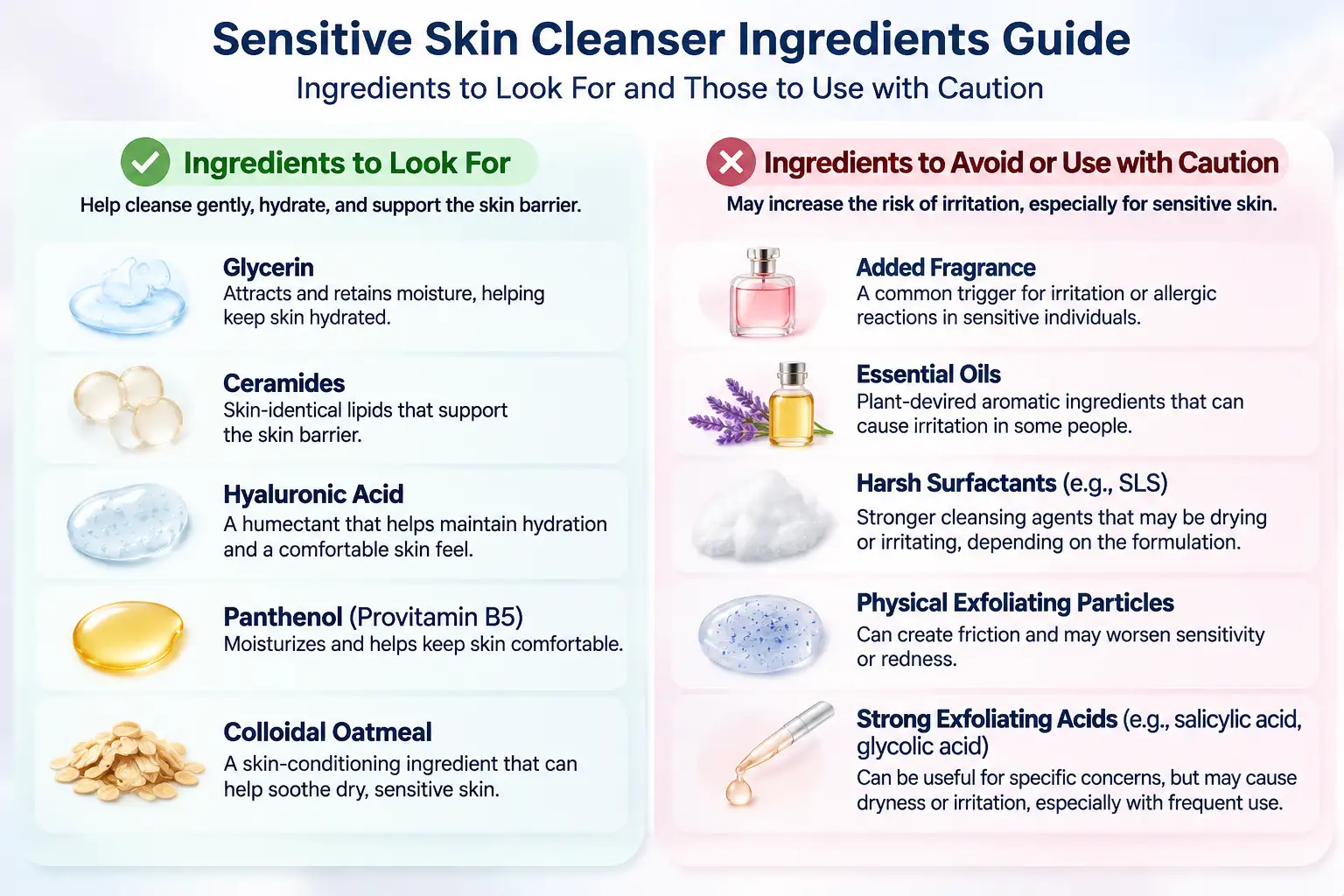
4.1 Glycerin
Glycerin is a humectant commonly used in skincare products. It attracts and helps retain water in the outermost layer of the skin, supporting hydration and reducing the feeling of dryness.
In facial cleansers, glycerin can help improve the skin feel during and after cleansing. It is commonly found in moisturizing face washes, cream cleansers, and gentle cleansing lotions.
Why it matters: Glycerin can help support skin hydration, particularly when cleansing is followed by an appropriate moisturizer.
4.2 Ceramides
Ceramides are lipids naturally present in the outermost layer of the skin. They contribute to the structure of the skin barrier and help reduce moisture loss.
Some facial cleansers contain ceramides as part of their moisturizing formulation. These products may be worth considering if your sensitive skin is also prone to dryness or tightness.
Why it matters: Ceramides help support the skin barrier, although the benefits of a rinse-off cleanser depend on its complete formulation and contact time.
4.3 Hyaluronic Acid
Hyaluronic acid is a humectant known for its ability to attract and retain water. It is widely used in hydrating skincare products, including facial cleansers.
A hydrating facial cleanser containing hyaluronic acid may help provide a comfortable cleansing experience without leaving the skin feeling excessively dry.
Why it matters: It supports hydration and can complement other moisturizing ingredients.
4.4 Panthenol (Provitamin B5)
Panthenol is a skincare ingredient commonly used for its moisturizing and skin-conditioning properties. It can help improve skin hydration and support a comfortable skin feel.
It is frequently included in products designed for dry, delicate, or sensitive skin.
Why it matters: Panthenol can complement a gentle cleansing formulation by helping maintain skin comfort.
4.5 Mild Surfactants
Surfactants are essential cleansing ingredients. They help water interact with oil, dirt, sweat, and other impurities so these substances can be removed during rinsing.
However, different surfactants have different cleansing properties and irritation potential. People with sensitive skin may prefer products formulated with mild cleansing systems rather than relying on stronger cleansing agents.
Examples of surfactants commonly found in gentle facial cleansers include:
- Cocamidopropyl betaine.
- Sodium cocoyl isethionate.
- Decyl glucoside.
- Coco-glucoside.
- Sodium cocoyl glycinate.
These ingredients are not automatically irritation-free. Their suitability depends on concentration, formulation, individual sensitivity, and product use.
4.6 Colloidal Oatmeal
Colloidal oatmeal is finely ground oatmeal used in skincare products for its skin-conditioning and soothing properties. It is particularly common in formulations designed for dry or irritated skin.
Some people with sensitive skin may find colloidal oatmeal-containing cleansers comfortable to use. However, individuals with known oat allergies should check the ingredient list carefully.
Why it matters: It can help support skin comfort and is frequently used in products for dry, sensitive skin.
5. Ingredients to Avoid or Use with Caution in Sensitive Skin Cleansers
There is no universal list of ingredients that every person with sensitive skin must avoid. Individual reactions vary, and an ingredient that causes discomfort for one person may be well tolerated by another.
Nevertheless, certain ingredients and formulation characteristics deserve additional attention when selecting a sensitive skin cleanser.
5.1 Added Fragrance
Fragrance is a common ingredient in skincare products, but it can trigger irritation or allergic contact dermatitis in susceptible individuals.
If your skin frequently reacts to skincare products, choosing a fragrance-free facial cleanser is a practical starting point.
Remember that fragrance-free and unscented are not necessarily interchangeable terms. Unscented products may contain ingredients that mask the smell of other components.
5.2 Essential Oils
Essential oils are plant-derived aromatic ingredients used in some facial cleansers and skincare products. Examples include lavender, peppermint, eucalyptus, and citrus oils.
Although these ingredients are often marketed as natural, natural does not automatically mean suitable for sensitive skin. Certain essential oils and their fragrance components may cause irritation or allergic reactions.
If you have a history of fragrance sensitivity, consider choosing a cleanser without added essential oils.
5.3 Harsh Cleansing Formulations
Some cleansing products are formulated to produce abundant foam and remove substantial amounts of surface oil. Depending on the surfactant system and overall formulation, they may leave certain skin types feeling dry or tight.
Sodium lauryl sulfate (SLS), for example, is a cleansing surfactant that can be irritating under some conditions, particularly at higher concentrations or with prolonged exposure.
However, the presence of one surfactant does not automatically determine whether a finished product is unsuitable. The complete formulation matters.
5.4 Physical Exfoliating Particles
Some face washes contain exfoliating particles designed to remove dead skin cells through physical friction.
For people experiencing sensitivity, redness, or an impaired skin barrier, frequent scrubbing may increase discomfort.
Consider choosing a non-abrasive daily facial cleanser rather than relying on rough exfoliating face washes.
5.5 Strong Active Ingredients
Ingredients such as salicylic acid, glycolic acid, and benzoyl peroxide are used in skincare products for specific concerns, including acne and exfoliation.
These ingredients are not inherently unsuitable for everyone with sensitive skin. However, they can cause dryness, irritation, or peeling, particularly when introduced too frequently or combined with other active products.
If your primary goal is gentle daily cleansing, a basic cleanser without strong exfoliating or acne-treatment ingredients may be a better starting point.
Ingredients Comparison for Sensitive Skin
| Ingredient or Category | Common Function | Consideration for Sensitive Skin |
|---|---|---|
| Glycerin | Humectant | Supports hydration |
| Ceramides | Skin-conditioning lipids | Supports skin barrier function |
| Hyaluronic acid | Humectant | Helps maintain hydration |
| Panthenol | Moisturizing and conditioning | Supports skin comfort |
| Colloidal oatmeal | Skin conditioning | May help soothe dry, uncomfortable skin |
| Added fragrance | Provides scent | Potential irritation or allergy trigger |
| Essential oils | Fragrance and other functions | Potential irritation or sensitization |
| Sodium lauryl sulfate | Cleansing surfactant | May be irritating depending on formulation |
| Strong exfoliating acids | Exfoliation | May increase dryness or irritation |
| Physical exfoliating particles | Mechanical exfoliation | May cause friction-related discomfort |
6. Is Fragrance-Free Always Better for Sensitive Skin?
Fragrance-free products are often a sensible choice for people with sensitive skin, especially those who have previously experienced reactions to scented skincare products.
However, fragrance-free does not automatically mean hypoallergenic, irritation-free, or suitable for every individual.
6.1 Fragrance-Free vs. Unscented
These two terms are sometimes confused, but they can have different meanings.
- Fragrance-free: Generally indicates that fragrance ingredients have not been added to provide or mask a scent.
- Unscented: Indicates that a product has little or no noticeable smell, but fragrance-masking ingredients may still be present.
If you are sensitive to fragrance, checking the ingredient list is more useful than relying on the product description alone.
6.2 Does Hypoallergenic Mean Safe for Sensitive Skin?
The term hypoallergenic is commonly used in skincare marketing to suggest that a product is formulated to reduce the likelihood of allergic reactions.
However, it does not guarantee that a product will never cause an allergic reaction or irritation.
There is no universally reliable way to guarantee that every person with sensitive skin will tolerate a particular facial cleanser. Individual skin conditions, allergies, and ingredient sensitivities all matter.
Therefore, consider the complete ingredient list, your previous reactions, and how your skin responds during use.
6.3 How to Choose a Fragrance-Free Facial Cleanser
When comparing fragrance-free facial cleansers, consider the following factors:
- Check whether the product contains added fragrance or aromatic essential oils.
- Look for mild cleansing ingredients suitable for your skin type.
- Consider moisturizing ingredients such as glycerin and ceramides.
- Avoid unnecessary exfoliating ingredients if your skin is currently irritated.
- Introduce new products gradually and monitor your skin’s response.
A simple fragrance-free cleanser with a mild cleansing system is often a reasonable starting point for people who want to simplify their sensitive skin routine.
7. How to Choose the Best Facial Cleanser for Sensitive Skin
Finding the best facial cleanser for sensitive skin does not necessarily mean choosing the most expensive product or the one with the longest ingredient list. The right cleanser should remove everyday impurities while helping your skin remain comfortable and hydrated.
Before purchasing a product, consider your skin type, current skin condition, cleansing preferences, and previous reactions to skincare ingredients.
7.1 Choose a Cleanser Based on Your Skin Type
Sensitive skin can be dry, oily, combination, or acne-prone. Understanding your skin type can help narrow down the most appropriate cleansing formulations.
- Dry sensitive skin: Consider a creamy, hydrating facial cleanser containing glycerin or other moisturizing ingredients. Avoid products that consistently leave your skin feeling tight.
- Oily sensitive skin: A lightweight gel cleanser with a mild cleansing system may help remove excess surface oil without excessive cleansing.
- Combination sensitive skin: Look for a balanced gentle facial cleanser that cleanses oily areas without making drier areas uncomfortable.
- Acne-prone sensitive skin: Start with a mild, non-abrasive cleanser. Avoid excessive scrubbing and introducing multiple active ingredients simultaneously.
- Mature sensitive skin: A moisturizing cleanser may be preferable if your skin is becoming drier or more easily irritated.
7.2 Choose the Right Cleanser Texture
Facial cleansers are available in several formulations. Their textures and cleansing properties can influence how comfortable they feel on different skin types.
| Cleanser Type | Typical Characteristics | Suitable Skin Considerations |
|---|---|---|
| Cream Cleanser | Rich, creamy texture | Often preferred by dry or easily dehydrated skin |
| Lotion Cleanser | Lightweight, milky consistency | Suitable for people who prefer gentle cleansing with a light texture |
| Gel Cleanser | Lightweight gel formulation | Can suit oily or combination skin |
| Foaming Cleanser | Produces foam during cleansing | May suit oily skin when formulated with mild surfactants |
| Oil Cleanser | Oil-based cleansing formulation | Often used to dissolve makeup and sunscreen |
There is no universally best texture for sensitive skin. A well-formulated gel cleanser may be comfortable for one person, while another may prefer a cream or lotion cleanser.
7.3 Check the Ingredient List
Do not rely exclusively on front-label claims such as gentle, natural, dermatologist-tested, or hypoallergenic.
Instead, review the complete ingredient list and look for a formulation that matches your skin’s needs.
For many people with sensitive skin, useful considerations include:
- A mild cleansing system.
- Glycerin or other moisturizing ingredients.
- Ceramides or other skin-conditioning lipids.
- Fragrance-free formulation if fragrance causes reactions.
- Limited unnecessary exfoliating ingredients.
7.4 Consider Your Current Skin Condition
Your skin’s needs can change over time. A cleanser that works well when your skin is healthy may become uncomfortable during periods of dryness, irritation, or increased sensitivity.
If your skin is currently irritated, consider simplifying your routine and avoiding unnecessary exfoliating or fragranced products. Persistent or severe symptoms should be evaluated by a dermatologist.
8. How to Wash Your Face Without Irritating Sensitive Skin
Choosing a suitable gentle cleanser is only part of maintaining comfortable skin. Your cleansing technique also matters.
Even a mild facial cleanser can cause discomfort if you wash too frequently, use excessively hot water, or scrub your face aggressively.
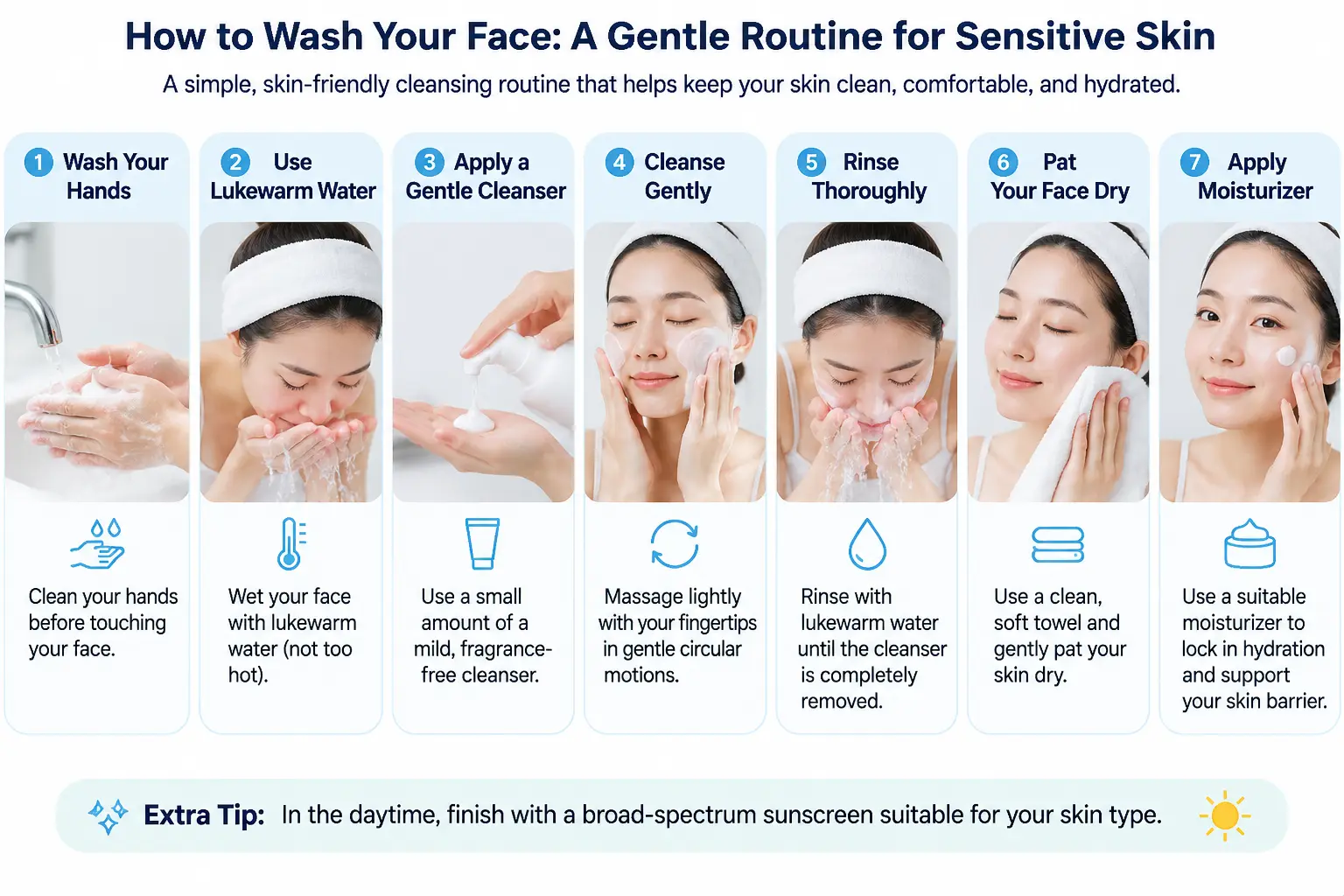
Step 1: Wash Your Hands First
Clean your hands before touching your face. This helps reduce the transfer of dirt and other unwanted substances during cleansing.
Step 2: Use Lukewarm Water
Wet your face with lukewarm water rather than very hot water. Hot water may increase dryness and discomfort, especially for skin that is already sensitive.
Step 3: Apply a Small Amount of Cleanser
Dispense an appropriate amount of facial cleanser and gently spread it across your face using your fingertips.
Avoid rough washcloths, abrasive brushes, and vigorous rubbing.
Step 4: Cleanse Gently
Use gentle circular movements without applying excessive pressure. Follow the product instructions and avoid unnecessarily prolonged cleansing.
Step 5: Rinse Thoroughly
Rinse your face with lukewarm water until the cleanser is completely removed. Remaining product may contribute to discomfort in some individuals.
Step 6: Pat Your Face Dry
Use a clean, soft towel and gently pat your face dry. Do not rub your skin aggressively.
Step 7: Apply Moisturizer
Apply a suitable moisturizer while your skin is slightly damp. This can help support hydration and reduce moisture loss.
During the daytime, finish your routine with a broad-spectrum sunscreen appropriate for your skin.

9. Common Mistakes When Choosing a Face Wash for Sensitive Skin
Some common skincare habits can make sensitive skin feel worse, even when you are using products marketed for delicate skin.
9.1 Choosing a Cleanser Based on Foam Alone
Many people assume that a cleanser must produce abundant foam to clean effectively. However, foam production does not necessarily indicate cleansing quality.
A low-foaming or non-foaming cleanser can still remove everyday impurities effectively.
9.2 Washing Your Face Too Frequently
Repeated cleansing may remove surface oils and contribute to dryness or irritation. For many people, washing once or twice daily is sufficient, with adjustments based on individual needs.
9.3 Using Multiple Active Ingredients at Once
Combining exfoliating acids, acne treatments, retinoids, and other active ingredients without considering their cumulative effects may increase irritation.
Introduce new skincare products gradually rather than changing your entire routine simultaneously.
9.4 Assuming Natural Ingredients Are Always Gentle
Plant extracts, essential oils, and naturally derived ingredients can still cause allergic or irritant reactions.
Choose products based on their complete formulation and your individual tolerance rather than marketing claims.
9.5 Ignoring Signs of Irritation
If a cleanser repeatedly causes burning, itching, redness, or unusual tightness, do not assume your skin simply needs time to adjust.
Stop using the product if you suspect a reaction. Seek medical advice if symptoms persist, worsen, or include swelling or significant discomfort.
10. When Should You Stop Using a Facial Cleanser?
Not every cleanser is suitable for every person. Paying attention to how your skin responds can help you identify a product that may not be compatible with your skin.
Consider discontinuing a cleanser if you repeatedly experience:
- Persistent burning or stinging after application.
- Increased redness following cleansing.
- Unusual itching or skin discomfort.
- Excessive dryness, peeling, or tightness.
- A new rash or worsening irritation.
These symptoms do not necessarily mean you have sensitive skin. They may indicate irritation, an allergic reaction, or another underlying skin condition.
If you experience persistent symptoms, consult a qualified dermatologist rather than repeatedly switching products without understanding the cause.
11. Frequently Asked Questions
What is the best facial cleanser for sensitive skin?
The best facial cleanser for sensitive skin is generally one with a mild cleansing formulation that removes everyday impurities without leaving the skin excessively dry or uncomfortable. Fragrance-free products containing moisturizing ingredients may be a useful starting point.
Should sensitive skin use a foaming or non-foaming cleanser?
Both can be suitable. Non-foaming cream and lotion cleansers are often preferred by people with dry sensitive skin, while mild foaming cleansers may work well for oily sensitive skin. The overall formulation matters more than the amount of foam.
Is Cetaphil or CeraVe better for sensitive skin?
Neither brand is universally better for everyone. Both offer different facial cleansing formulations. Compare the specific product ingredients, cleansing properties, and suitability for your skin type instead of choosing based on brand name alone.
Can I wash my face twice a day if I have sensitive skin?
Many people with sensitive skin can wash their face twice daily using a gentle cleanser. However, if your skin becomes dry or irritated, consider adjusting your cleansing frequency according to your skin’s needs.
Is fragrance-free face wash better for sensitive skin?
Fragrance-free face wash can be a good option, particularly for people who are sensitive to fragrance ingredients. However, fragrance-free does not guarantee that a product will never cause irritation.
Can sensitive skin use salicylic acid cleansers?
Some people with sensitive and acne-prone skin can tolerate salicylic acid cleansers. However, salicylic acid may cause dryness or irritation. Consider the concentration, frequency of use, and your skin’s condition before introducing it.
Should I use a moisturizer after washing my face?
Yes. Applying a suitable moisturizer after cleansing can help maintain hydration and support the skin barrier. This is particularly useful for people with dry or sensitive skin.
How do I know if my facial cleanser is irritating my skin?
Repeated burning, itching, redness, unusual tightness, or peeling after cleansing may indicate that a product is not suitable for your skin. Discontinue suspected products and seek professional advice if symptoms persist.
Is micellar water better than face wash for sensitive skin?
Micellar water and traditional facial cleansers work differently. Some micellar water formulations can provide gentle cleansing, while others may leave residue or contain ingredients that do not suit every individual. Choose according to your skin’s response and follow the product instructions.
Can I use baby soap on sensitive facial skin?
Not necessarily. Products formulated for babies are not automatically suitable for adult facial skin. Some soaps may have cleansing properties that leave the face feeling dry or uncomfortable. A facial cleanser formulated for your skin type is generally a more appropriate choice.
12. Final Thoughts: Finding the Right Gentle Facial Cleanser
Finding the best facial cleanser for sensitive skin requires understanding your skin type, identifying ingredients that you tolerate, and choosing a cleansing formulation that does not unnecessarily disrupt your skin’s comfort.
Rather than focusing exclusively on popular brands, abundant foam, or marketing claims, prioritize a mild cleansing system, appropriate hydration, and a simple formulation that works with your individual skin needs.
Remember that sensitive skin does not respond identically to every product. Introduce new cleansers gradually, monitor your skin’s response, and seek professional advice if irritation continues.
A consistent, gentle skincare routine is often a more practical starting point than repeatedly changing products in search of an instant solution.