Best Laser Hair Removal Technology: Diode vs Nd:YAG vs IPL
What is the best laser hair removal technology for professional clinics? Diode, alexandrite, and Nd:YAG lasers are widely used for long-term hair reduction, while intense pulsed light (IPL) systems offer a different light-based approach. Each technology has distinct optical characteristics, clinical applications, and limitations.
Choosing the best hair removal laser treatment requires more than comparing wavelengths or advertised power ratings. The patient’s skin pigmentation, hair color, follicle characteristics, treatment area, and individual response all influence the selection of an appropriate system.
For dermatology clinics, medical spas, and professional aesthetic providers, equipment selection also involves practical considerations. These include cooling performance, treatment speed, operator training, maintenance requirements, and regulatory documentation.
A device that performs well for lighter skin and dark, coarse hair may not be the most appropriate option for deeply pigmented skin. Similarly, a system optimized for larger body areas may not be ideal for every facial treatment or hair characteristic.
This comprehensive guide compares diode laser, alexandrite laser, Nd:YAG laser, and IPL hair removal technologies. It explains how each works, where their strengths and limitations differ, and what professional buyers should evaluate before investing in equipment.
Quick Answer: What Is the Best Laser Hair Removal Technology?
There is no single best laser hair removal technology for every patient. Alexandrite lasers at 755nm are often effective for suitable lighter skin types with dark hair. Diode lasers, commonly operating around 800–810nm, are widely used for professional hair reduction across selected skin types. Long-pulsed 1064nm Nd:YAG lasers are an established option for darker skin phototypes, particularly Fitzpatrick types V and VI.
IPL is not a laser. It uses filtered, broad-spectrum light and may provide hair reduction in appropriately selected patients, but its suitability depends heavily on the specific system and treatment protocol.
For clinics, the best choice depends on the patient population, treatment goals, clinical evidence, equipment specifications, and operator expertise.
Key Takeaways
- Alexandrite laser (755nm): Offers relatively strong melanin absorption and is commonly used for suitable lighter skin phototypes.
- Diode laser (approximately 800–810nm): A widely used professional hair removal technology with treatment capabilities that vary by device.
- Nd:YAG laser (1064nm): An established option for melanin-rich skin because of comparatively lower epidermal melanin absorption.
- IPL hair removal: Uses broad-spectrum, filtered light rather than a single laser wavelength.
- Clinical performance: Depends on more than wavelength. Cooling, pulse characteristics, delivered energy, and patient selection are essential.
- Professional equipment selection: Should consider clinical suitability, regulatory status, operating costs, service support, and training.
Best Hair Removal Technology at a Glance
| Technology | Typical Light Output | General Strength | Important Limitation |
|---|---|---|---|
| Diode Laser | Commonly around 800–810nm; other configurations available | Versatile professional hair reduction | Skin-type suitability depends on the device and protocol |
| Alexandrite Laser | 755nm | Strong melanin targeting for suitable lighter skin types | Greater epidermal absorption concerns in darker skin |
| Long-Pulsed Nd:YAG | 1064nm | Established use in darker skin phototypes | Lower melanin absorption may require carefully optimized treatment |
| IPL | Filtered broad-spectrum light; range varies by device | Flexible light-based treatment applications with suitable systems | Not a laser; results and skin-type suitability are highly device-dependent |
Important: These are general technology characteristics, not universal treatment recommendations. The clinical performance of individual devices must be evaluated using their specific indications and supporting evidence.
What Are the Main Types of Laser Hair Removal Technology?
Professional hair removal systems are often grouped together under the term “laser hair removal machines.” However, not every light-based hair reduction device uses a laser.
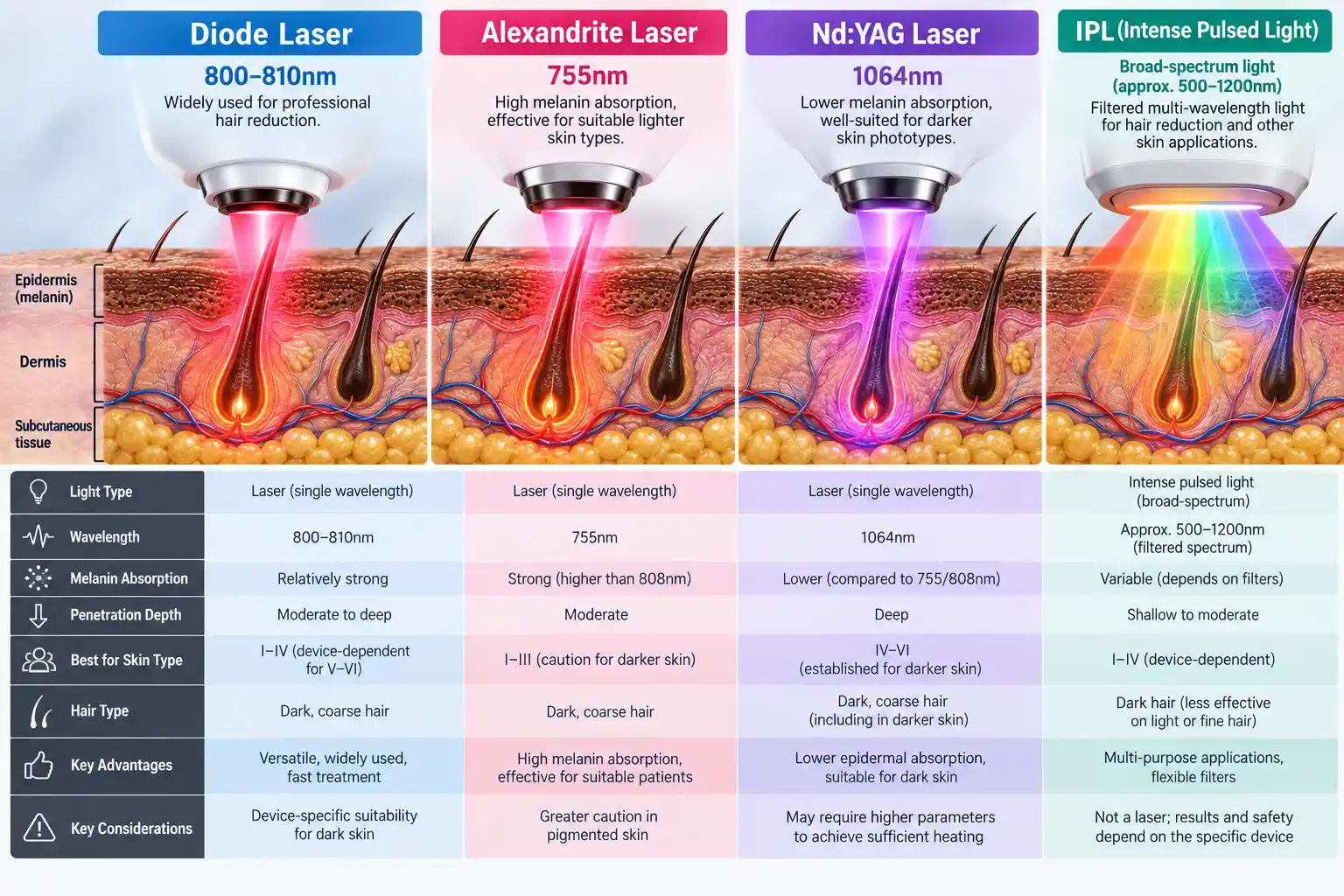
The main technologies considered in this comparison are diode, alexandrite, long-pulsed Nd:YAG, and intense pulsed light.
Diode Laser Hair Removal Technology
Diode lasers generate light using semiconductor technology. Many professional systems operate near 808nm, although other wavelengths and multi-wavelength configurations are available.
Their optical output is designed to deliver energy into hair-bearing skin, where melanin within the hair absorbs part of the light.
Modern diode platforms may incorporate contact cooling, adjustable pulse parameters, and different treatment handpiece configurations.
These features can make diode technology relevant to clinics seeking a professional hair reduction system for a varied patient population.
However, clinical suitability must be evaluated for the specific device rather than assumed from the diode technology category alone.
Alexandrite Laser Hair Removal Technology
Alexandrite lasers typically emit light at 755nm. This wavelength is relatively strongly absorbed by melanin.
The absorption characteristics make alexandrite technology useful for treating suitable patients with dark, pigmented hair.
However, stronger melanin absorption also creates additional challenges when the epidermis contains substantial pigmentation.
This is why alexandrite treatment requires careful patient selection, especially for darker skin phototypes.
Nd:YAG Laser Hair Removal Technology
Long-pulsed Nd:YAG lasers operate at 1064nm. Compared with shorter hair removal wavelengths, this wavelength is less strongly absorbed by epidermal melanin.
That characteristic contributes to the established clinical use of long-pulsed Nd:YAG systems for darker skin.
Nd:YAG technology still requires appropriate treatment parameters, cooling, and trained operation.
Lower epidermal absorption does not mean that treatment is completely free of burn or pigmentation risks.
IPL Hair Removal Technology
Intense pulsed light, commonly abbreviated as IPL, is a non-laser technology that delivers filtered broad-spectrum light.
Unlike a laser, which emits light within a comparatively narrow wavelength range, an IPL system produces light across a broader spectrum.
Optical filters and device settings influence which wavelengths reach the skin.
IPL may be used for hair reduction and certain other aesthetic applications, depending on the device and its approved indications.
Its effectiveness and safety depend on the specific system, skin characteristics, and treatment parameters.
How Does Laser Hair Removal Technology Work?
To compare the best hair removal laser treatment options, it is important to understand how light interacts with pigmented hair and surrounding skin.
Laser hair removal is based on the principle of selective photothermolysis .
In simple terms, selected wavelengths of light are absorbed by a target chromophore and converted into thermal energy.
In hair removal, melanin within the hair is a major absorbing chromophore.
The resulting heat can affect follicular structures involved in hair growth, leading to long-term reduction in hair production.
Why Melanin Absorption Matters
Melanin is found in both the hair and the epidermis.
The amount of light absorbed by each structure depends partly on wavelength and pigmentation.
Strong melanin absorption may help deliver energy to dark hair, but it can also increase unwanted heating of pigmented skin.
This creates an important clinical balance: sufficient heating of the hair follicle must be achieved without causing excessive thermal injury to surrounding tissue.
How Wavelength Affects Hair Removal
Different wavelengths have different absorption and scattering characteristics within biological tissue.
The 755nm alexandrite wavelength generally has stronger melanin absorption than 808nm diode and 1064nm Nd:YAG wavelengths.
The 1064nm wavelength has comparatively lower melanin absorption, which is one reason long-pulsed Nd:YAG technology is frequently selected for darker skin.
However, longer wavelengths are not automatically better for every patient or hair type.
Effective treatment requires an appropriate combination of wavelength, pulse characteristics, delivered energy, cooling, and clinical technique.
Why Pulse Duration and Fluence Matter
Fluence describes the amount of laser energy delivered per unit area.
Pulse duration describes the time over which energy is delivered.
Together with spot size, wavelength, and cooling, these parameters influence the temperature changes occurring in hair-bearing skin.
Treatment settings must be selected according to the specific device, patient, and clinical circumstances.
It would be inappropriate to recommend one universal fluence or pulse duration for all diode, alexandrite, and Nd:YAG systems.
Why Multiple Hair Removal Sessions Are Needed
Hair follicles move through different phases of growth, transition, and rest.
These are commonly described as anagen, catagen, and telogen.
Not every follicle provides the same effective target during a single treatment session.
Therefore, multiple treatments are generally necessary to achieve meaningful long-term hair reduction.
The number of sessions and treatment intervals vary according to anatomical area, hair characteristics, hormonal influences, technology, and individual response.
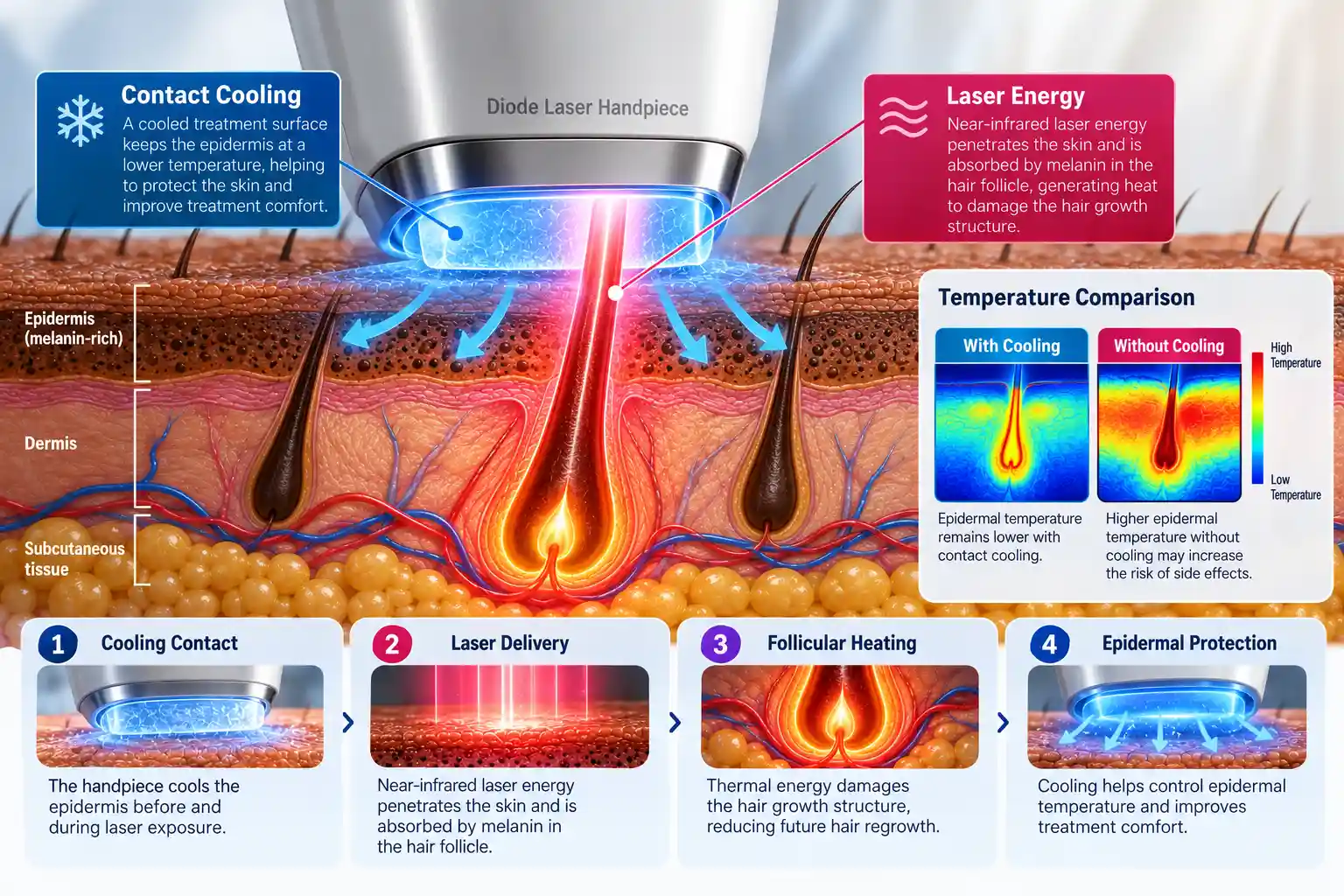
Why Cooling Is Important
Cooling technologies help manage epidermal heating during light-based hair removal.
Professional systems may use contact cooling, cold-air cooling, or other device-specific methods.
Appropriate cooling can support patient comfort and help reduce unwanted surface heating.
However, cooling cannot compensate for an unsuitable wavelength or inappropriate treatment settings.
The complete treatment system must be evaluated rather than relying on cooling performance alone.
Diode vs Alexandrite Laser Hair Removal: Which Is Better?
Diode and alexandrite lasers are two widely used technologies for professional hair reduction. Both target melanin within pigmented hair, but their wavelengths and optical characteristics influence treatment selection.
Alexandrite lasers typically operate at 755nm, while many conventional diode laser systems operate around 800–810nm. The difference in wavelength affects melanin absorption and the distribution of energy within the skin.
The best choice depends on the patient’s skin phototype, hair characteristics, the treatment area, and the specific device’s clinical capabilities.
Wavelength and Melanin Absorption
The 755nm alexandrite wavelength is relatively strongly absorbed by melanin. This makes it useful for targeting dark, pigmented hair in patients whose skin characteristics are appropriate for the technology.
The approximately 808nm diode wavelength has somewhat lower melanin absorption than 755nm. This can influence the balance between follicular targeting and epidermal heating.
However, neither wavelength is universally safer or more effective. Pulse characteristics, fluence, spot size, cooling, and operator technique also affect treatment outcomes.
Which Is Better for Light Skin?
Alexandrite lasers are commonly used for patients with lighter skin phototypes and dark terminal hair. Their strong melanin absorption can support effective follicular heating in suitable patients.
Diode laser systems may also provide effective hair reduction for lighter skin types. Comparative results depend on the specific systems, treatment protocols, and patient characteristics.
Which Is Better for Darker Skin?
For darker skin, the potential for epidermal melanin absorption becomes more important.
Certain diode systems may be appropriate for selected darker phototypes, depending on their clinical indications and treatment protocols.
Conventional 755nm alexandrite treatment generally requires greater caution in deeply pigmented skin because of relatively strong melanin absorption.
For Fitzpatrick types V and VI, long-pulsed 1064nm Nd:YAG is often a more established option than either conventional 755nm alexandrite or 808nm diode technology.
Diode vs Alexandrite: Key Differences
| Feature | Diode Laser | Alexandrite Laser |
|---|---|---|
| Common wavelength | Approximately 800–810nm | 755nm |
| Laser source | Semiconductor diode | Alexandrite crystal |
| Melanin absorption | Relatively strong | Generally stronger than at 808nm |
| Lighter skin | Commonly used with appropriate protocols | Established treatment option for suitable patients |
| Darker skin | Device-specific suitability | Greater caution, particularly in deeply pigmented skin |
| Cooling | Contact cooling is common | Device-dependent cooling methods |
| Best use case | Clinics seeking a versatile hair reduction platform | Clinics treating suitable lighter skin types with pigmented hair |
Verdict: Alexandrite and diode lasers can both provide effective hair reduction in appropriately selected patients. Alexandrite is particularly established for lighter skin with dark hair, while diode systems offer device-dependent flexibility across selected skin types.
Diode vs Nd:YAG Laser Hair Removal: What Is the Difference?
Diode and Nd:YAG lasers differ in their laser sources, commonly used wavelengths, and optical interactions with melanin-rich tissue.
Conventional diode hair removal systems often operate around 808nm, while long-pulsed Nd:YAG systems operate at 1064nm.
This wavelength difference is especially relevant when treating patients with darker skin phototypes.
808nm vs 1064nm: Melanin Absorption
The 808nm wavelength is more strongly absorbed by melanin than 1064nm light.
Stronger melanin absorption can help target pigmented hair, but it also increases the importance of managing energy absorption within the epidermis.
The 1064nm wavelength has comparatively lower melanin absorption, which can provide an advantage when treating deeply pigmented skin.
However, lower absorption also means that sufficient follicular heating must be achieved through appropriate device operation and treatment planning.
Which Is Better for Dark Skin?
Long-pulsed 1064nm Nd:YAG is an established technology for darker skin phototypes, particularly Fitzpatrick types V and VI.
Certain diode laser systems may also support treatment of selected darker skin types, but their suitability depends on the specific system and its documented indications.
Clinics treating a large population of deeply pigmented patients should evaluate long-pulsed Nd:YAG technology carefully rather than assuming that every diode system offers equivalent clinical performance.
Is a 1064nm Diode Laser the Same as Nd:YAG?
No. A 1064nm diode laser is not the same technology as a long-pulsed 1064nm Nd:YAG laser.
A diode laser uses semiconductor materials to generate light. An Nd:YAG laser uses a neodymium-doped yttrium aluminum garnet gain medium.
Even when both operate near 1064nm, they may differ in pulse characteristics, beam properties, energy delivery, and clinical evidence.
Therefore, the clinical evidence supporting long-pulsed Nd:YAG treatment cannot automatically be applied to every multi-wavelength diode system advertising 1064nm.
Diode vs Nd:YAG: Technology Comparison
| Feature | Diode Laser | Nd:YAG Laser |
|---|---|---|
| Common wavelength | Approximately 800–810nm; other configurations available | 1064nm |
| Laser source | Semiconductor | Neodymium-doped YAG crystal |
| Melanin absorption | Higher at 808nm than at 1064nm | Relatively lower at 1064nm |
| Darker skin suitability | Depends on the specific device and protocol | Established option for Fitzpatrick V–VI |
| Follicular targeting | Effective in appropriately selected patients | Effective when sufficient follicular heating is achieved |
| Primary consideration | Balance follicular absorption with epidermal protection | Achieve sufficient follicular heating while maintaining epidermal safety |
Verdict: Long-pulsed Nd:YAG is particularly relevant for deeply pigmented skin. Diode systems remain important professional hair removal technologies, but their suitability must be assessed individually.
Alexandrite vs Nd:YAG Laser: Which Is More Effective?
Alexandrite and Nd:YAG lasers are often compared because their wavelengths have different melanin absorption characteristics.
Alexandrite lasers typically operate at 755nm, while long-pulsed Nd:YAG lasers operate at 1064nm.
Both can produce long-term hair reduction, but their relative suitability depends on skin pigmentation, hair characteristics, and treatment conditions.
Alexandrite for Lighter Skin
The 755nm wavelength has relatively strong melanin absorption.
This can be useful for targeting dark terminal hair in patients with suitable lighter skin phototypes.
However, the same absorption characteristic can increase epidermal heating in patients with substantial skin pigmentation.
Nd:YAG for Darker Skin
Long-pulsed Nd:YAG technology has an established role in treating darker skin phototypes.
The relatively low absorption of 1064nm light by epidermal melanin can help reduce competing energy absorption near the skin surface.
This does not mean that Nd:YAG is always more effective at reducing hair.
Treatment outcomes depend on the complete system, patient selection, and the ability to achieve sufficient follicular heating safely.
Can Clinics Benefit from Both Technologies?
Clinics treating a wide range of skin phototypes may consider access to both alexandrite and Nd:YAG technologies.
This can provide flexibility when selecting treatment options for patients with different pigmentation and hair characteristics.
However, the purchasing decision should also consider clinical demand, equipment costs, maintenance, training, and regulatory requirements.
Verdict: Alexandrite is an established option for suitable lighter skin types, while long-pulsed Nd:YAG is particularly relevant for darker phototypes. Neither is universally superior for every patient.
IPL vs Laser Hair Removal: Which Technology Is Better?
IPL and laser hair removal are frequently compared because both use light energy to produce hair reduction.
However, IPL is not a laser. The two technologies differ in how light is generated, filtered, and delivered to the skin.
How Is IPL Different from a Laser?
Laser systems emit light within a relatively narrow wavelength range.
IPL systems produce broad-spectrum light that is filtered to select an appropriate portion of the spectrum for treatment.
This distinction influences how energy interacts with melanin and surrounding tissue.
The actual performance of an IPL system depends on its filters, pulse characteristics, energy delivery, and clinical indications.
IPL vs Laser Hair Removal Effectiveness
Both IPL and laser systems can produce hair reduction in appropriately selected patients.
However, clinical outcomes vary considerably between individual devices and treatment protocols.
It would be inaccurate to claim that every laser is more effective than every IPL device.
Professional buyers should compare device-specific clinical evidence rather than relying solely on the technology category.
IPL vs Laser Hair Removal for Dark Skin
Treating darker skin requires particular attention to epidermal melanin absorption.
IPL systems emit multiple wavelengths, and their suitability for deeply pigmented skin depends on the specific equipment and treatment parameters.
Long-pulsed 1064nm Nd:YAG has a more established role in treating deeply pigmented skin.
Clinics should not assume that every IPL device can safely treat all Fitzpatrick skin types.
IPL vs Laser: Comparison Table
| Feature | Laser Hair Removal | IPL Hair Removal |
|---|---|---|
| Light source | Laser | Intense pulsed broad-spectrum light |
| Wavelength output | Relatively narrow wavelength range | Filtered broad spectrum |
| Hair reduction | Can produce long-term reduction | Can produce hair reduction in suitable patients |
| Dark skin suitability | Depends on wavelength and device; long-pulsed Nd:YAG is established | Highly dependent on the specific system and protocol |
| Other applications | Depends on the laser type and indications | Some systems support additional aesthetic applications |
| Equipment selection | Evaluate wavelength, pulse control, cooling, and clinical evidence | Evaluate filters, spectrum, pulse control, cooling, and clinical evidence |
Verdict: Laser and IPL systems can both support hair reduction, but their optical characteristics differ substantially. The best option depends on the patient, device, and treatment objectives.
Diode Laser vs IPL: Which Is Better for Professional Clinics?
Diode laser and IPL systems are common equipment options for aesthetic clinics and professional hair removal providers.
A diode laser uses semiconductor technology to generate light within a relatively narrow wavelength range.
IPL uses filtered broad-spectrum light, which may support different treatment applications depending on the system.
Diode Laser Advantages for Clinics
- Laser output designed for follicular targeting.
- Availability of professional systems with integrated contact cooling.
- Adjustable treatment parameters in suitable devices.
- Different wavelength configurations for professional hair reduction.
IPL Advantages for Clinics
- Broad-spectrum light technology with configurable optical filters in some systems.
- Potential support for additional aesthetic applications when included in the device’s intended indications.
- Multiple device configurations and treatment interfaces.
Which Should a Clinic Buy?
Clinics primarily focused on professional hair reduction may consider a dedicated diode laser platform when its indications and performance match their patient population.
Clinics evaluating a broader range of light-based aesthetic applications may also consider suitable IPL systems.
However, neither technology should be selected solely on purchase price or advertised versatility.
Device-specific evidence, safety requirements, operator training, treatment demand, and long-term operating costs should guide the purchasing decision.
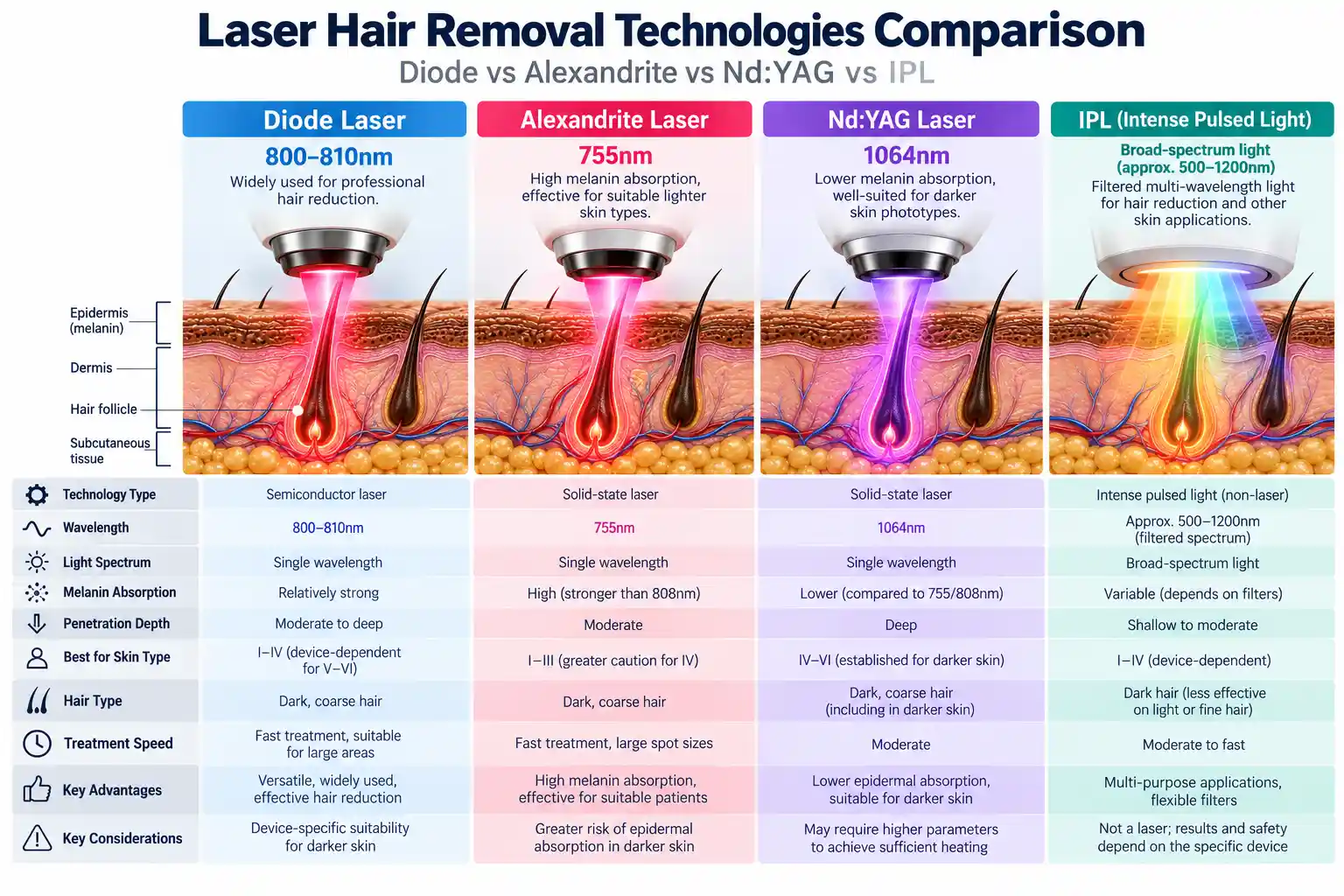
Diode vs Alexandrite vs Nd:YAG vs IPL: Complete Comparison Table
The following table summarizes the main differences between the four technologies.
It is intended to support technology evaluation, not to replace patient-specific clinical assessment or device-specific documentation.
| Comparison Factor | Diode | Alexandrite | Nd:YAG | IPL |
|---|---|---|---|---|
| Technology | Semiconductor laser | Solid-state laser | Solid-state laser | Non-laser pulsed light |
| Typical wavelength | Around 800–810nm; other options available | 755nm | 1064nm | Filtered broad spectrum |
| Melanin absorption | Relatively strong | Stronger than at 808nm | Lower than at shorter wavelengths | Depends on emitted spectrum and filters |
| Lighter skin | Commonly used with suitable protocols | Established option | Can be used in selected circumstances | Device-dependent |
| Darker skin | Device-specific suitability | Greater caution required | Established option for Fitzpatrick V–VI | Device-specific; greater caution may be needed |
| Cooling | Contact cooling common | Varies by system | Varies by system | Varies by system |
| Hair reduction | Long-term reduction possible | Long-term reduction possible | Long-term reduction possible | Hair reduction possible |
| Key advantage | Versatile professional configurations | Strong targeting of pigmented hair | Lower epidermal melanin absorption | Filtered broad-spectrum light applications |
| Key limitation | Device-specific suitability | Epidermal heating concerns in darker skin | Lower melanin absorption requires appropriate parameters | Performance depends heavily on device design |
| Professional buying focus | Wavelength configuration, cooling, pulse control | Clinical suitability, cooling, service | Pulse control, skin-type indications, cooling | Optical filters, spectrum, indications, cooling |
Which Technology Offers the Best Overall Balance?
There is no universally superior technology across all skin types and hair characteristics.
Diode laser systems are widely used for professional hair reduction. Alexandrite lasers are established options for suitable lighter skin phototypes.
Long-pulsed Nd:YAG technology is particularly important for darker skin, while IPL may be considered for appropriately selected patients and applications.
Professional clinics should prioritize clinical suitability, device performance, operator training, and safety rather than choosing equipment based on a single advertised advantage.
Best Laser Hair Removal Technology for Different Skin Types
Skin pigmentation is one of the most important factors in selecting a laser hair removal technology. Because melanin is present in both the hair and epidermis, skin phototype influences the balance between effective follicular heating and unwanted surface absorption.
The Fitzpatrick skin phototype classification is commonly used as part of laser treatment assessment. However, it describes a person’s typical response to ultraviolet exposure and should not be used as the sole basis for selecting treatment.
Recent tanning, baseline pigmentation, hair characteristics, medical history, and device-specific indications must also be considered.
Best Laser Hair Removal for Fair Skin: Fitzpatrick Types I–II
Patients with Fitzpatrick skin types I and II generally have relatively low baseline epidermal pigmentation. When they also have dark terminal hair, the contrast between hair melanin and epidermal melanin can be favorable for treatment.
The 755nm alexandrite laser is an established option for suitable lighter skin phototypes with pigmented hair.
Diode laser systems operating around 800–810nm may also provide effective hair reduction in appropriately selected patients.
However, very light blonde, red, gray, or white hair may respond poorly because the target contains insufficient melanin for predictable absorption.
Best Laser Hair Removal for Medium Skin: Fitzpatrick Types III–IV
Fitzpatrick types III and IV include patients with varying levels of epidermal pigmentation and tanning responses.
Diode laser systems are commonly considered for these skin types when supported by the device’s clinical indications.
Alexandrite and long-pulsed Nd:YAG technologies may also be appropriate in selected circumstances.
The choice depends on the patient’s current pigmentation, recent sun exposure, hair characteristics, and the specific equipment.
Skin type IV should not automatically be treated using the same protocol as lighter skin.
Best Laser Hair Removal for Dark Skin: Fitzpatrick Types V–VI
For deeply pigmented skin, epidermal melanin absorption becomes a particularly important safety consideration.
Long-pulsed 1064nm Nd:YAG is among the most established laser hair removal technologies for Fitzpatrick types V and VI.
The 1064nm wavelength is less strongly absorbed by epidermal melanin than shorter hair removal wavelengths such as 755nm and 808nm.
Certain diode laser systems may also support treatment of selected darker skin phototypes. Their suitability must be confirmed using device-specific documentation and appropriate clinical protocols.
Clinics should not assume that every multi-wavelength diode platform is equivalent to a dedicated long-pulsed Nd:YAG system.
For a more detailed discussion of wavelength selection and pigmentation risks, see our guide to laser hair removal for dark skin .
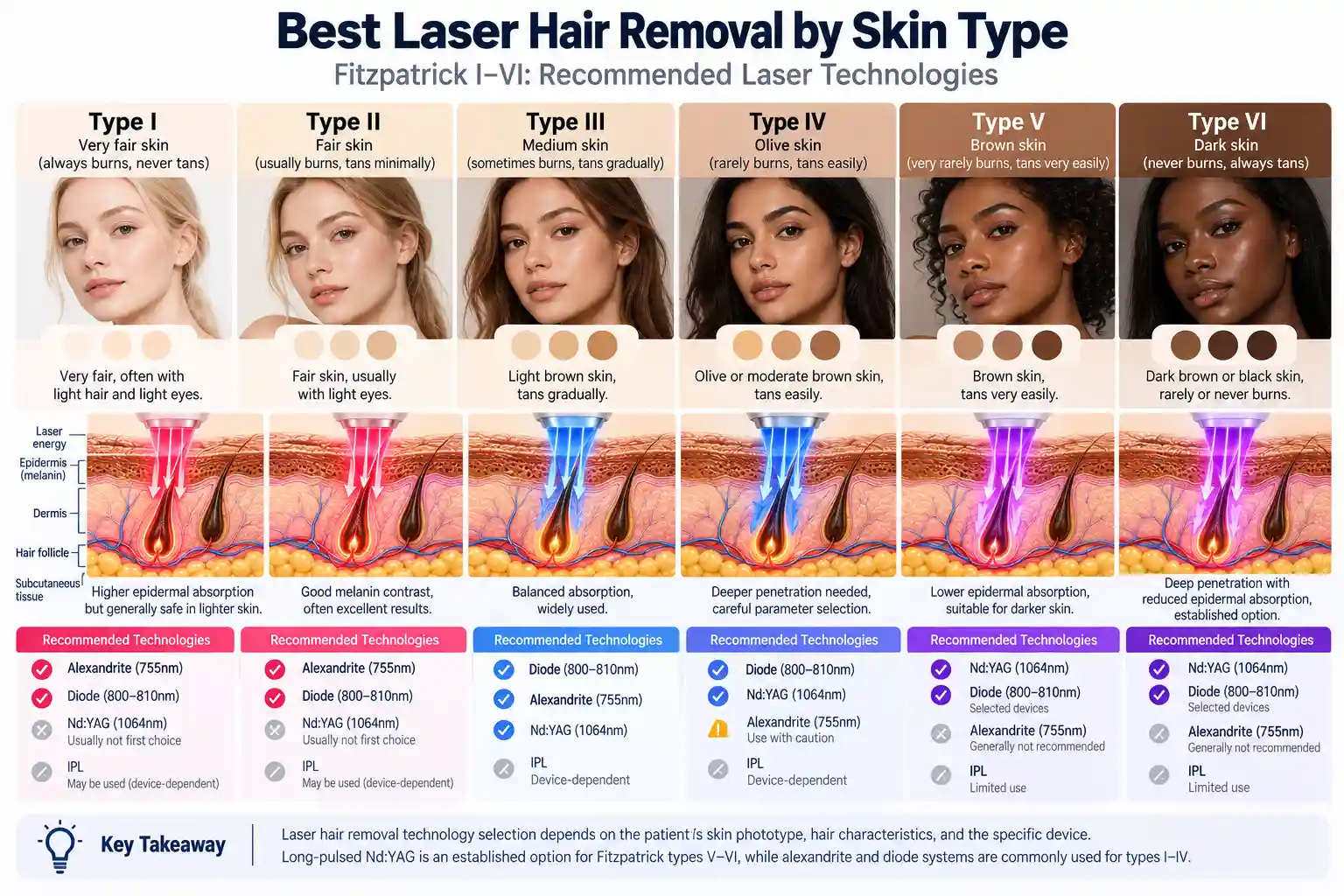
Laser Hair Removal Technology by Fitzpatrick Skin Type
| Skin Type | Commonly Considered Technologies | Key Considerations |
|---|---|---|
| I–II | Alexandrite and suitable diode systems | Dark hair generally provides a more favorable target than lightly pigmented hair |
| III | Diode, alexandrite, or Nd:YAG depending on the patient and device | Assess current pigmentation, tanning, and hair characteristics |
| IV | Suitable diode or long-pulsed Nd:YAG systems; other options require assessment | Greater attention to epidermal melanin absorption |
| V | Long-pulsed Nd:YAG; selected diode systems with supported indications | Cooling, appropriate parameters, and pigmentation-related risks are important |
| VI | Long-pulsed 1064nm Nd:YAG is an established option | Individualized assessment and documented device suitability are essential |
Clinical note: This table is an educational overview, not a treatment protocol. Skin phototype alone cannot establish which device or settings are appropriate for an individual patient.

Which Laser Hair Removal Technology Works Best for Different Hair Types?
Hair color, thickness, and follicular characteristics can influence treatment effectiveness as much as skin phototype.
Laser hair removal primarily relies on melanin absorption. Consequently, hair with sufficient pigment generally provides a more favorable target than hair with little or no melanin.
Dark, Coarse Hair
Dark, coarse terminal hair is generally the most favorable target for laser hair removal.
Its melanin content supports light absorption, while its structure can facilitate the transfer of thermal energy to relevant follicular tissue.
Alexandrite, diode, and long-pulsed Nd:YAG lasers can all provide hair reduction in suitable patients.
The best choice depends on the patient’s skin pigmentation and the specific device.
Fine or Thin Hair
Fine hair can be more difficult to treat because it may contain less melanin and provide a smaller thermal target.
Treatment response is often less predictable than with coarse terminal hair.
Not all fine hair is suitable for laser treatment. Very fine vellus hair may respond poorly, and inappropriate treatment in some areas can be associated with paradoxical hair growth.
A qualified provider should assess whether laser treatment is appropriate before proceeding.
Blonde, Red, Gray, and White Hair
Lightly pigmented hair often responds less predictably to conventional laser hair removal.
Blonde and red hair may contain different amounts and types of melanin, while gray and white hair may contain very little usable pigment.
Because melanin is the principal target for conventional hair removal lasers, changing to a different wavelength does not guarantee effective treatment of non-pigmented hair.
Electrolysis may be considered as an alternative for suitable patients seeking treatment of hair that responds poorly to lasers.
Hair Type and Technology Comparison
| Hair Type | General Treatment Response | Important Consideration |
|---|---|---|
| Dark, coarse hair | Often favorable for laser hair reduction | Select technology according to skin pigmentation |
| Dark, fine hair | Variable and potentially less predictable | Assess hair thickness and treatment area |
| Light blonde hair | Often limited response | Insufficient pigment may reduce absorption |
| Red hair | Variable, often less predictable | Pigment characteristics differ from dark hair |
| Gray or white hair | Generally poor response to conventional laser hair removal | Alternative hair removal methods may be considered |
Does the Best Laser Hair Removal Technology Depend on the Treatment Area?
Different anatomical areas have different hair densities, follicle characteristics, pigmentation, and sensitivity.
These differences can influence treatment planning, although no single technology is universally best for every body area.
Legs and Arms
Legs and arms often involve relatively large treatment surfaces.
Clinics may consider systems with suitable treatment coverage, consistent energy delivery, and effective cooling.
Diode, alexandrite, and Nd:YAG systems may all be used when appropriate for the patient’s skin and hair.
Underarms
Underarm hair is often relatively coarse and pigmented, which can provide a favorable target for laser hair reduction.
However, underarm skin pigmentation may differ from surrounding areas.
The provider should assess local pigmentation and skin condition before selecting treatment.
Bikini and Brazilian Areas
Bikini and Brazilian hair removal requires careful consideration of anatomical sensitivity and variation in skin pigmentation.
Hair may be coarse, but the surrounding skin can be more heavily pigmented than other body areas.
Suitable technology, professional assessment, and appropriate treatment protocols are essential.
Face and Neck
Facial hair can vary considerably in thickness, density, and hormonal influence.
Coarse terminal hair may respond differently from fine vellus hair.
In some circumstances, treating fine facial hair with light-based systems can be associated with paradoxical hypertrichosis, or increased hair growth.
Clinics should assess the type of facial hair and the suitability of treatment before proceeding.
Back and Chest
Back and chest hair removal may involve large areas with variable hair density and growth patterns.
Device coverage, cooling performance, treatment efficiency, and patient characteristics all influence equipment selection.
Hormonal factors may also affect regrowth and maintenance requirements.
Diode vs Alexandrite vs Nd:YAG vs IPL: Which Has the Best Results?
The effectiveness of professional hair removal depends on more than the technology category.
Clinical results are influenced by the patient’s skin and hair characteristics, treatment parameters, session intervals, device performance, and operator experience.
Diode, alexandrite, and long-pulsed Nd:YAG lasers can all produce meaningful long-term hair reduction in appropriately selected patients.
IPL can also provide hair reduction with suitable systems and protocols.
Which Laser Removes Hair the Fastest?
Treatment speed can refer to two different outcomes: the time required to complete a session and the number of sessions needed to achieve a desired reduction.
Session duration depends on spot size, repetition rate, treatment technique, anatomical area, and equipment design.
A system that covers a large area quickly does not necessarily produce better long-term results.
Similarly, no technology can be declared universally fastest in terms of achieving lasting hair reduction.
How Many Laser Hair Removal Sessions Are Needed?
Multiple treatment sessions are generally required because hair follicles do not all provide equally favorable targets during a single session.
A course of approximately six to eight sessions is commonly discussed, but actual requirements vary substantially.
Some patients may need additional treatments or periodic maintenance.
Session planning should account for anatomical location, hair characteristics, hormonal influences, treatment response, and the specific device.
Is Laser Hair Removal Permanent?
Laser hair removal is generally intended to produce permanent hair reduction rather than guaranteed permanent elimination of every hair.
Some follicles may produce little or no visible regrowth over an extended period.
Other follicles may recover or become active later, and hormonal changes can influence future hair growth.
Patients should receive realistic expectations before beginning treatment.
Can One Technology Guarantee Better Hair Reduction?
No. A technology category alone cannot guarantee superior outcomes.
Comparative clinical studies may demonstrate differences between particular devices and treatment protocols, but those findings should not automatically be generalized to every diode, alexandrite, Nd:YAG, or IPL system.
Professional buyers should review device-specific clinical evidence whenever available.
Which Laser Hair Removal Technology Hurts the Least?
Discomfort during laser hair removal varies among individuals and treatment areas.
Patients often describe sensations such as warmth, brief stinging, or snapping against the skin.
However, pain perception is subjective and cannot be predicted from wavelength alone.
Does Diode Laser Hair Removal Hurt?
Diode laser treatment may cause discomfort, particularly in sensitive areas or where hair is dense.
Many professional diode systems incorporate contact cooling to help manage epidermal temperature and improve patient comfort.
The experience depends on the device, settings, treatment area, and individual sensitivity.
Does Alexandrite Laser Hair Removal Hurt?
Alexandrite treatment can produce brief sensations of heat or stinging.
Cooling systems may help manage discomfort, but the experience varies according to treatment conditions.
Is Nd:YAG Laser Hair Removal More Painful?
Some patients may experience substantial discomfort during Nd:YAG treatment, but it would be inaccurate to state that Nd:YAG is always more painful than other technologies.
Pain depends on the delivered energy, pulse characteristics, treatment area, cooling, and individual response.
Is IPL Hair Removal Less Painful Than Laser?
IPL treatment may also produce warmth, stinging, or discomfort.
It is not universally less painful than laser hair removal.
Comparative comfort depends on the specific equipment, treatment settings, and patient characteristics.
How Cooling Technology Affects Comfort
Epidermal cooling can help reduce unwanted surface heating and improve patient comfort.
Common methods include contact cooling, cold-air cooling, and device-specific cryogen cooling.
However, cooling should not be used to justify inappropriate energy delivery or unsuitable treatment settings.
Which Hair Removal Technology Is Safest?
No diode, alexandrite, Nd:YAG, or IPL system can be considered universally safest for every patient.
Safety depends on the interaction between the patient’s characteristics, the equipment, the treatment parameters, and the operator’s clinical judgment.
Common Laser Hair Removal Side Effects
Temporary redness, perifollicular swelling, and mild discomfort may occur after treatment.
More significant complications can include burns, blistering, hyperpigmentation, hypopigmentation, and scarring.
Eye injury is also a serious potential hazard when appropriate laser safety procedures are not followed.
Why Darker Skin Requires Additional Consideration
Melanin-rich epidermis can absorb more energy from certain wavelengths, increasing the importance of selecting suitable technology and treatment parameters.
Long-pulsed 1064nm Nd:YAG is an established option for deeply pigmented skin because of its comparatively lower epidermal melanin absorption.
Nevertheless, inappropriate Nd:YAG treatment can still produce burns or pigmentation changes.
How Clinics Can Reduce Treatment Risks
- Assess skin phototype, current pigmentation, and hair characteristics.
- Review relevant medical history, medications, and recent sun exposure.
- Select equipment with documented indications appropriate for the patient.
- Follow device-specific operating instructions and treatment protocols.
- Use appropriate cooling and wavelength-specific eye protection.
- Consider test spots when clinically indicated.
- Provide clear aftercare instructions and recognize adverse reactions.
- Maintain operator training and equipment safety procedures.
Does More Advanced Technology Mean Safer Treatment?
Not necessarily. Features such as multiple wavelengths, high power, automated treatment modes, and advanced cooling can be useful, but none independently guarantees safety.
Clinics should evaluate the complete system, supported indications, training requirements, and clinical evidence before purchasing or using equipment.
How to Choose the Best Professional Laser Hair Removal Machine
Choosing the best professional laser hair removal machine requires a structured evaluation of clinical suitability, equipment performance, operating costs, and long-term supplier support.
A clinic should not purchase a system simply because it offers the highest advertised power, the greatest number of wavelengths, or the lowest initial price.
The most appropriate equipment is the system that meets the clinic’s treatment requirements, supports safe operation, and provides sustainable value over its working life.
1. Evaluate Your Patient Population
Begin by identifying the skin phototypes, hair characteristics, and treatment areas most frequently encountered in your clinic.
A practice primarily treating lighter skin with dark terminal hair may have different equipment requirements from a clinic serving a large population of Fitzpatrick V–VI patients.
For clinics treating deeply pigmented skin, the availability of an appropriate long-pulsed 1064nm Nd:YAG system deserves particular consideration.
2. Compare Wavelength Configurations
Wavelength selection affects how laser energy interacts with melanin and surrounding tissue.
Professional equipment may offer a single wavelength, multiple selectable wavelengths, or a combined multi-wavelength output.
These configurations are not interchangeable. Buyers should determine whether wavelengths are emitted separately, simultaneously, or through a particular optical arrangement.
They should also request documentation of the delivered energy and pulse characteristics for each operating mode.
3. Examine Cooling Performance
Cooling is an important feature of professional laser hair removal equipment. It helps manage epidermal heating and may improve patient comfort.
Buyers should examine the type of cooling technology, its consistency during extended treatment sessions, and the manufacturer’s recommended operating procedures.
A low advertised cooling temperature does not independently demonstrate superior clinical safety or effectiveness.
4. Review Pulse Control and Energy Delivery
Professional systems should provide treatment controls appropriate to their intended clinical applications.
Important specifications include fluence, pulse duration, spot size, repetition rate, and output stability.
Buyers should distinguish between electrical input power, nominal handpiece power, and actual optical energy delivered to the skin.
These specifications describe different aspects of equipment performance and should not be treated as equivalent.
5. Consider Treatment Efficiency
Treatment efficiency is especially important for clinics performing high volumes of hair reduction procedures.
Larger treatment spots may improve coverage of suitable body areas, while smaller spots can be useful for selected anatomical regions.
However, actual treatment speed depends on the complete system, operator technique, cooling, and required treatment parameters.
6. Verify Regulatory Documentation
Before purchasing medical aesthetic equipment, buyers should request regulatory documentation relevant to their intended market.
Requirements differ between countries and may depend on the equipment’s intended medical use and classification.
A supplier’s general statement about certification should not replace verification of the exact model, manufacturer, indications, and applicable regulatory status.
For example, buyers entering the United States should verify whether the specific device requires FDA clearance or another applicable regulatory pathway.
European buyers should review applicable EU medical device requirements and the supporting conformity documentation.
7. Assess Maintenance and Supplier Support
The initial purchase price is only one component of the total cost of owning professional equipment.
Clinics should also consider handpiece replacement, servicing, consumables, training, warranty conditions, and potential downtime.
For distributors and OEM partners, spare-parts availability, technical documentation, and after-sales communication are particularly important.
Professional Laser Hair Removal Equipment Buying Checklist
| Evaluation Area | Questions to Ask | Why It Matters |
|---|---|---|
| Clinical indications | Which skin and hair types are supported by the device documentation? | Patient suitability and safety |
| Laser technology | Is the system diode, alexandrite, Nd:YAG, or IPL? | Determines the underlying optical technology |
| Wavelength output | Are wavelengths selectable or combined? | Helps evaluate treatment flexibility |
| Energy delivery | What are the documented fluence, pulse, and spot size specifications? | Supports meaningful technical comparison |
| Cooling | How does the system manage epidermal temperature? | Comfort and thermal management |
| Clinical evidence | What evidence supports the specific device and its indications? | Avoids relying on general technology claims |
| Regulatory status | Can the supplier provide verifiable documentation? | Market access and compliance |
| Training | What operator training and safety instructions are provided? | Consistent and responsible operation |
| Maintenance | What are the servicing and replacement requirements? | Long-term operating costs |
| OEM / ODM support | What customization and distributor services are available? | Business development and supply continuity |
Single-Wavelength vs Multi-Wavelength Diode Laser: Which Should Clinics Choose?
Many professional diode laser hair removal machines are marketed according to their wavelength configurations.
Single-wavelength platforms commonly operate near 808nm, while certain multi-wavelength diode systems incorporate combinations such as 755nm, 808nm, 940nm, and 1064nm.
Single-Wavelength Diode Laser Systems
A single-wavelength diode platform may be appropriate for clinics whose patient population and treatment requirements align with the device’s indications.
Buyers should evaluate the system’s optical performance, cooling, clinical evidence, and operating costs.
Multi-Wavelength Diode Laser Systems
Multi-wavelength diode platforms are designed to provide additional wavelength configurations within one equipment system.
This may offer practical flexibility for clinics treating patients with different hair and skin characteristics.
However, a greater number of wavelengths does not automatically produce better clinical results.
Buyers should verify how the wavelengths are generated and delivered, their relative energy output, and the clinical evidence supporting each treatment mode.
Does a Four-Wavelength Diode Laser Replace Nd:YAG?
Not necessarily. A diode system incorporating 1064nm output should not automatically be considered clinically equivalent to a dedicated long-pulsed Nd:YAG laser.
Although the nominal wavelengths may match, the laser source, pulse characteristics, beam delivery, and supporting evidence may differ.
Clinics treating Fitzpatrick V–VI patients should assess the evidence and indications of the exact device.
Technology selection should prioritize documented clinical suitability over the number of advertised wavelengths.
COOLICE Multi-Wavelength Diode Laser Technology for Professional Clinics
For clinics and distributors evaluating professional diode laser hair removal equipment, Cocoon Laser offers the COOLICE multi-wavelength diode laser platform.
COOLICE is designed for professional aesthetic applications and combines four diode wavelength configurations within one equipment platform.
Four-Wavelength Diode Configuration
The COOLICE platform incorporates the following nominal wavelengths:
- 755nm: A shorter diode wavelength configuration with relatively strong melanin absorption.
- 808nm: A commonly used wavelength for professional diode laser hair reduction.
- 940nm: An additional near-infrared wavelength incorporated into the platform’s optical configuration.
- 1064nm: A longer diode wavelength with comparatively lower melanin absorption than shorter wavelengths.
These are diode laser wavelengths. The COOLICE 1064nm diode output should not be described as an Nd:YAG laser.
Integrated Cooling Architecture
COOLICE incorporates an integrated cooling architecture combining air cooling, water cooling, and semiconductor cooling components.
Its cooling design is intended to support equipment thermal management and patient comfort during professional treatment.
Clinical safety still depends on appropriate patient selection, treatment parameters, operator training, and device-specific protocols.
Professional Treatment Configurations
The platform provides multiple treatment spot configurations intended to support different clinical workflows and anatomical areas.
Clinics should evaluate the available handpieces, treatment controls, operating instructions, and maintenance requirements against their own service needs.
Equipment Evaluation for Clinics and Distributors
Cocoon Laser works with professional equipment buyers, aesthetic clinics, and international distribution partners.
Buyers considering COOLICE should request the latest technical specifications, model-specific regulatory documentation, operating requirements, and available OEM or ODM information.
For product information and equipment inquiries, visit Cocoon Laser .
Product note: COOLICE is presented as a professional diode laser equipment option, not as a clinically proven replacement for every alexandrite, Nd:YAG, or IPL system.
Common Mistakes When Choosing Laser Hair Removal Technology
Mistake 1: Assuming One Laser Is Best for Every Skin Type
Different skin phototypes have different pigmentation characteristics and treatment requirements.
A wavelength suitable for one patient may not be appropriate for another.
Mistake 2: Comparing Wavelengths Without Comparing Devices
Wavelength is only one aspect of laser performance.
Pulse characteristics, optical energy, cooling, spot size, and clinical evidence must also be evaluated.
Mistake 3: Treating IPL as a Laser
IPL and laser technologies both use light energy, but they are not identical.
Their optical characteristics and device-specific clinical applications differ.
Mistake 4: Assuming More Wavelengths Always Mean Better Results
Multi-wavelength systems may offer additional treatment configurations, but clinical outcomes depend on actual energy delivery and supported treatment protocols.
Mistake 5: Confusing 1064nm Diode With 1064nm Nd:YAG
The same nominal wavelength does not mean two laser systems have identical technology or clinical evidence.
Mistake 6: Focusing Only on Equipment Price
A lower initial purchase price may not reflect the total operating cost.
Maintenance, replacement components, training, warranty, and service support should be considered.
Mistake 7: Assuming Cooling Eliminates Treatment Risks
Cooling can help protect the epidermis, but it cannot eliminate the risks associated with unsuitable technology or inappropriate settings.
Mistake 8: Ignoring Device-Specific Regulatory Requirements
Buyers should verify regulatory documentation for the exact model and intended market.
General marketing statements are not a substitute for valid, applicable documentation.
Frequently Asked Questions About Laser Hair Removal Technology
1. What is the best laser hair removal technology?
There is no single best technology for every patient. Alexandrite, diode, and long-pulsed Nd:YAG lasers have different strengths depending on skin phototype, hair characteristics, and treatment goals.
2. Is diode laser better than alexandrite?
Not universally. Alexandrite is an established option for suitable lighter skin types with dark hair. Diode lasers are widely used across selected patient populations, depending on the device.
3. Is Nd:YAG better than diode laser for dark skin?
Long-pulsed 1064nm Nd:YAG is an established option for deeply pigmented skin. Certain diode systems may also be suitable, but their indications and clinical evidence must be evaluated individually.
4. Is IPL as effective as laser hair removal?
IPL can produce hair reduction in suitable patients. Comparative effectiveness depends on the specific IPL and laser systems, treatment protocols, and patient characteristics.
5. Which laser hair removal technology is best for light skin?
Alexandrite and suitable diode laser systems are commonly considered for lighter skin with dark, pigmented hair.
6. Which laser hair removal technology is best for dark skin?
Long-pulsed 1064nm Nd:YAG is among the most established options for Fitzpatrick V–VI. Individual assessment and appropriate device settings remain essential.
7. Which laser works best for coarse hair?
Dark, coarse terminal hair generally provides a favorable target for laser hair reduction. Several laser technologies may be effective when appropriate for the patient’s skin.
8. Can laser hair removal treat blonde or white hair?
Conventional laser hair removal is generally less effective on hair containing little or no melanin. Alternative approaches such as electrolysis may be considered.
9. Does diode laser hair removal permanently remove hair?
Diode laser treatment can provide long-term hair reduction, but complete and permanent removal of every hair is not guaranteed.
10. How many sessions are needed for laser hair removal?
Multiple sessions are generally required. The number depends on treatment area, hair characteristics, hormonal influences, device performance, and individual response.
11. Which hair removal technology is least painful?
No technology is universally least painful. Comfort depends on the treatment area, settings, cooling, and individual sensitivity.
12. Is a four-wavelength diode laser better than an 808nm laser?
A four-wavelength system may provide additional treatment configurations, but more wavelengths do not automatically mean better outcomes. Buyers should compare the specific devices and their supporting evidence.
13. Is a 1064nm diode laser the same as Nd:YAG?
No. Diode and Nd:YAG lasers use different light-generation technologies. Matching nominal wavelengths do not establish equivalent clinical performance.
14. What is the best laser hair removal machine for a medical spa?
The best machine depends on the medical spa’s patient population, treatment services, operator qualifications, budget, and local regulatory requirements.
15. Should a clinic buy diode laser or IPL equipment?
A clinic focused on professional hair reduction may consider a suitable diode laser system. IPL may be relevant when its documented applications align with the clinic’s service requirements. Neither option should be chosen without device-specific evaluation.
Final Verdict: Which Laser Hair Removal Technology Is Best?
The best laser hair removal technology depends on the patient, the treatment objectives, and the clinical equipment being used.
Alexandrite lasers are established options for suitable lighter skin phototypes with dark, pigmented hair.
Diode lasers are widely used professional hair reduction technologies with different wavelength configurations and device-specific capabilities.
Long-pulsed Nd:YAG lasers are particularly important for darker skin phototypes because 1064nm light has comparatively lower epidermal melanin absorption.
IPL systems offer filtered broad-spectrum light-based hair reduction in appropriately selected patients.
For professional clinics, the most important decision is not which technology has the most impressive marketing claims.
It is which system provides appropriate clinical capabilities, documented safety, reliable operation, and sustainable long-term value.
Looking for Professional Laser Hair Removal Equipment?
Cocoon Laser supplies professional medical aesthetic equipment for clinics, distributors, and OEM / ODM partners.
If you are evaluating a multi-wavelength diode laser hair removal system, you can request information about the COOLICE platform, available configurations, and purchasing requirements.
Explore Cocoon Laser equipment and contact our team to discuss your professional equipment requirements.
References and Further Reading
- Anderson RR, Parrish JA. Selective photothermolysis: precise microsurgery by selective absorption of pulsed radiation. Science. 1983;220(4596):524–527. DOI: 10.1126/science.6836297 .
- American Academy of Dermatology Association. Laser hair removal: patient information, preparation, and treatment considerations. American Academy of Dermatology .
- U.S. Food and Drug Administration. Medical device information, regulatory requirements, and device databases. FDA Medical Devices .
Reference note: These resources provide foundational information about selective photothermolysis, dermatological treatment, and medical device regulation. They do not establish clinical equivalence between individual commercial laser systems.