OPT vs IPL: What’s the Difference?
OPT and IPL are closely related aesthetic light technologies, but they do not describe two completely separate types of energy.
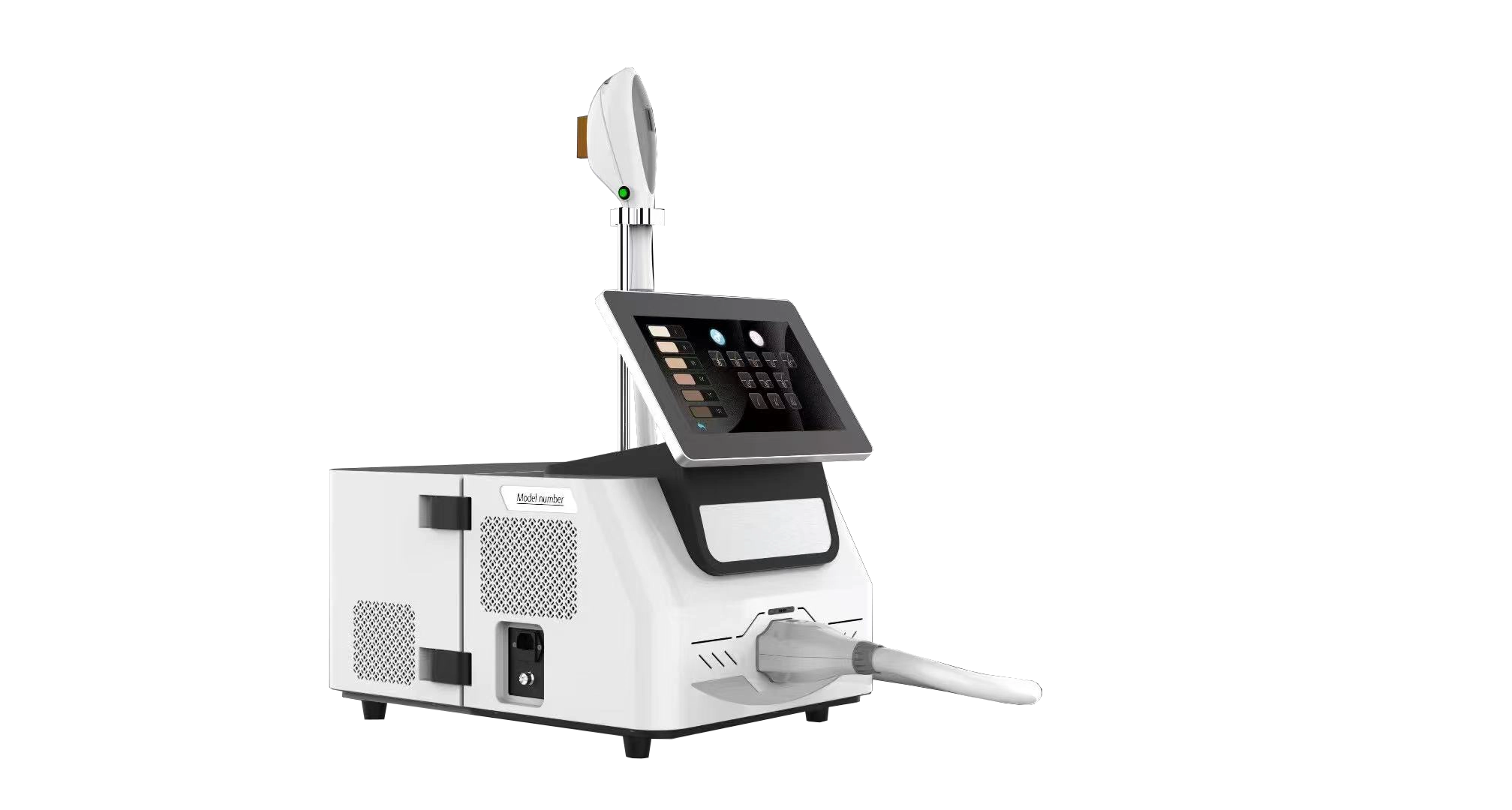
IPL, or Intense Pulsed Light, is a broad-spectrum pulsed light technology used in professional aesthetic systems for applications such as hair reduction, selected pigmentation, vascular concerns, and photorejuvenation.
OPT is commonly used in the aesthetic-device industry to describe an optimized approach to IPL pulse delivery. Depending on the specific platform, this may involve improved control over pulse shape, energy distribution, pulse duration, or pulse-to-pulse consistency.
In practical terms, an OPT system is generally still an IPL system. OPT does not represent a separate laser wavelength.
This guide explains OPT vs IPL, how optimized pulse delivery works, how OPT relates to SHR, where these technologies are used, and what clinics and distributors should evaluate when comparing professional IPL equipment.
Quick Answer
IPL is the underlying broad-spectrum light technology, while OPT generally refers to an optimized method of controlling how IPL energy is delivered.
Traditional and modern IPL systems both generate filtered broad-spectrum pulsed light. OPT-style systems typically place additional emphasis on controlling pulse shape, energy consistency, and treatment delivery.
Therefore, OPT is better understood as a pulse-control approach within IPL technology rather than a separate laser or wavelength.
However, OPT terminology and implementation vary among manufacturers. Clinics should compare the actual spectral filters, pulse architecture, fluence control, energy stability, repetition rate, cooling, and technical specifications of the specific device rather than relying on the OPT label alone.
What Is IPL?
IPL stands for Intense Pulsed Light.
Unlike a wavelength-specific laser, an IPL system produces high-intensity pulses across a broad optical spectrum.
Optical filters are used to modify the spectrum delivered toward the skin. Different filter configurations and treatment parameters can support different applications, depending on the capabilities and intended use of the device.
Professional IPL platforms may be designed for applications such as:
- Hair reduction
- Selected superficial pigmentation
- Photodamage
- Selected vascular concerns
- Photorejuvenation
- Uneven-looking skin tone
Treatment behavior depends on more than the wavelength range. Fluence, pulse duration, pulse structure, filters, spot size, cooling, and the optical design of the system all influence light-tissue interaction.
For the complete technology overview, see What Is IPL? How Intense Pulsed Light Works.
What Is OPT?
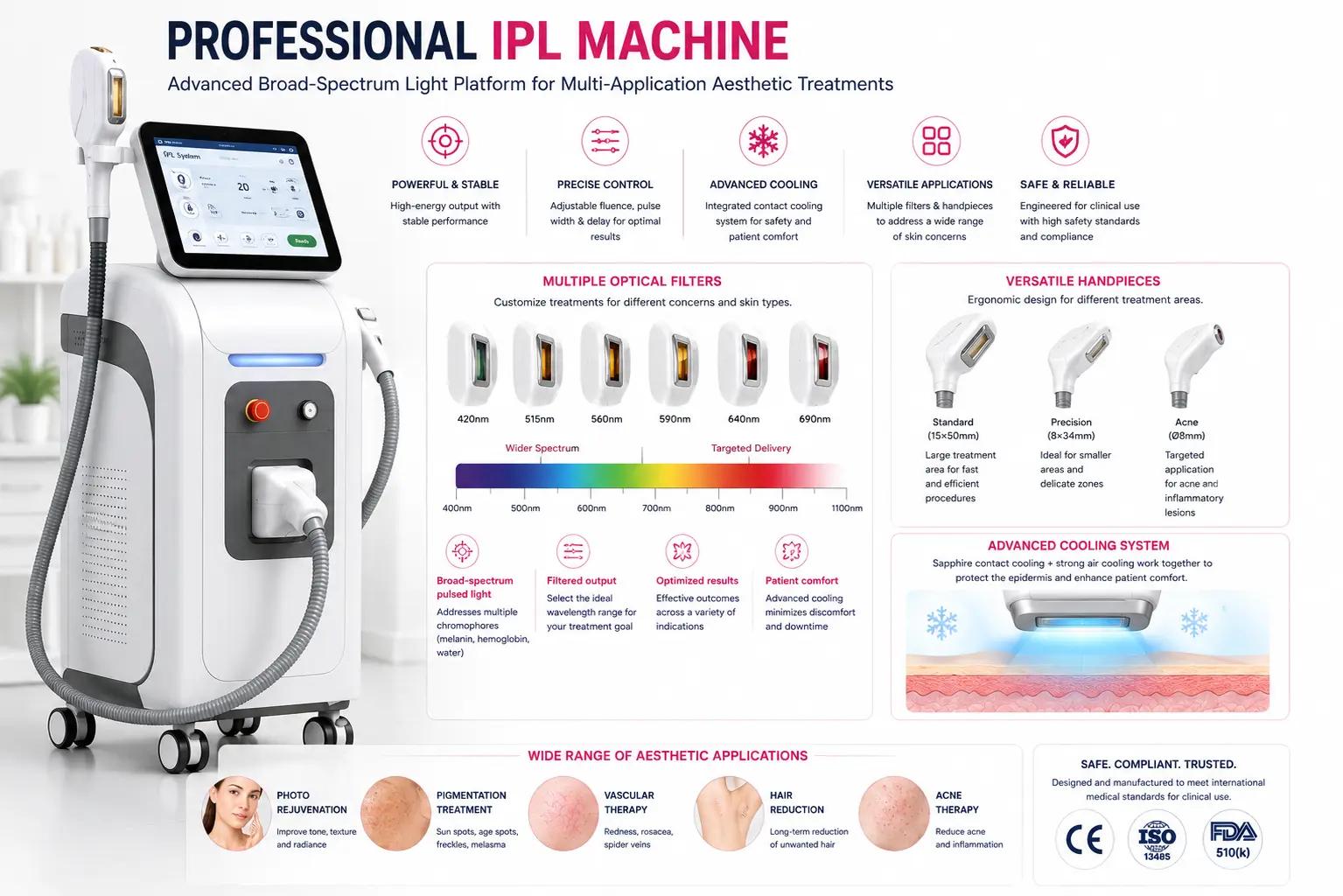
In professional aesthetic equipment, OPT is commonly used to describe optimized pulse technology or an optimized approach to IPL pulse delivery.
The objective is generally to provide greater control over how optical energy is distributed during a pulse or pulse sequence.
Depending on the specific platform, OPT-style technology may be designed to improve:
- Energy consistency
- Pulse-shape control
- Fluence stability
- Pulse-to-pulse reproducibility
- Parameter flexibility
- Thermal control
The exact implementation is device-specific. Two machines carrying an OPT label may use different electronics, pulse waveforms, control algorithms, filters, or cooling architectures.
Is OPT a Laser?
No. OPT should not generally be described as a laser.
OPT is commonly implemented within an IPL platform, and IPL itself is not technically a laser.
IPL produces broad-spectrum, non-coherent light. Laser systems generate optical energy within a much narrower and more specific wavelength range.
For example:
- IPL / OPT uses filtered broad-spectrum pulsed light.
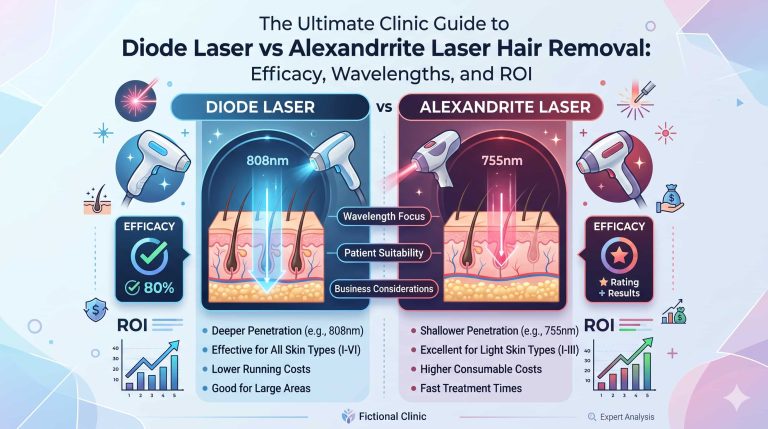
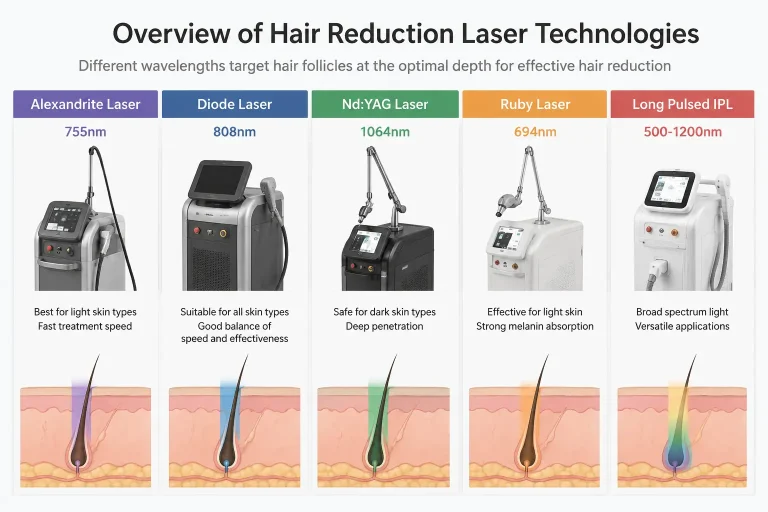
- Diode laser systems may use defined wavelengths such as approximately 808nm.
- Thulium aesthetic lasers may operate around approximately 1927nm.
- CO2 lasers commonly operate around approximately 10,600nm.
Optimizing IPL pulse delivery does not convert broad-spectrum light into a wavelength-specific laser.
For a broader comparison, see IPL vs Laser: What’s the Difference?.
OPT vs IPL at a Glance
| Feature | IPL | OPT |
|---|---|---|
| Underlying Technology | Intense Pulsed Light | Generally based on IPL |
| Light Source | Broad-spectrum pulsed light | Broad-spectrum pulsed light in typical implementations |
| Laser? | No | Generally no |
| Main Concept | Filtered broad-spectrum treatment | Optimized pulse and energy delivery |
| Pulse Control | Depends on device design | Typically emphasizes improved pulse control |
| Energy Stability | Device-dependent | Often an important design objective |
| Applications | Hair, pigmentation, vascular and photorejuvenation applications depending on device | Generally similar IPL application categories depending on device |
| Wavelength | Broad spectrum modified by filters | Still determined by the underlying IPL platform and filters |
The key distinction is that OPT vs IPL is not comparable to IPL vs diode laser or IPL vs CO2 laser. OPT is generally a way of improving or controlling IPL energy delivery.
How Does OPT Technology Work?
A simplified IPL treatment process can be divided into three stages:
- The system generates broad-spectrum optical energy.
- Optical filters modify the spectrum delivered toward the treatment area.
- The system controls how that energy is delivered over time.
OPT is primarily associated with the third stage: pulse and energy-delivery control.
Rather than considering only the total fluence displayed by the system, OPT-style technology also focuses on how consistently energy is distributed throughout a pulse or pulse sequence.
This matters because tissue response is influenced not only by total energy but also by the temporal characteristics of energy delivery.
Why Does IPL Pulse Shape Matter?
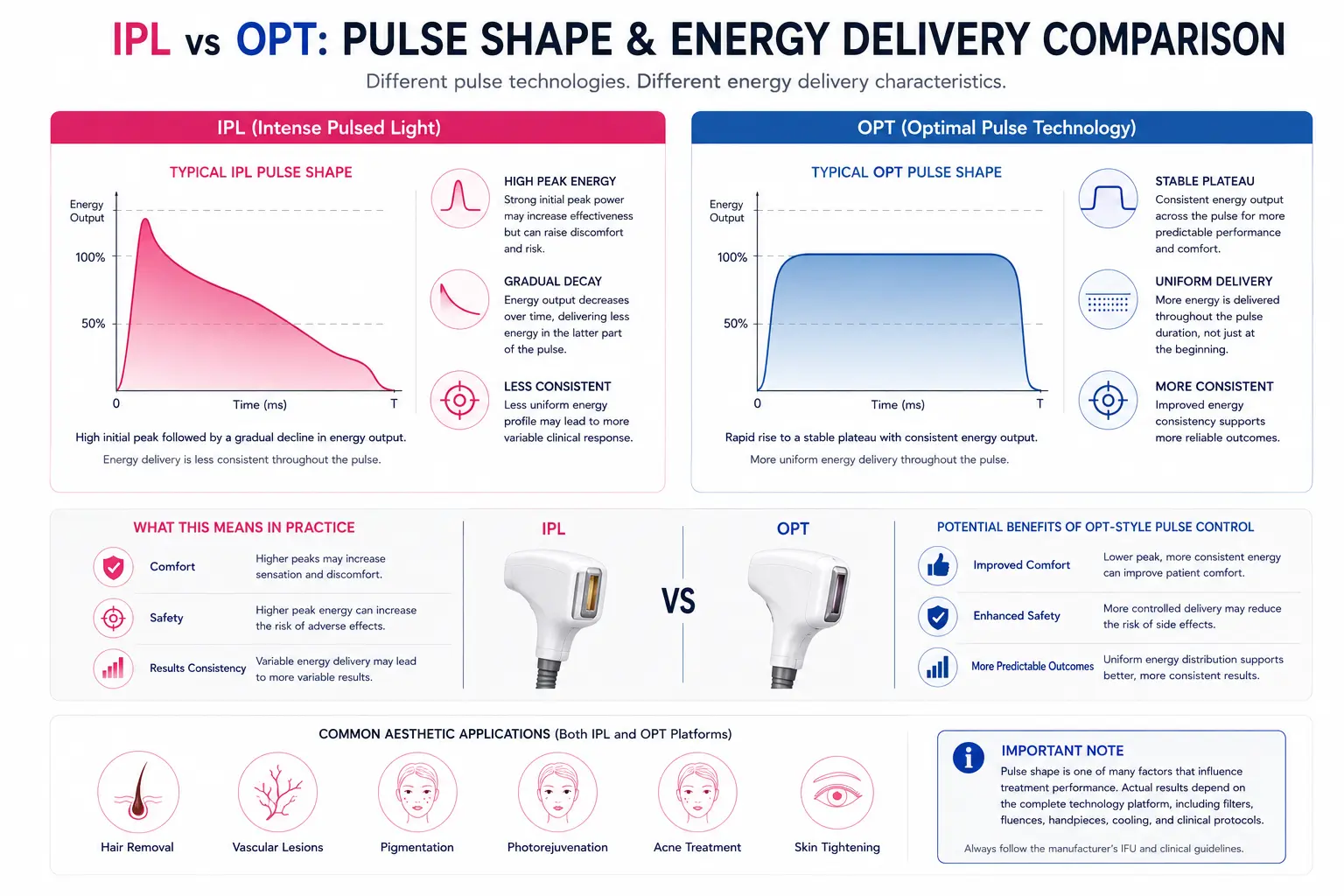
Pulse shape describes how optical output changes during the duration of a treatment pulse.
Two IPL systems may display similar total fluence values while distributing that energy differently over time.
One pulse may provide relatively stable output, while another may contain larger peaks or variations in instantaneous power.
Pulse characteristics can influence:
- Peak thermal loading
- Target heating
- Epidermal exposure
- Treatment consistency
- Patient sensation
- Pulse-to-pulse reproducibility
For professional equipment buyers, this is one reason maximum fluence alone does not provide a complete picture of system performance.
What Is a Square Pulse in OPT IPL?
The term square pulse is often used to describe a pulse designed to maintain relatively consistent optical output across its duration.
Conceptually, this can help reduce large peaks and drops in delivered power and provide more predictable energy delivery.
However, simplified waveform graphics should not be treated as proof of actual device output.
A perfectly rectangular diagram in a brochure does not necessarily mean that the measured optical waveform at the treatment window is perfectly rectangular.
Professional buyers should therefore evaluate device-specific technical documentation when pulse performance is an important purchasing criterion.
Does OPT Use Different Wavelengths Than IPL?
Not necessarily.
OPT generally changes how IPL energy is controlled rather than creating an entirely different wavelength category.
The optical spectrum reaching the skin is still influenced by:
- The IPL light source
- Optical filters
- Handpiece optics
- Device-specific spectral design
This is why clinics should compare the actual filter configuration and spectral characteristics of professional IPL equipment instead of assuming that OPT provides fundamentally different wavelengths.
OPT vs IPL for Hair Removal
Hair reduction is one of the major applications in which IPL, OPT, and SHR terminology frequently overlap.
In IPL-based hair reduction, selected portions of the delivered optical spectrum can be absorbed by melanin associated with the hair structure.
Absorbed optical energy is converted into heat, contributing to controlled thermal effects in structures involved in hair growth.
OPT-style technology may improve the consistency of energy delivery, but hair-reduction performance still depends on:
- Hair color and thickness
- Hair-growth stage
- Skin pigmentation
- Spectral range and filter
- Fluence
- Pulse duration
- Spot size
- Cooling
- Treatment technique
OPT pulse control cannot compensate for an inappropriate optical target or poorly selected treatment parameters.
How Are IPL, OPT and SHR Related?
IPL, OPT, and SHR are frequently presented together on professional aesthetic machines, which can make them appear to be three competing technologies.
A more accurate way to understand their relationship is:
- IPL describes the underlying broad-spectrum light platform.
- OPT generally describes optimization of pulse and energy delivery.
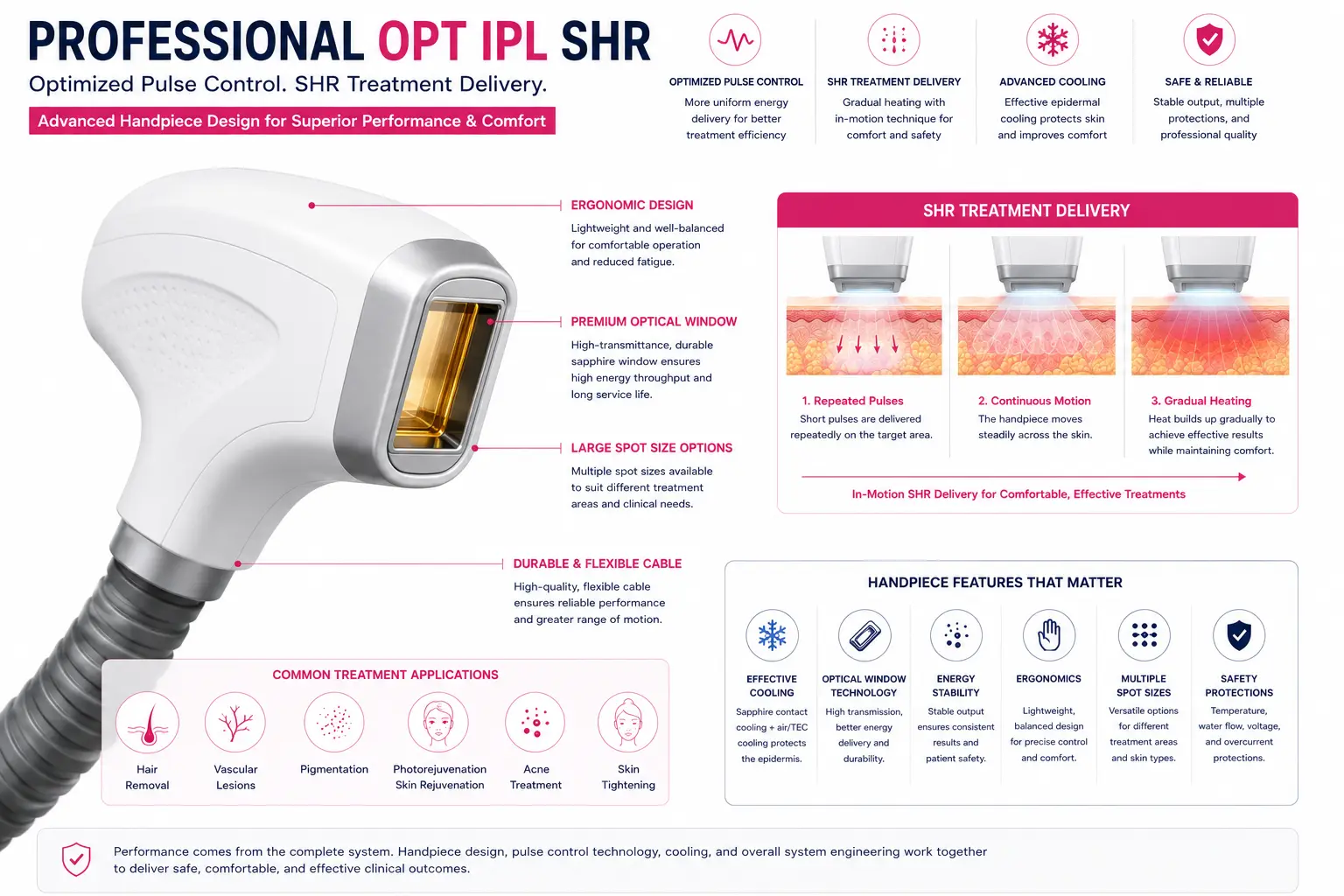
- SHR generally describes a repeated, often in-motion hair-reduction delivery strategy.
A single professional IPL platform may therefore combine optimized pulse control with an SHR treatment mode.
This does not necessarily mean that the machine contains three independent light sources.
For a detailed explanation of SHR, see What Is SHR Hair Removal? How SHR Technology Works.
OPT vs IPL for Pigmentation and Skin Rejuvenation
Both conventional IPL and OPT-style IPL systems may support selected pigmentation and photorejuvenation applications depending on their spectrum, filters, parameters, and intended use.
For superficial pigmentation, melanin is an important chromophore. For selected vascular applications, hemoglobin can be an important optical target.
OPT-style pulse control may improve energy consistency, but it does not eliminate the need to consider:
- Type and depth of the target
- Skin phototype
- Recent sun exposure
- Filter selection
- Fluence
- Pulse duration
- Cooling
- Risk of unwanted pigmentary response
OPT also remains fundamentally different from wavelength-specific resurfacing technologies such as 1927nm thulium and 10,600nm CO2 laser.
Is OPT Better Than Traditional IPL?
OPT can represent a meaningful improvement in IPL pulse control, but saying that “OPT is better than IPL” is technically too simplistic.
OPT is generally still IPL.
A well-engineered OPT-style system may provide advantages such as:
- More stable energy delivery
- Better-controlled pulse characteristics
- Greater parameter flexibility
- Improved pulse-to-pulse consistency
- More predictable treatment workflow
But the OPT label alone does not establish device quality.
A professional buyer should compare actual engineering performance, optical output, filters, cooling, pulse architecture, service requirements, and support rather than selecting equipment based on terminology alone.
What Should Clinics Look for in a Professional OPT IPL Machine?
For clinics, medical spas, distributors, and equipment buyers, the most useful question is not simply whether OPT is better than IPL.
The more important question is whether the complete system provides the optical, electronic, thermal, and workflow capabilities required for the intended applications.
Important purchasing considerations include:
- Actual light source and spectral output
- Available optical filters
- Pulse-duration range
- Pulse waveform and pulse-sequence control
- Fluence range
- Pulse-to-pulse energy stability
- Repetition rate under continuous operation
- Spot sizes
- Handpiece cooling
- Handpiece ergonomics
- Treatment modes including SHR where applicable
- Lamp or handpiece service life
- Consumable requirements
- Training and technical support
- Warranty and maintenance
- Documentation and regulatory status for the intended market

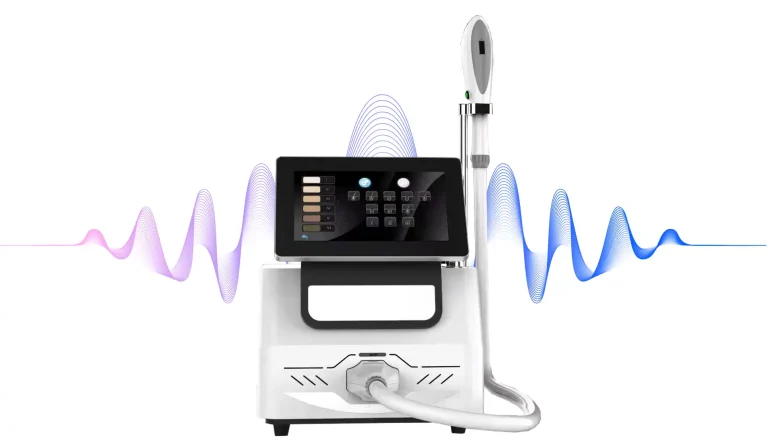
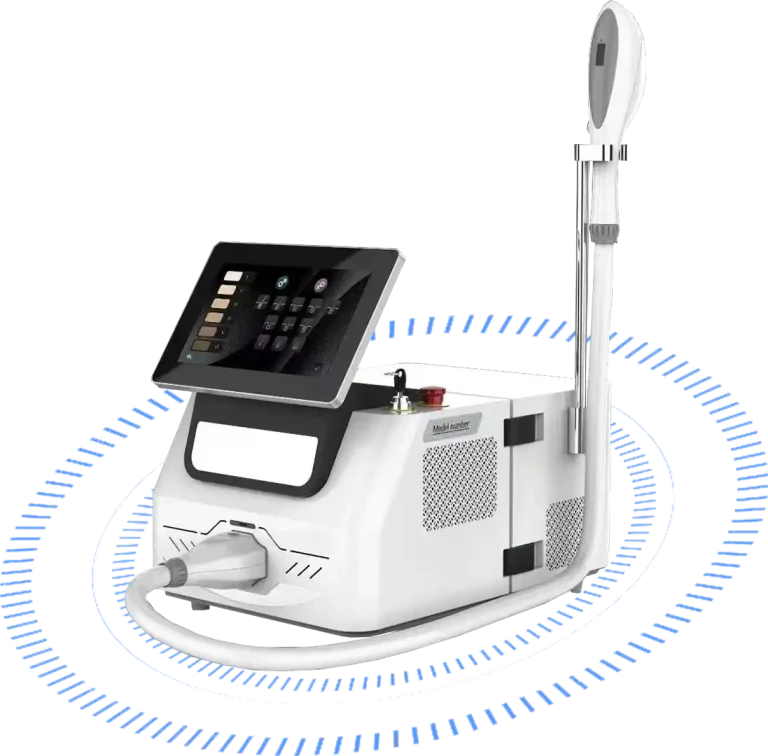
OPT IPL Max+ Multi-Function Aesthetic System
For clinics and distributors evaluating how IPL, OPT, and SHR can be integrated into one professional platform, Cocoon Laser’s OPT IPL Max+ provides a practical example of a multi-function light-based system.
The platform combines optimized IPL pulse delivery with multiple treatment modes and configurable treatment options for professional aesthetic workflows.
- OPT pulse-delivery technology
- SHR hair-reduction capability
- Single-pulse and multi-pulse modes
- Multiple interchangeable optical filters
- Multiple treatment spot sizes
- Professional treatment interface
- Integrated treatment-window cooling
- Designed for professional aesthetic use
Why the Machine Matters More Than the OPT Label
The product example above illustrates an important point: professional equipment should be evaluated as a complete system rather than by one technology acronym.
When comparing two OPT IPL machines, clinics should ask what the term OPT actually means on each platform.
Useful questions include:
- How is the pulse waveform controlled?
- What pulse durations are available?
- Does the system support single and multiple pulse structures?
- What optical filters are available?
- What spectral ranges do those filters provide?
- How stable is the delivered energy between repeated pulses?
- Does output remain stable at higher repetition rates?
- How is the treatment window cooled?
- What treatment modes are actually available?
- What is the expected service life of major consumable components?
- What training and technical support are provided?
- What documentation is available for the intended market?
If a supplier describes OPT only as “newer,” “stronger,” or “more advanced” without explaining how pulse delivery is controlled, the terminology alone provides limited information for a professional purchasing decision.
OPT vs SHR: What’s the Difference?
OPT and SHR are frequently listed together on professional IPL equipment, but they generally describe different aspects of treatment delivery.
OPT generally focuses on pulse control — how optical energy is distributed during a pulse or pulse sequence.
SHR generally focuses on a hair-reduction delivery strategy — commonly using repeated pulses, relatively high repetition rates, in-motion handpiece techniques, and progressive thermal accumulation.
| Feature | OPT | SHR |
|---|---|---|
| General Concept | Optimized pulse delivery | Repeated hair-reduction delivery strategy |
| Underlying Platform | Commonly IPL | Often IPL-based |
| Main Focus | Pulse shape and energy consistency | Progressive thermal accumulation |
| Handpiece Movement | Depends on treatment mode | Often in-motion |
| Repetition Rate | Device-dependent | Often relatively high |
| Typical Application Focus | Multiple IPL applications depending on device | Hair reduction |
An IPL platform can therefore incorporate both OPT-style pulse control and an SHR treatment mode. These terms do not necessarily indicate separate light sources.
Learn more in What Is SHR Hair Removal? How SHR Technology Works.
OPT vs Diode Laser: What’s the Difference?
Unlike OPT vs IPL, comparing OPT with diode laser involves a more fundamental difference in the underlying light source.
OPT is generally implemented within a broad-spectrum IPL platform. A diode laser uses semiconductor laser sources to produce wavelength-specific optical energy.
| Feature | OPT IPL | Diode Laser |
|---|---|---|
| Technology | Intense Pulsed Light with optimized pulse delivery | Semiconductor laser |
| Optical Output | Broad spectrum modified by filters | Specific wavelength or wavelength combination |
| Hair Reduction | Yes, depending on configuration and intended use | Major professional application |
| Photorejuvenation | Common application depending on device | Not usually the primary role of a standard hair-removal diode system |
| Pigmentation Applications | Selected applications depending on filters and device | Depends on wavelength and intended use |
| Vascular Applications | Selected applications depending on spectrum and device | Depends on wavelength and device design |
| Primary Equipment Advantage | Multi-application versatility | Wavelength-specific specialization |
For clinics, the decision is therefore not simply about which technology sounds more advanced.
A clinic focused primarily on high-volume hair reduction may have different equipment priorities from a clinic seeking one light-based platform for hair reduction, photorejuvenation, pigmentation, and selected vascular applications.
Is OPT More Comfortable Than Traditional IPL?
Controlled pulse delivery may contribute to a more predictable treatment experience, particularly when combined with effective cooling.
However, OPT should not automatically be described as painless.
Treatment sensation can depend on:
- Fluence
- Pulse duration
- Pulse structure
- Target chromophore
- Treatment area
- Skin pigmentation
- Cooling performance
- Individual sensitivity
Patients may experience warmth, brief snapping, stinging, or temporary heat during treatment.
A more appropriate claim is that well-controlled energy delivery and effective cooling may support treatment comfort rather than guaranteeing completely painless treatment.
Can OPT IPL Be Used on Different Skin Types?
Skin pigmentation remains an important consideration regardless of whether an IPL platform includes OPT pulse control.
Epidermal melanin can absorb part of the delivered optical energy. This means treatment planning should consider both the intended target and the amount of competing epidermal pigment.
Important factors include:
- Skin phototype
- Baseline pigmentation
- Recent tanning or sun exposure
- Treatment indication
- Optical filter
- Fluence
- Pulse duration
- Cooling
- History of pigmentary response
OPT can improve control over energy delivery, but it does not make every IPL treatment appropriate for every skin type.
OPT IPL for Darker Skin Types
Darker skin requires particularly careful parameter and technology selection because higher epidermal melanin levels can increase competition for optical energy.
The suitability of an OPT IPL system depends on its actual spectral output, available filters, treatment settings, cooling, intended application, and device-specific instructions.
The presence of OPT technology alone does not prove that a machine is appropriate for every darker skin phototype.
For professional hair reduction, clinics may also compare IPL-based OPT or SHR platforms with wavelength-specific technologies such as diode and 1064nm Nd:YAG systems when selecting equipment for their patient population.
OPT IPL Results: What Can Patients Expect?
OPT IPL does not produce one universal type of result because the same underlying platform may be configured for several different aesthetic applications.
Hair Reduction Results
Hair-reduction progress may be evaluated through changes in:
- Hair density
- Hair thickness
- Regrowth speed
- Overall regrowth pattern
Pigmentation Treatment Results
For appropriate superficial pigment targets, treatment response may involve changes in the appearance of selected pigmented areas over time.
Photorejuvenation Results
Depending on the device and indication, IPL photorejuvenation may be used to address selected visible signs of photodamage, uneven-looking skin tone, superficial pigmentation, or redness.
Actual results depend on patient selection, the target condition, filter selection, treatment parameters, device capabilities, and the number of sessions performed.
How Many OPT IPL Treatments Are Needed?
There is no universal treatment number for OPT IPL because treatment schedules vary according to the application.
Factors influencing the number of sessions may include:
- Treatment indication
- Extent of the concern
- Patient characteristics
- Hair-growth cycle when treating unwanted hair
- Pigment or vascular characteristics
- Device capabilities
- Selected treatment parameters
- Response to previous sessions
Hair reduction commonly requires a treatment series because hair follicles are not all in the same growth stage at the same time.
Pigmentation, vascular, and photorejuvenation applications may also involve multiple sessions depending on the treatment objective and response.
Does OPT IPL Have Downtime?
Many IPL-based procedures are associated with relatively limited visible downtime compared with more intensive ablative resurfacing procedures.
However, temporary treatment responses may still include:
- Redness
- Warmth
- Mild swelling
- Temporary sensitivity
- Temporary darkening of selected superficial pigmentation
- Short-term changes around treated vascular targets
Recovery varies according to treatment intensity, application, skin characteristics, and the specific device.
OPT should therefore not be described as universally providing zero downtime.
OPT IPL Side Effects and Risks
Optimized pulse control does not make IPL treatment risk-free.
Potential adverse effects can include:
- Excessive redness
- Swelling
- Skin irritation
- Burns or blistering
- Post-inflammatory hyperpigmentation
- Hypopigmentation
- Other unwanted pigmentary changes
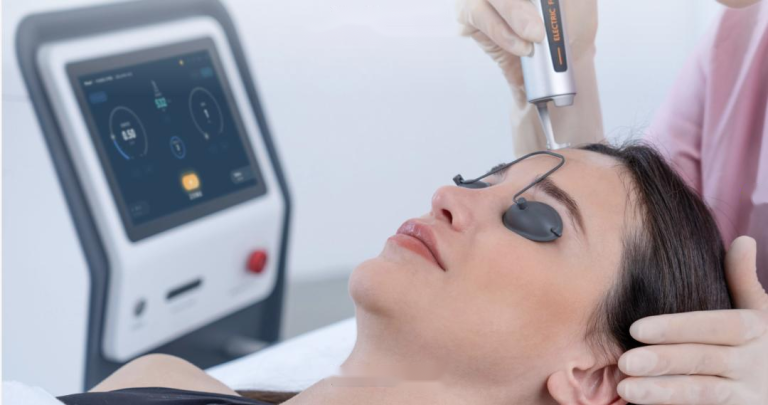
- Eye injury if appropriate eye protection is not used
Risk can be influenced by patient selection, recent sun exposure, inappropriate filters, excessive energy, inadequate cooling, treatment overlap, or incorrect technique.
Qualified operators should follow device-specific instructions, training, safety requirements, and applicable regulations.
IPL vs OPT vs SHR: The Simplest Way to Understand the Difference
The relationship between IPL, OPT, and SHR becomes much easier to understand when each term is assigned to the part of the system it actually describes.
| Technology | What It Describes | Primary Role | Separate Energy Source? |
|---|---|---|---|
| IPL | Intense Pulsed Light | Underlying broad-spectrum optical platform | Yes — the underlying light technology |
| OPT | Optimized pulse delivery | Controls how IPL energy is delivered | Generally no |
| SHR | Repeated hair-reduction delivery strategy | Progressive thermal accumulation, often using in-motion treatment | Generally no when implemented as an IPL mode |
In other words:
IPL provides the light. OPT helps control the pulse. SHR describes one way that light may be delivered for hair reduction.
A modern professional system can therefore incorporate all three concepts within one platform.
Who Should Consider a Professional OPT IPL Platform?
A multi-function OPT IPL platform may be particularly relevant for clinics and medical aesthetic businesses that want to offer several light-based treatment categories without purchasing a separate device for every application.
It may be worth evaluating for:
- Medical aesthetic clinics expanding their light-based treatment menu
- Medical spas offering both hair reduction and photorejuvenation services
- Practices that want interchangeable optical filters for different applications
- Businesses comparing a multi-function IPL platform with a dedicated diode hair-removal system
- Distributors sourcing professional IPL / OPT / SHR equipment
- OEM or ODM partners developing private-label aesthetic equipment portfolios
A clinic focused almost exclusively on one highly specialized indication may instead find that a wavelength-specific laser platform better matches its treatment strategy.
Equipment selection should therefore begin with the clinic’s intended applications, patient population, expected treatment volume, operator workflow, and regulatory requirements.
Frequently Asked Questions About OPT vs IPL
What is the difference between OPT and IPL?
IPL describes broad-spectrum Intense Pulsed Light technology. OPT generally describes an optimized approach to controlling how IPL energy is delivered during a pulse or pulse sequence.
Is OPT better than IPL?
OPT-style pulse control may offer advantages over some conventional IPL systems, but OPT is generally still based on IPL. Actual device performance is more important than the technology label alone.
Is OPT a laser?
No. OPT is commonly associated with IPL, which uses broad-spectrum, non-coherent pulsed light rather than a wavelength-specific laser source.
What does OPT mean in IPL?
OPT is commonly used to describe optimized pulse technology or optimized pulse delivery. Exact terminology and implementation vary among manufacturers.
Does OPT use different wavelengths from IPL?
Not necessarily. OPT generally changes pulse delivery rather than creating a new wavelength category. The delivered spectrum still depends on the underlying IPL light source, optical filters, and device design.
What is the difference between OPT and SHR?
OPT generally focuses on pulse and energy-delivery control. SHR commonly describes a repeated, often in-motion hair-reduction strategy designed around progressive thermal accumulation.
Can one machine have IPL, OPT, and SHR?
Yes. A professional IPL platform may incorporate optimized pulse-control features and an SHR treatment mode. This does not necessarily mean that the system contains three independent light sources.
Is OPT IPL good for hair removal?
OPT IPL systems may support professional hair reduction when the spectral range, filters, pulse parameters, cooling, treatment protocol, and patient characteristics are appropriate.
Can OPT IPL be used for pigmentation?
Some OPT IPL systems may be used for selected superficial pigmentation depending on their spectrum, filters, intended use, and treatment parameters. Not every pigmentary condition is appropriate for IPL.
Can OPT IPL be used for skin rejuvenation?
Depending on the system and intended use, IPL may be used for selected photorejuvenation applications involving visible photodamage, superficial pigmentation, redness, or uneven-looking skin tone.
Is OPT IPL suitable for all skin types?
No universal suitability claim should be made. Skin pigmentation, treatment indication, spectrum, filter selection, parameters, cooling, and device-specific instructions all influence treatment suitability.
Is OPT safer than traditional IPL?
Improved pulse control may support more predictable energy delivery, but safety still depends on the complete system, patient selection, parameters, cooling, operator technique, and appropriate eye protection.
What should clinics compare when buying an OPT IPL machine?
Clinics should compare spectral output, filters, pulse architecture, pulse duration, fluence, energy stability, repetition rate, spot size, cooling, handpiece design, operating costs, training, technical support, warranty, and applicable regulatory documentation.
Final Verdict: OPT vs IPL
OPT and IPL are not two completely separate aesthetic light technologies.
IPL is the underlying broad-spectrum pulsed light platform. OPT generally describes an approach intended to optimize how that IPL energy is controlled during a pulse or pulse sequence.
Depending on the platform, optimized pulse control may improve energy consistency, waveform control, parameter flexibility, and treatment reproducibility.
However, OPT does not transform IPL into a laser, create a new wavelength, guarantee better clinical results, or automatically make one machine superior to another.
For patients and treatment providers, the relevant factors remain the target condition, skin characteristics, filter selection, treatment parameters, cooling, device quality, and professional assessment.
For clinics and equipment buyers, the most meaningful comparison goes beyond the OPT vs IPL label.
Compare the actual spectral output, filters, pulse architecture, energy stability, treatment modes, cooling, handpiece design, workflow, operating costs, training, technical support, warranty, and regulatory documentation of the specific system.
The simplest technical relationship is: IPL is the light platform, OPT generally describes pulse optimization, and SHR commonly describes a repeated hair-reduction delivery strategy.
Editorial & Technical Review: This article was prepared for the Cocoon Laser professional aesthetic technology knowledge center for educational and equipment-research purposes. It does not replace individual medical assessment. Technology terminology and implementation may vary among manufacturers. Treatment suitability, parameters, contraindications, expected outcomes, recovery, and adverse-event risks vary by patient and device. Qualified professionals should follow the intended use, device instructions, operator training requirements, eye-protection procedures, and applicable regulations for the specific IPL or OPT system.