
How Does a Picosecond Laser Work?
Quick Answer
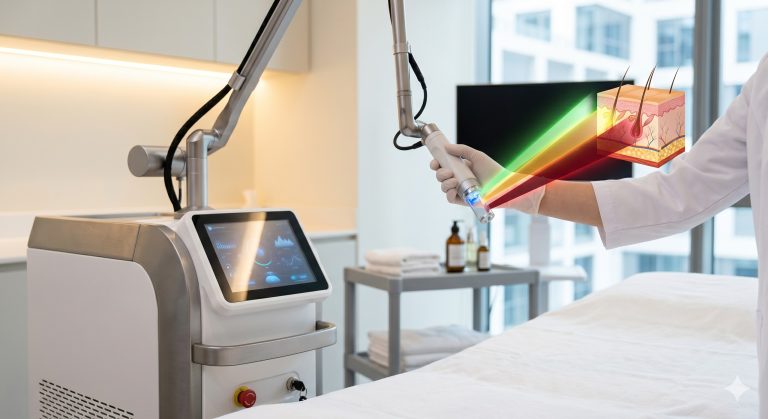
A picosecond laser works by delivering extremely short laser pulses measured in picoseconds (one trillionth of a second). These ultra-fast pulses create a high peak energy effect that targets pigments through a process known as the photomechanical effect.
Unlike traditional laser systems that primarily rely on heat-based photothermal effects, picosecond lasers generate powerful mechanical pressure waves that break pigment particles into smaller fragments. These smaller particles can then be naturally cleared by the body’s immune system.
The effectiveness of a picosecond laser depends on several factors, including pulse duration, wavelength, energy level, spot size, and cooling technology.
What Is the Working Principle of a Picosecond Laser?
The working principle of a picosecond laser is based on delivering laser energy within extremely short pulse durations.
A picosecond equals one trillionth of a second:
- 1 picosecond = 0.000000000001 seconds
By compressing laser energy into such a short time period, picosecond lasers can produce very high peak power while reducing unnecessary thermal diffusion into surrounding tissue.
The basic process includes:
- The laser system generates a high-energy pulse.
- The selected wavelength targets specific pigments.
- Energy is absorbed by the target pigment.
- Rapid energy delivery creates a photomechanical effect.
- Pigment particles are fragmented into smaller particles.
- The body gradually removes the fragmented particles.
Learn more: What Is a Picosecond Laser?
How Picosecond Laser Pulse Technology Works
The most important difference between picosecond lasers and conventional laser systems is pulse duration.
Traditional laser systems may deliver energy over longer pulse durations, allowing more heat to spread into surrounding areas.
Picosecond lasers deliver energy much faster, creating a highly concentrated energy release.
| Technology | Pulse Duration | Main Effect |
|---|---|---|
| Traditional Laser | Longer pulse duration | Mainly thermal effect |
| Q-Switched Laser | Nanosecond pulses | Photothermal + mechanical effects |
| Picosecond Laser | Picosecond pulses | Strong photomechanical effect |
This ultra-short pulse technology allows picosecond lasers to achieve precise pigment targeting while improving treatment efficiency for many aesthetic applications.
Understanding Picosecond Pulse Duration
Pulse duration describes how long laser energy is delivered during each laser shot.
The shorter the pulse duration, the faster energy is delivered to the target.
In picosecond laser systems, extremely short pulses create a rapid expansion effect inside pigment particles.
This process produces:
- High peak power
- Rapid pigment fragmentation
- Reduced heat accumulation
- More precise energy delivery
This is one of the key reasons why picosecond laser technology has become widely used in advanced aesthetic applications.
Photomechanical Effect: The Core Technology Behind Picosecond Lasers
The photomechanical effect is the fundamental mechanism that makes picosecond laser technology different from many traditional laser systems.
Instead of relying primarily on heat generation, picosecond lasers deliver energy so quickly that they create a mechanical disruption effect inside targeted pigment particles.
This rapid energy delivery produces:
- Extremely high peak power
- Rapid expansion inside pigment particles
- Acoustic pressure waves
- Pigment fragmentation
The photomechanical effect allows picosecond lasers to break pigment into much smaller particles while limiting unnecessary thermal impact on surrounding tissue.
How Does a Picosecond Laser Break Down Pigment Particles?
During a picosecond laser treatment, laser energy is absorbed by targeted pigment particles.
Because the energy is delivered within picosecond-level pulses, the pigment experiences rapid energy absorption before significant heat diffusion occurs.
The process can be divided into several stages:
Step 1: Laser Energy Delivery
The picosecond laser emits a controlled pulse at a selected wavelength, such as 532nm, 755nm, or 1064nm.
The wavelength is selected according to the target pigment characteristics.
Related: Picosecond Laser Wavelengths Explained: 532nm vs 755nm vs 1064nm
Step 2: Pigment Absorption
The target pigment absorbs the laser energy based on its optical absorption characteristics.
Different pigments respond differently to different wavelengths, which is why professional systems often use multiple wavelength configurations.
Step 3: Rapid Expansion and Fragmentation
The absorbed energy creates rapid expansion within the pigment particles.
This generates mechanical stress that breaks larger pigment particles into smaller fragments.
Step 4: Natural Clearance Process
After fragmentation, the body gradually removes the smaller pigment particles through natural biological processes.
This process allows progressive improvement over multiple treatment sessions.
Why Does Picosecond Technology Improve Laser Precision?
The main advantage of picosecond technology comes from its ability to deliver energy in an extremely short period of time.
Short pulse duration helps achieve:
- More concentrated energy delivery
- Higher peak power
- Reduced unnecessary heat diffusion
- Precise interaction with pigment targets
This precision makes picosecond lasers suitable for applications requiring controlled pigment disruption.
Picosecond Laser vs Q-Switched Laser: Technology Difference
Q-switched lasers were historically one of the most common technologies used for tattoo removal and pigment treatments.
Picosecond lasers represent a newer generation of laser technology by reducing pulse duration from nanoseconds to picoseconds.
| Feature | Q-Switched Laser | Picosecond Laser |
|---|---|---|
| Pulse Duration | Nanosecond range | Picosecond range |
| Energy Delivery | Longer pulse energy release | Ultra-short high peak power pulses |
| Primary Effect | Photothermal and mechanical effects | Strong photomechanical effect |
| Pigment Fragmentation | Larger pigment particles | Smaller pigment particles |
| Technology Generation | Traditional pigment laser technology | Advanced ultra-short pulse technology |
The shorter pulse duration of picosecond lasers allows more efficient energy delivery and improved control for many pigment-related applications.
Learn more: Picosecond Laser vs Q-Switched Laser
The Relationship Between Pulse Duration and Treatment Performance
Pulse duration is one of the most important technical specifications of a professional picosecond laser system.
A shorter pulse duration allows laser energy to interact with pigment targets faster than heat can spread to surrounding areas.
This principle is related to the concept of selective photothermolysis, where laser parameters are selected to target specific structures while minimizing effects on surrounding tissue.
Related technology: What Is Selective Photothermolysis?
The Role of Laser Wavelength in Picosecond Laser Operation
Although pulse duration is the defining feature of picosecond laser technology, wavelength selection determines how laser energy interacts with different targets.
A professional picosecond laser system combines ultra-short pulse technology with specific wavelengths to achieve targeted energy delivery.
The most common wavelengths used in professional picosecond lasers include:
- 532nm wavelength
- 755nm wavelength
- 1064nm wavelength
532nm Wavelength Operation
The 532nm wavelength is commonly selected for pigments that have strong absorption characteristics in the visible light range.
It is frequently used for:
- Red tattoo pigments
- Warm-color pigments
- Selected superficial pigmentation applications
755nm Wavelength Operation
The 755nm wavelength provides additional treatment flexibility for advanced picosecond laser platforms.
It is often included in multi-wavelength systems because it provides different absorption characteristics compared with 532nm and 1064nm.
1064nm Wavelength Operation
The 1064nm wavelength is widely used in professional pigment laser systems because of its deeper penetration characteristics.
Common applications include:
- Black tattoo pigment removal
- Dark pigment treatment
- Deeper target applications
By combining different wavelengths, professional picosecond lasers can provide broader treatment capability.
Learn more: Picosecond Laser Wavelengths Explained
The Role of Cooling Systems in Picosecond Laser Performance
Cooling technology is an important supporting component of professional picosecond laser systems.
Although picosecond lasers deliver energy in extremely short pulses, effective thermal management is still necessary to maintain stable system performance.
A professional cooling system helps:
- Maintain stable laser operation
- Manage heat generated by internal components
- Improve treatment comfort
- Support long-term equipment reliability
Modern picosecond laser platforms may integrate different cooling technologies, including air cooling and advanced thermal management systems.
Related: Professional Laser Cooling Technology
Complete Picosecond Laser Energy Delivery Process
A professional picosecond laser system involves multiple engineering components working together to deliver precise laser energy.
The complete process can be divided into several stages.
Stage 1: Laser Energy Generation
The laser source generates high-energy pulses within picosecond-level durations.
The system controls:
- Pulse duration
- Energy output
- Repetition rate
These parameters determine how laser energy interacts with the treatment target.
Stage 2: Optical Energy Transmission
The generated laser energy travels through the optical system and is delivered through the treatment handpiece.
Professional systems are designed to maintain stable energy transmission throughout the optical pathway.
Stage 3: Wavelength Selection
The operator selects the appropriate wavelength according to the treatment objective.
Different wavelengths provide different interactions with pigments and tissue targets.
Stage 4: Laser Pulse Delivery
The handpiece delivers controlled picosecond pulses to the target area.
The ultra-short pulse creates a photomechanical effect that fragments targeted pigment particles.
Stage 5: Biological Clearance
After pigment fragmentation, smaller particles are gradually processed and removed through natural biological mechanisms.
Key Components Inside a Professional Picosecond Laser System
A professional picosecond laser is a complete engineering platform consisting of multiple integrated components.
| Component | Function |
|---|---|
| Laser Source | Generates ultra-short laser pulses |
| Optical System | Controls laser transmission and delivery |
| Handpiece | Delivers laser energy to the treatment area |
| Cooling System | Supports thermal management |
| Control Interface | Adjusts treatment parameters |
Understanding these components helps clinics evaluate professional picosecond laser equipment beyond basic specifications.
Why Picosecond Laser Technology Is Considered an Advanced Laser Platform
Picosecond laser technology represents a major development in aesthetic laser systems because it combines:
- Ultra-short pulse duration
- High peak power
- Multiple wavelength options
- Advanced energy control
- Integrated cooling technology
This combination allows professional systems to support a wide range of aesthetic applications, including tattoo removal, pigmentation treatment, and skin rejuvenation procedures.
Applications Based on Picosecond Laser Technology
The advanced pulse technology of picosecond lasers allows them to support a wide range of professional aesthetic applications.
By combining ultra-short pulse duration, precise wavelength selection, and controlled energy delivery, picosecond laser systems can be used for different pigment and skin-related treatments.
Picosecond Laser Tattoo Removal
Tattoo removal is one of the most recognized applications of picosecond laser technology.
During tattoo removal, the laser targets tattoo pigments and creates rapid fragmentation through the photomechanical effect.
Different wavelengths may be selected depending on tattoo color and pigment characteristics.
Common wavelength combinations include:
- 1064nm for black and dark pigments
- 532nm for selected red and warm-color pigments
- 755nm for specific pigment applications
Learn more: Picosecond Laser Tattoo Removal Technology
Picosecond Laser Pigmentation Treatment
Picosecond lasers are also used in professional pigmentation treatments because of their ability to deliver controlled energy to pigment targets.
Applications may include:
- Pigment correction procedures
- Selected epidermal pigmentation treatments
- Advanced aesthetic skin applications
The choice of wavelength and treatment parameters depends on the specific target and clinical requirements.
Picosecond Laser Skin Rejuvenation Applications
Some professional picosecond laser systems include treatment modes designed for skin rejuvenation applications.
These applications utilize controlled laser energy delivery to support aesthetic skin improvement procedures.
The exact applications depend on the device configuration and treatment protocols.
Picosecond Laser Technology Compared With Traditional Laser Systems
Picosecond lasers represent an evolution of laser technology by reducing pulse duration and increasing energy delivery precision.
| Feature | Traditional Laser | Picosecond Laser |
|---|---|---|
| Pulse Duration | Longer pulses | Picosecond-level pulses |
| Energy Delivery | More thermal energy distribution | Ultra-short high peak power delivery |
| Primary Interaction | Thermal effect | Photomechanical effect |
| Pigment Fragmentation | Traditional pigment disruption | Advanced pigment fragmentation |
The main technological advantage of picosecond lasers is the ability to deliver energy extremely quickly, creating precise interactions with targeted structures.
Why Professional Clinics Choose Picosecond Laser Technology
Professional clinics evaluate laser platforms based on more than just laser power. The complete system design determines long-term performance and application flexibility.
Important advantages of professional picosecond laser systems include:
- Advanced ultra-short pulse technology
- Multiple wavelength options
- Precise energy control
- Flexible treatment applications
- Modern operating systems
- Professional cooling solutions
For clinics and distributors, a reliable picosecond laser platform can provide opportunities to expand aesthetic treatment services.
Explore: Professional Picosecond Laser Machine Buying Guide
Frequently Asked Questions About How Picosecond Lasers Work
How does a picosecond laser work?
A picosecond laser works by delivering laser energy in ultra-short pulses measured in trillionths of a second. The rapid energy delivery creates a photomechanical effect that fragments targeted pigment particles.
What is the photomechanical effect in picosecond lasers?
The photomechanical effect occurs when ultra-short laser pulses create rapid expansion and mechanical stress inside pigment particles, causing them to break into smaller fragments.
Why are picosecond laser pulses so short?
Picosecond pulses allow laser energy to be delivered extremely quickly, creating high peak power while reducing unnecessary heat diffusion into surrounding areas.
What is the difference between picosecond and nanosecond lasers?
The main difference is pulse duration. Picosecond lasers operate in trillionths of a second, while nanosecond lasers operate in billionths of a second.
The shorter pulse duration allows picosecond lasers to create stronger photomechanical interactions.
How does wavelength affect picosecond laser performance?
Wavelength determines how laser energy interacts with different pigments and targets. Common professional wavelengths include 532nm, 755nm, and 1064nm.
Do picosecond lasers use cooling systems?
Yes. Professional picosecond lasers use cooling technologies to support stable operation, manage heat, and improve treatment comfort.
What components are inside a professional picosecond laser?
A professional picosecond laser system typically includes:
- Laser source
- Optical system
- Control interface
- Treatment handpiece
- Cooling system
Final Verdict: Understanding How Picosecond Lasers Work
Picosecond laser technology works by combining ultra-short pulse duration, precise wavelength selection, and advanced energy control to create highly targeted laser interactions.
The core mechanism behind picosecond lasers is the photomechanical effect, where extremely rapid energy delivery creates pigment fragmentation while limiting unnecessary thermal diffusion.
A complete professional picosecond laser system depends on multiple technologies working together:
- Ultra-short pulse generation
- Wavelength selection
- Optical delivery
- Cooling technology
- Intelligent control systems
Understanding how picosecond lasers work helps clinics, distributors, and aesthetic professionals evaluate equipment more effectively and select the right technology for their applications.
Explore professional picosecond laser solutions: Professional Picosecond Laser Systems