Picosecond Laser Wavelengths Explained: 532nm vs 755nm vs 1064nm
Quick Answer
Picosecond laser wavelengths determine how laser energy interacts with different pigments and treatment targets. The most common wavelengths used in professional picosecond laser systems are 532nm, 755nm, and 1064nm.
The 1064nm wavelength is commonly used for darker tattoo pigments and deeper targets, while 532nm is often selected for red and warm-colored pigments. The 755nm wavelength provides additional pigment absorption characteristics and is widely used in advanced picosecond laser platforms.
Professional clinics often choose multi-wavelength picosecond laser systems because different wavelengths provide greater flexibility for tattoo removal, pigmentation treatment, and aesthetic applications.

What Are Picosecond Laser Wavelengths?
A laser wavelength refers to the specific length of electromagnetic radiation produced by a laser system. Different wavelengths interact with tissues and pigments differently because materials absorb light energy according to their optical properties.
In aesthetic laser treatments, wavelength selection is one of the most important factors affecting:
- Target pigment absorption
- Treatment depth
- Application suitability
- Energy delivery characteristics
Picosecond lasers combine ultra-short pulse duration with specific wavelengths to achieve precise interactions with tattoo pigments and other aesthetic targets.
Learn more: What Is a Picosecond Laser?
Why Do Picosecond Lasers Use Multiple Wavelengths?
Different pigments absorb different wavelengths of laser energy. A single wavelength cannot effectively target every pigment color or treatment requirement.
For example:
- Dark pigments generally respond well to 1064nm wavelength
- Red and some warm pigments may respond to 532nm wavelength
- Certain pigment applications may benefit from 755nm wavelength
This is why professional picosecond laser platforms often include multiple wavelength configurations.
A multi-wavelength system allows clinics to expand treatment capabilities while using one platform for different aesthetic applications.
532nm Picosecond Laser: Applications and Benefits
The 532nm wavelength is a frequency-doubled wavelength commonly used in professional pigment laser systems.
Because shorter wavelengths have higher absorption characteristics for certain pigments, 532nm is often used for superficial pigment targets and selected tattoo colors.
Common Applications of 532nm Picosecond Laser
- Red tattoo pigment treatment
- Orange and warm-color pigments
- Certain superficial pigmentation applications
In tattoo removal applications, 532nm wavelength is commonly combined with other wavelengths to address different ink colors within the same treatment plan.
755nm Picosecond Laser: Applications and Benefits
The 755nm wavelength provides another option for advanced picosecond laser systems, particularly for specific pigment absorption characteristics.
755nm wavelength is commonly associated with:
- Certain tattoo pigment applications
- Advanced pigmentation treatments
- Professional multi-wavelength laser platforms
Because wavelength selection depends on pigment characteristics and treatment goals, 755nm is often used as part of a broader multi-wavelength approach.
1064nm Picosecond Laser: Applications and Benefits
The 1064nm wavelength is one of the most widely used wavelengths in professional tattoo removal laser systems.
Its longer wavelength allows deeper penetration compared with shorter wavelengths, making it commonly selected for darker pigments and deeper targets.
Common Applications of 1064nm Picosecond Laser
- Black tattoo pigment removal
- Dark blue tattoo pigment treatment
- Deeper pigment targeting
Many professional picosecond laser systems combine 1064nm with 532nm to provide broader tattoo removal capability.
Related article: Picosecond Laser Tattoo Removal Technology
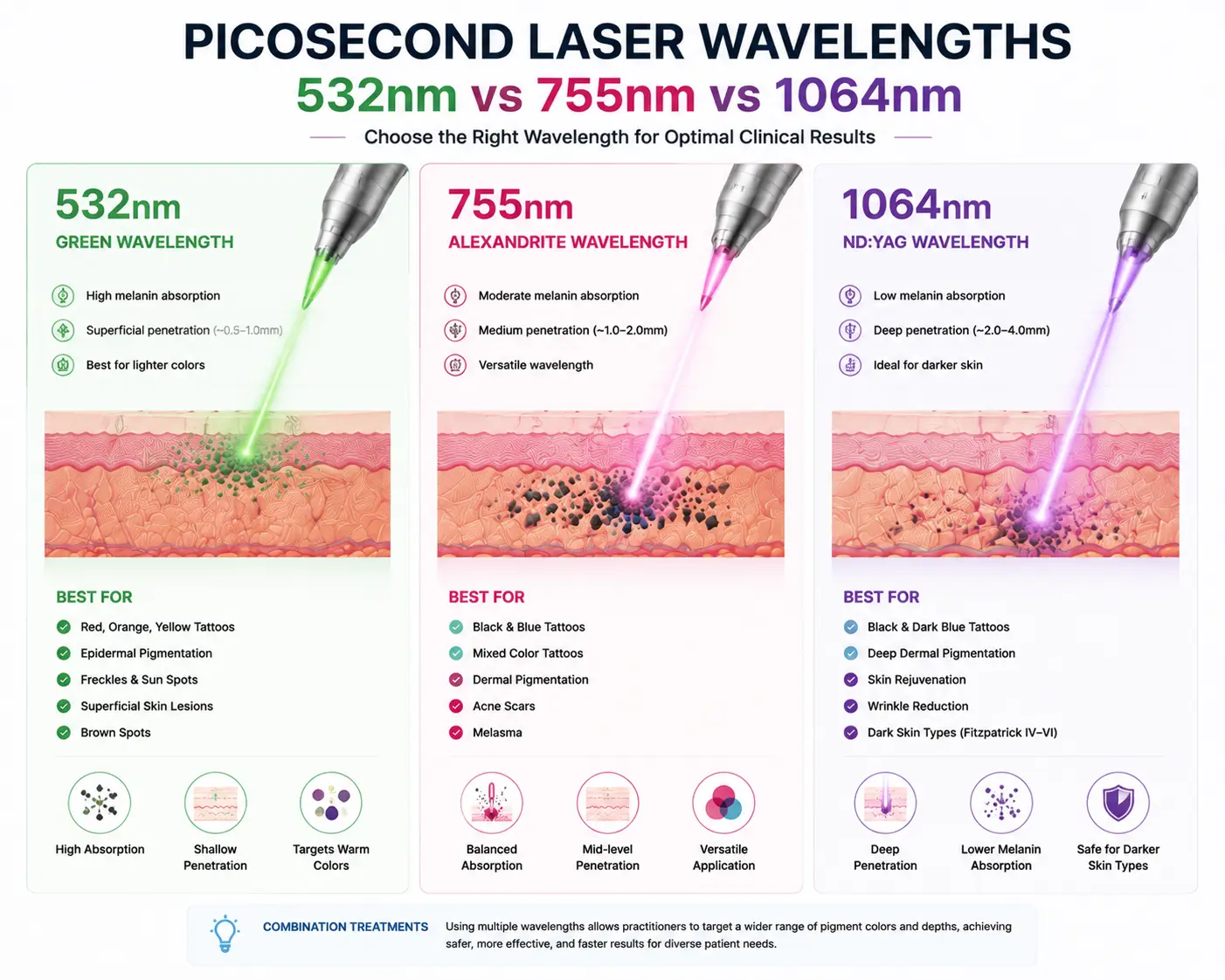
532nm vs 755nm vs 1064nm Picosecond Laser: Key Differences
The three most common wavelengths used in professional picosecond laser systems are 532nm, 755nm, and 1064nm. Each wavelength has different absorption characteristics and treatment applications.
Choosing the correct wavelength depends on factors such as pigment color, pigment depth, skin characteristics, and treatment objectives.
| Feature | 532nm | 755nm | 1064nm |
|---|---|---|---|
| Wavelength Range | Visible green light | Near-infrared light | Near-infrared light |
| Common Application | Superficial pigments and selected tattoo colors | Specific pigment applications | Deep pigment and dark tattoo removal |
| Typical Tattoo Colors | Red, orange, warm pigments | Selected green and blue pigments | Black, dark blue pigments |
| Penetration Depth | Relatively superficial | Medium penetration | Deeper penetration |
| Professional Use | Usually combined with other wavelengths | Often available in advanced systems | One of the most common tattoo wavelengths |
How Does Wavelength Affect Picosecond Laser Treatment?
Laser wavelength determines how deeply laser energy can travel and how effectively it is absorbed by different pigments.
This relationship between wavelength and pigment absorption is one of the most important principles in professional laser treatment.
Shorter Wavelengths
Shorter wavelengths, such as 532nm, generally have stronger absorption by certain pigments and are commonly used for superficial targets.
However, shorter wavelengths typically have less penetration depth compared with longer wavelengths.
Longer Wavelengths
Longer wavelengths, such as 1064nm, penetrate deeper into tissue and are commonly selected for darker pigments located at greater depths.
This makes 1064nm an important wavelength in professional tattoo removal systems.
Picosecond Laser Wavelengths for Tattoo Removal
Tattoo removal is one of the most common applications where wavelength selection becomes critical.
Different tattoo inks contain different pigments, and each pigment has different light absorption characteristics.
| Tattoo Color | Common Picosecond Laser Wavelength |
|---|---|
| Black Ink | 1064nm |
| Dark Blue Ink | 1064nm |
| Red Ink | 532nm |
| Orange Ink | 532nm |
| Green / Blue Pigments | 755nm or other specialized wavelengths |
Because modern tattoos often contain multiple colors, professional clinics commonly prefer multi-wavelength picosecond laser platforms.
A multi-wavelength system allows operators to select different wavelengths based on pigment characteristics instead of relying on a single laser wavelength.
532nm vs 1064nm Picosecond Laser: Which Is Better?
A common question in professional tattoo removal is whether 532nm or 1064nm is the better wavelength.
The answer depends on the tattoo pigment being treated.
When 532nm Is Preferred
532nm is commonly selected for:
- Red pigments
- Orange pigments
- Certain superficial pigment conditions
When 1064nm Is Preferred
1064nm is commonly selected for:
- Black tattoo ink
- Dark blue pigments
- Deeper pigment targets
Professional picosecond laser systems often combine both wavelengths because tattoo removal frequently involves multiple pigment colors.
Why Multi-Wavelength Picosecond Lasers Are Important for Clinics
For professional aesthetic clinics, a multi-wavelength picosecond laser system provides greater treatment flexibility compared with a single-wavelength platform.
Benefits include:
- Ability to treat different tattoo colors
- Broader pigmentation applications
- More flexible treatment planning
- Support for different patient requirements
For clinics and distributors evaluating professional laser equipment, wavelength configuration is one of the key factors to consider.
Related: Picosecond Laser vs Q-Switched Laser Technology Comparison
Picosecond Laser Wavelengths for Pigmentation Treatment
Besides tattoo removal, picosecond lasers are also widely used for pigmentation-related aesthetic applications. The selected wavelength determines how laser energy interacts with different pigment targets.
Professional practitioners consider wavelength selection based on:
- Pigment type
- Pigment depth
- Treatment area
- Skin characteristics
- Desired treatment goals
532nm Picosecond Laser for Pigmentation
The 532nm wavelength is commonly used for superficial pigment applications because many surface-level pigment targets have strong absorption characteristics at this wavelength.
Professional applications may include:
- Epidermal pigmentation treatment
- Certain sun-related pigmentation concerns
- Selected superficial pigment lesions
Because 532nm has a shorter wavelength, treatment parameters must be carefully selected according to patient characteristics and clinical requirements.
755nm Picosecond Laser for Advanced Pigment Applications
The 755nm wavelength provides a balance between absorption characteristics and penetration depth, making it an important option in advanced picosecond laser platforms.
755nm technology is commonly considered for:
- Specific tattoo pigment applications
- Complex pigment conditions
- Advanced aesthetic laser treatments
The availability of 755nm wavelength allows professional systems to provide more flexibility compared with platforms limited to only 532nm and 1064nm.
1064nm Picosecond Laser for Deeper Pigmentation
The 1064nm wavelength provides deeper penetration and is widely used for targets located below the superficial skin layers.
Professional applications include:
- Deep pigmentation treatment
- Dark tattoo pigment removal
- Selected skin rejuvenation procedures
Because of its penetration characteristics, 1064nm is one of the most important wavelengths in modern professional picosecond laser systems.
How Professional Clinics Select Picosecond Laser Wavelengths
Choosing the correct wavelength is not simply about selecting the strongest laser setting. Professional treatment requires matching wavelength characteristics with the specific target.
Clinics typically consider several factors:
1. Target Pigment Characteristics
Different pigments absorb different wavelengths. The correct wavelength helps maximize energy absorption by the target while reducing unnecessary energy exposure.
2. Treatment Depth
Shorter wavelengths are generally associated with more superficial applications, while longer wavelengths can reach deeper targets.
This is why 532nm and 1064nm are often combined in professional systems.
3. Multi-Wavelength Capability
A professional multi-wavelength picosecond laser system provides greater flexibility compared with a single-wavelength device.
Advantages include:
- Treatment of multiple tattoo colors
- Broader pigmentation applications
- More adaptable clinical protocols
- Higher equipment versatility
Single-Wavelength vs Multi-Wavelength Picosecond Lasers
| Feature | Single-Wavelength System | Multi-Wavelength System |
|---|---|---|
| Treatment Range | Limited applications | Broader treatment capability |
| Tattoo Color Flexibility | More limited | Suitable for multiple pigment colors |
| Clinic Applications | Specific treatments | Tattoo, pigmentation, rejuvenation |
| Investment Value | Lower initial cost | Higher versatility |
For clinics and distributors, multi-wavelength picosecond laser systems are often preferred because they provide broader service capabilities from a single platform.
Important Specifications When Evaluating Picosecond Laser Wavelengths
Wavelength configuration is only one part of a professional picosecond laser system. Buyers should also evaluate other technical specifications.
| Specification | Why It Matters |
|---|---|
| Pulse Duration | Determines ultra-short pulse performance |
| Energy Output | Influences treatment capability |
| Spot Size Options | Supports different treatment areas |
| Cooling System | Improves comfort and system stability |
| Wavelength Configuration | Determines application flexibility |
Related technology: Professional Laser Cooling Technology
Why Professional Picosecond Laser Systems Use 532nm, 755nm and 1064nm
The combination of 532nm, 755nm, and 1064nm wavelengths allows professional picosecond laser platforms to address a wider range of aesthetic applications.
Rather than relying on one wavelength, advanced systems provide multiple options to match different treatment requirements.
This flexibility is one of the reasons why multi-wavelength picosecond laser technology has become increasingly important in modern aesthetic clinics.
For professional equipment buyers, wavelength configuration should be considered together with system reliability, cooling technology, manufacturer support, and long-term application potential.
Frequently Asked Questions About Picosecond Laser Wavelengths
What wavelength is best for tattoo removal?
The best wavelength for tattoo removal depends on the tattoo pigment color, ink composition, and pigment depth.
Professional picosecond laser systems commonly use multiple wavelengths, including 532nm, 755nm, and 1064nm, because different tattoo colors respond differently to laser energy.
For example, 1064nm is commonly used for black and dark pigments, while 532nm is often selected for red and warm-colored pigments.
Is 1064nm better than 532nm for tattoo removal?
Neither wavelength is universally better because they target different pigment characteristics.
1064nm is commonly preferred for darker tattoo pigments because of its deeper penetration, while 532nm is often used for selected lighter or warm-color pigments.
Professional tattoo removal systems frequently combine both wavelengths to provide broader treatment flexibility.
What is a 755nm picosecond laser used for?
A 755nm picosecond laser wavelength is used in advanced aesthetic laser systems for selected pigment applications and tattoo colors that may benefit from its absorption characteristics.
Because 755nm provides different optical properties compared with 532nm and 1064nm, it can expand the treatment capability of multi-wavelength picosecond platforms.
Why do professional picosecond lasers use multiple wavelengths?
Professional picosecond lasers use multiple wavelengths because different pigments absorb laser energy differently.
A multi-wavelength system allows clinics to select the most suitable wavelength based on:
- Tattoo pigment color
- Treatment depth
- Skin characteristics
- Clinical objectives
Can one picosecond laser wavelength treat all tattoo colors?
A single wavelength cannot effectively target every tattoo color. Different pigments have different absorption characteristics, which is why professional systems often include multiple wavelengths.
A multi-wavelength picosecond laser provides greater flexibility for complex tattoo removal procedures.
What is the difference between 532nm and 1064nm laser wavelengths?
The main difference between 532nm and 1064nm is their interaction with pigments and penetration characteristics.
- 532nm: commonly used for selected superficial pigments and warm-color tattoo inks
- 1064nm: commonly used for darker pigments and deeper targets
Are picosecond laser wavelengths important for pigmentation treatments?
Yes. Wavelength selection is an important factor in pigmentation treatments because different pigment targets absorb different wavelengths.
Professional practitioners select wavelengths according to the specific treatment goal and patient requirements.
What wavelengths are available in professional picosecond laser machines?
Professional picosecond laser machines commonly offer combinations such as:
- 532nm
- 755nm
- 1064nm
The exact configuration depends on the laser platform and manufacturer design.
How to Choose a Professional Picosecond Laser With the Right Wavelength Configuration
For clinics, distributors, and OEM partners, wavelength configuration should be evaluated as part of the complete laser system rather than as an isolated specification.
Important considerations include:
- Available wavelengths
- Energy stability
- Pulse duration
- Cooling system performance
- Handpiece design
- Manufacturer support
A professional multi-wavelength picosecond laser platform provides greater flexibility for clinics offering tattoo removal, pigmentation treatments, and advanced aesthetic procedures.
Learn more: Professional Picosecond Laser Machine Buying Guide
Final Verdict: Understanding Picosecond Laser Wavelengths
Picosecond laser wavelength selection plays a critical role in professional aesthetic treatments. While pulse duration determines how laser energy is delivered, wavelength determines how that energy interacts with different pigments and targets.
The three most common professional picosecond laser wavelengths — 532nm, 755nm, and 1064nm — each provide unique advantages:
| Wavelength | Main Advantage |
|---|---|
| 532nm | Suitable for selected superficial pigments and warm-color tattoo inks |
| 755nm | Provides additional flexibility for advanced pigment applications |
| 1064nm | Effective for deeper targets and dark tattoo pigments |
For modern aesthetic clinics, multi-wavelength picosecond laser systems provide broader treatment possibilities compared with single-wavelength platforms.
When selecting professional laser equipment, wavelength configuration should be considered together with pulse technology, cooling performance, system reliability, and manufacturer expertise.
Explore professional picosecond laser solutions: Professional Picosecond Laser Systems