Laser Hair Removal for Men: Cost, Pain & Results (2026)
Evidence-informed education about men’s laser hair removal, costs, comfort, results and safety.
Published by Cocoon Laser · Professional aesthetic equipment supplier
Laser hair removal for men can reduce unwanted hair on the back, chest, shoulders, neck, face, underarms and other suitable body areas. For men who are tired of frequent shaving, razor bumps or repeated waxing, professional laser treatment may provide longer-lasting hair reduction.
However, laser hair removal is not a one-session solution. Coarse hair, dense growth patterns, skin tone, treatment area and hormonal influences can all affect how many appointments are needed and how much hair remains afterward.
This guide explains which areas men commonly treat, how much treatments may cost, what the procedure feels like, how many sessions are typically required, and what realistic long-term results look like.
Quick Answer: Does Laser Hair Removal Work for Men?
Yes. Laser hair removal can work for men by using concentrated light to target pigment in hair follicles and reduce future hair growth. It is commonly used on the back, chest, shoulders, underarms, neck and selected facial areas.
Many treatment plans involve approximately 6–8 sessions, although facial and hormonally influenced hair may require a different schedule or ongoing maintenance. Sessions are spaced according to the treatment area, hair growth and clinical response.
The procedure may feel like a brief snapping or stinging sensation. Costs vary substantially by body area and location. Laser treatment aims for long-term hair reduction, not guaranteed permanent removal of every hair.
What Is Laser Hair Removal for Men?
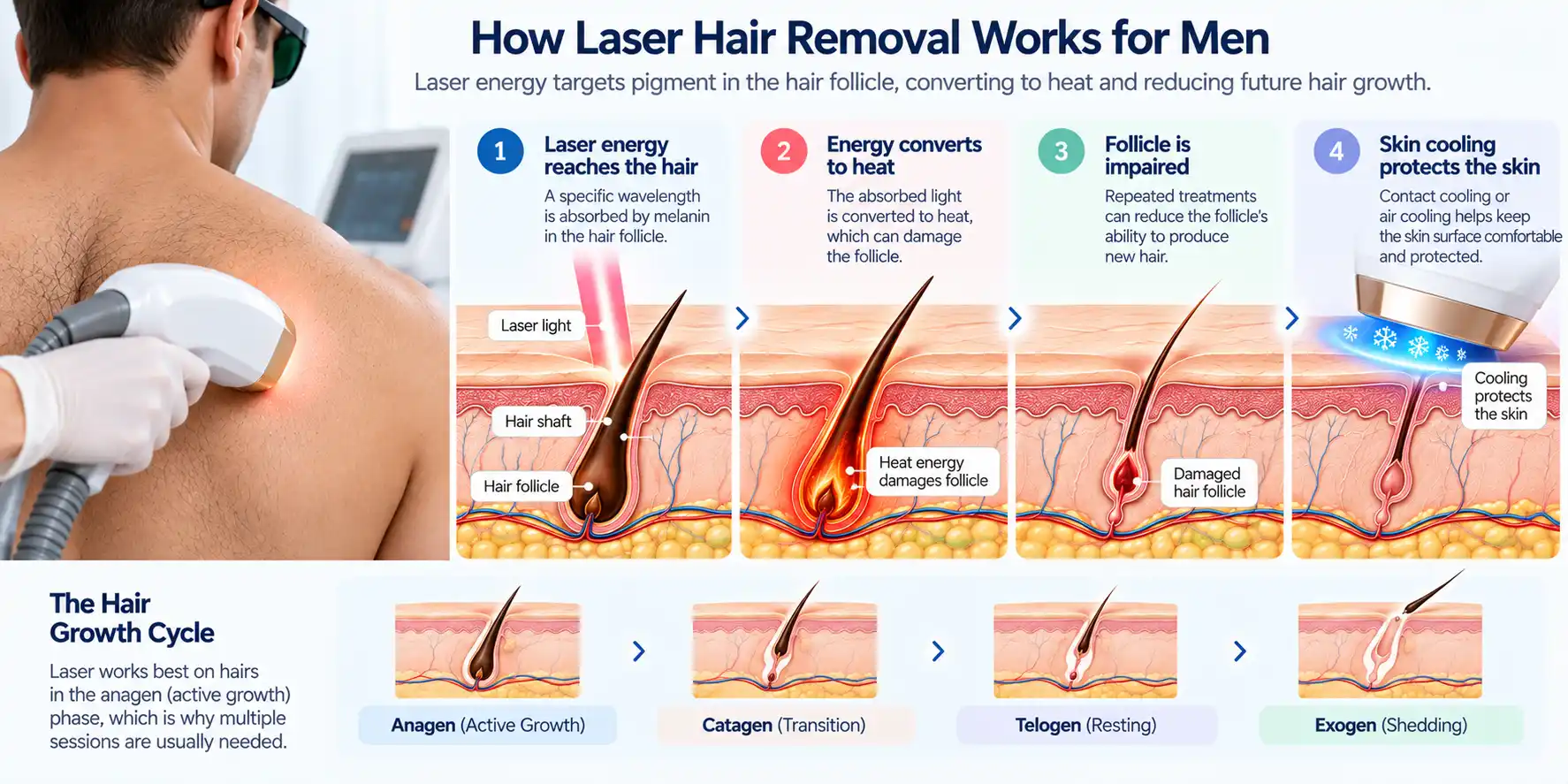
Men’s laser hair removal is a professional procedure that uses laser energy to reduce unwanted hair growth. The underlying principle is the same as for other patients: light is absorbed by melanin within the hair, producing heat that can impair structures responsible for future hair growth.
This process is called selective photothermolysis. The objective is to deliver sufficient energy to the target follicle while minimizing unwanted heating of surrounding skin.
Men often seek treatment for larger or densely haired areas, such as the back and chest, or for specific grooming concerns, such as neck irritation from shaving.
Is Men’s Hair Different From Women’s Hair?
Hair characteristics vary more between individuals and body areas than a simple male-versus-female comparison suggests. Nevertheless, androgen-sensitive areas in many men can develop thicker, coarser and denser terminal hair.
This matters because coarse, dark hair may respond well to appropriately selected laser treatment, while ongoing hormonal stimulation can contribute to continued growth or later regrowth.
How Does the Laser Remove Hair?
During treatment, a professional laser delivers pulses of light to the skin. Pigment in suitable hair shafts and follicles absorbs some of that energy, generating heat. When enough heat reaches the appropriate follicular structures, future hair production may be reduced.
Hair follicles cycle through active growth, transition and resting phases. Not every follicle is equally responsive at the same appointment, which is one reason repeated sessions are necessary.
What Areas Can Men Get Laser Hair Removal On?
Men can seek laser hair reduction on several body areas, provided the skin and hair characteristics are suitable and the intended treatment is supported by the equipment and provider’s protocols.
| Treatment Area | Common Reason | Special Consideration |
|---|---|---|
| Back | Reduce widespread, difficult-to-reach hair | Large surface area and possible maintenance |
| Chest | Reduce density or achieve a smoother appearance | Hair pattern and desired reduction vary |
| Shoulders | Manage coarse or patchy growth | Regrowth and paradoxical stimulation should be discussed |
| Neck | Reduce shaving irritation and unwanted hair | Careful assessment of skin and follicular conditions |
| Beard / Face | Reduce beard density or selected facial hair | Precision, long-term appearance and eye safety |
| Underarms | Reduce frequent shaving and hair density | Skin sensitivity and aftercare |
| Legs / Arms | Reduce body hair over larger areas | Time and cost depend on treatment coverage |
| Groin / Intimate Areas | Personal grooming preferences | Provider experience, anatomy and device restrictions |
1. Back Laser Hair Removal for Men
Back laser hair removal is a common option for men who have dense hair across the upper back, lower back or shoulders. Unlike shaving, which can be difficult to perform independently, laser treatment aims to reduce hair growth over time.
The back is a relatively large treatment area, so appointments may take longer and cost more than treatment of a small area such as the underarms or neck.
Does Back Laser Hair Removal Work Permanently?
Long-term reduction is possible, but complete permanent hair removal should not be guaranteed. Some men experience persistent or newly stimulated hair growth over time, particularly in androgen-sensitive areas.
Maintenance appointments may be appropriate depending on the initial response and future regrowth.
2. Chest Laser Hair Removal for Men
Chest laser hair removal can be used to reduce hair density across the pectoral region and, where appropriate, the upper abdomen.
Not every man wants a completely hair-free chest. Some prefer a less dense, more manageable appearance. It is important to discuss the desired outcome with the provider before starting.
Can You Thin Chest Hair Instead of Removing It All?
Partial reduction may be an aesthetic goal, but achieving a precisely uniform reduction is difficult to guarantee. Hair follicles do not all respond identically, and treatment can produce uneven density during the course.
If maintaining a natural-looking hair pattern is important, discuss the limitations of selective reduction before treatment.
3. Beard and Facial Laser Hair Removal for Men
Facial laser hair removal may appeal to men who want to reduce beard density, address unwanted facial hair or manage certain shaving-related concerns.
However, facial treatment requires careful planning. The beard area is hormonally influenced, and permanent reduction may alter future grooming choices.
Can Laser Hair Removal Help With Razor Bumps?
Some men develop pseudofolliculitis barbae, commonly called razor bumps, when curved or coarse hairs re-enter the skin after shaving. Reducing the number of growing hairs may help selected patients with this condition.
However, not every facial bump is caused by ingrown hair. Persistent inflammation, infection or scarring should be assessed by a qualified healthcare professional.
Can You Laser Your Beard Line?
Selected beard-border areas may be treated by appropriately qualified providers using equipment and techniques suitable for facial hair reduction.
Because results can be long-lasting and precise borders are difficult to guarantee, consider how the treatment might affect your preferred beard style in the future.
Laser exposure near the eyes presents a serious hazard. Treatment in or near the orbital region requires strict adherence to device labeling and applicable clinical safety protocols.
4. Neck Laser Hair Removal for Men
Neck laser hair removal is often considered by men who experience frequent shaving irritation, coarse regrowth or unwanted hair below the beard line.
The neck can be sensitive, and existing inflammation may affect treatment planning. Providers should evaluate skin condition, hair direction, pigment characteristics and the potential for adverse reactions.
5. Underarm Laser Hair Removal for Men
Underarm laser hair removal can reduce armpit hair density and the need for frequent shaving. Men with dense underarm hair may be interested in either substantial reduction or easier grooming.
The treatment principles, possible side effects and aftercare considerations are broadly similar across patients, although individual hair density and skin response differ.
For a detailed guide to armpit treatment, see our underarm laser hair removal guide, which covers costs, pain, sessions and aftercare.
6. Male Brazilian and Groin Laser Hair Removal
Some men seek hair reduction in the groin or other intimate regions. These treatments require especially careful attention to anatomical boundaries, patient privacy, informed consent, protective measures and the specific indications of the laser device.
Clinics differ in which intimate areas they treat. Do not assume that a service described as “male Brazilian” includes every surrounding area or that all skin surfaces are suitable for the same equipment.
Before booking, ask the clinic to explain exactly which external areas can be treated, which areas are excluded, and how the provider manages sensitive skin and patient comfort.
How Much Does Laser Hair Removal Cost for Men?
The cost of men’s laser hair removal depends heavily on the body area, treatment coverage, clinic location, provider qualifications, equipment and package structure.
Larger areas such as the back generally cost more than smaller areas such as the neck or underarms. Some clinics also distinguish between partial and full-area treatments.
Men’s Laser Hair Removal Cost by Body Area
The following amounts are illustrative US budgeting scenarios, not verified national averages or current clinic quotations. Use them only to understand how total costs can differ between small and large areas.
| Area | Illustrative Per-Session Budget | Six-Session Arithmetic Example |
|---|---|---|
| Underarms | $75–$200 | $450–$1,200 |
| Neck | $75–$250 | $450–$1,500 |
| Chest | $150–$400 | $900–$2,400 |
| Back | $200–$600 | $1,200–$3,600 |
| Shoulders | $100–$300 | $600–$1,800 |
USD estimates are illustrative planning assumptions, not a statistical pricing survey. The six-session column simply multiplies the example session price by six; it does not predict how many sessions a particular patient needs. Package discounts, taxes, consultations and maintenance are excluded.
Why Does Back Laser Hair Removal Cost More?
The back covers a larger area and may require more treatment time than the neck or underarms. Total cost also depends on hair density, whether the shoulders are included and the clinic’s pricing model.
Are Laser Hair Removal Packages Worth It?
Multi-session packages may reduce the advertised cost per visit, but compare the full price and terms before paying.
- Confirm the exact treatment boundaries.
- Ask how many sessions are included.
- Check whether consultation fees are separate.
- Review expiration, cancellation and refund policies.
- Ask whether maintenance visits are included or discounted.
- Confirm the provider’s qualifications and device type.
How Many Laser Hair Removal Sessions Do Men Need?
Many initial treatment courses involve around six to eight sessions, but there is no universal number for every man or every body area.
Hair growth patterns differ between the face, back, chest, underarms and legs. The provider should adjust treatment intervals based on the anatomical area, observed regrowth, skin recovery and device instructions.
Why Are Multiple Sessions Necessary?
Laser treatment works most effectively on suitable pigmented hairs during active growth. Because follicles do not all enter that phase at the same time, a series of appointments can reach additional hairs as they cycle.
What Happens After Each Session?
| Treatment Stage | Possible Observation | Important Limitation |
|---|---|---|
| First appointment | Temporary redness or swelling; treated hairs may shed later | Visible reduction is not immediate |
| Early treatment series | Some areas may show slower or patchier regrowth | Response varies between follicles |
| Later sessions | Hair density or thickness may decrease further | Uniform or complete clearance is not guaranteed |
| Long-term follow-up | Reduced growth may persist; some regrowth is possible | Maintenance may be appropriate |
Do Men Need More Sessions Than Women?
Some men may need additional treatments in hormonally influenced or densely haired areas, but sex alone does not determine the required number of sessions.
Hair thickness, pigmentation, skin type, body area, equipment and individual response are more useful factors for planning.
Does Laser Hair Removal Hurt for Men?
Men’s laser hair removal can cause temporary discomfort. The sensation is often described as a brief rubber-band snap, a sting or a pulse of heat.
Pain varies between individuals and treatment areas. A densely haired chest or back may feel different from the underarms or neck.
Which Areas Are More Sensitive?
Areas with delicate skin, dense hair or greater individual sensitivity may feel more uncomfortable. The face, neck and groin may require particular attention to comfort, although individual experiences differ.
There is no reliable universal pain ranking that applies to every patient.
How Can Men Reduce Discomfort?
- Choose a trained provider with suitable equipment.
- Follow the clinic’s shaving and preparation instructions.
- Discuss previous reactions and pain concerns before treatment.
- Ask about the system’s skin-cooling method.
- Report unusually intense or persistent pain immediately.
- Use topical anesthetics only when specifically approved and supervised.
Significant pain should never be interpreted as evidence that treatment is more effective.
Laser Hair Removal for Men: Before and After Results
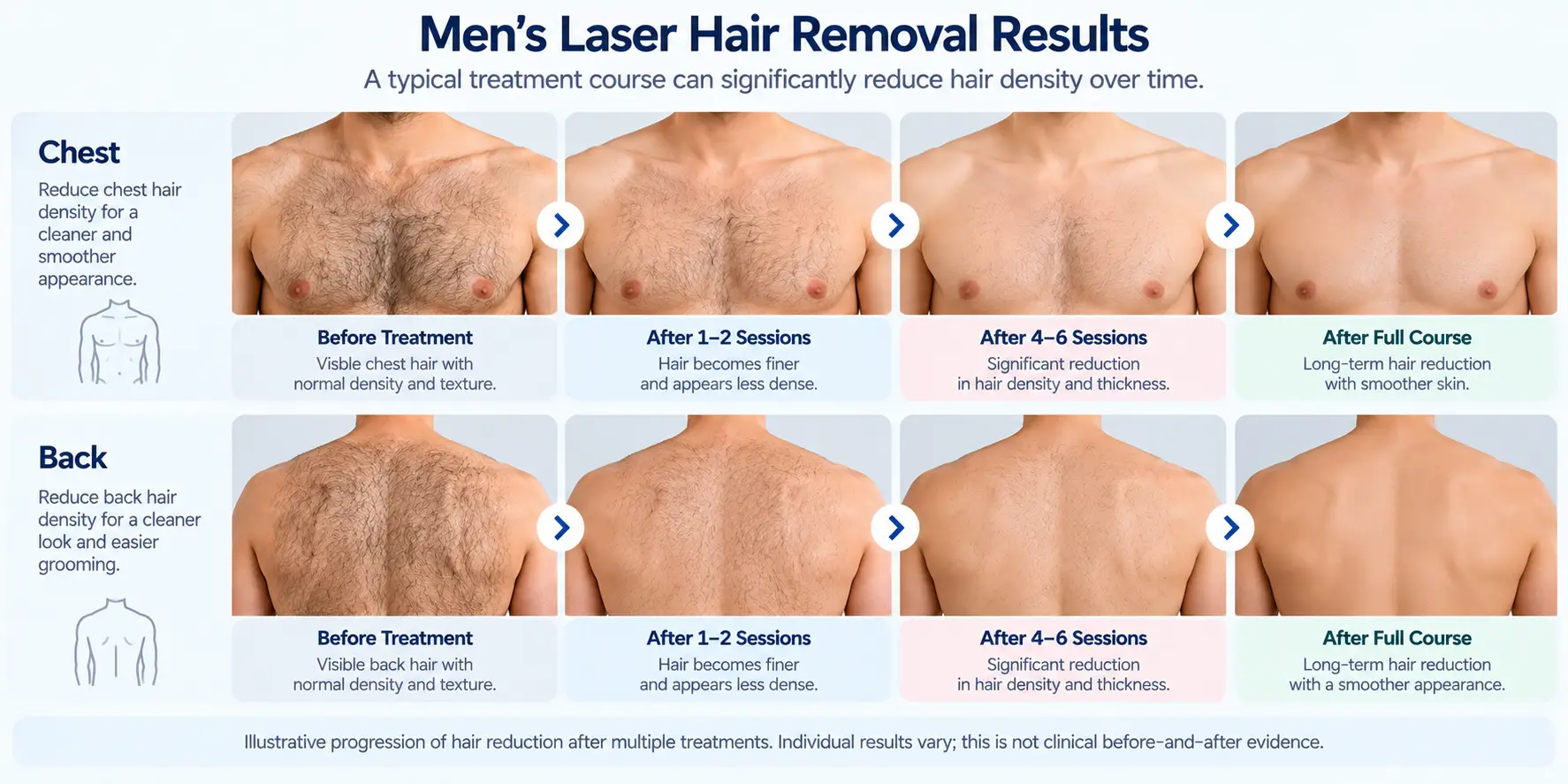
Before treatment, many men experience frequent hair regrowth after shaving or waxing. Following an effective laser treatment course, some notice lower hair density, finer regrowth or longer intervals between grooming.
Results are not always uniform. Certain areas may respond more quickly than others, and some follicles may continue to produce hair.

Is Laser Hair Removal Permanent for Men?
Laser treatment is best understood as a method of achieving long-term or permanent hair reduction, not guaranteed permanent elimination of every hair.
Some follicles may remain active, and new or increased growth may occur over time. Hormonal influences are particularly relevant in certain male body areas.
Can Hair Grow Back Years Later?
Yes. Some regrowth may occur months or years after an initial treatment course. The amount and timing vary substantially.
Occasional maintenance appointments may help manage regrowth when clinically appropriate.
Can Laser Hair Removal Make Hair Grow More?
A less common adverse outcome called paradoxical hypertrichosis involves increased hair growth in or around a treated area. It has been reported after light-based hair removal, particularly in certain anatomical regions and patient populations.
Discuss this possibility with your provider, especially when treating finer hair or areas where treatment outcomes are less predictable.
Is Laser Hair Removal Safe for Men?
Laser hair removal can be performed safely in appropriately selected patients when qualified professionals follow suitable protocols, device instructions and applicable regulations.
However, complications are possible. Common temporary effects include redness, mild swelling around follicles and transient skin sensitivity.
More serious adverse effects can include burns, blisters, pigment changes, scarring and eye injury if appropriate precautions are not followed.
Is Men’s Laser Hair Removal Safe for Dark Skin?
Many people with darker skin phototypes can be evaluated for professional laser hair removal. The provider must consider the interaction between laser energy, hair pigment and epidermal melanin.
Appropriate wavelength selection, pulse duration, fluence, cooling and operator experience are especially important for reducing unwanted skin injury.
What About Tattoos?
Hair removal lasers should not be applied directly over tattoos unless a qualified professional determines that the specific procedure is supported by the device’s instructions and appropriate safety protocols.
Tattoo pigments can absorb laser energy and may increase the risk of burns or pigment alteration.
Can Laser Hair Removal Affect Fertility?
Conventional hair removal lasers target superficial pigmented structures rather than internal reproductive organs. Nevertheless, this does not mean every genital or intimate-area treatment is appropriate or risk-free.
Treatment of sensitive anatomy must follow device labeling, clinical contraindications and provider-specific safety protocols. Discuss concerns about fertility or intimate-area treatment with an appropriately qualified clinician.
How to Prepare for Men’s Laser Hair Removal
Preparation helps the provider assess treatment suitability and reduce avoidable irritation.
Before Your Appointment
- Disclose relevant medical conditions and medications.
- Tell the clinic about previous laser reactions or skin sensitivity.
- Report recent tanning, sun exposure or self-tanning products.
- Avoid waxing and plucking for the period specified by the provider.
- Shave only according to the clinic’s instructions.
- Do not treat infected, broken or significantly irritated skin without assessment.
- Ask whether topical products should be removed before treatment.
Should Men Shave Before Laser Hair Removal?
Clinics commonly recommend shaving before laser hair removal. Excessive hair above the skin may absorb energy and interfere with treatment. Follow your provider’s instructions for the timing and method of shaving.
Can You Wax Between Laser Sessions?
Waxing and plucking remove the hair shaft that helps provide a target for pigment-based laser treatment. Shaving is generally preferred between sessions when the skin has recovered and the provider allows it.
What Happens During a Men’s Laser Hair Removal Appointment?
- Consultation: The provider reviews skin type, hair characteristics, medical history and treatment goals.
- Preparation: The area is cleaned and prepared according to the treatment protocol.
- Eye protection: Appropriate wavelength-specific laser protective eyewear is provided and used.
- Laser application: The operator delivers pulses using parameters selected for the patient and equipment.
- Aftercare: The provider assesses the skin response and explains post-treatment precautions.
How Long Does a Session Take?
Smaller areas such as the neck or underarms may require relatively little laser application time. Larger areas such as the full back can take considerably longer.
Total appointment duration also includes preparation, consultation and post-treatment assessment.
Aftercare: What Should Men Avoid After Laser Hair Removal?
Recently treated skin may be sensitive to heat, friction and irritating products. Follow the instructions provided by your clinic and the device-specific protocol.
- Avoid scratching or aggressively exfoliating irritated skin.
- Limit excessive heat and strenuous activity until cleared by the provider.
- Avoid fragranced products that sting or irritate the area.
- Protect exposed treated skin from excessive sun exposure.
- Do not wax or pluck treated hairs between appointments.
- Seek advice for severe pain, blistering or persistent skin changes.
Can You Work Out After Laser Hair Removal?
Sweat, friction and heat may aggravate temporary post-treatment irritation. Ask your provider when it is appropriate to resume strenuous exercise, especially after chest, back or groin treatment.
When Can You Shave Again?
Shaving is commonly permitted once the skin has recovered, but avoid shaving over redness, tenderness or damaged skin. Follow your provider’s aftercare instructions.
Laser Hair Removal vs. Shaving vs. Waxing for Men
| Factor | Laser Hair Removal | Shaving | Waxing |
|---|---|---|---|
| Primary Goal | Long-term reduction | Temporary surface removal | Temporary root-level removal |
| Initial Cost | Usually higher | Usually lower | Varies by area and provider |
| Maintenance | Initial series; possible follow-up | Frequent shaving | Repeated waxing |
| Discomfort | Heat or snapping sensation | Possible razor irritation | Hair-pulling discomfort |
| Limitations | Cost, suitability, risks and variable response | Rapid regrowth and razor bumps | Temporary results and possible irritation |
Is Laser Hair Removal Worth It for Men?
Laser hair removal may be worthwhile if you want to reduce repeated grooming, manage dense unwanted hair or achieve a longer-lasting reduction than shaving or waxing provides.
It may be less appealing if you want an inexpensive short-term solution, are unsure about permanently changing your hair pattern or have hair characteristics that respond poorly to conventional pigment-targeting lasers.
Which Laser Technology Is Best for Men?
Professional clinics may use alexandrite, diode or Nd:YAG laser systems. The most appropriate option depends on skin phototype, hair characteristics, treatment area, device specifications and operator experience.
| Technology | Common Wavelength | Clinical Consideration |
|---|---|---|
| Alexandrite Laser | 755nm | Often considered for suitable lighter skin phototypes |
| Diode Laser | Approximately 800–810nm in many systems | Widely used for professional hair reduction |
| Nd:YAG Laser | 1064nm | Often considered for darker skin phototypes under suitable protocols |
Some diode platforms offer several diode wavelengths in one system. A 1064nm diode source should not be confused with a 1064nm Nd:YAG laser merely because the nominal wavelength is the same.
No single laser type is automatically best for every man. Device settings, cooling, operator skill and patient selection are essential to treatment planning.
What Should Men Look for in a Laser Hair Removal Clinic?
Qualified Operators
Ask about training, experience and applicable medical supervision.
Appropriate Equipment
Confirm that the system is suitable for your skin and hair characteristics.
Clear Treatment Boundaries
Understand exactly which body areas are included in the quoted price.
Realistic Expectations
Look for an explanation of possible regrowth, risks and maintenance.
Frequently Asked Questions About Laser Hair Removal for Men
Does laser hair removal work on men’s thick hair?
Coarse, dark hair may respond well to appropriately selected laser treatment because it contains pigment that can absorb laser energy. Individual results still vary.
How many sessions does a man need for laser hair removal?
Many initial plans involve approximately six to eight sessions, although facial hair, hormonally influenced areas and individual response can change the number required.
Is laser hair removal painful for men?
It may cause a brief snapping, stinging or warm sensation. Comfort varies by body area, hair density, cooling and individual tolerance.
Can men get laser hair removal on their private parts?
Some clinics offer selected intimate-area treatments, but anatomical restrictions and device indications vary. Consult an experienced, qualified provider and confirm which areas can safely be treated.
Can men get full-body laser hair removal?
Some providers offer packages covering multiple suitable body areas. “Full body” does not necessarily include every anatomical region. Confirm coverage, exclusions and safety requirements.
Does laser hair removal stop beard growth forever?
Laser treatment can produce long-term beard hair reduction, but complete and permanent removal of every hair is not guaranteed.
Can laser hair removal help prevent razor bumps?
Reducing hair growth may help selected patients with shaving-related ingrown hairs, including pseudofolliculitis barbae. Other skin conditions may require separate medical treatment.
Can laser hair removal make men’s hair grow back thicker?
The intended result is reduced growth, but paradoxical hypertrichosis, or increased hair growth in or around treated areas, is a recognized potential adverse outcome.
Does men’s laser hair removal work on gray or white hair?
Conventional pigment-targeting hair removal lasers generally respond poorly to hair with little or no melanin, including white and gray hair.
Can men shave between laser hair removal sessions?
Shaving is generally preferred over waxing or plucking between appointments, provided the skin has recovered and the provider allows it.
Is laser hair removal safe for men with dark skin?
Many men with darker skin can be evaluated for professional treatment. Appropriate technology, parameters, cooling and clinical expertise are important for reducing adverse effects.
How long do men’s laser hair removal results last?
Results may persist for extended periods, but regrowth varies by individual and body area. Maintenance treatments may be considered.
Final Verdict: Should Men Get Laser Hair Removal?
Laser hair removal can be a useful long-term grooming option for men who want to reduce unwanted hair on the back, chest, neck, underarms or other suitable areas.
Its main advantages are the potential for lasting hair reduction and less frequent grooming. Its limitations include multiple appointments, higher initial cost, variable results and possible side effects.
Before starting treatment, choose a qualified provider, discuss your preferred hair pattern and ask for a realistic explanation of costs, treatment intervals and potential regrowth.
Professional Laser Hair Removal Equipment
Cocoon Laser supplies professional diode laser hair removal systems for aesthetic clinics, medical spas and distributors. Explore available equipment configurations and technical details.
Explore COOLICE Diode Laser →