Spider Veins Explained: How a Commercial Dual Wavelength Laser Device Erases Redness
Executive Summary
For modern dermatology clinics, managing vascular lesions requires precision engineering that legacy systems cannot provide. A commercial dual wavelength laser device (532nm and 1064nm) is the definitive clinical workstation for treating complex spider veins and erythema. By leveraging the principles of selective photothermolysis, these platforms precisely target oxyhemoglobin, achieving controlled thermal coagulation rather than violent vessel rupture. This dual-wavelength synergy ensures optimal clinical efficacy with virtually no downtime. Crucially, the 1064nm Nd:YAG wavelength allows practitioners to safely treat patients across the entire Fitzpatrick Scale, eliminating the risk of epidermal burns inherent in single-wavelength systems. Equipped with advanced TEC Cooling, an exceptionally high shots count, and rigorous compliance with FDA 510(k) and Medical CE standards, integrating a dual wavelength laser device from Cocoon Laser guarantees superior patient outcomes and a rapidly accelerated clinic ROI.
The Clinical Challenge: Why Spider Veins and Vascular Lesions are Hard to Treat
In the medical aesthetic industry, vascular lesions represent one of the most frequently requested, yet clinically challenging, indications. Patients presenting with facial erythema or leg veins require a highly nuanced approach. Utilizing outdated technology not only yields poor clinical outcomes but also exposes the clinic to severe liabilities. To understand the requisite technology, practitioners must first understand the anatomical complexity of the target.
The Anatomy of Telangiectasia (Spider Veins)
Telangiectasia, commonly known as spider veins, are abnormally dilated blood vessels located near the surface of the skin. However, these lesions are rarely uniform. They present a complex, three-dimensional challenge characterized by varying depths, diameters, and hemodynamic properties:
- Superficial Red Vessels: Typically found on the face (alar creases, cheeks), these fine capillaries sit high in the dermis and are heavily saturated with highly oxygenated blood (oxyhemoglobin).
- Deep Blue/Purple Veins: Often presenting as reticular veins on the lower extremities, these vessels are larger in diameter, sit deeper within the dermal-subcutaneous junction, and contain a higher concentration of deoxygenated blood.
This anatomical variance dictates a fundamental physical reality: a single optical approach cannot effectively or safely treat the entire spectrum of vascular lesions.
The Shortcomings of IPL and Single-Wavelength Lasers
Historically, many clinics relied on Intense Pulsed Light (IPL) or single-wavelength vascular lasers. From a strict clinical perspective, these modalities present significant operational limitations:
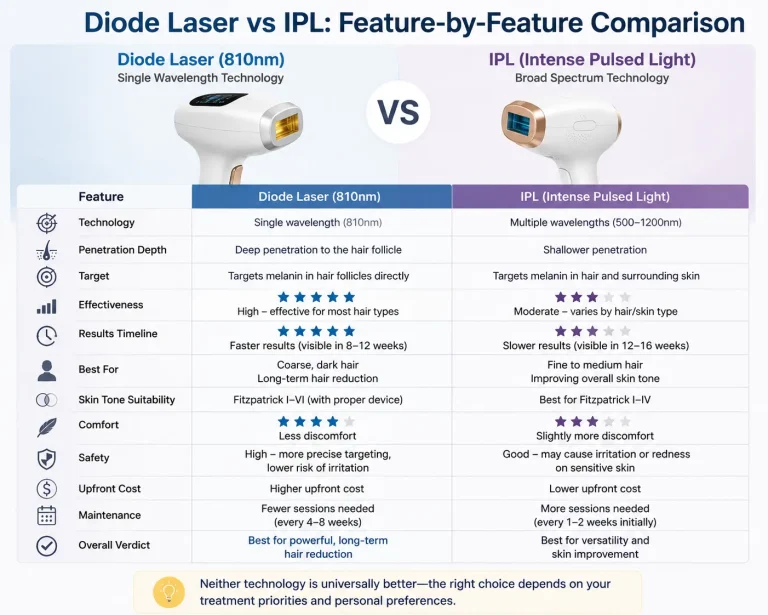
- IPL Limitations: IPL emits a broad spectrum of scattered light. While it can superficially address diffuse redness, it lacks the concentrated monochromatic energy and penetration depth required to collapse deeper reticular veins. Pushing IPL fluences too high in an attempt to reach deep vessels inevitably overheats the epidermal melanin, leading to severe burns.
- Single-Wavelength Laser Failures: A standalone 532nm laser is excellent for superficial redness but physically cannot penetrate deeply enough to reach blue leg veins. Conversely, relying solely on an isolated, deep-penetrating laser without the ability to treat fine superficial networks leads to incomplete clearance, high recurrence rates, and ultimately, patient dissatisfaction.
The Science of Erasing Redness: Selective Photothermolysis
To evaluate a commercial vascular laser effectively, medical directors must look past marketing claims and analyze the underlying physics. The efficacy of modern laser systems relies entirely on the precise execution of selective photothermolysis.
Targeting Hemoglobin: The Role of Absorption Spectra
Selective photothermolysis is the process of using targeted light energy to destroy a specific microscopic structure (the chromophore) without inducing collateral thermal damage to surrounding healthy tissue.
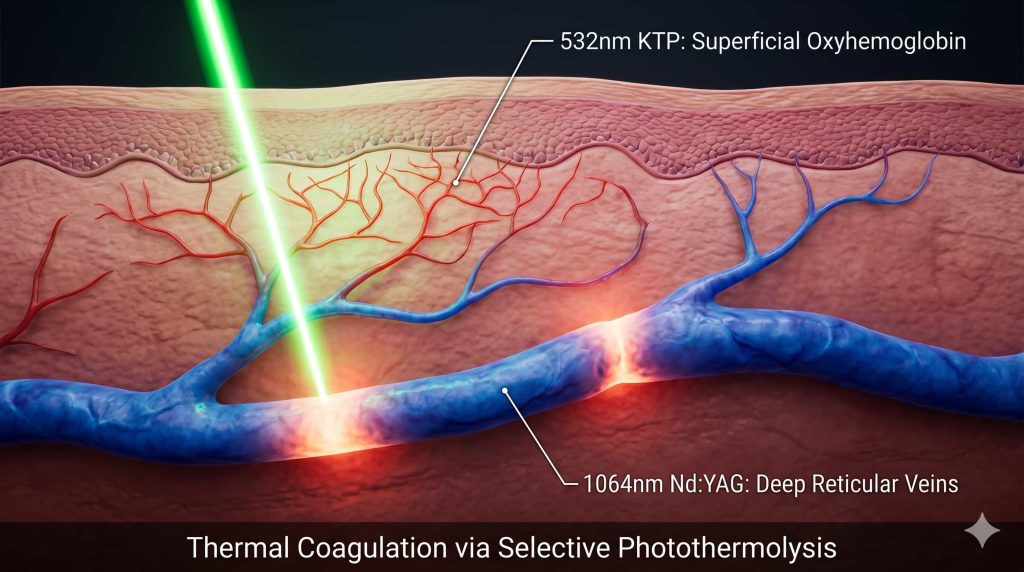
In the context of vascular treatments, the primary chromophores are Oxyhemoglobin and Methemoglobin circulating within the red blood cells. When the laser emits a specific wavelength, these chromophores absorb the photons and immediately convert that optical energy into heat. As the temperature of the blood rapidly rises, the heat transfers to the endothelial cells lining the vessel wall, fundamentally denaturing the target.
Thermal Coagulation vs. Vessel Rupture (Preventing Purpura)
The biological goal of a vascular laser treatment is Thermal Coagulation, not vaporization.
- Unlike the photoacoustic effect utilized by Q-switched lasers to shatter tattoo ink, vascular lasers must use extended pulse durations (measured in milliseconds).
- If the pulse duration is too short, the rapid heating causes the blood to boil instantly. This explosive vaporization ruptures the vessel wall, resulting in Purpura (unsightly, long-lasting subcutaneous bruising).
- By precisely extending the pulse duration, high-end commercial systems gently raise the intravascular temperature. The vessel wall safely coagulates, collapses inward, and seals itself off. Over the following weeks, the body’s macrophage system naturally absorbs and clears the collapsed vessel, yielding a flawless, purpura-free result that preserves patient downtime expectations.
Decoding the Dual Wavelength Advantage: 532nm + 1064nm Synergy
The engineering pinnacle of vascular treatments is the integration of two distinct optical resonators—the 532nm KTP and the 1064nm Nd:YAG—into a single, cohesive delivery system. This dual-wavelength architecture equips the practitioner with the ultimate clinical arsenal.
532nm Wavelength: The Master of Superficial Redness
The 532nm wavelength aligns perfectly with the primary absorption peak of oxyhemoglobin.
- Physical Properties: Because of its exceptionally high absorption coefficient for red blood cells, it requires relatively low fluences to achieve coagulation. However, its penetration depth is strictly limited to the superficial dermis.
- Clinical Targets: It is the absolute gold standard for treating fine, bright red micro-vessels, including facial telangiectasia.
- Primary Indications: Unmatched efficacy in managing Rosacea, clearing Cherry Angiomas, and erasing diffuse epidermal redness.
1064nm Nd:YAG: Penetrating Deep for Blue/Purple Veins
To address the deeper vascular networks that the 532nm cannot reach, the platform seamlessly shifts to the 1064nm Nd:YAG wavelength.
- Physical Properties: The 1064nm wavelength features a much lower absorption rate by epidermal melanin and a high affinity for deeper, deoxygenated blood. This allows the photons to bypass the skin surface and travel deep into the reticular dermis.
- Clinical Targets: Specifically engineered to target large, dark blue, and purple reticular veins, particularly on the lower legs.
- Safety Profile: Because it largely bypasses epidermal melanin, the 1064nm Nd:YAG is the cornerstone of safety for treating vascular lesions on patients with Fitzpatrick Scale skin types IV through VI.
The Sequential Emission Protocol (Multiplexing)
The most advanced clinical application of this technology is sequential emission, often referred to as multiplexing. High-tier commercial systems can fire both wavelengths in a rapid, pre-programmed sequence within milliseconds.
- A sub-purpuric pulse of 532nm fires first. This converts the targeted oxyhemoglobin into methemoglobin and creates micro-clots.
- Methemoglobin has a 300% to 500% higher absorption rate for the 1064nm wavelength than regular oxyhemoglobin.
- Milliseconds later, the 1064nm pulse fires. Because the optical properties of the blood were altered by the first pulse, the Nd:YAG laser requires significantly less energy (fluence) to completely coagulate the deep vessel.
This synergistic multiplexing drastically lowers the total thermal load applied to the tissue, maximizing clearance rates while minimizing patient discomfort and the risk of scarring.
Technical Comparison: Vascular Laser Wavelengths
| Parameter | 532nm KTP Laser | 1064nm Nd:YAG Laser | Dual-Wavelength Synergy |
| Primary Chromophore | Oxyhemoglobin (Peak absorption) | Deoxygenated blood / Methemoglobin | Comprehensive Hemoglobin targeting |
| Penetration Depth | Superficial (Epidermis / Upper Dermis) | Deep (Reticular Dermis) | Multi-layered 3D coagulation |
| Target Vessel Size | Micro-vessels, fine red capillaries | Large, coarse blue/purple veins | Addresses complex vascular networks |
| Optimal Fitzpatrick Type | Types I – III | Types I – VI | Universal Safety across Types I – VI |
| Clinical Indications | Rosacea, Cherry Angiomas, Spider veins | Deep leg veins, Venous lakes | Total vascular and rejuvenation platform |
Expanding Treatment Menus and Maximizing Clinic ROI
Acquiring capital medical equipment is a profound financial commitment. Clinic directors must view the procurement of a dual wavelength laser device not just as a clinical upgrade, but as a strategic business asset designed to generate rapid Return on Investment (ROI).
Treating Across the Fitzpatrick Scale Safely
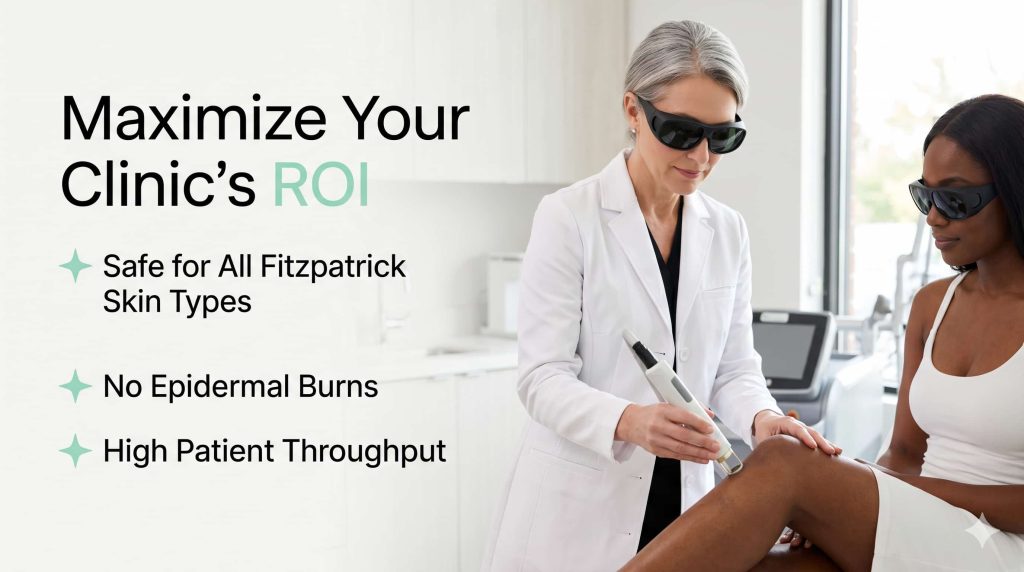
From a revenue perspective, the inability to treat darker skin tones is a severe operational liability. Traditional 532nm lasers or IPL devices carry extreme risks of hypopigmentation or severe burns on melanin-rich skin. By utilizing the 1064nm Nd:YAG capabilities, your clinic secures the ability to safely onboard and treat patients across the entire Fitzpatrick Scale. Capturing this previously excluded demographic dramatically expands your addressable market and directly increases your gross clinical revenue.
Beyond Spider Veins: A Multi-Indication Workstation
A premium dual-wavelength platform transcends vascular indications, serving as a comprehensive multi-indication workstation. This versatility ensures the equipment is never idle.
- Pigmented Lesions: The 532nm wavelength provides exceptional clearance for benign epidermal pigmented lesions, solar lentigines, and freckles.
- Port Wine Stains: The sequential firing protocols offer advanced management for congenital vascular malformations.
- Skin Rejuvenation: The 1064nm Nd:YAG can be utilized in micro-pulsed modes for non-ablative skin rejuvenation, stimulating neocollagenesis to reduce fine lines, shrink pore size, and improve overall skin texture.
Consolidating these highly requested treatments into a single hardware footprint maximizes your clinical utilization rate, driving a faster break-even point and substantially higher profit margins.
Advanced Epidermal Cooling for Patient Retention
Patient retention is inextricably linked to pain management and procedural safety. Generating high levels of photothermal energy requires an equally sophisticated thermal management system.
Investing in a platform equipped with integrated, industrial-grade TEC Cooling (Thermo-Electric Cooling) or continuous contact sapphire cooling is non-negotiable.
- Epidermal Protection: Robust cooling pre-chills the epidermis before the laser fires, protects it during the pulse, and cools it immediately after. This completely neutralizes the risk of thermal blistering.
- The Business Impact: A painless, burn-free experience guarantees zero patient downtime. Patients who experience comfortable treatments are significantly more likely to complete their multi-session protocols and refer your clinic to their network, organically driving your customer acquisition.
Conclusion: Elevating Vascular Treatments with Cocoon Laser
The clinical transition from unpredictable single-wavelength devices to an advanced dual-wavelength workstation is the hallmark of a top-tier aesthetic practice. By mastering the physical principles of selective photothermolysis across 532nm and 1064nm, practitioners can consistently deliver flawless, purpura-free vascular clearance.
What to Look for in a Commercial Vascular Laser
When B2B buyers and medical directors evaluate their next capital equipment purchase, rigorous due diligence is required. Do not settle for subpar engineering. Ensure the platform features:
- Wavelength Synergy: True 532nm and 1064nm integration.
- Adjustable Spot Sizes: To trace fine facial capillaries and target large leg veins efficiently.
- Top-Hat Beam Profile: To ensure uniform energy distribution, preventing central “hot spots” that cause clinical scarring.
- Component Longevity: High-quality resonators that guarantee a massive shots count before requiring costly maintenance.
- Regulatory Compliance: Strict adherence to FDA 510(k) and Medical CE certifications to guarantee legal compliance and clinical safety.
Partner with Cocoon Laser for Clinical Excellence
As a globally recognized manufacturer, Cocoon Laser engineers professional medical aesthetic devices that meet the highest standards of the B2B healthcare market. A dual wavelength laser device from Cocoon Laser is built to provide uninterrupted performance, unmatched patient safety, and a highly lucrative business model for your clinic.
Future-proof your practice and elevate your clinical standard of care. We invite medical professionals to visit the official website to explore how Cocoon Laser aesthetic devices can transform your treatment menu. Contact our expert team today to download a detailed technical Specification Sheet, review our customized clinic ROI reports, or schedule a comprehensive B2B virtual demonstration of our industry-leading Cocoon Laser clinical workstation technology.
If you need more information, please click “Contact Us”.
If you want to obtain more information, please follow our official website and Facebook.