Electrolysis vs Laser Hair Removal: Which Is Better?
Choosing between electrolysis vs laser hair removal is not simply a question of which treatment is “better.” The right option depends on your hair color, skin type, treatment area, amount of hair, budget and whether your priority is faster long-term hair reduction or permanent removal of individual treated follicles.
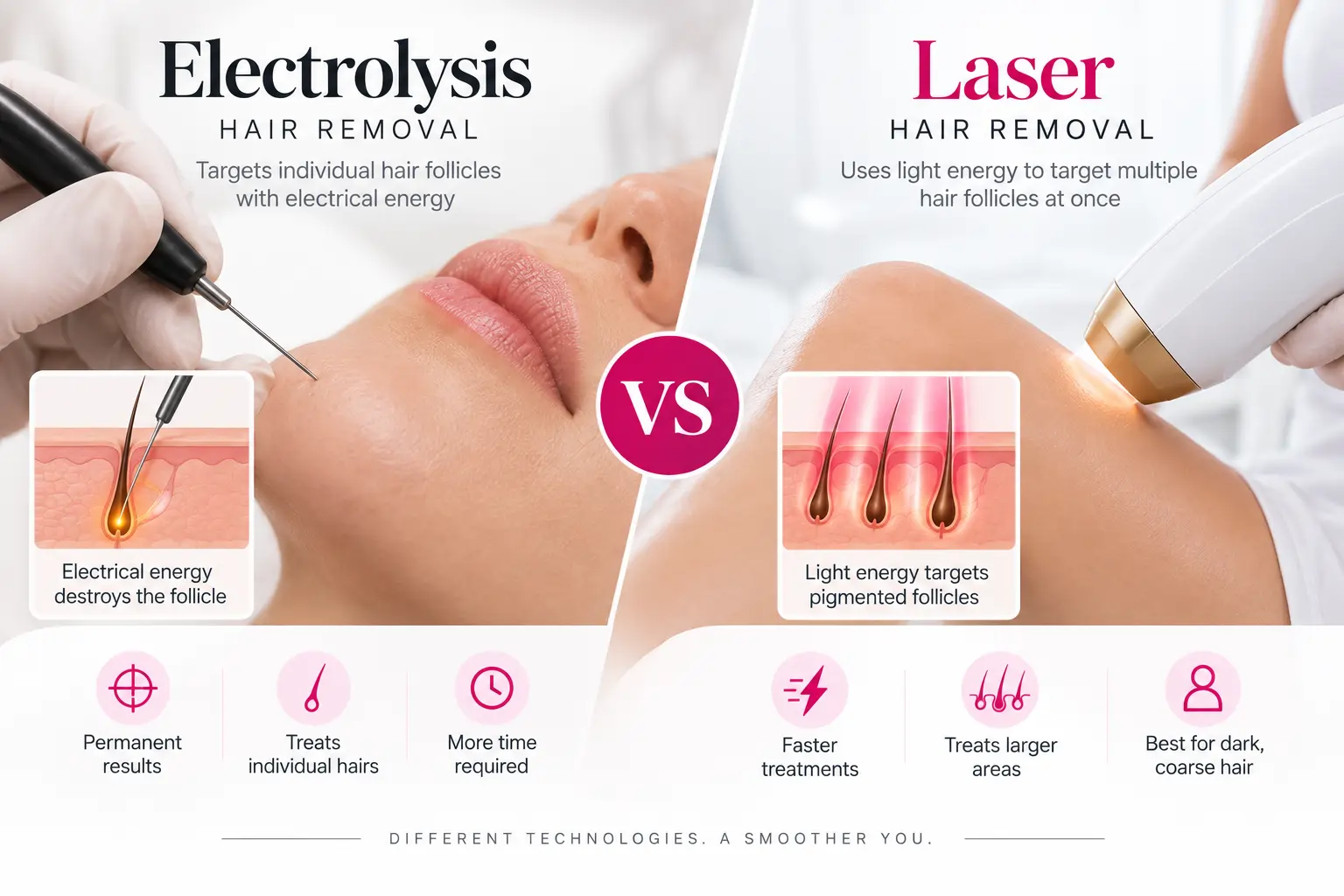
Laser hair removal uses light energy to target pigment in the hair follicle and is generally more practical for treating larger areas of pigmented hair. Electrolysis works differently: a fine probe is inserted into individual hair follicles and electrical energy is applied to destroy the follicle’s ability to produce hair.
This guide provides a detailed electrolysis vs laser hair removal comparison, including permanent results, effectiveness, cost, pain, treatment time, safety, side effects, facial hair, PCOS-related hair growth, dark skin, bikini and Brazilian areas, legs, and blonde, gray, white and red hair.
Quick Answer: Electrolysis vs Laser Hair Removal
Laser hair removal is generally better for quickly reducing larger areas of dark, pigmented hair, while electrolysis is better suited to permanently removing individual hairs and treating hair colors that laser cannot effectively target.
Laser treatment can cover areas such as the legs, back, underarms and bikini region much faster because many follicles can be exposed during a treatment session. However, laser effectiveness depends strongly on the presence of pigment in the hair.
Electrolysis treats follicles individually and does not depend on hair pigment. This makes it particularly important for blonde, gray, white and some red hairs that respond poorly to conventional laser hair removal.
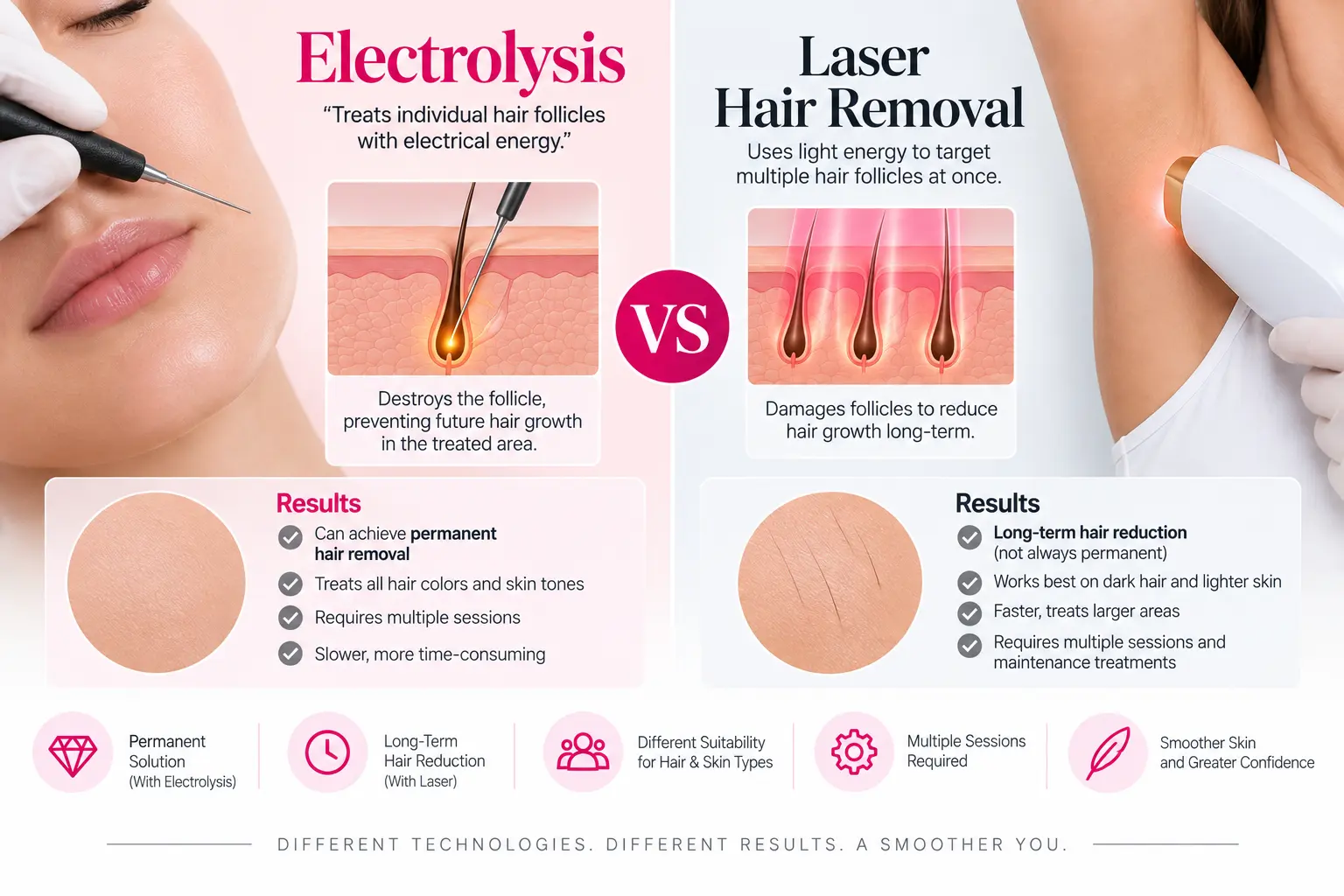
If the question is electrolysis vs laser hair removal which is more permanent, electrolysis has the stronger claim to permanent hair removal of successfully treated follicles, while laser hair removal is generally described in terms of long-term or permanent hair reduction.
Electrolysis vs Laser Hair Removal: Key Differences
The most important electrolysis vs laser hair removal differences come from how the two technologies interact with the follicle.
| Comparison | Laser Hair Removal | Electrolysis |
|---|---|---|
| Primary Mechanism | Light energy targets pigment associated with the hair follicle | Electrical energy is delivered to individual follicles through a fine probe |
| Best Hair Candidates | Generally dark, pigmented hair | Can treat hairs regardless of pigment |
| Blonde / Gray / White Hair | Generally poor candidates due to insufficient pigment | Can be treated |
| Large Areas | Fast and practical | Much more time-consuming |
| Individual Hairs | Less targeted for isolated hairs | Highly precise |
| Treatment Endpoint | Long-term / permanent hair reduction | Permanent hair removal of successfully treated follicles |
| Hair Pigment Required | Yes, for effective optical targeting | No |
| Typical Treatment Speed | Faster for large areas | Slower because follicles are treated individually |
| Common Uses | Legs, back, underarms, bikini, beard and other larger areas | Face, chin, upper lip, residual hairs and light-colored hairs |
Therefore, when you compare electrolysis vs laser hair removal, the answer changes depending on whether you are treating thousands of dark hairs across a large area or a relatively small number of individual hairs.

How Does Laser Hair Removal Work?
Laser hair removal works through selective absorption of light energy. A laser wavelength is selected so that energy can be absorbed by melanin associated with the hair shaft and follicle. The absorbed optical energy is converted into heat, which can damage structures involved in future hair growth.
Because melanin is an important optical target, hair color has a major influence on treatment response. Dark terminal hair generally provides a stronger target than blonde, gray or white hair.
Professional hair-removal platforms may use technologies such as:
- 755 nm Alexandrite laser
- 808/810 nm diode laser
- 1064 nm Nd:YAG laser
- Multi-wavelength diode laser systems
Different wavelengths and treatment parameters may be selected according to factors such as skin characteristics, hair characteristics and treatment area.
How Does Electrolysis Hair Removal Work?
Electrolysis does not rely on melanin as an optical target. Instead, a very fine probe is inserted into the natural opening of an individual hair follicle.
Electrical energy is then delivered to damage the follicle’s hair-producing structures. The treated hair can subsequently be removed.
Because each follicle is treated separately, electrolysis can be extremely precise. The trade-off is speed: treating a few hairs can be practical, while treating thousands of hairs across the legs or back can require substantial time.
This pigment-independent mechanism is also why electrolysis remains relevant for hair colors that are difficult to treat with laser.
Electrolysis vs Laser Hair Removal Effectiveness
Electrolysis vs laser hair removal effectiveness cannot be compared fairly without considering hair color, treatment area and the desired endpoint.
Laser hair removal can be highly effective for reducing substantial amounts of appropriately pigmented hair across large areas. Instead of treating every follicle one at a time, laser pulses cover treatment spots containing multiple hairs.
Electrolysis can be effective for individual follicles regardless of whether the hair is black, brown, blonde, gray or white. However, treating a large area can take considerably longer because each follicle must be addressed individually.
| Situation | Usually More Practical | Why |
|---|---|---|
| Large area of dark hair | Laser | Faster coverage of many pigmented follicles |
| Small number of isolated hairs | Electrolysis | Individual follicle precision |
| Blonde hair | Electrolysis | Does not depend on hair pigment |
| Gray or white hair | Electrolysis | Laser generally lacks an adequate melanin target |
| Large body area | Laser | Greater treatment throughput |
| Residual hairs after laser | Electrolysis may be useful | Individual remaining follicles can be targeted |
Electrolysis vs Laser Hair Removal Permanent Results
Electrolysis vs laser hair removal permanent results is one of the most important distinctions between the two methods.
Laser hair removal is generally associated with permanent or long-term hair reduction. A successful treatment course can substantially reduce the amount and density of hair, but it should not automatically be interpreted as guaranteed permanent removal of every hair.
Electrolysis is different because successfully treated individual follicles can be permanently disabled.
This distinction is especially important when users search for electrolysis vs laser hair removal permanent. The words “reduction” and “removal” should not be treated as interchangeable.
Electrolysis vs Laser Hair Removal: Which Is More Permanent?
For users asking electrolysis vs laser hair removal which is more permanent, electrolysis has the clearer advantage when the goal is permanent removal of individual successfully treated follicles.
Laser treatment, however, can provide substantial long-term reduction much more efficiently across large areas containing suitable pigmented hair.
This creates an important distinction:
- Laser: better suited to reducing large quantities of suitable hair efficiently.
- Electrolysis: better suited to permanently treating individual follicles.
Therefore, the method with the stronger permanence claim is not automatically the best first treatment for every person.
Electrolysis vs Laser Hair Removal Cost
Electrolysis vs laser hair removal cost should be compared using total treatment requirements rather than simply looking at the price of one appointment.
Laser is usually priced by treatment area, session or package. Electrolysis is commonly priced according to treatment time because individual follicles are treated separately.
| Cost Factor | Laser Hair Removal | Electrolysis |
|---|---|---|
| Common Pricing | Per area, session or package | Often based on treatment duration |
| Small Number of Hairs | May not be the most economical approach | Can be cost-effective |
| Large Area | Generally more time-efficient | Total cost can increase because of treatment time |
| Number of Treatments | Multiple sessions usually required | Repeated treatments are usually required |
| Package Pricing | Common | Depends on provider |
This means the answer to cost of electrolysis vs laser hair removal can change dramatically according to the treatment area.
Removing a few persistent chin hairs with electrolysis is fundamentally different from using electrolysis to clear an entire back or both legs.
Electrolysis vs Laser Hair Removal Price Per Session
When comparing electrolysis vs laser hair removal price, the units used by providers may be different.
Laser hair removal may be quoted as a fixed price for the underarms, face, Brazilian area, legs or another defined zone. Electrolysis may instead be offered in time blocks such as shorter appointments or longer sessions.
Because of these different pricing models, simply comparing “$100 for laser” with “$100 for electrolysis” does not tell you which treatment will cost less overall.
Which Costs Less for a Complete Treatment?
For large areas containing dark hair, laser hair removal can often be more economical in terms of treatment time because many follicles are exposed during each session.
For a small number of isolated hairs, electrolysis may be more economical because the treatment can focus directly on those individual follicles.
You can compare detailed pricing separately in our Laser Hair Removal Cost Guide and Electrolysis Hair Removal Cost Guide.
Electrolysis vs Laser Hair Removal Pain
Electrolysis vs laser hair removal pain is highly individual, and neither treatment can be guaranteed to be painless.
Laser treatment is often described as a brief heating, snapping or stinging sensation with each pulse. Modern professional systems may incorporate contact cooling, cold air or other cooling technologies designed to improve treatment comfort and protect the skin surface.
Electrolysis can produce a localized stinging, heating or pinching sensation as individual follicles are treated.
A meaningful electrolysis vs laser hair removal pain comparison also needs to consider treatment duration. A laser may produce stronger individual pulses but cover a large area quickly, whereas electrolysis involves repeated treatment of individual follicles.
Pain and comfort can vary according to:
- Treatment area
- Individual pain sensitivity
- Energy settings
- Hair density
- Cooling method
- Session duration
- Provider technique
Electrolysis vs Laser Hair Removal Treatment Time
Treatment speed is one of the largest practical differences between electrolysis and laser hair removal.
Laser platforms can treat relatively large surface areas because each pulse covers a defined spot rather than one individual follicle. This makes laser particularly useful for areas such as:
- Legs
- Back
- Chest
- Arms
- Underarms
- Bikini area
Electrolysis is slower because follicles are treated one by one. This is not necessarily a disadvantage when only a small number of hairs need treatment, but it becomes important when considering very large areas.
Therefore, if the comparison is based on treatment throughput, laser hair removal generally has a substantial advantage for large areas. If the comparison is based on precise treatment of individual hairs, electrolysis has the advantage.
Electrolysis vs Laser Hair Removal for Different Hair Colors
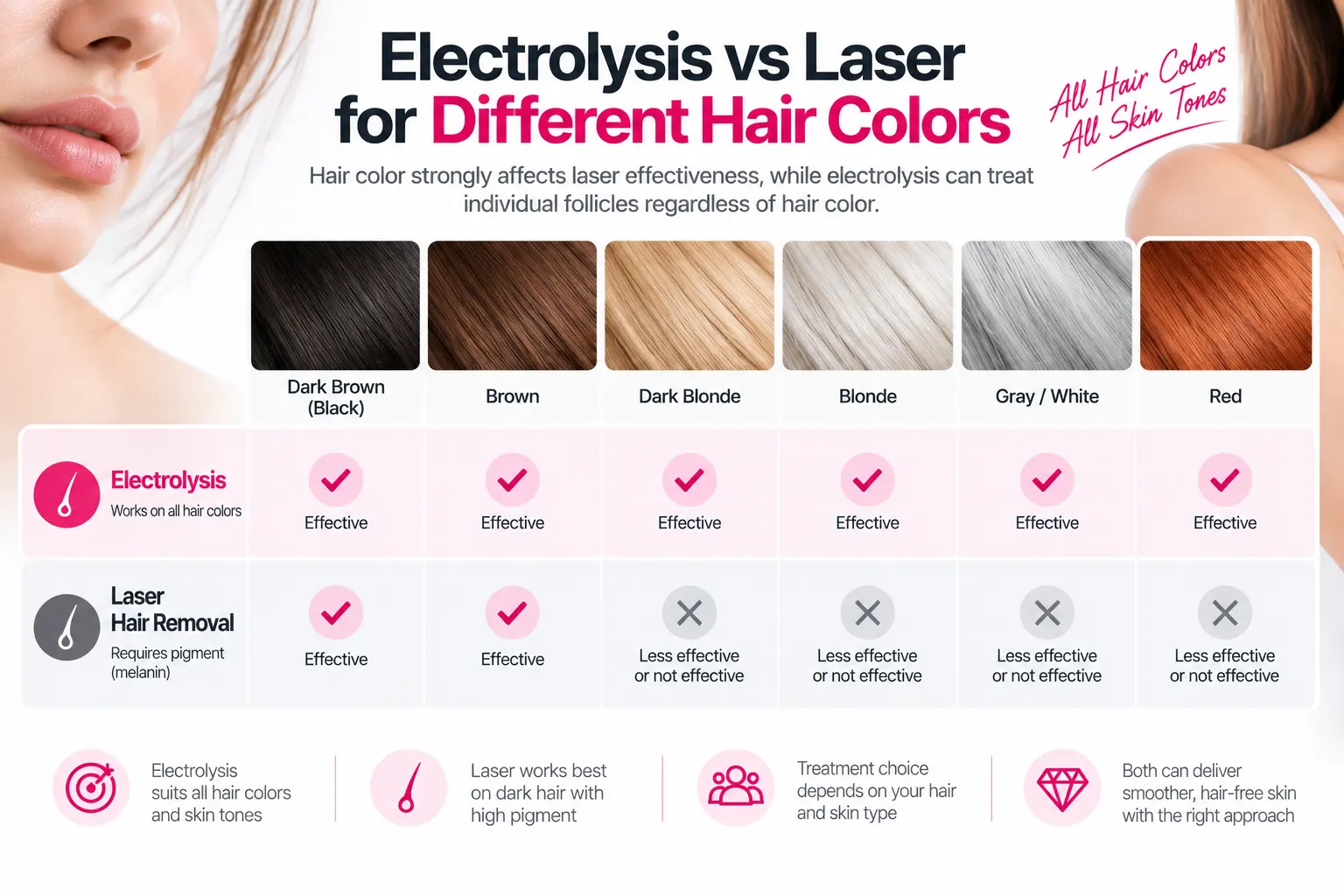
Hair color is one of the most important factors when comparing electrolysis vs laser hair removal. Laser hair removal depends on sufficient pigment in the hair to absorb light energy, while electrolysis does not depend on hair color.
This difference means that the best treatment can change dramatically between someone with coarse black hair and someone with blonde, gray or white hair.
| Hair Color | Laser Hair Removal | Electrolysis | General Consideration |
|---|---|---|---|
| Black / Dark Brown | Generally a strong optical target | Can treat | Laser is often more practical for larger areas |
| Medium Brown | Often treatable | Can treat | Suitability depends on pigment and skin characteristics |
| Blonde | Often limited or ineffective | Can treat | Electrolysis is generally more appropriate |
| Red | Response can be limited or unpredictable | Can treat | Electrolysis may be more reliable when laser lacks an adequate target |
| Gray | Generally poor candidate | Can treat | Electrolysis is usually preferred |
| White | Generally ineffective | Can treat | Electrolysis is usually preferred |
Electrolysis vs Laser for Blonde Hair
When comparing electrolysis vs laser for blonde hair, electrolysis usually has an important advantage because it does not require melanin in the hair shaft.
Blonde hair may contain too little pigment to absorb enough laser energy for reliable follicular heating. Very light blonde hair can therefore respond poorly even when surrounding skin characteristics would otherwise make laser treatment possible.
Electrolysis vs Laser for Gray and White Hair
Electrolysis vs laser for gray hair and electrolysis vs laser for white hair generally favor electrolysis. Gray and especially white hairs contain little or no melanin available for conventional laser hair-removal systems to target.
Electrolysis bypasses this limitation because treatment is delivered directly to the individual follicle rather than relying on optical absorption by hair pigment.
For a more detailed explanation, see our guide to Permanent Hair Removal for Blonde, Gray & White Hair .
Electrolysis vs Laser for Red Hair
Red hair can also be difficult for conventional laser hair removal because its pigment composition differs from dark brown or black hair. Results can vary according to the actual hair color and technology used.
When there is insufficient optical contrast for reliable laser targeting, electrolysis becomes the more practical pigment-independent option.
Electrolysis vs Laser Hair Removal for Dark Skin
Electrolysis vs laser hair removal for dark skin requires a more nuanced comparison than simply choosing one technology based on skin tone.
Electrolysis does not rely on a contrast between hair pigment and skin pigment, so the basic treatment mechanism is not limited by skin color in the same way as optical hair-removal technologies.
Laser hair removal can also be performed on darker skin, but wavelength selection, fluence, pulse duration, cooling and professional assessment become especially important because epidermal melanin can also absorb optical energy.
Longer-wavelength systems such as 1064 nm Nd:YAG are commonly considered when treating darker skin because their optical characteristics differ from shorter wavelengths. Professional diode platforms may also be used with appropriately selected parameters and cooling.
Dark skin therefore does not automatically mean that electrolysis is the only option. Hair color, skin characteristics, treatment area, technology and provider experience should all be considered.
Electrolysis vs Laser Hair Removal for Face
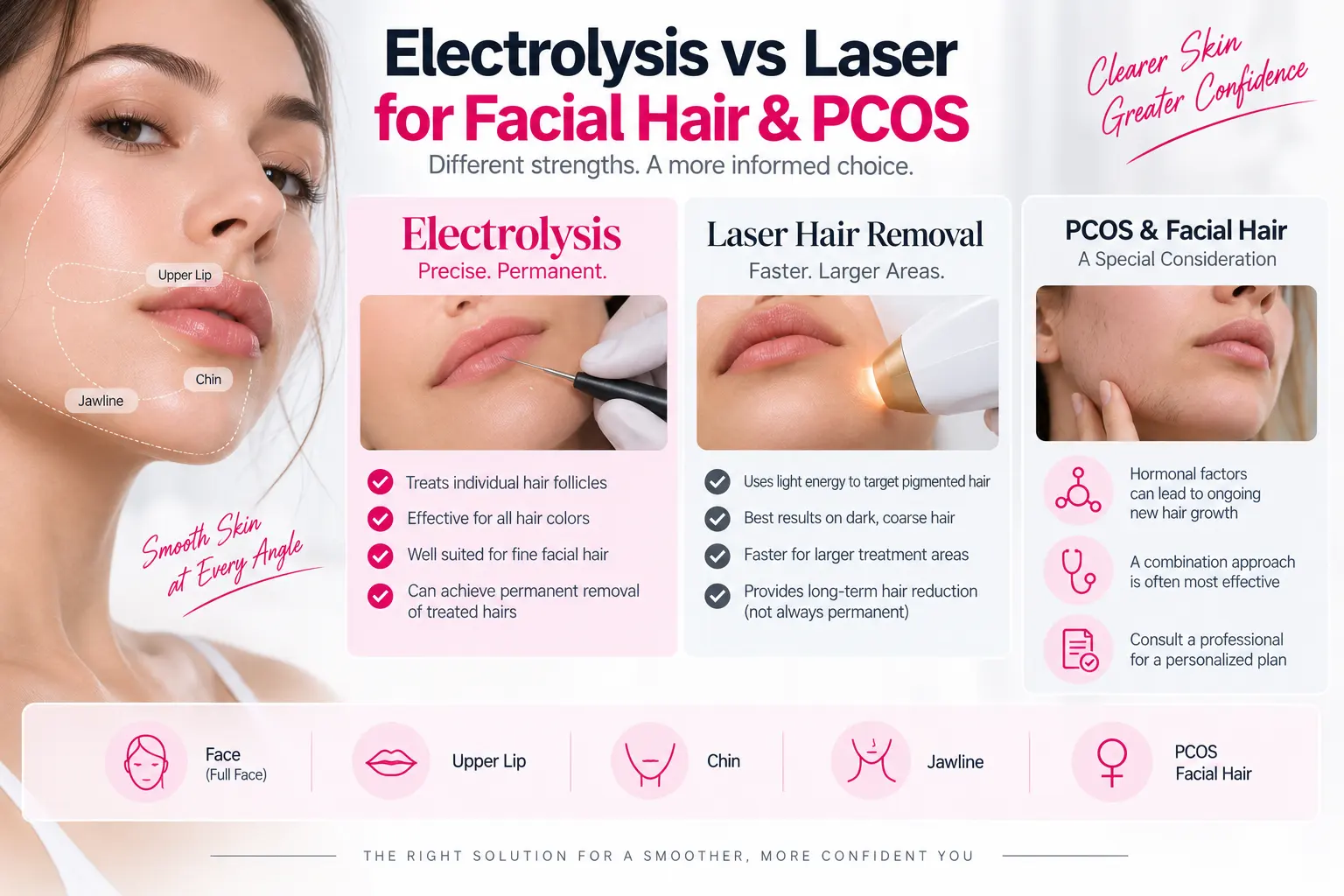
Electrolysis vs laser hair removal face is a particularly important comparison because facial hair can vary from a few isolated hairs to dense, coarse terminal growth.
When comparing electrolysis vs laser hair removal for face, laser may be more practical when there is a substantial amount of dark, coarse hair that provides a suitable optical target.
Electrolysis may be more practical when:
- Only a small number of facial hairs remain
- The hairs are blonde, gray, white or otherwise poorly suited to laser
- Highly precise removal of individual hairs is required
- Residual hairs remain after a laser treatment course
Electrolysis vs Laser Hair Removal Chin
Electrolysis vs laser hair removal chin depends heavily on the number, thickness and color of the hairs.
A chin with many coarse, dark terminal hairs may be suitable for laser reduction. A chin with only several persistent hairs may be more efficiently addressed with electrolysis.
This is also an area where hormonal influences can matter. New hairs developing later are not necessarily evidence that a previously treated follicle has regenerated.
Electrolysis vs Laser Hair Removal Upper Lip
Electrolysis vs laser hair removal upper lip follows a similar decision process.
Dark, sufficiently coarse upper-lip hair may respond to appropriately selected laser treatment. Very fine or lightly pigmented hair may provide a poor laser target, making electrolysis more appropriate for individual hairs.
Electrolysis vs Laser Hair Removal PCOS
Electrolysis vs laser hair removal PCOS deserves separate consideration because hair growth associated with polycystic ovary syndrome can be influenced by ongoing hormonal factors.
Laser hair removal may substantially reduce visible dark, coarse facial or body hair when the hair provides an appropriate optical target. This can make laser useful when a larger number of hairs need treatment.
Electrolysis can permanently treat individual follicles and may be particularly useful for residual hairs after laser or for hairs that lack sufficient pigment for laser targeting.
However, neither method can prevent hormonal factors from stimulating previously inactive follicles to produce new terminal hairs in the future.
Therefore, electrolysis vs laser hair removal for PCOS should not be framed as a guaranteed permanent cure for hormonally influenced hair growth. Some individuals may require ongoing management or maintenance even after successful treatment of existing hairs.
Electrolysis vs Laser Hair Removal Brazilian and Bikini Area
Searches for electrolysis vs laser hair removal Brazilian, electrolysis vs laser hair removal bikini and electrolysis vs laser hair removal for bikini area involve an area that often contains relatively coarse, pigmented terminal hair.
When the hair is dark and appropriately suited to optical treatment, laser hair removal can be much faster for reducing a large number of hairs across the bikini or Brazilian area.
Electrolysis can still be useful when:
- Only scattered hairs remain
- Some remaining hairs are too light for laser
- Precise treatment of individual follicles is desired
For a complete Brazilian clearance using electrolysis alone, the time commitment may be considerably greater because follicles are treated individually.
Electrolysis vs Laser Hair Removal Legs
Electrolysis vs laser hair removal legs illustrates one of the clearest differences between the two technologies.
Legs contain a very large treatment surface. If the hair is dark enough for effective optical targeting, professional laser treatment can cover the area much more efficiently than treating follicles individually with electrolysis.
Electrolysis may become more useful after substantial laser reduction if only a relatively small number of resistant or light-colored hairs remain.
Electrolysis vs Laser Hair Removal Safety
Electrolysis vs laser hair removal safety depends not only on the technology but also on correct treatment technique, appropriate patient selection and professional operation.
Laser hair removal requires careful consideration of skin pigmentation, hair characteristics, wavelength, fluence, pulse duration and cooling. Incorrect parameters can increase the risk of excessive thermal injury.
Electrolysis also requires proper technique. Because a probe is introduced into individual follicles, hygiene, accurate insertion and appropriate energy delivery are important.
Neither treatment should be considered completely risk-free.
Electrolysis vs Laser Hair Removal Side Effects
Electrolysis vs laser hair removal side effects differ because the two methods deliver energy in different ways.
Possible Laser Hair Removal Side Effects
Temporary reactions can include:
- Redness
- Perifollicular swelling
- Warmth or tenderness
- Temporary irritation
- Temporary pigment changes
Less common complications can occur, particularly when treatment parameters or patient selection are inappropriate.
Possible Electrolysis Side Effects
Temporary reactions can include:
- Redness
- Localized swelling
- Tenderness
- Small temporary crusts or scabs
- Temporary skin irritation
Poor technique or inappropriate aftercare can increase the risk of unwanted skin changes.
Electrolysis vs Laser Hair Removal Pros and Cons
An electrolysis vs laser hair removal pros cons comparison makes the trade-offs easier to understand.
| Method | Pros | Cons |
|---|---|---|
| Laser Hair Removal | Fast for large areas; effective reduction of suitable dark hair; useful for legs, back, underarms and bikini areas | Depends on hair pigment; poor option for white and gray hair; multiple sessions required; maintenance may sometimes be needed |
| Electrolysis | Can permanently remove successfully treated follicles; works regardless of hair color; highly precise | Slow for large areas; follicles are treated individually; extensive clearance can require many treatment hours |
Who Should Choose Laser Hair Removal?
Laser hair removal may be the more practical first choice when:
- You have a large amount of dark, pigmented hair
- You want to treat large body areas efficiently
- Your goal is substantial long-term hair reduction
- You are treating legs, back, chest, underarms or bikini areas
- Your hair and skin characteristics are appropriate for the selected laser technology
Professional assessment remains important because not every wavelength or treatment parameter is suitable for every skin and hair combination.
Who Should Choose Electrolysis?
Electrolysis may be the better choice when:
- You have blonde, gray or white hair
- Only a small number of unwanted hairs need treatment
- You have isolated facial hairs on the chin or upper lip
- You have residual hairs after laser treatment
- Your priority is permanent removal of individual treated follicles
- Your hair does not provide a suitable optical target for laser
Can You Combine Laser Hair Removal and Electrolysis?
Yes. Laser hair removal and electrolysis do not always need to be treated as competing alternatives.
For some people, a staged approach can make practical sense:
- Use professional laser treatment to reduce a large volume of dark, suitable hair.
- Complete the planned laser treatment course.
- Reassess the remaining hair.
- Use electrolysis for isolated residual hairs or hairs that lack sufficient pigment for laser.
This approach uses the main advantage of each technology: laser for treatment throughput and electrolysis for follicle-by-follicle precision.
Electrolysis vs Laser Hair Removal: Which Is Better?
So, electrolysis vs laser hair removal which is better?
There is no universal winner.
| Your Priority | Generally More Practical |
|---|---|
| Large area of dark hair | Laser hair removal |
| Fast treatment of many hairs | Laser hair removal |
| Blonde hair | Electrolysis |
| Gray or white hair | Electrolysis |
| A few isolated hairs | Electrolysis |
| Permanent removal of individual follicles | Electrolysis |
| Large-scale long-term hair reduction | Laser hair removal |
| Residual hairs after laser | Electrolysis may be useful |
For many people with large areas of dark hair, laser is the logical first-line option because of its speed. For light-colored hair or small numbers of remaining hairs, electrolysis can offer an important advantage.
常见问题
Is electrolysis better than laser hair removal?
Electrolysis is better when permanent removal of individual follicles is the priority or when the unwanted hairs are blonde, gray or white. Laser hair removal is generally more practical for quickly reducing large areas of dark, pigmented hair.
Is laser hair removal better than electrolysis?
Laser hair removal can be better for large treatment areas containing suitable pigmented hair because it can treat many follicles much faster than electrolysis. It is not necessarily better for very light hair or a small number of isolated hairs.
Which is more permanent, electrolysis or laser hair removal?
In an electrolysis vs laser hair removal permanence comparison, electrolysis has the stronger claim to permanent removal of successfully treated individual follicles. Laser hair removal is generally used to achieve long-term or permanent hair reduction.
Is electrolysis more expensive than laser hair removal?
It depends on the treatment area. Electrolysis may be economical for a small number of individual hairs, but clearing a large area can require many treatment hours. Laser is often more time-efficient for large areas of appropriately pigmented hair.
Which hurts more, electrolysis or laser hair removal?
There is no universal answer to electrolysis vs laser hair removal pain. Both can cause temporary discomfort, and perceived pain depends on the treatment area, settings, session duration, cooling and individual sensitivity.
Is electrolysis or laser better for facial hair?
For electrolysis vs laser hair removal for face, laser may be more practical for larger amounts of coarse dark hair, while electrolysis can be better for isolated hairs and blonde, gray or white facial hair.
Is electrolysis or laser better for chin hair?
For electrolysis vs laser hair removal chin, laser may be useful when many coarse dark hairs are present. Electrolysis may be preferable when only a few hairs remain or when they are too lightly pigmented for laser.
Is electrolysis or laser better for PCOS facial hair?
In an electrolysis vs laser hair removal PCOS comparison, laser may efficiently reduce large amounts of coarse dark hair, while electrolysis can permanently treat individual follicles and remaining light-colored hairs. Neither treatment prevents hormonal factors from stimulating new hair growth in previously inactive follicles.
Is electrolysis or laser better for blonde, gray or white hair?
Electrolysis is generally the more appropriate option for blonde, gray and white hair because it does not depend on hair pigment. Conventional laser hair removal needs sufficient pigment to create an effective optical target.
Can I get electrolysis after laser hair removal?
Yes. Electrolysis may be used after a laser treatment course to target isolated residual hairs, particularly hairs that are too light for effective laser targeting.
Can electrolysis and laser hair removal both be permanent?
They use different treatment endpoints. Electrolysis can permanently remove successfully treated individual follicles, while laser hair removal is generally described as producing long-term or permanent hair reduction.
Final Verdict
The central difference in electrolysis vs laser hair removal is not simply effectiveness. It is the combination of treatment mechanism, hair color, treatment speed, area size and desired endpoint.
Laser hair removal is generally the more practical option for large areas of dark, pigmented hair. It can cover significantly more follicles during a treatment session and is therefore commonly used for legs, back, underarms, bikini areas and other larger zones.
Electrolysis is generally the stronger option for permanent removal of individual follicles and for blonde, gray and white hairs that conventional laser systems cannot effectively target.
The two methods can also complement each other. Laser may first reduce a large volume of suitable pigmented hair, after which electrolysis can target isolated remaining hairs.
The best choice therefore depends on what hair you are treating—not simply which technology sounds more permanent.