Best Facial Hair Removal Device: IPL, Laser or Epilator?
Choosing the best facial hair removal device is more complicated than simply buying the product with the highest energy setting or the strongest marketing claims. Facial hair varies significantly in color, thickness, density and growth pattern, while the skin of the face can also be more visible and sensitive to unwanted treatment reactions.
Another source of confusion is terminology. Products described online as facial hair removal devices may include mechanical epilators, IPL devices, home-use laser devices, electric shavers and professional laser systems. These technologies do not remove or reduce hair in the same way.
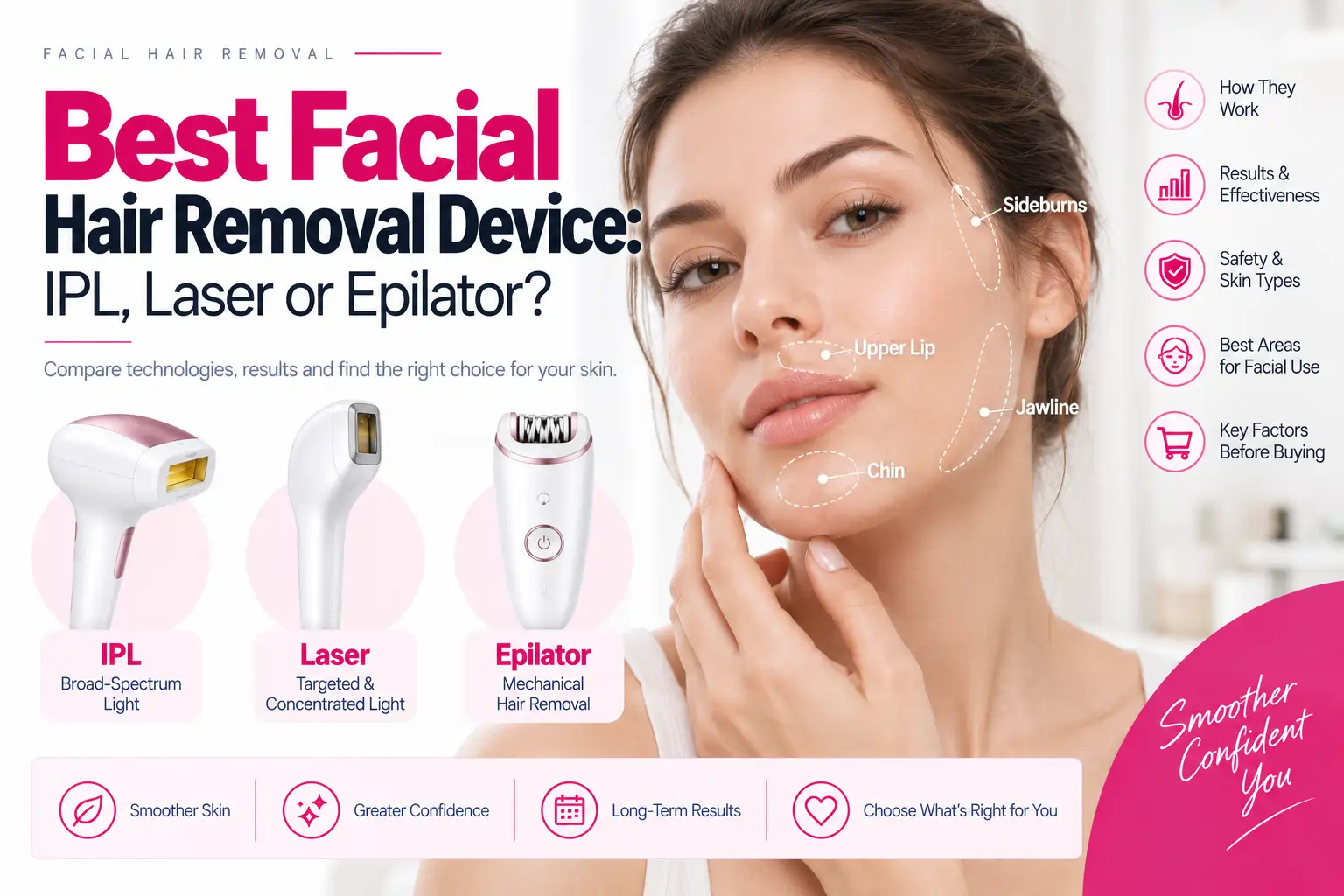
This guide compares IPL, laser and facial epilators to help you understand which technology may be more appropriate for the upper lip, chin, jawline, sideburn area and other suitable facial treatment zones.
Quick Answer: What Is the Best Facial Hair Removal Device?
There is no single facial hair removal device that is best for everyone. The right option depends primarily on whether you want temporary hair removal or longer-term hair reduction, as well as your hair color, skin tone, treatment area, budget and willingness to follow a repeated treatment schedule.
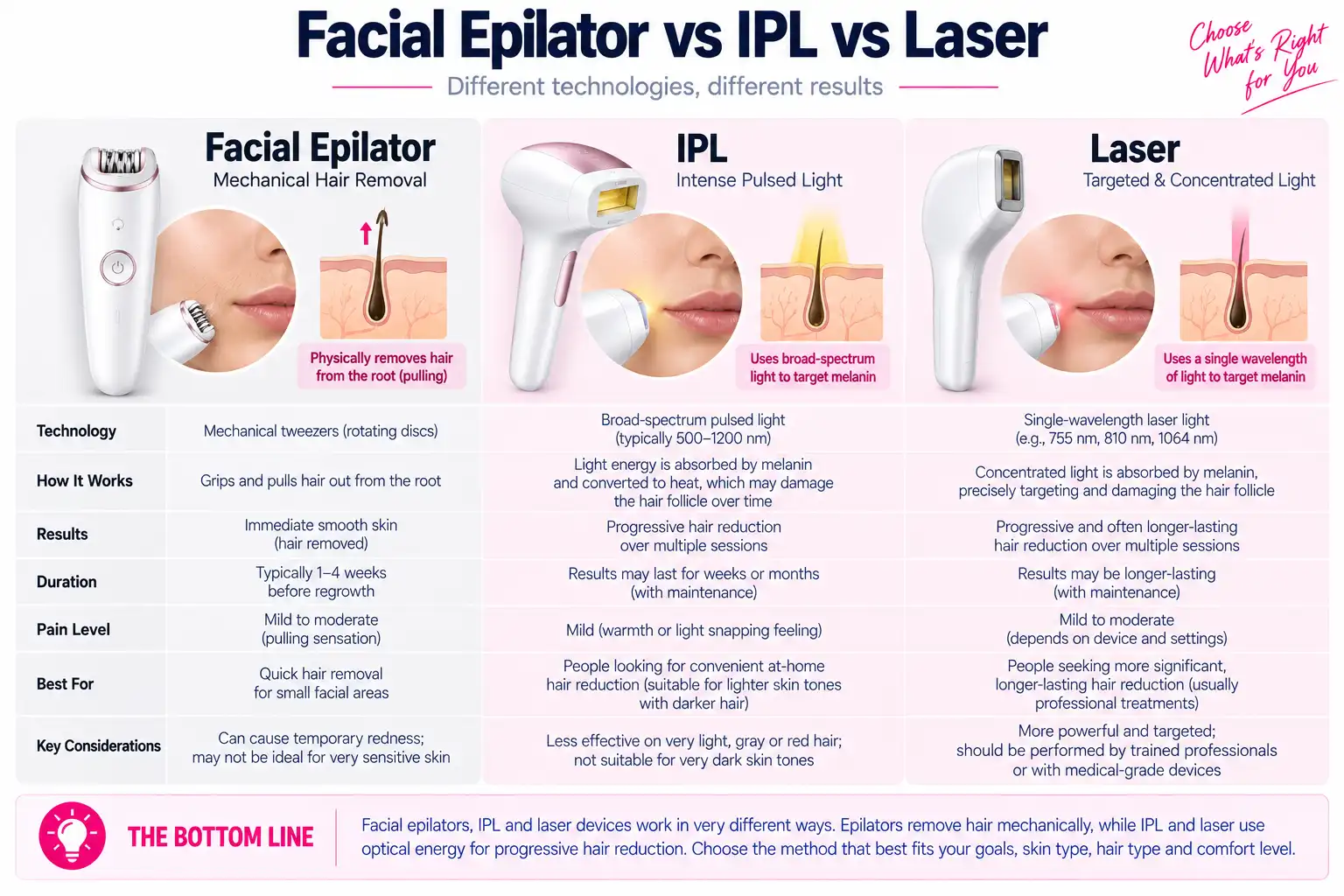
A mechanical epilator physically removes hair from the root and can provide temporary smoothness without targeting future hair growth. IPL uses broadband pulsed light to target suitable pigmented hair and can progressively reduce visible regrowth. Laser hair removal uses laser light at specific wavelength ranges and is available in both selected home-use devices and professional systems.
For users primarily interested in long-term reduction rather than temporary removal, light-based IPL or an appropriate laser technology is generally the more relevant category to investigate. However, device suitability is especially important when treating facial areas.
Facial Epilator vs IPL vs Laser: What’s the Difference?
Before comparing individual devices, it is important to distinguish the technologies. The terms epilator, IPL and laser are sometimes mixed together in online searches, but technically they refer to very different methods.
| Technology | How It Works | Primary Goal | Typical Use |
|---|---|---|---|
| Mechanical Epilator | Physically grips and pulls hairs from the follicle | Temporary hair removal | Home use |
| IPL | Uses filtered broadband pulsed light | Progressive long-term hair reduction | Home and professional use |
| Home Laser | Uses a consumer laser source according to device design | Progressive hair reduction | Home use |
| Professional Laser | Uses professional laser technology at defined wavelength ranges | Professional long-term hair reduction | Clinic or professional setting |
This distinction matters because a user searching for a “laser epilator for face” may actually be looking for a light-based facial hair reduction device rather than a traditional mechanical epilator.
How Does a Facial Epilator Work?
A facial epilator is a mechanical hair-removal device. Small rotating elements or tweezer-like mechanisms capture multiple hairs and pull them from the follicle.
Because the hair is removed rather than simply cut at skin level, the result may last longer than shaving. However, epilation does not use optical energy to selectively target structures involved in future hair growth.
In practical terms:
- Hair is physically removed from the follicle.
- Results are temporary.
- Hair eventually grows again.
- The process can be uncomfortable, particularly in sensitive facial areas.
- Repeated epilation is required to maintain the hair-free appearance.
A mechanical facial epilator may therefore make sense for someone who wants immediate temporary removal without using a light-based device, but it should not be marketed or understood as equivalent to laser hair reduction.
How Does IPL Work for Facial Hair?
IPL, or intense pulsed light, is fundamentally different from mechanical epilation. Instead of pulling hair from the follicle, an IPL system delivers pulses of broadband optical energy.
For hair reduction, melanin associated with suitable pigmented hair absorbs part of this optical energy. The resulting thermal effect is intended to affect follicular structures involved in future hair growth.
Because individual follicles move through different stages of the hair-growth cycle, IPL normally requires repeated treatments rather than a single session.
With an effective treatment course, changes may include:
- Slower visible regrowth
- Reduced hair density
- Fewer visible hairs
- Sparser growth
- Finer or less noticeable regrowth in some users
IPL suitability depends strongly on hair pigmentation, skin pigmentation, device design, treatment area and treatment parameters.
Learn more about the technology in our What Is IPL? How Intense Pulsed Light Works guide.
How Does Laser Facial Hair Removal Work?
Laser hair removal also uses selective optical heating, but unlike IPL’s broadband output, a laser operates within a comparatively narrow wavelength range determined by the laser system.
Professional hair-removal platforms may use technologies such as:
- Alexandrite laser — commonly associated with approximately 755 nm
- Diode laser — commonly built around the approximately 800–810 nm region
- Nd:YAG laser — commonly associated with 1064 nm
These wavelengths have different optical characteristics and are not automatically interchangeable across every skin type, hair type or treatment area.
Professional laser systems may also provide adjustable fluence, pulse duration, spot size, repetition rate and cooling depending on the device design.
For a broader comparison between these two light-based technologies, see IPL vs Laser: What’s the Difference?.
Which Facial Hair Removal Method Lasts the Longest?
The answer depends on what is meant by “lasts.”
Mechanical epilation can leave the skin temporarily free of visible hair because the hair has been pulled from the follicle. However, new hair eventually becomes visible as the follicle continues its growth cycle.
IPL and laser are different because their objective is progressive reduction in future visible hair growth rather than simply removing the existing hair shaft.
| Method | Immediate Hair Removal | Long-Term Hair Reduction | Repeat Treatment |
|---|---|---|---|
| Shaving | Yes, at skin level | No | Frequently |
| Mechanical Epilator | Yes, removes hair from the follicle | Not its primary mechanism | As hair returns |
| IPL | Not immediately | Yes, for suitable hair and skin combinations | Initial series; maintenance may be needed |
| Laser | Not immediately | Yes, when appropriately applied | Multiple sessions; maintenance may be needed |
Neither IPL nor laser should be interpreted as a guarantee that every facial hair will disappear permanently. For the distinction between permanent removal and long-term reduction, see our Is IPL Hair Removal Permanent? guide.
What Is the Best Facial Hair Removal Device for Women?
Women searching for a facial epilator or hair-removal device may be treating very different types of facial hair, ranging from relatively fine upper-lip hair to darker, coarser chin or jawline growth.
The first decision should therefore not be based on gender alone. More useful factors are:
- Hair color
- Hair thickness
- Skin tone
- Treatment area
- Whether immediate removal or long-term reduction is the goal
- Whether treatment will be performed at home or professionally
For someone who simply wants to remove visible hairs immediately, a facial epilator may be sufficient. For someone seeking progressive reduction in suitable pigmented facial hair, an appropriate IPL or laser system may be more relevant.
Facial hair growth can also be influenced by hormonal and biological factors. A device can address suitable visible hair, but it does not diagnose or treat the underlying cause of unexpected hair growth.
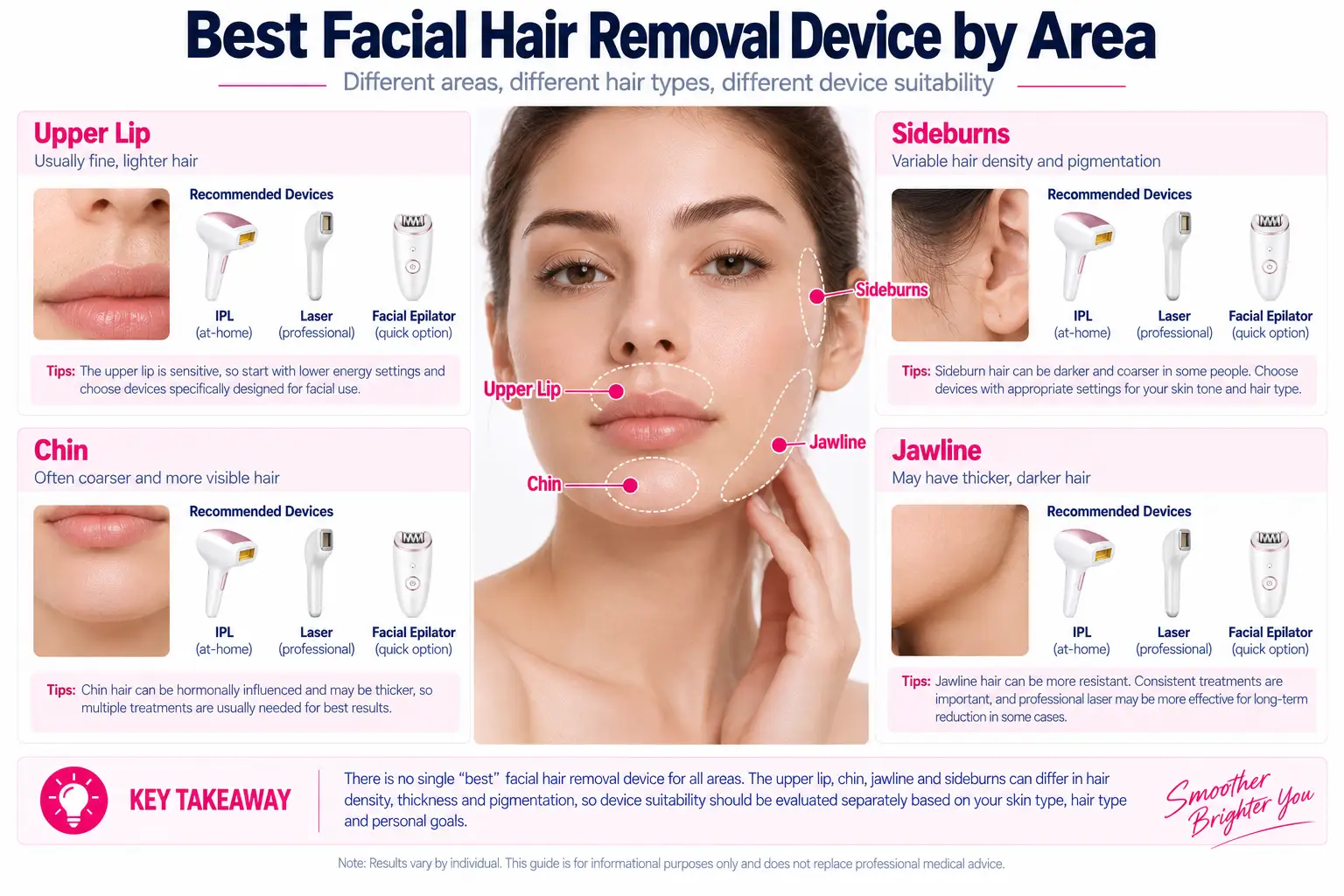
Best Facial Hair Removal Device by Treatment Area
“Facial hair” is not one uniform treatment area. The upper lip, chin, jawline and sideburn region can have different hair characteristics, and device instructions may permit treatment in some facial zones while excluding others.
Always follow the treatment-area restrictions for the specific device.
Best Hair Removal Device for the Upper Lip
The upper lip is a relatively small and highly visible area, so precision and device suitability matter.
A mechanical facial epilator can provide immediate temporary removal but may be uncomfortable for some users. Suitable IPL or laser devices may provide progressive reduction when the hair contains sufficient target pigment and the device is intended for use in that facial area.
Consumer IPL or laser devices should only be used on the upper lip if the manufacturer’s instructions specifically permit treatment there.
Best Hair Removal Device for Chin Hair
Chin hair can sometimes be darker or coarser than hair elsewhere on the face, which may make light-based hair reduction relevant when the skin and hair combination is appropriate.
However, chin hair can also be influenced by hormonal factors. Recurring or newly developing coarse facial hair should not automatically be interpreted as a device failure.
For temporary removal, epilation remains an option. For longer-term reduction, suitable IPL or laser technology may be considered according to device compatibility and professional assessment where appropriate.
Best Hair Removal Device for the Jawline
Jawline treatment requires attention to coverage because hair can be scattered rather than uniformly distributed.
Larger treatment windows may improve speed, while smaller treatment areas may benefit from greater precision. The ideal design depends on the specific device and intended use rather than treatment-window size alone.
Best Hair Removal Device for Sideburns
Sideburn hair may range from fine facial hair to darker terminal hair. This distinction matters because light-based devices depend substantially on the presence of suitable pigment within the hair.
Do not assume that every fine or lightly pigmented facial hair will respond effectively to IPL or laser simply because the device can physically be positioned over the area.
Is IPL Good for Facial Hair?
IPL can be useful for reducing suitable pigmented facial hair, but it is not universally effective for every hair color or skin tone.
Because IPL hair reduction relies substantially on melanin as an optical target, darker pigmented hair generally provides a stronger target than hair containing very little melanin.
IPL may therefore be less effective for:
- White hair
- Gray hair
- Very light blonde hair
- Some red hair
Skin pigmentation must also be considered because epidermal melanin can absorb optical energy. Device-specific skin-tone compatibility is therefore important for both effectiveness and safety.
What Is the Best Facial Hair Removal Device for Dark Skin?
Selecting a light-based facial hair removal device for darker skin requires greater attention to wavelength, device design, cooling, treatment parameters and skin-tone compatibility.
The challenge is that melanin exists in both the hair and epidermis. A system intended to target pigmented hair must limit unnecessary heating of surrounding skin.
This is one reason it is not appropriate to say that every IPL or laser device is suitable for every skin tone.
Professional laser technology may provide additional wavelength and parameter options. For example, 1064 nm Nd:YAG systems are frequently considered in professional hair-removal discussions involving darker skin because of their optical characteristics, but suitability still depends on the specific system, operator, parameters and individual assessment.
For home use, follow the manufacturer’s stated skin-tone compatibility rather than assuming that a device marketed as “safe for the face” is automatically appropriate for every skin tone.
What Is the Best Facial Hair Removal Device for Sensitive Skin?
There is no universal device that can be labeled the best for all sensitive skin. “Sensitive skin” can describe many different experiences, and the cause of irritation matters.
Mechanical epilation can cause temporary redness or irritation because multiple hairs are physically pulled from the skin. IPL and laser involve optical and thermal exposure and can also cause temporary skin reactions.
The better approach is to consider:
- Whether the device is intended for the treatment area
- Skin-tone compatibility
- Device-specific intensity settings
- Cooling or comfort features
- Manufacturer instructions
- History of skin reactions
- Any contraindications relevant to the user
Users concerned about IPL-related reactions can read our IPL Hair Removal Side Effects: Is IPL Safe? guide.
Which Facial Hair Removal Method Is Best by Goal?
| Your Main Goal | Technology to Consider | Why |
|---|---|---|
| Fast temporary removal | Shaving or facial epilator | Removes existing visible hair without a treatment course |
| Hair removed from the root | Facial epilator | Mechanical removal can last longer than surface shaving |
| At-home long-term reduction | Compatible IPL or home laser device | Targets suitable pigmented hair over repeated treatments |
| Professional long-term reduction | Professional laser or IPL | Allows professional assessment and device-dependent parameter selection |
| Very light or non-pigmented hair | Light-based devices may be limited | IPL and laser hair reduction depend substantially on suitable optical targets |
At-Home vs Professional Facial Hair Removal Devices
Another important decision is whether facial hair reduction should be performed with an at-home device or a professional system. These two categories may use related light-based principles, but they are designed for different users, treatment environments and levels of parameter control.
At-home devices prioritize convenience and consumer usability. Professional systems are designed for trained operators and may provide broader device-dependent control over wavelength, fluence, pulse duration, spot size, repetition rate and cooling.
| Factor | At-Home Device | Professional System |
|---|---|---|
| Primary user | Consumer | Trained professional |
| Convenience | High | Requires appointments or professional treatment |
| Parameter control | Usually simplified | Potentially broader, depending on the system |
| Skin and hair assessment | User follows device guidance | Professional assessment can guide treatment |
| Treatment area | Limited to manufacturer-approved areas | Determined by system indications and professional assessment |
| Maintenance | Easy to perform at home when appropriate | May require additional professional sessions |
Neither category is automatically “better.” The more useful question is which approach is appropriate for the user’s skin, hair, treatment area, expectations and preferred treatment environment.
If home use is your priority, our Best At-Home Laser Hair Removal Device: IPL vs Diode Explained guide examines the broader home-device category.
How to Choose the Best Facial Hair Removal Device
Product marketing often emphasizes power levels, flash counts or treatment speed, but these specifications should not be considered in isolation. For facial treatment, compatibility and controlled energy delivery are generally more important than simply choosing the device with the largest number on the specification sheet.
1. Decide Between Temporary Removal and Long-Term Reduction
This is the most important first step.
If your goal is simply to remove visible hair immediately, shaving or mechanical epilation may be sufficient. If your goal is to progressively reduce future visible hair growth, IPL or laser becomes more relevant.
2. Check Your Hair Color
Hair pigmentation matters for light-based hair reduction because melanin is an important optical target.
Darker pigmented hair generally provides a stronger optical target than white, gray or very lightly pigmented hair. This is why a highly rated IPL or laser device may still be a poor choice for someone whose facial hair lacks sufficient target pigment.
3. Check Skin-Tone Compatibility
Skin tone is particularly important because epidermal melanin can also absorb optical energy. A device must therefore be appropriate for the user’s skin characteristics rather than selected solely according to hair color.
For home devices, follow the manufacturer’s compatibility chart and instructions. For professional treatment, skin assessment and appropriate technology and parameter selection are important parts of treatment planning.
4. Confirm That the Device Is Intended for Facial Use
A device marketed for hair removal is not automatically approved or intended for every part of the face.
Pay attention to:
- Permitted facial treatment areas
- Minimum distance from the eyes
- Whether upper-lip treatment is permitted
- Whether chin and jawline treatment is permitted
- Instructions for treating around facial contours
- Areas explicitly excluded by the manufacturer
Light-based hair-removal devices should never be used around the eyes contrary to the manufacturer’s instructions.
5. Consider Treatment Window Size and Precision
A large treatment window can improve speed on areas such as the legs, but facial hair removal may benefit from a design that allows accurate placement around smaller treatment zones.
This is particularly relevant around the upper lip, chin edges and jawline, where precision may matter more than maximum treatment speed.
6. Consider Cooling and Comfort
Cooling does not determine effectiveness by itself, but it can influence treatment comfort and thermal management.
Professional laser and IPL platforms may incorporate contact cooling, cooled sapphire components or other device-specific cooling technologies. Consumer devices may use different comfort-management approaches.
Cooling should be considered alongside optical output, treatment parameters and overall system design rather than treated as a standalone indicator of device quality.
7. Consider Treatment Speed
Treatment speed is less critical for a small upper-lip area than for full legs, but it can still matter when treating the jawline, sideburn region or multiple body areas.
Repetition rate, treatment-window size and operating mode can influence how quickly a light-based system covers an area.
8. Look Beyond Flash Count
Consumer IPL devices are frequently marketed using very high flash-count numbers. While lamp life can affect device longevity, a larger flash count does not automatically mean better hair-reduction performance.
Compatibility, optical design, treatment consistency and appropriate energy delivery are more meaningful than flash count alone.
Facial Hair Removal Device Compatibility by Hair and Skin Characteristics
| Situation | What to Consider |
|---|---|
| Dark, coarse facial hair | May provide a useful optical target for an appropriate IPL or laser system, subject to skin-tone compatibility. |
| Very light blonde hair | Conventional light-based reduction may be limited because target melanin is low. |
| Gray or white facial hair | IPL and conventional laser hair reduction may be poorly suited because melanin is minimal or absent. |
| Red facial hair | Response to conventional light-based devices can be limited depending on pigmentation characteristics. |
| Darker skin tones | Device, wavelength, cooling and parameter selection require particular attention to epidermal melanin. |
| Fine facial hair | Suitability depends on pigmentation and other characteristics; not every fine hair is an effective optical target. |
Can You Use IPL for Facial Hair at Home?
Some consumer IPL devices are designed for use on selected facial areas, but this should never be assumed simply because a product is marketed as an at-home hair-removal device.
Before treating facial hair at home, confirm:
- The face is included in the permitted treatment areas
- Your skin tone is within the device’s stated compatibility range
- Your hair color is suitable for the technology
- You understand where treatment around the eyes is prohibited
- You have followed any required patch-test instructions
- You understand the recommended treatment interval
Do not use a body-only IPL device on the face unless the manufacturer’s instructions specifically permit it.
Can Facial Hair Be Removed Permanently?
The word permanent is frequently used too loosely in facial hair removal marketing.
Mechanical epilators provide temporary removal because the hair eventually grows again. IPL and laser are intended to produce progressive, longer-term reduction in suitable hair, but they should not automatically be interpreted as guaranteeing that every treated hair will disappear forever.
Some facial hair can become visible again over time, and biological or hormonal influences can contribute to future growth. Maintenance treatments may therefore be appropriate for some people.
This distinction is especially important when evaluating products marketed as a permanent facial hair remover. The marketing phrase itself does not prove that a device can permanently eliminate every facial hair.
How Long Does Facial IPL or Laser Hair Removal Take to Work?
Light-based facial hair reduction is a treatment course rather than an instant removal method.
Individual follicles are not synchronized in the same stage of the hair-growth cycle. Repeated treatments provide opportunities to target suitable hairs as their biological state changes.
Depending on the technology, treatment schedule and individual response, progress may appear as:
- Slower visible regrowth
- Reduced hair density
- Increasingly sparse areas
- Finer or less noticeable regrowth
- Longer intervals before visible hair returns
Do not judge a light-based facial hair removal device solely by whether all visible hair disappears immediately after the first treatment.
For a detailed results timeline, see IPL Hair Removal Before and After: What Results Can You Expect? .
Should You Pluck or Epilate Before IPL or Laser Hair Removal?
This is an important distinction between mechanical epilation and light-based hair reduction.
If you are following an IPL or laser hair-removal protocol, pulling hairs from the follicle immediately before treatment may interfere with the intended optical targeting process. Many light-based hair-removal protocols instead use shaving to remove hair above the skin while retaining the pigmented hair structure within the follicular pathway.
Follow the preparation instructions supplied with the specific device or by the treating professional rather than combining epilation and IPL or laser without considering how the technologies work.
Facial Epilator vs IPL: Which Is Better?
Neither is universally better because they solve different problems.
| Choose a Facial Epilator If… | Consider IPL If… |
|---|---|
| You want immediate removal | You want progressive long-term reduction |
| You are comfortable pulling hair from the root | Your hair and skin are compatible with the device |
| You do not want a light-based treatment course | You are willing to perform repeated treatments |
| Your hair is not well suited to optical targeting | Your facial hair contains suitable target pigment |
The key difference is therefore temporary physical removal versus progressive optical hair reduction.
IPL vs Laser for Facial Hair: Which Is Better?
IPL and laser both belong to the light-based hair-reduction category, but they are not the same technology.
IPL uses filtered broadband light, while a laser operates within a comparatively narrow wavelength range. Professional laser systems can therefore be selected around specific wavelength characteristics, while professional IPL systems may use filters and pulse configurations to shape their optical output.
Which is more appropriate depends on factors including:
- Skin pigmentation
- Hair pigmentation and thickness
- Treatment area
- Professional versus home use
- Device capabilities
- Cooling
- Operator experience
- Individual treatment goals
This means “laser is always better than IPL” and “IPL is always better than laser” are both overly simplistic conclusions.
Common Mistakes When Choosing a Facial Hair Removal Device
Choosing by Energy Level Alone
Higher energy is not automatically better. Energy must be appropriate for the technology, treatment area, skin characteristics and device protocol.
Assuming “Laser Epilator” Is a Specific Technology
The phrase laser epilator is frequently used in consumer searches, but it can blur the distinction between mechanical epilation, IPL and actual laser technology. Always check what energy source the device really uses.
Buying an IPL Device Without Checking Skin-Tone Compatibility
A popular device is not necessarily appropriate for every skin tone. Compatibility should be checked before purchase and before treatment.
Expecting Light-Based Treatment to Remove Hair Instantly
IPL and laser are not equivalent to shaving or epilation. Hair reduction develops over a treatment course.
Using a Device Too Close to the Eyes
Facial treatment requires strict attention to device-specific restrictions around the eyes. Never extend the treatment area beyond what the manufacturer or professional protocol permits.
Using a Body Device on the Face Without Checking the Instructions
Not every hair-removal device is designed for facial use. A body attachment or body-only device should not automatically be used on the face.
Ignoring the Cause of Changing Facial Hair Growth
A hair-removal device addresses hair; it does not diagnose why facial hair is developing. If facial hair changes substantially or is accompanied by other concerning symptoms, appropriate medical evaluation may be useful.
Which Facial Hair Removal Device Should You Choose?
| If You Want… | Start by Considering… |
|---|---|
| Simple, immediate removal | Shaving or a mechanical facial epilator |
| Hair pulled from the root | Facial epilator |
| Home-based progressive hair reduction | Compatible home IPL or laser device |
| Professional facial hair reduction | Professional IPL or laser treatment |
| Treatment for darker skin | A system specifically appropriate for the skin tone; professional wavelength and parameter selection may deserve consideration |
| Treatment for white or gray hair | Recognize that conventional IPL and laser hair reduction may have significant limitations |
常见问题
What is the best device for facial hair removal?
The best device depends on your goal. Mechanical epilators are designed for temporary hair removal from the root, while suitable IPL and laser devices are more relevant when the goal is progressive long-term hair reduction.
Is a facial epilator good for facial hair removal?
A facial epilator can effectively remove suitable hairs mechanically and may provide longer temporary smoothness than shaving. However, it does not work through the same long-term hair-reduction mechanism as IPL or laser.
Is IPL good for facial hair?
IPL can reduce suitable pigmented facial hair when the device, treatment area, skin tone and hair characteristics are compatible. It is not equally effective for every hair color or skin type.
Is laser better than an epilator for facial hair?
They serve different purposes. An epilator physically removes existing hair, while laser treatment is intended to progressively reduce future hair growth. The better choice depends on whether temporary removal or longer-term reduction is the goal.
Can I use a hair removal device on my upper lip?
Only if the specific device is intended for that facial area. Check the manufacturer’s instructions carefully, particularly restrictions involving the lips, eyes and surrounding facial structures.
Which laser is best for facial hair removal?
There is no single laser wavelength that is best for every person. Professional systems may use technologies such as 755 nm Alexandrite, approximately 800–810 nm diode or 1064 nm Nd:YAG. Selection depends on skin pigmentation, hair characteristics, treatment area and professional assessment.
What is the best facial hair removal device for women?
The choice should be based on hair and skin characteristics rather than gender alone. Women seeking immediate temporary removal may consider a facial epilator, while those seeking progressive reduction may investigate compatible IPL or laser technologies.
Can IPL permanently remove facial hair?
IPL is better understood as a technology for progressive and potentially long-term hair reduction rather than a guarantee that every facial hair will be permanently eliminated. Some regrowth and maintenance treatment may occur.
Does facial hair grow back after laser or IPL?
Some hair can become visible again after a treatment course. Regrowth may be reduced, slower, finer or less dense in successful treatments, but results vary between individuals.
Can IPL or laser remove white facial hair?
Conventional IPL and laser hair-reduction technologies depend substantially on melanin as an optical target. White and gray hair therefore generally present significant limitations because they contain little or no melanin.
Final Verdict: IPL, Laser or Facial Epilator?
The best facial hair removal device depends first on whether you want temporary removal or progressive long-term hair reduction.
A facial epilator is primarily a mechanical solution. It removes existing hair from the root and can provide temporary smoothness, but the hair eventually returns.
IPL is a light-based option available in both consumer and professional systems. For suitable hair and skin combinations, repeated treatments can progressively reduce visible facial hair growth.
Laser hair removal uses specific laser wavelengths and can offer additional technology choices in professional settings. However, the correct laser depends on the individual’s skin pigmentation, hair characteristics and treatment requirements rather than on a universal “best wavelength.”
For facial treatment in particular, prioritize hair and skin compatibility, permitted treatment areas, precision, appropriate energy delivery and realistic expectations over claims such as maximum power, unlimited flashes or permanent removal.
If your primary goal is home-based long-term hair reduction, continue with our Best At-Home Laser Hair Removal Device guide. If you are deciding specifically between light-based technologies, read IPL vs Laser.