CO2 Laser vs Thulium Laser FAQ: Expert Answers for Aesthetic Clinics & Dermatologists
Overview
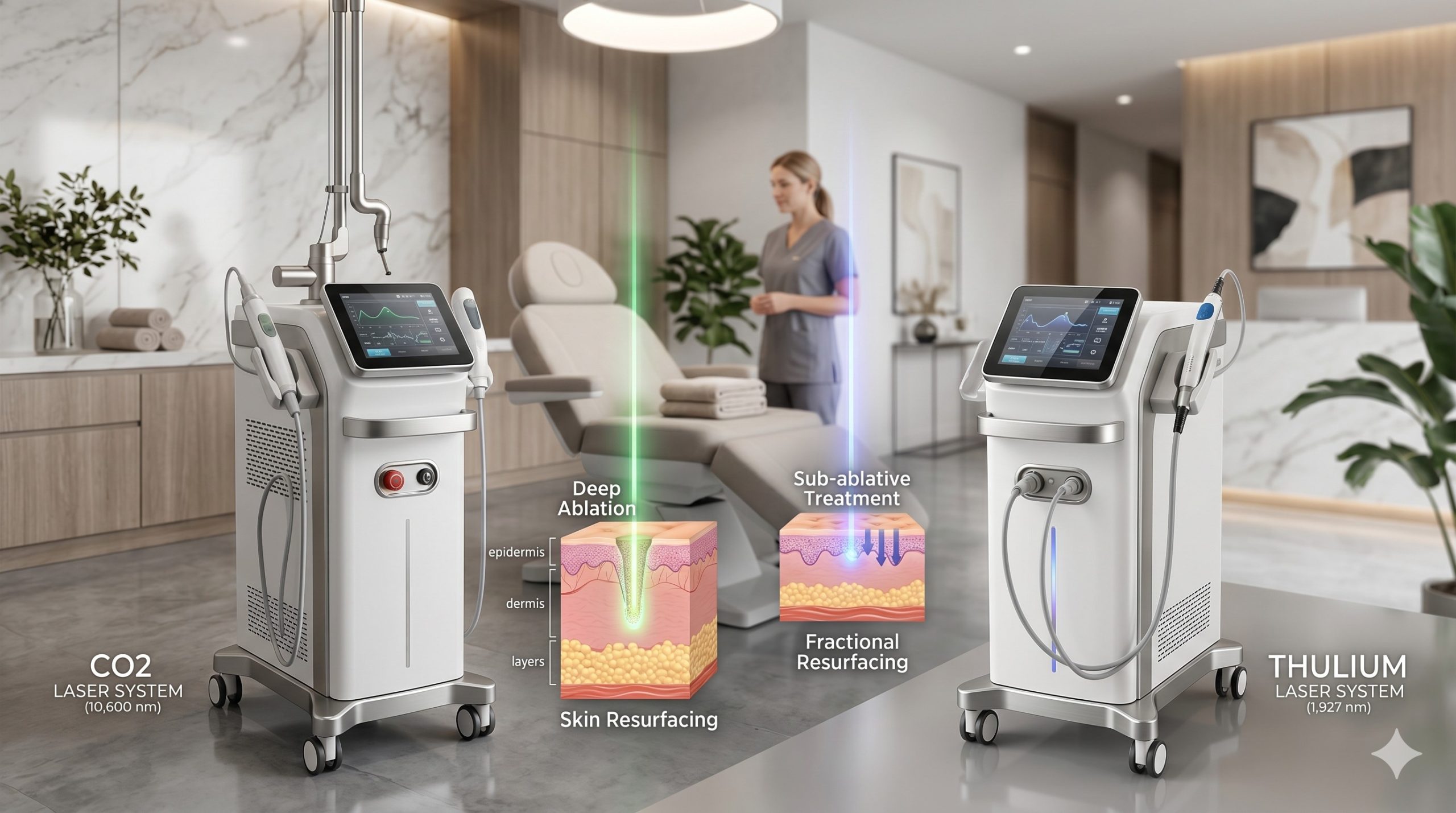
Choosing between a CO2 and a 1927nm Thulium laser is a critical capital decision for any aesthetic clinic. Each technology operates on fundamentally different principles of tissue interaction, dictating their clinical applications, patient experience, and return on investment. CO2 lasers (10,600nm) are the gold standard for deep, ablative resurfacing, while Thulium lasers (1927nm) offer a non-ablative or micro-ablative approach for superficial rejuvenation with minimal downtime . This FAQ provides evidence-based answers to the most common pre-sales and post-sales questions for B2B buyers.
Frequently Asked Questions
Q1: What is the primary clinical difference between CO2 and 1927nm Thulium lasers?
The primary difference lies in their ablative mechanism and treatment depth. CO2 lasers are ablative, meaning they vaporize the outer layers of skin to create deep micro-channels, making them ideal for severe wrinkles, deep acne scars, and significant photoaging . In contrast, the 1927nm Thulium laser is non-ablative or micro-ablative, targeting water in the epidermis and superficial dermis without vaporizing the stratum corneum, preserving the skin barrier for quicker healing . This makes Thulium better suited for superficial pigmentation, melasma, and fine lines.
Q2: Which laser is safer for Fitzpatrick Skin Types IV-VI?
The 1927nm Thulium laser is significantly safer and preferred for darker skin types (Fitzpatrick IV-VI). The Thulium wavelength has lower melanin absorption compared to the 10,600nm CO2 wavelength, substantially minimizing the risk of post-inflammatory hyperpigmentation (PIH), a common complication in darker skin . For types V-VI, Thulium protocols typically utilize lower fluences (≤ 5 mJ) and mandatory pre-treatment with tyrosinase inhibitors, whereas CO2 lasers are generally contraindicated or require extreme caution for these skin types .
Q3: How do downtime and recovery periods compare between the two devices?
Recovery time is a stark differentiator. CO2 laser downtime is long, typically lasting 7 to 14 days of visible redness, swelling, and scabbing, with full erythema resolution taking weeks to months . The Thulium laser offers minimal downtime of only 1 to 3 days, with patients experiencing mild redness and slight desquamation . Studies have shown that the inflammation induced by CO2 is so pronounced that it requires anesthesia, while Thulium treatments often do not .
Q4: What are the typical ROI and business model considerations for each laser?
The ROI models for these lasers differ based on treatment frequency and pricing. The Thulium laser is ideal for generating high-volume, repeatable bookings, as patients require 3-5 sessions for optimal results and return quickly for maintenance, creating a steady recurring revenue stream . The CO2 laser offers a higher single-treatment price point due to its dramatic results but involves lower patient throughput because of the extended recovery time . Many clinics utilize Thulium as a “gateway” treatment to attract patients, later upselling them to CO2 for premium, transformative correction .
Q5: What is the difference in pain management between CO2 and Thulium treatments?
Pain levels are significantly lower with Thulium lasers. CO2 laser treatments generate intense heat and pain, typically rated 6-8 out of 10, requiring the application of topical anesthetic ointment for 30-60 minutes and potentially injectable nerve blocks . In contrast, the 1927nm Thulium laser is much gentler, with pain levels ranging from 2 to 4 out of 10, often described as a warm pinprick, and topical anesthesia is usually sufficient . This contributes to a significantly better patient comfort experience and higher satisfaction.
Q6: How effective are these lasers for laser-assisted drug delivery (LADD)?
Both lasers effectively enhance topical drug penetration, but with different mechanisms and outcomes. Both CO2 and Thulium lasers improve the cutaneous uptake of substances like hyaluronic acid, reaching the upper dermal layer . However, CO2 creates larger micro-channels, leading to larger aggregate sizes of the delivered drug, while Thulium results in more uniformly small aggregates . While the CO2 laser may be slightly more effective at delivering the product, the Thulium laser offers a treatment option with significantly less downtime and subclinical inflammation .