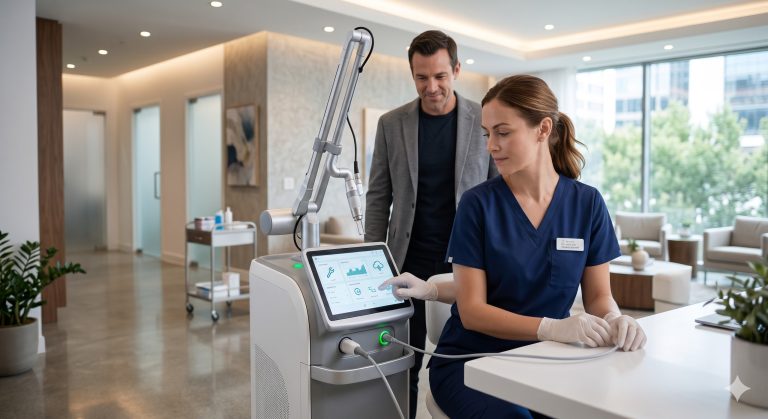
Top Picosecond Tattoo Removal Questions Answered: Skin Types, Lifespan & Efficacy
Overview
For B2B clinic buyers and dermatologists, understanding the rigorous pre and post-care protocols for picosecond tattoo removal is essential for maximizing patient outcomes, minimizing liability, and ensuring device longevity. This FAQ addresses high-intent clinical and operational questions for aesthetic practices investing in modern picosecond technology.

Frequently Asked Questions
Q1: Is picosecond laser tattoo removal suitable for all Fitzpatrick skin types (I-VI)?
Yes, picosecond lasers are clinically safe and effective for Fitzpatrick skin types I through VI. This is achieved through ultra-short pulse durations (picoseconds instead of nanoseconds) that shatter ink via photomechanical impact rather than thermal damage, dramatically reducing the risk of post-inflammatory hyperpigmentation (PIH) common in darker skin types. For type V-VI skin, clinics must use lower fluence (0.8-2.5 J/cm²) and longer pulse repetition intervals (3-5 seconds) combined with dynamic cooling.
Q2: What are the mandatory pre-care protocols before a picosecond tattoo removal session?
Mandatory pre-care includes: 1) No sun exposure or tanning (natural or artificial) for 4 weeks prior—test with a spectrophotometer if needed. 2) Avoid blood-thinning medications (aspirin, NSAIDs, fish oil, vitamin E) for 5-7 days. 3) Shave the treatment area 24 hours before (never wax or pluck). 4) Perform a test spot at least 72 hours before full treatment to assess ink reaction and epidermal response, especially on Fitzpatrick IV-VI. 5) Document baseline skin condition with cross-polarized photography.
Q3: What is the expected number of sessions for complete tattoo clearance with picosecond?
Clinical studies demonstrate 50-75% ink clearance in 3-4 sessions for professional tattoos, with complete clearance typically requiring 6-10 sessions spaced 6-8 weeks apart. Amateur tattoos may clear in 2-4 sessions. Multicolored tattoos require more sessions (especially yellows and pastels) due to variable absorption coefficients. A key B2B insight: picosecond reduces total sessions by 30-50% compared to Q-switched nanosecond lasers, directly improving clinic throughput and patient retention.
Q4: What post-care side effects are normal versus requiring escalation?
Normal post-care effects (24-72 hours): pinpoint bleeding (petechiae), mild to moderate edema, erythema, and a frosted gray-white epidermal change (epidermal vacuolization). Frosting typically resolves within 30-60 minutes. Abnormal signs requiring escalation: blistering extending beyond the treatment perimeter (>5mm), purulent discharge, fever >38.5°C, or severe pain unresponsive to ice—these indicate infection or overtreatment. Immediate clinic protocol: discontinue treatment, prescribe topical antibiotics (mupirocin 2%) and refer for medical evaluation.
Q5: How should patients manage the 7-day post-treatment wound care protocol?
Day 1-3: Apply sterile occlusive petrolatum-based dressing changed twice daily, no soaking or scrubbing, ice packs (10 min/hour) for edema. Day 3-7: Transition to non-occlusive hydrogel or silicone dressing, apply broad-spectrum SPF 50+ mineral sunscreen (zinc oxide/titanium dioxide) if exposed, and absolutely no exfoliation, retinoids, or acids. Prohibited activities for 7 days: sauna, swimming pools, hot tubs, intense exercise causing sweating over the site. Document healing at day 7 with standardized lighting.
Q6: What is the typical handpiece lifespan and consumable schedule for a picosecond device?
The typical handpiece lifespan of a medical-grade picosecond laser is 2-3 million shots (or 18-24 months under standard clinical usage of 200-300 pulses per session, 20 sessions weekly). Clinics must track shot count via the device’s internal counter. Consumable replacement schedule: energy delivery lens (every 500k shots or annual PM), distilled water filters (every 3 months), and contact cooling sapphire tips (every 6 months or if cracked). Factor consumable costs at $0.08-$0.12 per shot into your ROI calculation.
Q7: What is the contraindicated post-care patient behavior that most increases side effect risk?
The single most contraindicated behavior is premature manual removal of crusting or micro-crusts (typically day 4-7 post-treatment). Scrubbing or picking disrupts the nascent epidermal barrier, increasing infection risk by 4x and hypopigmentation risk by 7x based on published adverse event registries. Patients must be explicitly counseled to allow crusts to fall off naturally (10-14 days). Second highest risk: direct sun exposure without SPF 50+ within 30 days post-treatment, which can cause permanent mottled hyperpigmentation.
Q8: How quickly can a clinic expect ROI on a picosecond tattoo removal device?
A clinic performing 8-12 tattoo removal sessions weekly at $350-$600 per session (depending on size/color complexity) achieves ROI within 6-9 months on a $80,000-$120,000 picosecond system. Calculate payback period as: (Device cost + training + consumables) / (Avg session price × Weekly sessions × 4.3 weeks × Clinic margin after overhead). Key B2B metric: picosecond’s reduced session count (30-50% fewer than Q-switched) allows 30% more patient turnover, directly increasing revenue per room. Most clinics see positive cash flow by month 4.