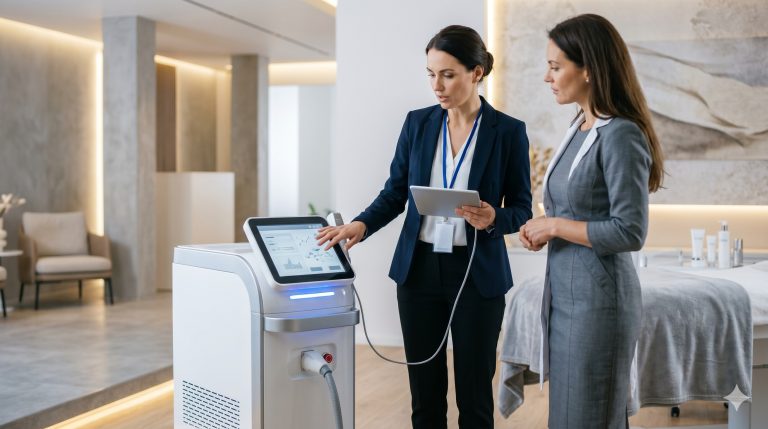
How Does a 1927nm Thulium Laser Work: Clinic Investment & Clinical FAQ
Overview
The 1927nm thulium laser operates in the mid-infrared spectrum, targeting intracellular water in the epidermis and superficial dermis with peak absorption just below the water absorption peak of CO2 (10600nm) and erbium (2940nm). This creates microscopic treatment zones (MTZs) via fractional ablation while preserving surrounding tissue. For B2B clinic buyers, understanding the precise mechanism—selective photothermolysis through water targeting—directly impacts treatment efficacy, patient safety, and device ROI. Below are the most critical pre-sales and post-sales questions answered for dermatologists and clinic procurement managers.
Frequently Asked Questions
Q1: How does a 1927nm thulium laser achieve both ablation and coagulation in the same pulse?
The 1927nm wavelength simultaneously creates a superficial micro-ablation zone (50-100µm depth) and a deeper coagulation zone (150-300µm). This dual effect occurs because water absorption at 1927nm is strong enough to vaporize tissue superficially but not so strong that it blocks energy penetration entirely. The result: immediate skin resurfacing plus collagen remodeling without the prolonged downtime associated with fully ablative lasers.
Q2: Is the 1927nm thulium laser suitable for all Fitzpatrick skin types including IV, V, and VI?
Yes, the 1927nm thulium laser is clinically safe for Fitzpatrick skin types I through VI when properly configured with lower energy densities (20-40 mJ/MTZ) and longer pulse widths. Unlike Q-switched or IPL devices, the 1927nm wavelength has minimal melanin absorption competition—its primary chromophore is water, not melanin. This reduces post-inflammatory hyperpigmentation risk. Key safety protocol: perform a test spot at 48 hours, use hydroquinone pre-treatment for 2 weeks on higher Fitzpatrick types, and select energy settings not exceeding 30 mJ for type V-VI.
Q3: What is the typical handpiece shot lifespan and how often must I replace consumables on a 1927nm thulium machine?
The handpiece of a medical-grade 1927nm thulium laser typically delivers 3 million to 10 million effective shots before requiring replacement, depending on the diode pump source quality (imported German or US bars vs. domestic). Consumables include: the sapphire contact cooling window (replace every 2-3 million shots or if scratched), the distilled water filter (change every 500 hours), and the handpiece cable (every 18-24 months). Low-consumable designs cost approximately $0.03-$0.07 per patient treatment area, significantly lower than fractional CO2 ($0.15-$0.30 per spot).
Q4: How does the integrated contact cooling system prevent epidermal burns during 1927nm thulium laser treatments?
The 1927nm thulium laser uses continuous sapphire contact cooling maintained at 0°C to 4°C. This cooling mechanism works by: (1) conducting heat away from the stratum corneum before thermal diffusion reaches pain receptors, (2) constricting superficial capillaries to reduce unintended erythema, and (3) creating a reverse thermal gradient that protects basal keratinocytes. Without cooling, the 1927nm wavelength would cause superficial crusting even at therapeutic settings. Always verify that your device includes real-time skin temperature monitoring (cutoff at 42°C) and a closed-loop water chiller system.
Q5: What is the expected ROI and payback period for a clinic purchasing a 1927nm thulium laser?
A 1927nm thulium laser generates ROI within 6-14 months for a typical med spa averaging 20-30 treatments per week at $350-$650 per session (face resurfacing or melasma treatment). Calculation example: $45,000 device cost + $3,000 annual consumables vs. $520 average treatment price × 25 weekly treatments × 48 weeks = $624,000 annual gross revenue, minus $150,000 operator and overhead → net profit of $474,000, yielding full payback in 1.1 months gross and 5-6 months net. Key profit drivers: low consumable cost per patient, minimal disposables (no fractal tips needed), and ability to treat pigmentation, scars, and rejuvenation with one platform.
Q6: What maintenance protocols are required for the water circulation system in a 1927nm thulium laser?
Required monthly maintenance for the closed-loop water circulation system: (1) check conductivity levels (must remain below 5 µS/cm; replace distilled water if exceeded), (2) inspect the deionization cartridge (replace every 6 months or 1,000 operating hours), (3) clean the radiator fins with compressed air, and (4) verify flow rate above 1.2 L/min via the device’s internal sensor. Annual maintenance includes replacing the water pump diaphragm and descaling the heat exchanger with citric acid solution. Failure to maintain the water circuit leads to pump cavitation, overheating at the handpiece, and eventual diode bar failure—a $4,000-$7,000 repair.
Q7: What technical certifications (FDA, CE, ISO 13485) should I verify before purchasing a 1927nm thulium laser?
Valid regulatory requirements for a 1927nm thulium laser intended for medical aesthetic use: (1) FDA 510(k) clearance specifically for ‘non-ablative and micro-ablative dermatologic procedures’ (Class II device), (2) CE Mark under MDR (EU) 2017/745 with notified body certificate (not self-declared), (3) ISO 13485:2016 for the manufacturing facility, and (4) IEC 60825-1 Class 4 laser safety certification. Red flags include: devices marketed as ‘FDA registered’ instead of ‘FDA cleared,’ missing pulse energy calibration certificates, or CE marks without a four-digit notified body number. For B2B procurement, request the original 510(k) summary (e.g., K191234 format) and the technical file declaration.
Q8: How do I troubleshoot inconsistent fluence output during a 1927nm thulium laser treatment session?
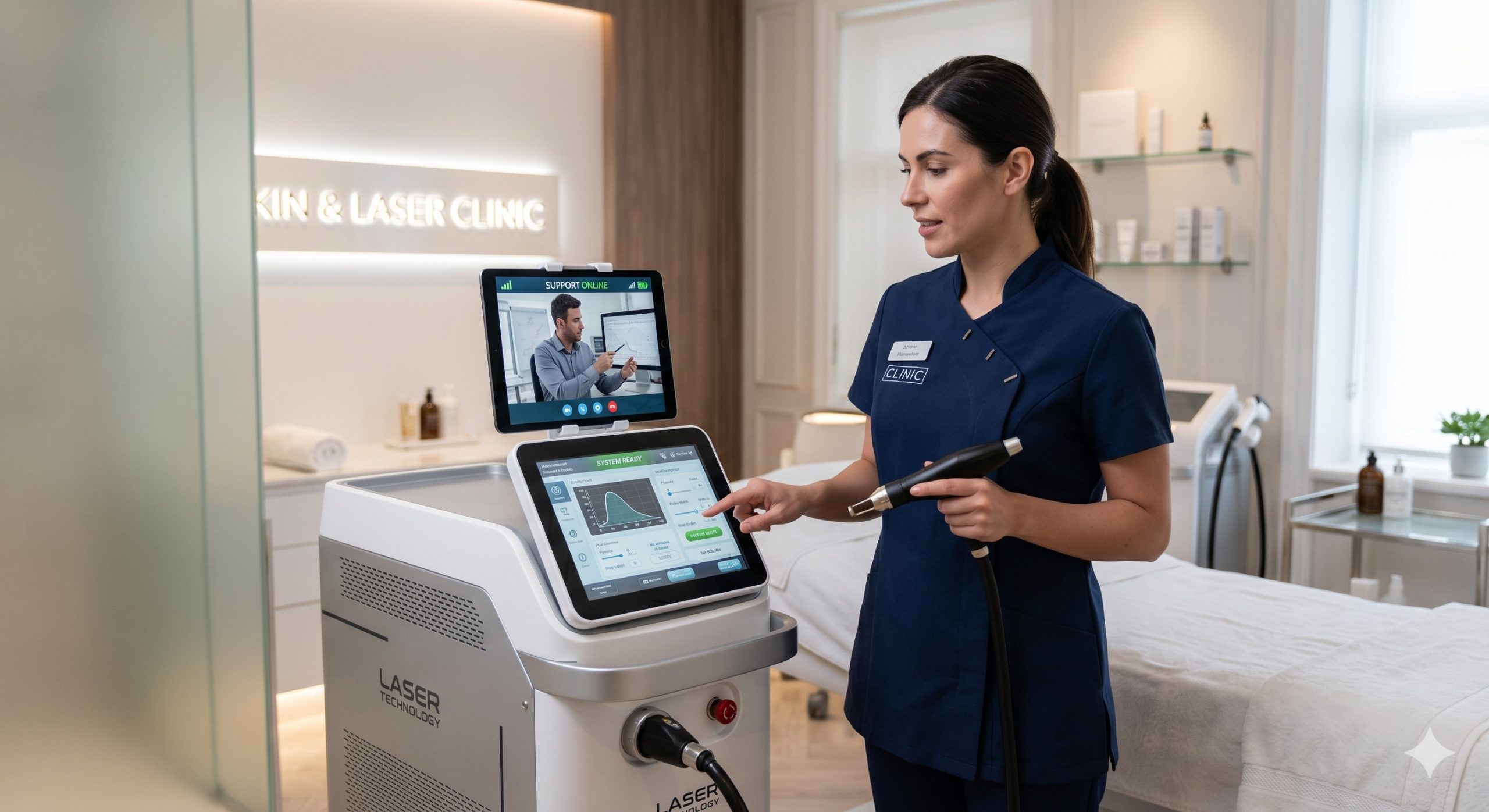
First, recalibrate the energy meter using the device’s internal test mode—most systems require recalibration every 200 hours. If fluence remains inconsistent: (1) check the sapphire window for debris or micro-cracks (clean with isopropyl alcohol and lint-free wipe), (2) verify the handpiece cable is fully seated and not kinked, (3) examine the water filter for clogs that reduce pump cooling efficiency (replace if discolored), and (4) run the ‘diode current diagnostic’ to detect individual emitter degradation. If variation exceeds ±10% of set fluence across three consecutive test pulses, contact technical support for bar calibration or diode array replacement. Never increase energy settings to compensate for a drop—this masks underlying hardware degradation and risks patient injury.