Treating stretch marks (striae) with microneedling RF FAQ: Expert Answers for Aesthetic Clinics & Dermatologists
Overview
For aesthetic clinics and dermatologists, microneedling radiofrequency (RF) has emerged as one of the most effective, minimally invasive solutions for treating striae distensae (stretch marks). Unlike legacy lasers that rely solely on color-based targeting, microneedling RF bypasses the epidermis to deliver controlled thermal injury deep within the dermis, stimulating neocollagenesis and elastin remodeling. This FAQ addresses high-intent B2B concerns: from clinical efficacy across Fitzpatrick skin types and handpiece consumable costs to regulatory compliance and ROI. The following answers are structured to support informed purchasing, safe operation, and maximum patient retention.

Frequently Asked Questions
Q1: Is microneedling RF for treating stretch marks safe for all Fitzpatrick skin types (I-VI)?
Yes, microneedling RF is safe and effective for Fitzpatrick skin types I through VI. Unlike ablative lasers that target epidermal melanin and carry a high risk of post-inflammatory hyperpigmentation (PIH) in darker skin tones, microneedling RF bypasses the epidermis via insulated or non-insulated ultra-fine needles. The RF energy is delivered directly into the dermal layer where stretch marks reside, leaving the epidermal-dermal junction largely intact. For optimal safety in types V-VI, use deeper needle penetration (2.0-3.5mm) with lower RF power (6-10W) and longer pulse duration to minimize heat accumulation at the basal layer. Always perform a test spot in an inconspicuous area 48 hours prior to full treatment.
Q2: What is the typical handpiece lifespan and consumable replacement schedule for a microneedling RF system?
The typical handpiece lifespan of a medical-grade microneedling RF system ranges from 200 to 300 clinical uses or 6-12 months, depending on sterilization cycles and energy output. Each disposable cartridge tip (containing 25-64 microneedles) is strictly single-use to prevent cross-contamination and guarantee needle sharpness. For a clinic treating 8-10 stretch mark patients weekly, plan to order 40-50 cartridges per month. The reusable handpiece body requires professional inspection every 300 cycles for cable insulation integrity and needle driver alignment. High-volume clinics should budget an annual handpiece replacement (approx. $800-$1500) and a monthly consumable cost of $15-$25 per patient.
Q3: How many treatment sessions are clinically required to see significant striae reduction, and what clearance rate can we promise patients?
Clinically, 3 to 6 sessions spaced 4-6 weeks apart are required to achieve 50-75% visible improvement in striae alba (white stretch marks) and 60-85% improvement in striae rubra (red/purple stretch marks). The first session targets dermal fibrosis and initiates neovascularization; improvement in texture appears at week 3-4. Session 2-3 focus on collagen remodeling (type III to type I conversion). For mature white striae with epidermal thinning, adding a topical growth factor or platelet-rich plasma (PRP) immediately after RF needling can increase clearance rates by an additional 20-30%. Manage patient expectations: complete clearance is rare, but softening, width reduction, and repigmentation are achievable in 85% of compliant cases.
Q4: What advanced contact cooling mechanisms protect the epidermis during microneedling RF for stretch marks?
The most advanced microneedling RF systems integrate real-time sapphire contact cooling or thermoelectric cooling (TEC) modules that maintain epidermal surface temperature at 10-15°C while delivering 55-65°C dermal coagulation. This dual-zone thermal control is achieved via a closed-loop water circulation circuit that extracts heat from the handpiece tip at 5-8 mL per second. For stretch marks on lax abdominal or thigh skin, look for systems with dynamic temperature feedback (thermistor at the needle base) that automatically shuts off RF if epidermal temperature exceeds 40°C. Passive cooling (ice packs or chilled gel) is insufficient for high-energy protocols; active contact cooling reduces patient pain scores from 7/10 to 2/10 and eliminates downtime burns.
Q5: What is the clinical ROI and payback period for investing in a microneedling RF device dedicated to striae treatment?
The average payback period for a $15,000-$25,000 microneedling RF system dedicated to stretch mark treatment is 4-7 months in a medium-volume med spa (15-20 treatments/week). At a conservative price of $450 per stretch mark session (abdomen, thighs, or arms), each treatment delivers $250-$300 gross profit after consumables ($15 cartridge + $30 topical numbing + $5 disposables). With 6 sessions per patient, lifetime value per patient = $2700. To reach break-even on a $22,000 device, schedule just 49 sessions (9 full-treatment patients). High-volume clinics can achieve ROI in under 12 weeks. Additional revenue streams: package 6 sessions at $2200 upfront, add PRP for $300 extra per session, or combine with RF skin tightening for full abdomen contouring at $800/session.
Q6: How do we maintain the water circulation system to ensure consistent RF output and thermal regulation?
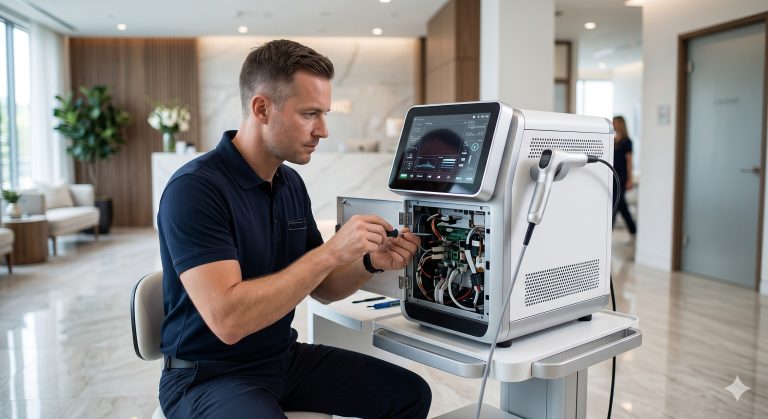
Flush the closed-loop water circulation system every 30 days or after 50 treatment cycles using a medical-grade deionized water and propylene glycol solution (70/30 ratio). Stretch mark protocols require prolonged RF pulses (200-300ms per pin), which generate higher thermal load than facial rejuvenation. Signs of compromised cooling include intermittent RF shutdowns, prolonged handpiece tip heat ( >38°C on the outer barrel), or error codes related to flow rate. Monthly maintenance: run a 5-minute cleaning cycle with a citric acid-based descaler to remove mineral deposits, then refill with fresh coolant. Replace the inline bacterial filter every 90 days. Failure to maintain water circulation reduces needle insulation lifespan by 50% and increases epidermal burn risk.
Q7: What regulatory compliance standards (CE, FDA, ISO) should we verify before purchasing a microneedling RF system for stretch marks?
A compliant microneedling RF system for medical use must carry FDA 510(k) clearance for dermatological treatment of striae or soft tissue coagulation, CE Mark (Class IIb or higher) under MDR 2017/745, and ISO 13485:2016 for manufacturing quality systems. Additionally, verify that the device has specific IEC 60601-2-2 compliance for high-frequency surgical equipment and IEC 60601-1-11 for home healthcare environment (if used in outpatient clinics). Request the Technical File and Declaration of Conformity from your supplier. Avoid devices with only CE Mark for “general cosmetic use” — these lack specific striae claims and may violate local medical device regulations. In the US, using a non-510(k) cleared device for stretch marks can lead to malpractice liability and insurance claim denial.
Q8: How do we troubleshoot incomplete needle penetration or uneven RF coagulation on striae alba?
Incomplete needle penetration on fibrotic stretch marks is most often caused by dull cartridge tips (reuse past single use) or incorrect vacuum suction pressure. First, replace the cartridge with a new sterile tip — dull needles create divots and skip zones. Second, verify your system’s vacuum-assisted handpiece achieves at least -25 kPa negative pressure on abdominal skin; lower suction allows tenting instead of full insertion. Third, for striae alba with dense collagen scar tissue, increase needle depth to 3.0mm and reduce treatment speed to 0.5 cm²/sec. Uneven coagulation manifests as patchy erythema or skipped tracks — recalibrate the RF generator using the manufacturer’s load test module (typically a 500-ohm resistor) and confirm all 25-64 pins are emitting uniform impedance (variance <10%). Document calibration weekly.