Dark Skin Laser Hair Removal FAQ: Expert Answers for Aesthetic Clinics & Dermatologists
Overview
For years, offering laser hair removal to patients with darker skin tones (Fitzpatrick types IV-VI) presented a significant clinical challenge due to the high risk of epidermal burns and pigmentation changes. However, advancements in laser technology, specifically the adoption of longer wavelengths like the 1064nm Nd:YAG and advanced cooling systems, have made treatment not only safe but highly effective for these skin types . This FAQ addresses the critical clinical, technical, and business considerations for aesthetic clinics looking to expand their services to this demographic safely and profitably.

Frequently Asked Questions
Q1: Is laser hair removal safe for Fitzpatrick skin types V and VI?
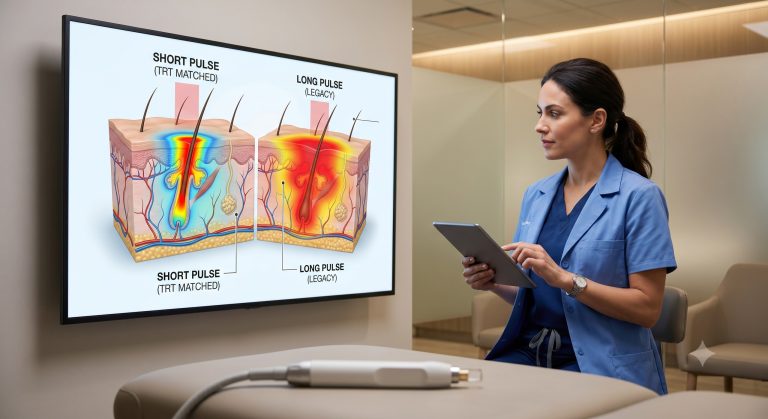
Yes, it is safe and effective for Fitzpatrick skin types V and VI when using the correct technology and protocols. The key to safety lies in using a 1064nm Nd:YAG laser, as its longer wavelength penetrates deeper and is less absorbed by epidermal melanin, bypassing the skin surface to target the hair follicle directly . This significantly reduces the risk of burns, blistering, and post-inflammatory hyperpigmentation (PIH) compared to shorter wavelength lasers like Alexandrite . Clinical studies on patients with Fitzpatrick IV-VI skin have demonstrated excellent safety profiles with minimal adverse events when using this wavelength .
Q2: How does the 1064nm Nd:YAG laser differ from diode or alexandrite lasers for dark skin?
The 1064nm Nd:YAG laser is the gold standard and safest choice for Fitzpatrick V-VI skin, while Alexandrite (755nm) and Diode (810nm) lasers carry a higher risk. The Nd:YAG’s longer wavelength minimizes absorption by the melanin in the skin’s surface, reducing the risk of thermal damage . Alexandrite lasers, with their shorter wavelength, are highly absorbed by epidermal melanin and are generally not recommended for types V-VI . Diode lasers can be used on darker skin with extreme caution and rigorous parameter modification, but the Nd:YAG provides a wider safety margin .
Q3: What is the risk of hyperpigmentation or hypopigmentation, and how can it be prevented?
Pigmentary changes are the primary risk when using the wrong laser or incorrect settings on dark skin . Hyperpigmentation (dark spots) is the most common complication, caused by laser energy being absorbed by the skin instead of the hair follicle . To prevent this, use a 1064nm Nd:YAG laser, start with conservative fluence (e.g., 25-40 J/cm²) and longer pulse durations (e.g., 20-40 ms), and employ robust contact cooling . Strict pre- and post-treatment sun protection (SPF 30+) is mandatory to minimize risk .
Q4: What specific treatment parameters should be used for Fitzpatrick IV-VI patients?
For optimal safety and efficacy, recommended parameters for an Nd:YAG laser are a fluence of 25-40 J/cm² and a pulse duration of 20-40 ms . The clinical endpoint is delayed perifollicular edema and erythema (redness and swelling around the hair follicle), which indicates successful follicular destruction without epidermal damage . Larger spot sizes (10-18 mm) are also recommended to improve penetration depth . As one expert notes, the goal is to “treat to perifollicular edema/erythema, not epidermal whitening” .
Q5: How many treatment sessions are typically needed, and what are the expected results?
Most patients with dark skin require 6-8 treatment sessions spaced 4-8 weeks apart to achieve significant and lasting hair reduction . Hair reduction rates are substantial, with studies showing up to 74.6% reduction in the underarm area and 65.7% on the thighs at six months post-treatment . A 2025 study on Sudanese women (Fitzpatrick IV-VI) confirmed that low-fluence 1064nm Nd:YAG treatment is safe and effective, with no adverse events reported . It is important to set realistic expectations, as treatment results in significant permanent hair reduction, not total removal in every follicle .
Q6: Is a test spot necessary before treating a patient with Fitzpatrick V-VI skin?
While a test spot was once considered mandatory, it is no longer strictly necessary when using a long-pulsed Nd:YAG laser, as its safety in darker skin types is well-established . However, a test spot is still a prudent clinical practice, particularly when the patient’s skin phenotype or tanning history is uncertain or when using a new device . Conducting a test spot in a high-risk area (e.g., the neck or bikini line) and evaluating it 48-72 hours later can provide an extra layer of safety and help calibrate the final treatment settings .
Q7: What is the clinical and business ROI for offering this service?
Offering safe laser hair removal for dark skin expands your clinic’s addressable market to a historically underserved demographic, providing a significant competitive advantage. The primary investment is in a premium, multi-wavelength platform with a 1064nm Nd:YAG, which often commands a higher price point. However, this is offset by the high patient demand and loyalty from clients who find a provider capable of treating them safely. With proper training and parameter selection, consumable costs are controlled, and treatment sessions are quick, ensuring high throughput and a rapid return on investment. The key to profitability is operator expertise, which reduces the risk of costly complications and builds a strong reputation.