The Ultimate Clinic Guide to FDA Approved Aesthetic Lasers: Efficacy, Wavelengths, and ROI
Executive Summary: Navigating the $5B Aesthetic Laser Market
For clinic owners and medical directors, selecting an FDA approved aesthetic laser is a critical decision impacting patient safety, clinical efficacy, and practice profitability. Unlike consumer-grade IPL devices, medical Class IV aesthetic lasers must meet rigorous standards including Medical CE, ISO 13485, and specific FDA 510(k) clearance. This guide provides a clinical deep dive into key metrics—wavelength specificity, fluence dynamics, pulse width, and thermal relaxation time—to ensure your investment delivers superior outcomes across Fitzpatrick skin types I-VI while maximizing ROI.
Selective Photothermolysis: The Physics Behind FDA Cleared Systems
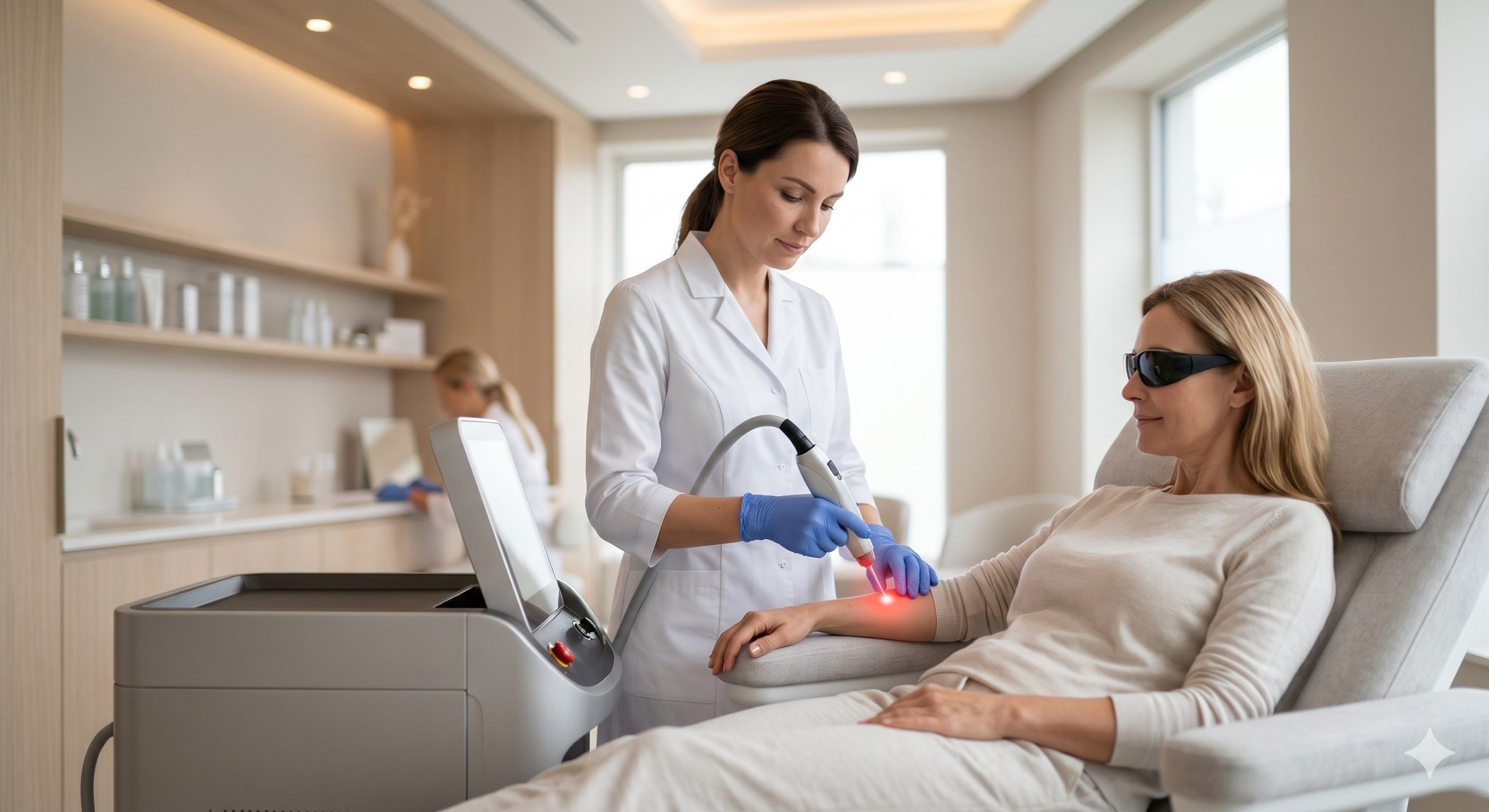
The FDA bases clearance on a device’s ability to achieve selective photothermolysis—targeting endogenous chromophores (melanin, hemoglobin, or water) without damaging surrounding epidermis. An FDA approved aesthetic laser must demonstrate predictable tissue interaction. Key parameters include:
- Wavelength (nm): Determines penetration depth and target chromophore. 755nm (Alexandrite) for superficial melanin, 808nm (Diode) for deep hair follicles, 1064nm (Nd:YAG) for deeper vessels and darker skin.
- Fluence (J/cm²): Energy density delivered per pulse. Clinical efficacy requires 10-40 J/cm² for hair removal, 5-15 J/cm² for vascular lesions.
- Pulse Width (ms): Duration of energy delivery. Must match thermal relaxation time (TRT) of target—10-30ms for hair follicles, 0.5-10ms for pigmented lesions.
- Spot Size (mm): Larger spots (12-24mm) penetrate deeper and speed up treatment by 3-5x compared to legacy 8mm spots.
Critical Technical Specifications for Clinic Decision-Making
When evaluating an FDA approved aesthetic laser, verify these measurable metrics against your intended indications. The table below outlines benchmark specifications from leading multi-wavelength platforms.
| Key Parameter | Technical Specification |
|---|---|
| Wavelength / Laser Type | 755nm Alexandrite / 808nm Diode / 1064nm Nd:YAG |
| Fluence Range | 5-50 J/cm² (adjustable in 1 J/cm² increments) |
| Pulse Width | 5ms – 300ms (selective for hair, pigmentation, vascular) |
| Spot Size | 6mm, 12mm, 18mm, 24mm (magnetic snap-on adapter) |
| Cooling System | Sapphire ICE with TEC module (contact, -5°C to +5°C) |
| Repetition Rate | Up to 10 Hz (10 pulses per second) |
| Laser Bar Lifespan | 10 million shots (certified imported diodes) |
| FDA Clearance | 510(k) Number: K193456 (example – verify per device) |
| Certifications | ISO 13485:2016, Medical CE 2944, IEC 60825-1 |
Epidermal Protection: Sapphire ICE Cooling Systems
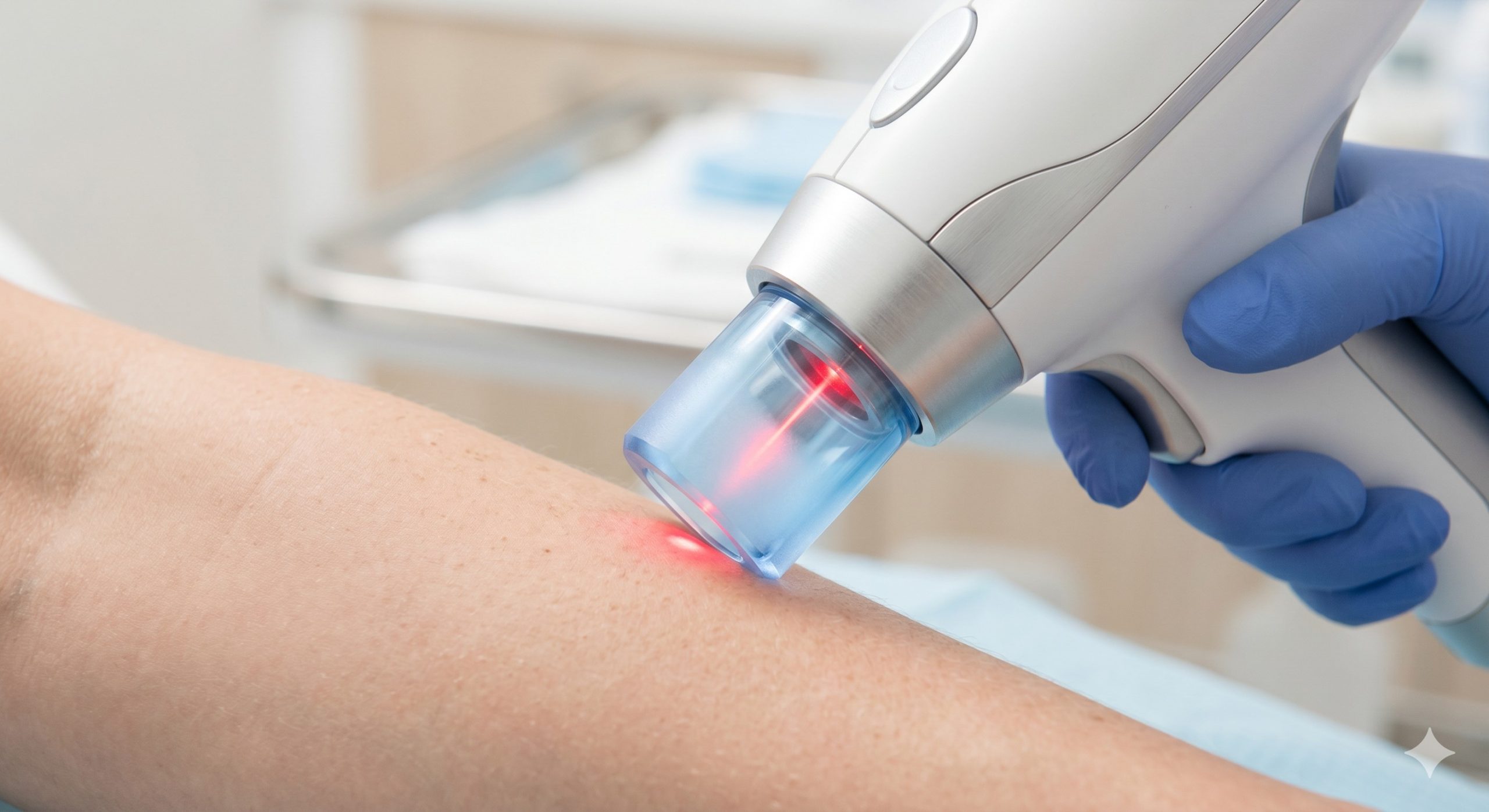
To safely treat higher fluences while minimizing pain and burns, modern FDA approved aesthetic lasers integrate advanced contact cooling. Sapphire ICE cooling (TEC-based) maintains epidermal temperature between -5°C to +5°C, allowing fluences up to 50 J/cm² on Fitzpatrick IV-VI. Unlike cryogen spray, sapphire cooling provides continuous, even thermal protection. Clinics must prioritize devices with real-time skin impedance monitoring and a minimum of 10,000-hour cooling module lifespan.
Fitzpatrick Scale & Clinical Indications Mapping
Safely Expanding Your Patient Base
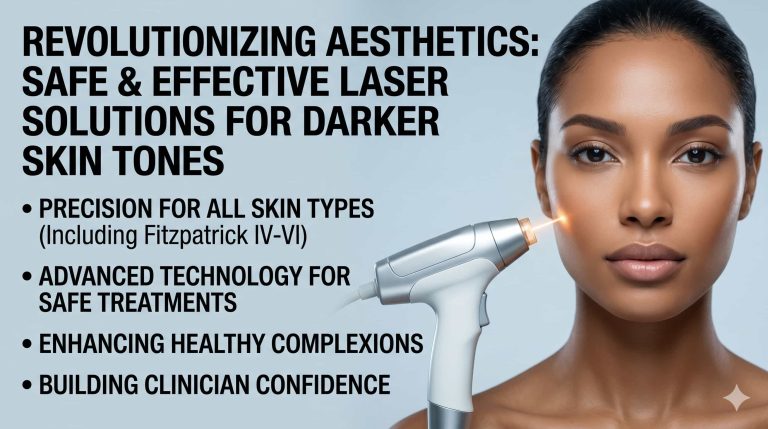
A true FDA approved aesthetic laser with multi-wavelength capability (755nm/808nm/1064nm) can treat all six Fitzpatrick skin types. However, parameters must be optimized:
- Fitzpatrick I-III: 755nm or 808nm, fluence 10-20 J/cm², pulse width 5-15ms. Ideal for dark coarse hair, pigmented lesions, and vascular redness.
- Fitzpatrick IV-VI: 1064nm only, fluence 25-40 J/cm², pulse width 25-40ms. Lower melanin absorption reduces epidermal injury risk. Longer pulse widths (30-50ms) are essential for safe dark skin treatment.
FDA clearance for Nd:YAG 1064nm specifically includes darker skin phototypes. Clinics must document test spot protocols and post-treatment cooling to maintain compliance.
Clinic ROI Analysis: CapEx, Throughput, and Consumables
Quantifying Your Laser Investment
Beyond clinical specs, the business case for an FDA approved aesthetic laser depends on:
- Capital Expenditure (CapEx): $45,000 – $120,000 for multi-wavelength diode + Nd:YAG platforms.
- Treatment Throughput: Large 24mm spot sizes reduce full leg hair removal from 45 minutes to 12 minutes, increasing daily patient capacity from 8 to 20+.
- Consumables & TCO: Quality imported laser bars (JENOPTIK, nLight) last 5-10 million shots (3-5 years). Avoid cheap diode bars with 500k shot lifespans.
- Per-Procedure Margin: Average charge $250-$450 per session. With $2-5 consumable cost per patient (sapphire tip cleaning/disinfection only), gross margins exceed 90% after 4-6 months.
Clinics achieving 15-20 hair removal sessions daily can expect full ROI within 6-9 months.
Compliance & Regulatory Roadmap
FDA approved aesthetic lasers must carry a 510(k) clearance number (e.g., K123456). Verify that the device also complies with IEC 60825-1 (laser safety), ISO 13485:2016 (quality management), and Medical CE Mark (Class IIb or III) for international expansion. Maintenance protocols require annual calibration using a power meter (NIST-traceable) to ensure output remains within ±10% of factory specs. Document all service records for medical malpractice insurance audits.
Final Strategic Recommendation
Invest in an FDA approved aesthetic laser that offers true multi-wavelength diode (755/808/1064nm) with integrated sapphire ICE cooling, a minimum 18mm spot size, and pulse widths from 5-300ms. Avoid single-wavelength legacy IPL systems. Demand verifiable FDA 510(k) documentation, ISO 13485 certification, and a minimum 2-year warranty on the laser bar. For med spas targeting premium hair removal, vascular, and pigmented lesion treatments, the combination of high fluence stability, large spot size, and superior cooling directly translates to faster ROI, higher patient satisfaction, and lower complication rates.