SHR Hair Removal Machine FAQ: Expert Answers for Aesthetic Clinics & Dermatologists
Overview
Super Hair Removal (SHR) technology represents a major advancement in laser hair removal, offering faster, virtually painless treatments across all skin tones. For B2B clinic owners and dermatologists, understanding technical specifications, maintenance requirements, and cost structures is critical before purchasing. This FAQ answers the most common pre-sales and post-sales questions about SHR machines using evidence-based data to help you make a confident investment.
Frequently Asked Questions
Q1: Is the SHR hair removal machine suitable for all Fitzpatrick skin types?
Yes, SHR technology is safe and effective for Fitzpatrick skin types I through VI, including tanned and dark skin. Unlike traditional IPL or single-shot lasers that deliver high fluence in one pulse, SHR uses low fluence but high repetition rate (up to 10Hz), gradually heating the dermis without damaging the epidermis. This mechanism drastically reduces melanin absorption competition, making it the preferred choice for clinics treating diverse ethnic populations.
Q2: How does SHR differ from IPL and traditional diode lasers?
SHR uses repetitive low-fluence pulses with in-motion technology, whereas IPL uses broad-spectrum high-fluence flashlamps and traditional diode lasers use single high-fluence shots. The key differences are: 1) Pain levels: SHR is nearly painless (3/10 scale) vs. IPL/traditional diode (6-8/10). 2) Speed: SHR treats full legs in 15 minutes vs. 45-60 minutes for IPL. 3) Safety: SHR has zero epidermal burning risk on skin types IV-VI, while IPL has high risk. 4) Efficacy: SHR requires 6-8 sessions versus 8-12 for IPL.
Q3: How painful is SHR hair removal compared to other methods?
SHR is rated as 2-3 out of 10 on the pain scale, described as a ‘warm massage’ or ‘gentle tapping sensation.’ This is because SHR delivers only 3-10 J/cm² per pulse (vs. 20-40 J/cm² for traditional lasers), staying below the pain threshold while cumulative heating destroys hair follicles. Most SHR machines also integrate contact cooling (0°C to -5°C at the sapphire tip), further eliminating thermal discomfort. No topical anesthetic is required, saving clinic time and consumable costs.
Q4: What is the typical lifespan of an SHR hair removal machine handpiece?
A certified SHR handpiece delivers 500,000 to 1,000,000 safe pulses before diode degradation reaches 80% of initial output. Assuming 200-300 clients per month with 60 pulses per session, the handpiece lasts 2.5 to 5 years. Practical signs for replacement include: visible fluence drop (longer sessions to achieve same results), inconsistent shot-to-shot energy, or error codes on the main console. High-quality SHR machines from ISO13485 manufacturers provide a 1-year warranty on handpieces and 2 years on the main unit.
Q5: What are the ongoing consumable costs for an SHR machine?
The only consumable is the disposable IPL-free handpiece window film (if using a hybrid machine) or protective sapphire cover – but pure SHR systems require zero consumables. Two cost items exist: 1) Handpiece replacement every 2-5 years ($800-$1,500), 2) Calibration service every 2 years ($200-$400). Unlike IPL, no gel or cooling spray is needed because SHR uses contact cooling. Total annual operating cost (excluding electricity) averages $150-$300, making per-treatment margin exceptionally high for clinics at $50-$150 per session.
Q6: How often does an SHR machine require maintenance or calibration?
Annual preventative maintenance is recommended: cleaning the air filter, checking the cooling system water level (closed-loop systems last 3-5 years without refill), and verifying energy output with a calibrated energy meter. Calibration is required every 2 years or after 200,000 pulses to maintain FDA/CE compliance. Warning signs needing immediate service include: error code E-01 (laser diode overheating), uneven spot pattern, or the sapphire tip not cooling below 10°C. Most manufacturers offer remote diagnostics and on-site service contracts at $500/year.
Q7: What training is required for clinic staff to operate an SHR machine?
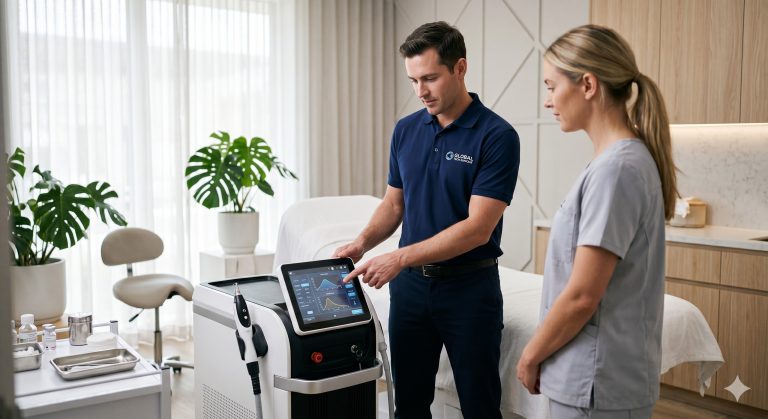
Operators need 4-6 hours of hands-on training plus completion of a laser safety course (standard for any Class 4 medical device). Training should cover: 1) Fitzpatrick skin type identification and energy parameter mapping (e.g., 2 J/cm² @ 10Hz for skin VI, 8 J/cm² @ 7Hz for skin II). 2) In-motion technique: sliding velocity of 1-2 cm/sec with 50% overlap. 3) Contraindications: pregnancy, active infections, tattoos, or recent isotretinoin use. 4) Emergency shutdown and eyewear protocol. Reputable SHR vendors provide free initial training for 2-3 staff members and certification upon completion.
Q8: Can an SHR machine also treat pigmentation or vascular lesions?
No, pure SHR hair removal machines are optimized only for hair follicle destruction using 755nm, 808nm, or 1064nm diode wavelengths. They cannot treat pigmentation (melasma, freckles) or vascular lesions (spider veins, rosacea) because those require specific Q-switched Nd:YAG (532nm/1064nm) or IPL cut-off filters. Some hybrid machines advertise ‘SHR + picosecond’ but these are two separate handpieces. For a clinic wanting multi-application, purchase a dedicated SHR hair removal unit plus a separate IPL or Pico laser – never compromise on wavelength specificity.