The “Baby Face” Effect: How 1927nm Thulium Lasers Revolutionized Non-Ablative Skin Resurfacing
Executive Summary
For aesthetic dermatologists, medical directors, and B2B clinic operators, the 1927nm Thulium laser represents a critical paradigm shift in non-ablative skin resurfacing. Historically, practices were forced to compromise between the superior clinical efficacy of ablative fractional CO2 lasers (which carry high risks of Post-Inflammatory Hyperpigmentation and prolonged downtime) and the lower-risk, but heavily protracted results of mild chemical peels. The 1927nm wavelength bridges this gap by targeting the epidermal-dermal junction with a high water-absorption coefficient, creating precise Micro-Thermal Treatment Zones (MTZs) while fully preserving the stratum corneum. This unique mechanism induces rapid epidermal renewal—clinically branded as the “Baby Face” effect—delivering dramatic improvements in pigmentation, texture, and actinic damage with virtually zero downtime. For medical procurement teams, integrating Cocoon Laser advanced thulium systems ensures a high-throughput, high-margin asset with excellent patient compliance, backed by predictable Total Cost of Ownership (TCO) and rigorous Medical CE and FDA 510(k) compliance.
The Optical Physics of 1927nm: Understanding Thulium Laser Technology
To fully grasp the commercial and clinical viability of Thulium technology, B2B procurement decision-makers must first understand the fundamental laser-tissue interactions that dictate its efficacy. The 1927nm wavelength falls within the mid-infrared spectrum. Its primary clinical advantage relies on its specific absorption coefficient for water—the primary chromophore targeted in non-ablative fractional resurfacing.
The absorption rate of water at 1927nm is approximately ten times higher than that of the 1550nm Erbium Glass wavelength, yet significantly lower than the 10,600nm CO2 wavelength. This precise mathematical balance dictates the laser’s depth of penetration and thermal diffusion profile, locking its energy absorption perfectly within the epidermis and the superficial papillary dermis.
Micro-Thermal Treatment Zones (MTZs) and Tissue Coagulation
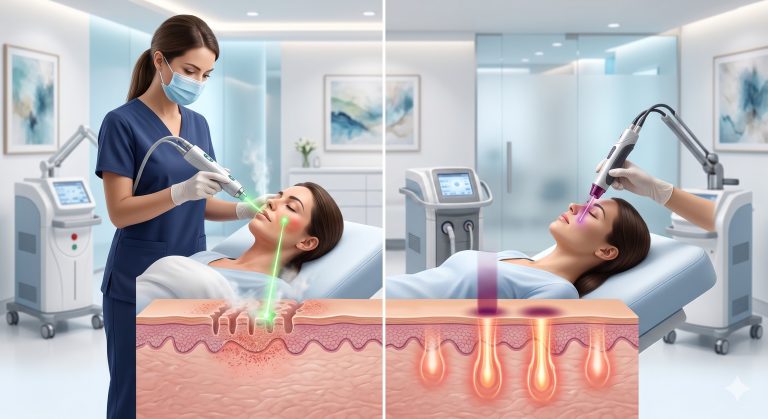
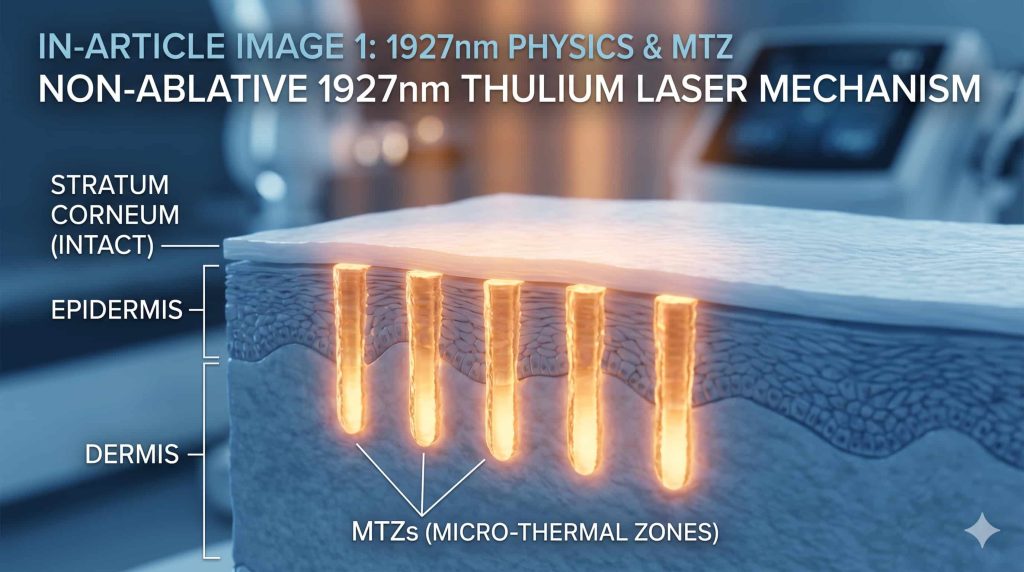
Unlike ablative technologies that instantaneously vaporize intracellular water and physically ablate tissue, the 1927nm Thulium laser operates strictly on a coagulative principle. When the laser energy interacts with the skin, it generates meticulously controlled columns of heat known as Micro-Thermal Treatment Zones (MTZs).
Depending on the operational parameters (typically ranging from 5 mJ to 20 mJ per MTZ), the laser coagulates epidermal tissue to a depth of approximately 200 to 300 microns. The geometry of these MTZs is critical. Because the energy delivery is fractionated, each column of coagulated tissue is surrounded by a substantial reservoir of entirely viable, healthy tissue. This uninjured surrounding skin contains the stem cells and keratinocytes necessary to immediately initiate a rapid, highly organized wound-healing cascade, drastically reducing the inflammatory phase of healing.
Preservation of the Stratum Corneum
The true engineering triumph of the 1927nm wavelength—and the foundation of the “zero-downtime” claim—is its interaction with the outermost layer of the epidermis: the stratum corneum.
The stratum corneum is primarily composed of anucleated corneocytes embedded in a lipid matrix, and it possesses a substantially lower water content (roughly 10% to 15%) compared to the viable epidermis below it (which is closer to 70% water). Because the Thulium laser’s primary target is water, the energy functionally passes through the relatively dehydrated stratum corneum with minimal absorption.
Consequently, the stratum corneum remains structurally intact during and after the procedure. It acts as an impenetrable, natural biological dressing. This immediate sealing of the MTZs prevents transepidermal water loss (TEWL), dramatically lowers the risk of opportunistic bacterial infection, and eliminates the raw, exudative tissue associated with traditional ablative resurfacing.
Decoding the “Baby Face” Phenomenon: Clinical Mechanisms of Action
The “Baby Face” effect is a heavily marketed term, but for dermatologists and clinical operators, it describes a highly specific physiological outcome: the generation of a homogenous, highly reflective, and structurally sound epidermal layer devoid of dyschromia. This is achieved through two simultaneous biological mechanisms.
Rapid Epidermal Renewal and Pigment Clearance
Following the creation of the MTZs, the coagulated epidermal tissue undergoes a unique form of necrosis. Within 24 to 48 hours, the destroyed cellular debris, which includes heavily pigmented keratinocytes and fragmented melanosomes, forms Microscopic Epidermal Necrotic Debris (MENDs).
Because the surrounding healthy tissue rapidly generates new keratinocytes, these MENDs are pushed upward toward the preserved stratum corneum. Clinically, this manifests as a very fine, sandpaper-like texture on the patient’s skin, often with a slight bronzing effect. Between days 3 and 5, this stratum corneum—along with the trapped MENDs—naturally desquamates (sheds).
Simultaneously, in the deeper tissue, local macrophages engage in the phagocytosis of any residual fragmented melanin that diffused into the papillary dermis. Once the MENDs shed, the underlying skin revealed is newly generated, exhibiting the tight cellular junctions and uniform pigment distribution characteristic of youthful skin.
Dermal Remodeling and Neocollagenesis
While the 1927nm wavelength is heavily biased toward the epidermis, the thermal diffusion extending from the base of the MTZs into the papillary dermis provides a secondary, long-term clinical benefit. This controlled sub-necrotic heating triggers the up-regulation of heat shock proteins (specifically HSP 47 and HSP 70), which in turn activate dormant dermal fibroblasts.
Over a period of 30 to 90 days post-treatment, these activated fibroblasts synthesize both Type I and Type III collagen, as well as new elastin fibers. While not as aggressive as the neocollagenesis induced by deep fractional CO2, this mild dermal remodeling is highly effective for reducing superficial fine lines, decreasing pore size, and improving overall skin turgor—essential components of the comprehensive “Baby Face” aesthetic.
Comparative Analysis: Thulium Lasers vs. Traditional Resurfacing Modalities
For the B2B procurement director analyzing medical laser equipment procurement options, understanding where the 1927nm Thulium laser sits within the broader technology stack is vital. The decision to invest heavily relies on replacing or complementing existing legacy systems.
| Technical Parameter | Thulium Laser (1927nm) | Fractional CO2 (10,600nm) | Erbium Glass (1550nm) |
| Tissue Interaction | Non-Ablative (Coagulative) | Ablative (Vaporization + Coagulation) | Non-Ablative (Coagulative) |
| Primary Depth | Epidermis / Superficial Dermis | Deep Dermis | Mid to Deep Dermis |
| Stratum Corneum | Preserved (Intact) | Destroyed (Vaporized) | Preserved (Intact) |
| Clinical Downtime | 12 – 24 Hours (Erythema only) | 7 – 14 Days (Exudative, crusting) | 2 – 4 Days (Edema, Erythema) |
| PIH Risk Profile | Low (Safe for Fitzpatrick Scale I-VI) | High (Requires extreme caution on IV-VI) | Moderate |
| Primary Indication | Epidermal Pigmentation, Actinic Damage, Texture, “Glow” | Severe Rhytides, Deep Acne Scarring, Skin Laxity | Mild to Moderate Acne Scarring, Dermal Remodeling |
| Anesthesia Req. | Topical cream (Often optional) | Subcutaneous block or heavy topical | Heavy topical required |
Thulium (1927nm) vs. Fractional CO2 (10,600nm)
The operational contrast here is absolute. While CO2 remains the gold standard for severe structural scarring, its utilization is severely limited by its high adverse event profile. The aggressive vaporization destroys the epidermal barrier, mandating a strict, prolonged recovery period that modern patients frequently reject. Furthermore, the intense thermal trauma of CO2 significantly spikes the risk of Post-Inflammatory Hyperpigmentation (PIH), rendering it a risky modality for clinics operating in regions with predominantly Fitzpatrick Skin Types III-VI. The 1927nm Thulium virtually eliminates these commercial and clinical bottlenecks, allowing clinics to treat a much broader demographic with minimal risk.
Thulium (1927nm) vs. Erbium Glass (1550nm)
Both are non-ablative, but they target different dermatological planes. The 1550nm wavelength penetrates deeper, making it highly effective for dermal pathologies like acne scarring, but it requires significantly more energy to affect the epidermis, leading to increased pain and prolonged post-procedural edema (swelling). The 1927nm wavelength, with its higher water affinity, deposits its energy instantly upon entering the skin, making it exponentially more efficient at clearing epidermal pigment (melasma, ephelides) and achieving the sought-after superficial “Baby Face” polish that 1550nm systems struggle to produce efficiently.
Laser-Assisted Drug Delivery (LADD): A Synergistic Clinical Approach
One of the most lucrative and clinically profound advancements associated with 1927nm Thulium technology is its application in Laser-Assisted Drug Delivery (LADD). This represents a major revenue multiplier for clinics, allowing them to combine high-margin device treatments with premium cosmeceutical consumables.
Altering Stratum Corneum Permeability
The human stratum corneum is a highly efficient barrier, strictly governed by the “500 Dalton Rule,” which dictates that molecules larger than 500 Daltons generally cannot penetrate healthy, intact skin. This renders many highly potent topical serums practically useless when applied to untreated skin.
The Thulium laser disrupts this barrier function not by destroying the tissue, but by creating thousands of microscopic, highly permeable MTZ channels. Because the stratum corneum remains physically intact as a “cap” over the coagulated column, these micro-channels act as direct biological conduits into the viable epidermis and papillary dermis. When topicals are applied immediately post-treatment (within the 15 to 30-minute window before the channels begin to naturally constrict), the absorption rates of macromolecules increase by exponential factors compared to standard topical application.
Optimizing Outcomes with Combination Protocols
Clinics utilizing professional aesthetic devices are rapidly adopting standardized LADD protocols to hyper-target specific conditions:
- Melasma and Dyschromia: Utilizing the Thulium laser followed by the immediate application of Tranexamic Acid or stabilized Vitamin C (L-ascorbic acid). The laser clears existing melanin, while the deeply penetrated topicals inhibit future tyrosinase activity.
- Tissue Regeneration and Anti-Aging: Combining the 1927nm treatment with lyophilized Exosomes or high-molecular-weight Hyaluronic Acid. The micro-trauma of the laser initiates the healing cascade, while the delivered exosomes provide the growth factors necessary to accelerate neocollagenesis, severely reducing any transient erythema.
Core Clinical Indications and Efficacy Protocols
To ensure maximum utilization rates and optimize the Return on Investment (ROI), a clinic must be able to deploy the device across multiple daily indications. The 1927nm Thulium system excels due to its broad spectrum of FDA-cleared and CE-marked applications.
- Epidermal Melasma and Dyschromia Management: Unlike Q-Switched nanosecond lasers which rely on acoustic shockwaves, the gentle coagulative effect of the Thulium laser safely targets broad patches of epidermal melasma. By extruding the pigment via MENDs rather than aggressively shattering it, the Thulium laser bypasses the heavy inflammatory responses that frequently trigger melasma relapse.
- Actinic Keratosis and Textural Irregularities: For older demographics suffering from chronic photoaging, the 1927nm wavelength effectively resurfaces actinic damage. The rapid turnover of keratinocytes forces the extrusion of dysplastic cells, resulting in a dramatic smoothing of epidermal texture and a reduction in pre-cancerous lesions.
- Preventative “Prejuvenation” for Younger Demographics: The “Baby Face” treatment is highly marketable to the 25-40 age demographic. By utilizing lower fluence settings (low mJ, low density), practitioners can offer a fast, preventative “glow” treatment that clears microscopic sun damage, shrinks pore appearance, and stimulates baseline collagen production without interrupting the patient’s active lifestyle.
Strategic Integration for Dermatological Practices: ROI and Compliance
When evaluating capital equipment, B2B buyers must look beyond pure clinical efficacy and rigorously analyze unit economics, operational friction, and equipment durability. The 1927nm Thulium laser represents one of the most commercially stable investments in modern aesthetic medicine.
Minimizing Downtime: The “Lunchtime” Procedure Appeal
Aesthetic practices often suffer from seasonal or scheduling bottlenecks caused by treatments requiring significant downtime (e.g., heavy ablative resurfacing usually reserved for winter months or long holidays). The Thulium laser circumvents this entirely. Because the clinical endpoint is mild, transient erythema (resembling a mild sunburn) that subsides within 12 to 24 hours, the procedure is easily positioned as a “lunchtime” treatment.
This high patient compliance translates directly to higher patient retention, increased lifetime value (LTV), and the ability to sell multi-session packages. Patients are far more likely to return for a 4-session protocol if the intervention does not disrupt their professional or social obligations.
Maximizing Throughput and Clinic Profitability
From an operational standpoint, the 1927nm Thulium laser maximizes clinic profitability through speed and ease of use:
- High Throughput: A full-face treatment typically requires only 15 to 20 minutes of laser time. Unlike complex dermal filler injections or thread lifts, the procedure is highly standardized, reducing operator fatigue.
- Low Total Cost of Ownership (TCO): Advanced aesthetic medical laser supplier systems are designed with high-durability optical fibers and intelligent internal cooling systems. High-quality systems employ advanced TEC Cooling (Thermoelectric Cooling) modules, which stabilize the internal laser cavity, drastically extending the lifespan of the laser diode and reducing unexpected maintenance downtime.
- Consumable Economics: Evaluating the shots count limit on proprietary roller tips or optical lenses is crucial. Systems that offer high-capacity or multi-use autoclavable tips allow the clinic to keep the Operational Expenditure (OPEX) strictly controlled, ensuring a high profit margin on every session from the very first month of deployment.
Conclusion and Technical Specifications
The integration of 1927nm Thulium technology is no longer an optional luxury for high-tier aesthetic practices; it is a clinical and commercial imperative. By perfectly balancing the efficacy of fractional tissue coagulation with the safety of stratum corneum preservation, it solves the inherent pain points of legacy resurfacing modalities. The resulting “Baby Face” effect provides patients with immediate, visible gratification, while the system’s high throughput, broad safety profile across all skin types, and LADD compatibility offer B2B operators an unmatched trajectory for ROI.
When procuring non-ablative skin resurfacing equipment, prioritizing systems with rigorous engineering, verifiable regulatory compliance (FDA/Medical CE), and robust after-sales clinical support is paramount to mitigating risk and ensuring long-term operational success.
Request Professional Consultation and Equipment Inquiries
To explore detailed technical specifications, optical delivery engineering, and comprehensive TCO models of advanced Thulium systems, or to request an authorized clinical consultation for your medical practice, submit a direct B2B inquiry to the clinical engineering team.
Secure the commercial advantage for your clinic and review technical data sheets directly via the professional portal here: Contact the Cocoon Laser B2B Engineering Team
If you need more information, please click “Contact Us”.
If you want to obtain more information, please follow our official website and Facebook.