The Synergistic Effect of 1927nm + 1550nm Dual Wavelengths: Redefining Fractional Non-Ablative Laser Therapy
Executive Summary: The Evolution of Dual-Wavelength Modalities in Dermatology
The integration of the 1927nm and 1550nm wavelengths within a single platform represents a critical paradigm shift in fractional non-ablative dermatological treatments. This dual-wavelength modality simultaneously targets the epidermal-dermal junction and the deeper reticular dermis. By utilizing the 1927nm Thulium wavelength for superficial dyschromia and the 1550nm Erbium:Glass wavelength for deep dermal volumization, practitioners achieve comprehensive pan-dermal tissue remodeling. This synergistic approach generates precise Microscopic Treatment Zones (MTZs) without ablating the stratum corneum, significantly reducing patient downtime. For clinic owners and medical directors, this configuration maximizes clinical efficacy across all Fitzpatrick Scale skin types (I-VI), ensuring an optimized total cost of ownership (TCO) and rapid return on investment (ROI) within the highly competitive medical aesthetic landscape.
Technical Foundations: Deconstructing the Chromophore and Penetration Physics
To fully leverage a multimodal laser system, practitioners must understand the specific optical physics dictating tissue interaction. The primary chromophore (the target molecule that absorbs laser energy) for both the 1927nm and 1550nm wavelengths is intracellular and extracellular water. However, the divergence in their absorption coefficients dictates entirely different clinical utilities.
The 1927nm Thulium Laser: Superficial Precision at the Epidermal-Dermal Junction
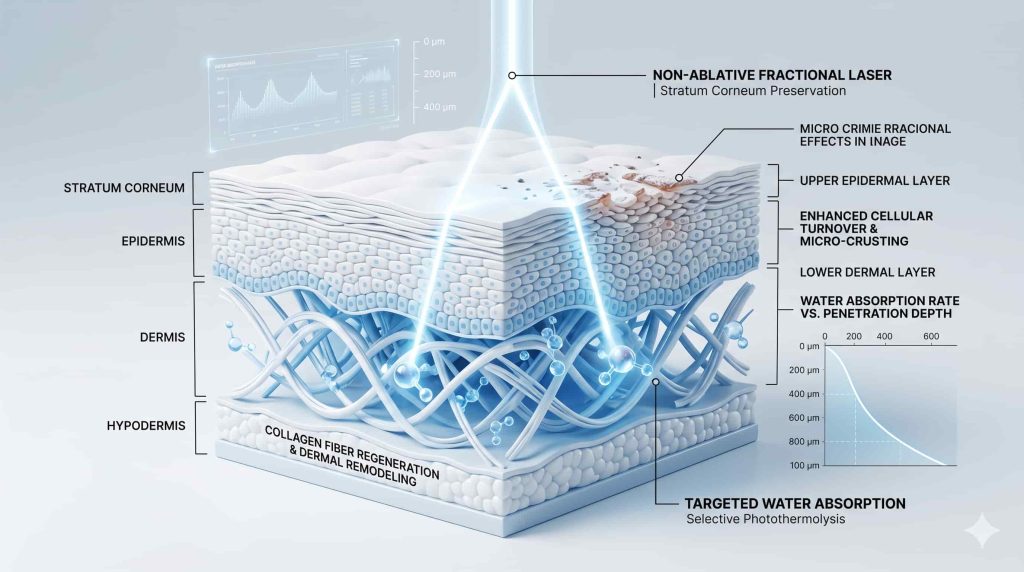
The 1927nm wavelength, generated via a Thulium-doped fiber optic source, possesses a water absorption coefficient approximately an order of magnitude (10 times) higher than that of the 1550nm wavelength. Because the tissue water immediately absorbs this energy, the penetration depth is strictly limited to the superficial layers of the skin (typically between 100 to 200 microns).
This localized absorption creates micro-epidermal necrotic debris (MENDs) at the epidermal-dermal junction while meticulously preserving the outermost layer, the stratum corneum. By maintaining an intact stratum corneum, the epidermis functions as a natural biological biological dressing. This rapid, superficial cellular turnover effectively shatters melanin clusters in the basal layer, accelerating their expulsion. Consequently, the 1927nm wavelength acts as a highly specialized tool for resolving superficial pigmentation, actinic damage, and overall epidermal tone without the risk of extensive deep-tissue thermal injury.
The 1550nm Er:Glass Laser: Deep Dermal Volumization and Neocollagenesis
Conversely, the 1550nm Erbium:Glass (Er:Glass) wavelength exhibits a lower water absorption coefficient. This reduced absorption allows the photon beam to bypass the upper epidermis largely undisturbed, penetrating significantly deeper into the reticular dermis (ranging from 400 up to 1500 microns, depending on the millijoule (mJ) energy applied).
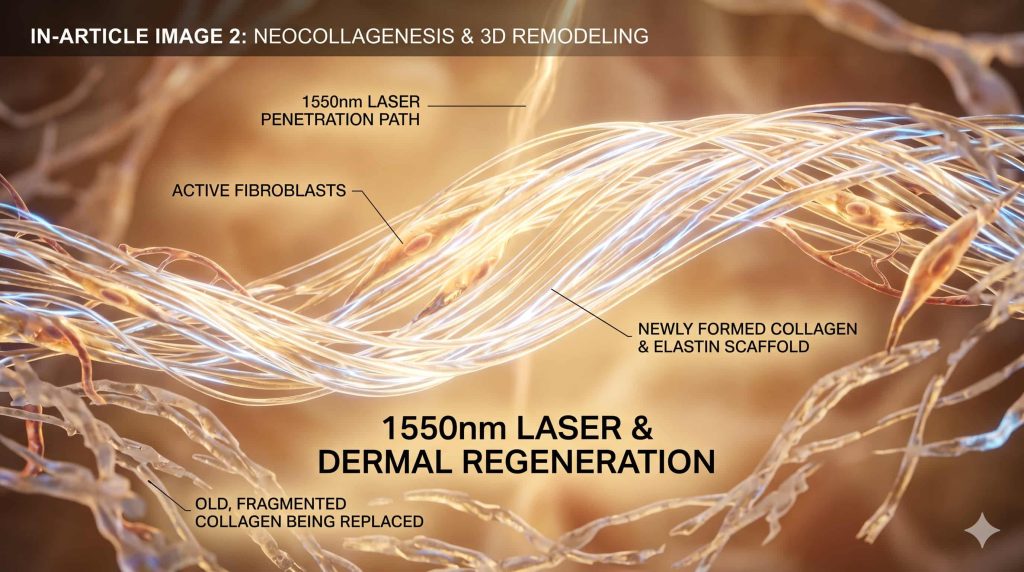
Once the energy reaches the targeted dermal depth, it creates robust thermal columns—Microscopic Treatment Zones (MTZs). The localized volumetric heating denatures existing, fragmented collagen fibers and initiates a wound-healing cascade. This biological response heavily stimulates fibroblast activity, leading to sustained Neocollagenesis (the synthesis of new collagen Type I and Type III) and elastogenesis over a period of 3 to 6 months. This deep dermal remodeling is the foundational mechanism for treating severe textural irregularities, deep rhytides, and atrophic scarring.
Comparative Analysis of Modalities
| Technical Parameter | 1927nm Thulium Laser | 1550nm Er:Glass Laser |
| Primary Target Chromophore | Water (High Absorption) | Water (Moderate Absorption) |
| Penetration Depth | 100 – 200 µm (Superficial) | 400 – 1500 µm (Deep) |
| Targeted Anatomical Layer | Epidermis & Epidermal-Dermal Junction | Papillary & Reticular Dermis |
| Primary Biological Response | Rapid epidermal turnover, melanin shedding | Fibroblast stimulation, Neocollagenesis |
| Core Clinical Utility | Dyschromia, hyperpigmentation, skin tone | Wrinkles, acne scars, skin laxity, striae |
| Healing Trajectory | Fast (Micro-crusting peels in 3-5 days) | Gradual (Dermal remodeling over 3-6 months) |
The Core Mechanism of Synergy: Why 1+1 > 2 in Clinical Practice
Deploying either wavelength in isolation yields targeted results; however, the true commercial and clinical value of an advanced medical device lies in the synergistic deployment of both wavelengths in a single treatment session. The simultaneous or closely sequential delivery of 1927nm and 1550nm generates a therapeutic effect that far exceeds the sum of their individual applications.
Simultaneous vs. Sequential Delivery: Optimizing Thermal Relaxation Time (TRT)
A critical factor in device engineering and clinical application is managing Thermal Relaxation Time (TRT)—the time required for the heated target tissue to dissipate 50% of its thermal energy into surrounding structures. Advanced laser controllers allow practitioners to modulate pulse durations and emission sequences (either multiplexed simultaneously or fired sequentially) to prevent catastrophic thermal stacking.
If thermal energy accumulates faster than the tissue’s TRT allows it to cool, it can result in unwanted bulk heating, blistering, or scarring. By intelligently sequencing the 1550nm deep pulses with the 1927nm superficial pulses, the tissue can diffuse heat efficiently. The utilization of integrated TEC Cooling (Thermoelectric Cooling) on the handpiece further protects the epidermis, allowing high-fluence energy delivery into the dermis while maintaining strict safety margins. This thermodynamic balance maximizes clinical outcomes while minimizing adverse events.
Comprehensive Tissue Coagulation: From Epidermis to Reticular Dermis
The synergistic application establishes a 3D pan-dermal coagulation profile. While the 1550nm wavelength creates deep structural pillars of coagulated tissue (acting as a dermal scaffold), the 1927nm wavelength addresses the horizontal surface layer, resolving the superficial pigmentary issues that often accompany structural aging.
This multi-tiered thermal damage signals a massive, coordinated immune and repair response. The deep structural remodeling initiated by the 1550nm is visually complemented by the rapid surface brightening induced by the 1927nm. For the patient, this means superior outcomes in a single clinic visit—addressing both “color” (pigment) and “contour” (texture) simultaneously.
Evidence-Based Clinical Indications and Treatment Protocols
A robust clinical portfolio is essential for the commercial viability of any capital equipment purchase. The 1927nm + 1550nm dual-wavelength architecture allows dermatologists to establish highly effective, protocol-driven treatments for complex dermatological conditions.
- Recalcitrant Melasma and Complex DyschromiaTreating melasma is notoriously difficult due to the high risk of rebound hyperpigmentation and Post-Inflammatory Hyperpigmentation (PIH). Traditional ablative lasers or aggressive Q-switched systems can generate a photoacoustic effect or excess heat that triggers melanocyte hyperactivity. The dual non-ablative approach is superior: the 1927nm wavelength safely accelerates the shedding of epidermal melanin without breaking the stratum corneum, while the 1550nm gently repairs the underlying basement membrane, reducing vascular permeability that often feeds dermal melasma. This combined protocol significantly lowers the recurrence rate.
- Acne Scarring, Striae, and Textural IrregularitiesAtrophic acne scars (rolling, boxcar, and ice-pick) and striae distensae require aggressive dermal restructuring. The 1550nm wavelength penetrates deep into the fibrotic scar tissue, breaking down tethered collagen and initiating the formation of organized, healthy tissue. Simultaneously, the 1927nm wavelength addresses the post-inflammatory erythema (PIE) and rough epidermal texture that typically border the scar tissue. This dual-action provides a comprehensive resurfacing result that isolated deep treatments fail to achieve.
- Advanced Photoaging and Actinic KeratosisChronic UV exposure results in solar elastosis, characterized by deep rhytides, leathery texture, and actinic lesions. The dual-wavelength approach offers a non-surgical facelift effect. The 1550nm wavelength addresses dermal laxity by restoring collagen density, effectively “plumping” the skin from below. Concurrently, the 1927nm wavelength clears actinic keratosis and solar lentigines, resulting in a cohesive, youthful epidermal appearance.
Strategic Advantages for Medical Aesthetic Practices (ROI & Patient Satisfaction)
From a B2B procurement perspective, the acquisition of a dual-wavelength platform must be justified by its financial performance. Clinic owners must evaluate the Total Cost of Ownership (TCO), consumable overhead (such as shots count capacity), and the ability to command premium treatment pricing.
Reduced Downtime Profile via Stratum Corneum Preservation
Modern aesthetic consumers demand high-efficacy treatments with minimal social interruption. Because the 1927nm + 1550nm modalities are strictly non-ablative, the stratum corneum remains intact. Patients experience mild erythema and localized edema for 24 to 48 hours, followed by a microscopic bronzing (MENDs) that naturally exfoliates within 3 to 5 days. This “lunchtime procedure” profile ensures high patient compliance and drives repeat bookings. Furthermore, the absence of open wounds eliminates the need for complex post-operative wound care and drastically reduces the risk of bacterial infection, thereby lowering the clinic’s liability profile.
Expanding the Addressable Patient Demographic (Fitzpatrick Types I-VI)
One of the most significant commercial advantages of this specific laser architecture is its exceptional safety profile across the entire Fitzpatrick Scale. Traditional ablative CO2 or aggressive fractional Erbium:YAG lasers carry an unacceptably high risk of PIH or hypopigmentation in darker skin types (Fitzpatrick IV-VI). Because the 1550nm/1927nm combination bypasses epidermal melanin bulk heating and relies on water as the primary chromophore, practitioners can confidently treat a much broader patient demographic. This directly expands the clinic’s addressable market, driving higher utilization rates for the device and accelerating equipment amortization.
Conclusion: The Future of Multimodal Fractional Lasers with Cocoon Laser
The clinical data and commercial metrics are unequivocal: the synergistic application of 1927nm and 1550nm wavelengths represents the apex of current non-ablative fractional laser technology. By offering the ability to tailor superficial and deep tissue interventions independently or simultaneously, practitioners are equipped with a highly versatile, revenue-generating asset that delivers consistent, predictable, and superior clinical outcomes.
For medical directors and clinic owners looking to elevate their practice’s clinical capabilities, investing in highly engineered, compliant (FDA 510(k) and Medical CE cleared) equipment is paramount. Cocoon Laser stands at the forefront of this technological convergence. By integrating a Cocoon Laser dual-wavelength system into your clinical protocols, you ensure your practice remains competitive in the rapidly advancing aesthetic market.
To review comprehensive technical specifications, evaluate the consumable lifespan, and understand how the 1927nm Thulium laser and 1550nm integrations can optimize your practice’s ROI, consult with a premier medical aesthetic device supplier. Explore the future of tissue remodeling and secure your position as a clinical leader by integrating professional medical laser equipment.
Request a Clinical Whitepaper or Device Demonstration today at Cocoon Laser: https://www.cocoonlaser.com/ to discover how the Cocoon Laser fractional laser can transform your patient outcomes.
Frequently Asked Questions (FAQ)
Q: Is the combination of 1550nm and 1927nm safe for dark skin (Fitzpatrick Types IV-VI)?
A: Yes. Both the 1550nm and 1927nm wavelengths utilize water as their primary chromophore, rather than melanin. This significantly reduces the risk of epidermal overheating. The fractional, non-ablative nature of the delivery, combined with advanced contact cooling, ensures that the melanocytes are not excessively stimulated, making it a highly safe and effective protocol for darker skin types with a minimized risk of Post-Inflammatory Hyperpigmentation (PIH).
Q: How does the dual-wavelength system improve clinic ROI compared to single-wavelength devices?
A: A dual-wavelength system consolidates two distinct clinical applications—superficial pigment correction (1927nm) and deep dermal remodeling (1550nm)—into a single footprint. This reduces the clinic’s Total Cost of Ownership (TCO) by eliminating the need to purchase, maintain, and house two separate capital devices. Additionally, the ability to treat multiple indications in a single, high-value session increases per-patient revenue while the low-downtime profile drives higher patient volume and retention.
Q: What is the expected downtime for a combined 1550nm and 1927nm treatment?
A: Because the treatment is non-ablative and preserves the stratum corneum, true “downtime” is minimal. Patients typically experience immediate erythema (redness) and mild edema (swelling) that resolves within 24 to 48 hours. This is followed by a sandpaper-like texture (micro-crusting) as the necrotic debris is expelled, which naturally exfoliates within 3 to 7 days. Patients can typically apply mineral makeup and resume normal professional activities within 24 hours.
If you need more information, please click “Contact Us”.
If you want to obtain more information, please follow our official website and Facebook.