The Technical Anatomy of the I-Cool Pico PURE: Next-Generation Picosecond Technology for Dermatology Practices
Executive Summary
For modern dermatology clinics and aesthetic practices, the transition from nanosecond to picosecond laser technology is a clinical necessity for managing recalcitrant pigmentation and complex tattoos. The I-Cool Pico PURE represents a sophisticated advancement in Energy-Based Devices (EBDs), combining ultra-short pulse durations with highly stabilized peak power and advanced integrated cooling mechanisms. By leveraging the pure photoacoustic effect, this Nd:YAG-based platform minimizes the thermal relaxation time threshold, significantly reducing the risk of Post-Inflammatory Hyperpigmentation (PIH) across all Fitzpatrick skin types. This technical review evaluates the core architecture, clinical indications, and ROI potential of the I-Cool Pico PURE, providing B2B procurement decision-makers with the critical data required for strategic technology integration.
What is the I-Cool Pico PURE?
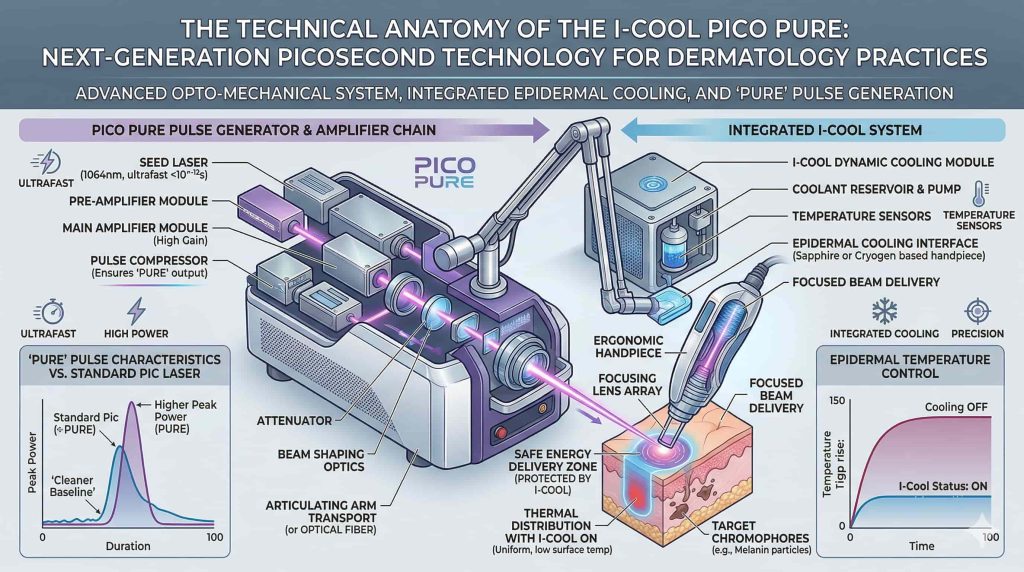
The I-Cool Pico PURE is an advanced, medical-grade picosecond laser system designed to deliver extremely short bursts of energy (measured in trillionths of a second) to targeted chromophores within the dermis and epidermis.
Unlike traditional lasers that rely heavily on a photothermal (heat) response, the I-Cool Pico PURE operates primarily on a photoacoustic mechanism. It typically utilizes dual-wavelength capabilities (1064nm and 532nm) to address a broad spectrum of endogenous pigments (like melanin in melasma or lentigines) and exogenous pigments (tattoo ink). The “I-Cool” designation highlights its proprietary integrated thermal management system, which actively protects the epidermis and maintains device stability during high-volume clinical operations.
Why Clinics Need the I-Cool Pico PURE (The Business & Clinical Rationale)
Procuring an aesthetic laser is a balance of evaluating clinical efficacy against the Total Cost of Ownership (TCO). The I-Cool Pico PURE addresses critical operational bottlenecks in modern practices:
- Superior Clearance Rates: The high peak power shatters pigment into substantially smaller microscopic particles (“dust”) compared to older Q-Switched technology (“pebbles”). This allows the patient’s lymphatic system to metabolize and clear the pigment in fewer total sessions, increasing patient satisfaction and clinic throughput.
- Maximized Epidermal Safety: By minimizing thermal diffusion into surrounding healthy tissue, the risk of adverse events such as PIH or scarring is drastically reduced. This makes the device highly suitable for treating demographics with darker skin tones (Fitzpatrick Types IV-VI), expanding the clinic’s addressable market.
- Reduced Patient Downtime: The precision of the picosecond pulse means less collateral tissue damage, translating to faster epidermal recovery. “Lunchtime procedures” become a viable marketing strategy for skin revitalization protocols.
How the I-Cool Pico PURE Works: The Clinical Mechanics
Understanding the physics behind the device is crucial for protocol optimization.
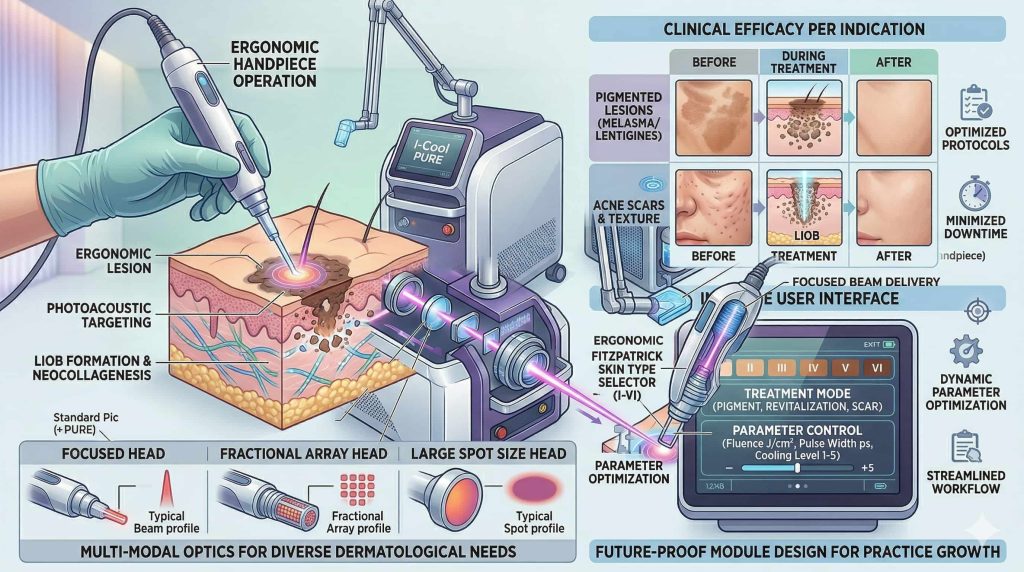
The Photoacoustic Effect and LIOB
When the I-Cool Pico PURE delivers its ultra-short pulse, the acoustic wave generated is so intense that it creates a mechanical shockwave. This shatters the target chromophore without generating excessive heat.
Furthermore, when equipped with fractional optics, the picosecond laser creates Laser-Induced Optical Breakdown (LIOB). LIOBs are micro-cavities formed within the dermis without ablating the epidermal surface. These micro-injuries trigger a robust localized wound-healing cascade, stimulating the production of new collagen and elastin fibers, making it an exceptional tool for acne scar revision and structural skin rejuvenation.
Advanced Thermal Management
Sustained high peak power requires rigorous internal temperature control to prevent energy degradation during a session. The integrated cooling system ensures that the laser cavity and flashlamps remain at an optimal operating temperature. For the patient, advanced contact or parallel cooling protects the dermo-epidermal junction, providing an analgesic effect that often eliminates the need for topical numbing creams.
Technical Parameter Comparison: I-Cool Pico PURE vs. Traditional Q-Switched Technology
To aid in procurement evaluation, the following matrix highlights the technical divergence between standard nanosecond devices and advanced picosecond platforms.
| Parameter | Traditional Q-Switched (Nanosecond) | I-Cool Pico PURE (Picosecond) | Clinical Impact for Clinics |
| Pulse Duration | $10^{-9}$ seconds (Nanoseconds) | $10^{-12}$ seconds (Picoseconds) | Shorter pulses drastically reduce thermal spread, maximizing safety. |
| Primary Mechanism | Photothermal & Photoacoustic | Purely Photoacoustic | Prevents collateral heat damage; essential for treating melasma safely. |
| Target Fragmentation | Fractures ink/pigment into “pebbles” | Shatters ink/pigment into microscopic “dust” | Faster clearance by macrophages; requires fewer total treatment sessions. |
| PIH Risk Factor | Moderate to High (in darker skin) | Extremely Low | Enables safe treatment across Fitzpatrick Scale I-VI. |
| Fractional Capability | Limited dermal remodeling | Advanced LIOB formation | Unlocks highly profitable skin revitalization and acne scar treatments. |
Frequently Asked Questions (FAQs) for B2B Buyers
Q1: What are the primary consumable costs associated with the I-Cool Pico PURE?
A: Unlike ablative devices that require disposable tips per patient, the primary consumable for the I-Cool Pico PURE is the flashlamp within the laser cavity. Modern picosecond platforms are engineered for longevity, typically offering millions of shots before requiring a flashlamp replacement, ensuring a low marginal cost per treatment.
Q2: Does the device support fractional handpieces for skin resurfacing?
A: Yes. Picosecond devices utilizing specialized fractional arrays (such as diffractive or holographic optics) are critical for generating LIOBs. This capability shifts the device from a purely pigment/tattoo removal tool into a comprehensive anti-aging and scar-revision workstation.
Q3: How does the dual-wavelength (1064nm/532nm) configuration optimize ROI?
A: The 1064nm wavelength is highly penetrative and poorly absorbed by epidermal melanin, making it safe for deep dermal pigment and dark tattoo inks in all skin types. The 532nm wavelength is highly absorbed by melanin and hemoglobin, targeting superficial benign pigmented lesions and warmer tattoo colors (red, orange). This dual capability allows a clinic to address over 90% of presenting pigmentary concerns with a single capital equipment purchase.
Conclusion: Strategic Integration for Clinical Excellence
The integration of the I-Cool Pico PURE into a dermatology practice is a strategic upgrade from legacy technology. By shifting the mechanism of action from photothermal heating to precise photoacoustic fragmentation, clinics can confidently address complex indications—ranging from multi-colored tattoos to severe melasma and acne scarring—with unprecedented safety and speed. For aesthetic businesses, this translates to higher patient throughput, reduced complication rates, and a definitively stronger return on investment.
To explore detailed technical specifications, request a clinical demonstration, or to view our complete portfolio of professional-grade aesthetic platforms, visit the official Cocoon Laser website. Partner with industry experts to future-proof your clinic’s technological capabilities.