Best Permanent Hair Removal Method: Laser vs IPL vs Electrolysis
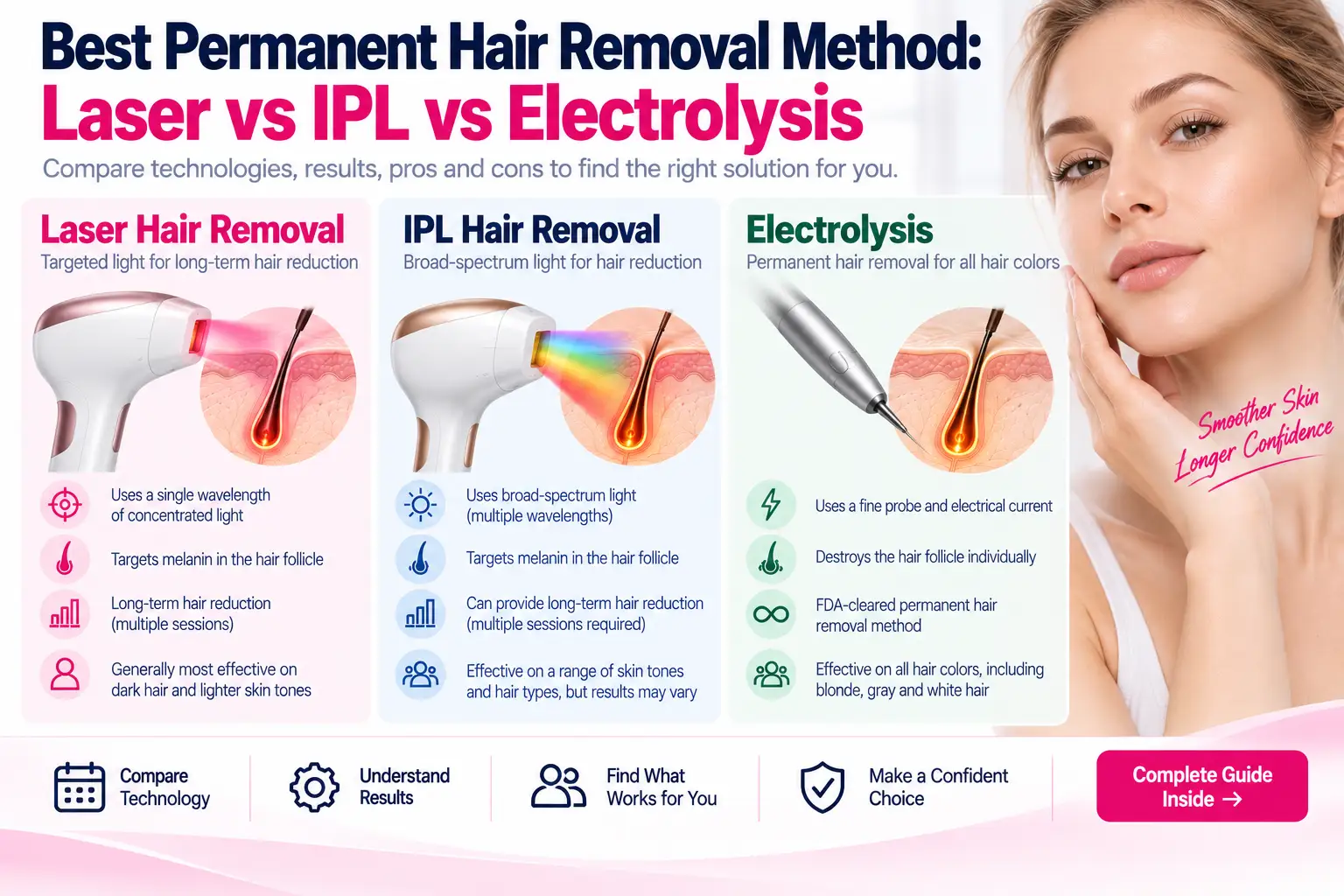
What is the best permanent hair removal method? For most people comparing long-term hair removal options, the decision comes down to three major technologies: professional laser hair removal, IPL and electrolysis.
However, these permanent hair removal methods do not produce exactly the same type of result. Laser and IPL are light-based technologies primarily used for long-term hair reduction, while electrolysis treats individual follicles using electrical energy and does not depend on hair pigment in the same way.
This difference is why there is no single permanent hair removal solution that is best for every person. Dark coarse hair across the legs, white hairs on the chin and facial hair on darker skin present very different treatment challenges.
In this guide, we compare the major permanent hair removal options, including laser treatment, IPL and electrolysis, to determine which method makes the most sense for different hair colors, skin types and treatment areas.
Quick Answer: What Is the Best Permanent Hair Removal Method?
If you are asking what is the best method for permanent hair removal, the answer depends on what you mean by “permanent” and what type of hair you want to treat.
Electrolysis is particularly relevant when the objective is permanent removal of individual treated hairs. Because it does not rely on melanin as an optical target, it can also treat blonde, red, gray and white hairs that may respond poorly to conventional laser and IPL.
Professional laser hair removal is generally more practical when the goal is substantial long-term reduction of many appropriately pigmented hairs across medium or large treatment areas such as the legs, underarms, bikini area, chest or back.
IPL can also provide long-term hair reduction in compatible hair-and-skin combinations and is particularly common in at-home hair removal devices.
Therefore, when asking which treatment is best for permanent hair removal, think of it this way: electrolysis is strongest for follicle-by-follicle permanent removal, professional laser is often more practical for efficient large-area reduction of suitable pigmented hair, and IPL is especially relevant when convenience and repeated at-home reduction are priorities.
Permanent Hair Removal Methods: What Are Your Options?
The most established permanent hair removal methods discussed by consumers and aesthetic professionals are laser hair removal, intense pulsed light (IPL) and electrolysis.
Although all three may appear when searching for permanent hair removal options, they use fundamentally different mechanisms.
| Permanent Hair Removal Option | How It Works | Typical Goal | Hair Pigment Required? | Best Practical Use |
|---|---|---|---|---|
| Professional Laser | Uses laser light to thermally affect suitable pigmented follicular targets | Long-term / permanent hair reduction | Yes | Efficient reduction across medium and large areas |
| IPL | Uses filtered broadband pulsed light | Long-term hair reduction | Yes | Professional applications and convenient home hair reduction |
| Electrolysis | Applies electrical energy through a fine probe to individual follicles | Permanent removal of treated hairs | No | Individual hairs, residual hair and light-colored hair |
Other temporary hair removal techniques such as shaving, waxing, threading, depilatory creams and mechanical epilation remove or shorten existing hair but do not belong in the same category when the objective is sustained reduction or permanent follicular removal.
Permanent Hair Removal vs Permanent Hair Reduction
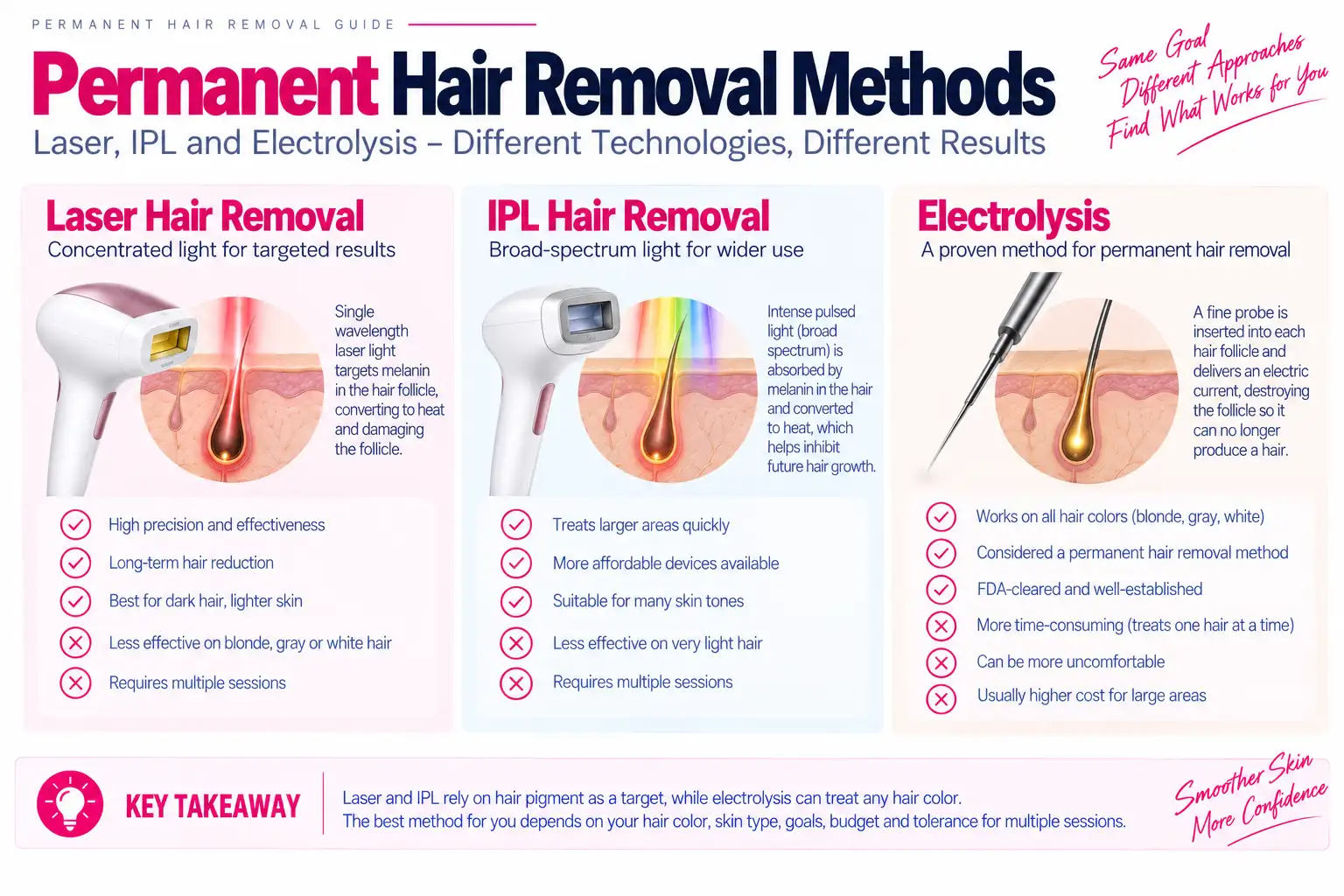
Before comparing different permanent hair removal techniques, it is important to understand the difference between permanent hair removal and permanent or long-term hair reduction.
Consumers often use these expressions interchangeably, but they should not automatically be interpreted as identical treatment claims.
Laser and IPL are designed to reduce future hair growth by delivering optical energy to suitable pigmented hair structures. A successful treatment course can substantially reduce visible hair density and regrowth, but this does not mean that every exposed follicle will necessarily stop producing hair forever.
Electrolysis approaches the problem differently by treating follicles individually rather than using hair melanin as the optical target.
This distinction is essential when evaluating advertisements or products described as a “permanent hair removal machine.” The technology, intended endpoint and evidence behind the claim matter more than the marketing phrase itself.
Why Does Permanent Hair Removal Require Multiple Treatments?
Hair follicles do not all progress through their growth cycles simultaneously. At any given treatment session, different hairs can be in different biological stages.
That is one reason a single laser, IPL or electrolysis session should not normally be expected to complete an entire treatment goal.
You can learn more about this mechanism in our Hair Growth Cycle and Laser Hair Removal guide.
Laser Treatment for Permanent Hair Removal
Laser treatment for permanent hair removal is one of the most commonly searched solutions for unwanted body and facial hair. More precisely, professional laser systems are used to achieve substantial long-term or permanent hair reduction in suitable candidates.
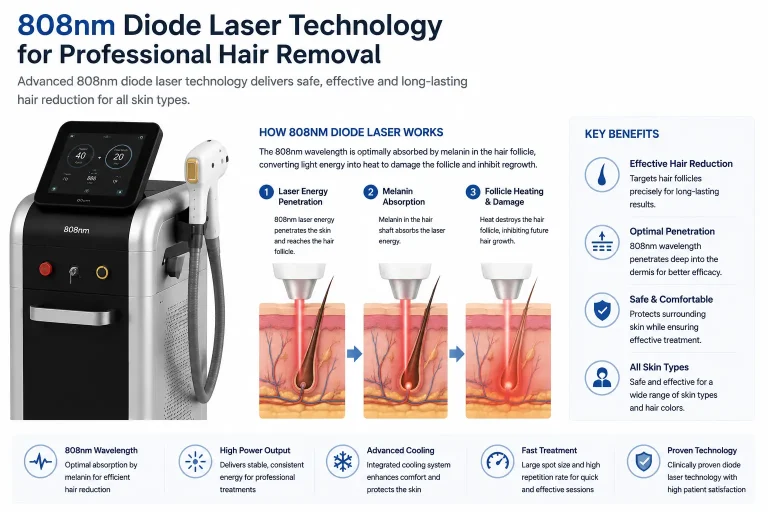
A hair-removal laser delivers light at a defined wavelength. When sufficient optical energy is absorbed by melanin associated with the target hair, that energy is converted into heat and can thermally affect follicular structures involved in future growth.
This is based on the principle of selective photothermolysis, where wavelength, pulse duration and energy delivery are selected according to the intended optical target while managing exposure to surrounding tissue.
For a deeper explanation, see our What Is Selective Photothermolysis? guide.
Which Lasers Are Used for Permanent Hair Reduction?
Professional laser hair removal can involve several wavelength regions, including:
- 755 nm Alexandrite
- approximately 800–810 nm diode laser
- 1064 nm Nd:YAG
- multi-wavelength diode laser platforms
These wavelengths do not behave identically in tissue. Their usefulness depends on factors such as melanin absorption, penetration depth, hair characteristics, skin pigmentation and the treatment parameters selected by the operator.
Wavelength should therefore never be considered in isolation. Fluence, pulse width, spot size, repetition rate, cooling and operator technique also influence treatment.
Who Is Laser Hair Removal Best For?
Professional laser is particularly relevant when the target area contains many sufficiently pigmented hairs and efficient coverage is important.
Common treatment areas include:
- Legs
- Underarms
- Bikini area
- Back
- Chest
- Suitable facial hair
The major limitation of conventional laser hair removal is hair pigmentation. Blonde, red, gray and white hairs may contain insufficient useful melanin for reliable optical targeting, depending on the actual pigment present.
IPL for Permanent Hair Removal
IPL, or intense pulsed light, is another widely used light-based hair reduction technology. It is often marketed alongside laser devices, but IPL is not a laser.
Instead of producing a comparatively narrow laser wavelength, IPL systems generate broadband light that is filtered and controlled for the intended application.
For hair reduction, useful portions of this light are absorbed by pigment associated with the hair. The absorbed optical energy is converted into heat and can affect follicular structures involved in regrowth.
Like laser hair removal, IPL therefore depends substantially on sufficient hair pigment. This is why IPL is generally ineffective or unreliable for completely white hair and can be challenging for very light blonde or some red hair.
Is IPL Permanent Hair Removal?
IPL can produce long-lasting hair reduction in suitable users, but it should not automatically be described as guaranteed permanent elimination of every treated follicle.
This distinction is especially important in the at-home market, where phrases such as “permanent hair removal device” may be used broadly in product descriptions.
We examine this question separately in Is IPL Hair Removal Permanent? .
Electrolysis for Permanent Hair Removal
Permanent hair removal with electrolysis works differently from both laser and IPL. Instead of relying on optical absorption by hair melanin, a trained practitioner inserts a fine probe into an individual follicle and applies electrical energy to treat follicular tissue involved in hair growth.
This difference gives electrolysis an important advantage: the hair does not need to provide the same pigmented optical target required by conventional laser or IPL.
As a result, electrolysis is an important permanent hair removal option for:
- Blonde hair with insufficient pigment for laser treatment
- Red hair that responds poorly to optical targeting
- Gray or grey hair
- White hair
- Small numbers of residual hairs after laser treatment
- Individual unwanted facial hairs
Is Electrolysis Permanent Hair Removal?
Yes, electrolysis is used for permanent removal of treated hairs. This is one of the most important distinctions between electrolysis and light-based hair reduction technologies.
However, “permanent” does not mean an entire treatment area can necessarily be completed in one appointment. Individual hairs emerge at different times, and repeated appointments are normally needed to treat follicles throughout the overall hair-growth cycle.
What Is the Main Disadvantage of Electrolysis?
The main practical limitation is treatment speed.
Electrolysis works follicle by follicle. That can be highly useful when treating a few white chin hairs, but much more time-consuming when thousands of hairs across the legs, back or chest need treatment.
This is why the most permanent hair removal technique is not automatically the most practical solution for every treatment area.
Laser vs IPL vs Electrolysis: Permanent Hair Removal Options Compared
| Factor | Professional Laser | IPL | Electrolysis |
|---|---|---|---|
| Technology | Laser light | Filtered broadband pulsed light | Electrical energy through a follicular probe |
| Primary Treatment Goal | Long-term / permanent hair reduction | Long-term hair reduction | Permanent removal of treated hairs |
| Requires Hair Pigment? | Yes | Yes | No |
| Large Areas | Highly practical | Practical in appropriate applications | Time-consuming |
| Dark Hair | Often well suited | Can be well suited | Can be treated |
| Blonde Hair | Depends on pigment level | Depends on pigment level | Can be treated |
| Gray / White Hair | Generally poor optical target | Generally poor optical target | Can be treated |
| Typical Treatment Speed | Fast for larger areas | Can cover larger areas efficiently | Slower because hairs are treated individually |
| Common Home-Device Category | Limited consumer laser options | Very common | Not equivalent to professional electrolysis treatment |
Which Treatment Is Best for Permanent Hair Removal?
If your main question is which treatment is best for permanent hair removal, there are three different answers depending on the treatment objective.
For permanent follicle-by-follicle removal: electrolysis is the most relevant option, especially when treating a limited number of hairs or hair that lacks enough pigment for laser and IPL.
For efficient long-term reduction of large areas of dark, appropriately pigmented hair: professional laser treatment is often the more practical option.
For convenient repeated home hair reduction: consumer IPL can be an attractive option when the user’s skin tone and hair color are compatible with the device.
Therefore, the best permanent hair removal solution is not determined by which technology sounds most powerful. It is determined by matching the treatment mechanism to the individual’s hair color, skin characteristics, treatment area and desired endpoint.
Laser vs Electrolysis Hair Removal: Which Is Better?
Laser vs electrolysis hair removal is one of the most important comparisons because the two technologies solve different problems.
Laser can expose an area containing multiple suitable hairs with each treatment pulse, making it efficient for larger treatment zones. Electrolysis treats individual follicles, making it slower but independent of the same optical hair-pigment requirement.
| Laser vs Electrolysis | Laser Hair Removal | Electrolysis |
|---|---|---|
| Best for large areas | Yes | Less practical |
| Dark pigmented hair | Often well suited | Suitable |
| White / gray hair | Generally unsuitable as an optical target | Suitable |
| Treatment speed | Faster for many hairs | Slower |
| Treatment endpoint | Long-term / permanent reduction | Permanent removal of treated hairs |
A practical strategy does not always require choosing one technology forever. For example, suitable pigmented hair across a larger area may first be substantially reduced with professional laser treatment, while a small number of remaining light-colored hairs may later be treated individually with electrolysis.
IPL vs Laser Hair Removal: Which Is Better?
The IPL vs laser hair removal comparison is different because both are light-based technologies and both depend substantially on suitable pigmentation in the target hair.
The key technological difference is the light source. A laser produces light within a defined wavelength range, while IPL produces broadband light that is filtered for the intended application.
Professional laser platforms can offer wavelength-specific treatment and extensive parameter control. IPL can offer versatility and is also widely used in consumer hair-reduction devices.
Therefore, “laser vs IPL” should also distinguish between professional clinic systems and consumer at-home devices. Comparing a professional diode laser directly with a small consumer IPL handset without accounting for their different intended uses can be misleading.
Professional Laser vs At-Home IPL
Professional laser systems are designed around clinic workflows, trained operation, adjustable treatment parameters, cooling and efficient treatment of larger areas.
Consumer IPL devices prioritize usability, portability and repeated self-treatment. Their role is therefore different even though both categories may appear for the same search query.
If you are specifically choosing a home device, read our Best At-Home Laser Hair Removal Device: IPL vs Diode Explained guide.
IPL vs Electrolysis for Permanent Hair Removal
IPL and electrolysis represent almost opposite approaches to hair removal.
IPL can expose a relatively broad treatment area and is convenient for repeated hair reduction when sufficient hair pigment is present. Electrolysis is highly targeted, treating one follicle at a time without relying on hair melanin as the optical target.
IPL may therefore make more practical sense for compatible dark hair across larger areas, particularly when home treatment is desired. Electrolysis becomes more relevant when treating isolated hairs, pursuing permanent removal of treated follicles or addressing blonde, gray or white hairs that IPL cannot reliably target.
Best Permanent Hair Removal Method by Hair Color
Hair color is one of the strongest factors affecting which permanent hair removal method makes sense because laser and IPL depend substantially on optical absorption by pigment.
| Hair Color | Professional Laser | IPL | Electrolysis | Most Practical Starting Point |
|---|---|---|---|---|
| Black | Often highly suitable with appropriate skin assessment | Often suitable with compatible skin | Suitable | Professional laser for larger areas |
| Dark Brown | Often suitable | Often suitable | Suitable | Professional laser |
| Dark Blonde | Variable | Variable | Suitable | Professional assessment |
| Very Light Blonde | Often difficult | Often difficult | Suitable | Electrolysis may be more relevant |
| Red | Variable to difficult | Often challenging | Suitable | Depends on pigment; electrolysis is important |
| Gray / White | Generally poor optical target | Generally poor optical target | Suitable | Electrolysis |
This subject deserves particular attention because searching for a stronger laser wavelength does not solve the fundamental problem of a hair that contains little or no useful melanin.
We cover this separately in Permanent Hair Removal for Blonde, Gray & White Hair: What Actually Works? .
Best Permanent Hair Removal Method by Skin Type
Skin pigmentation is especially important when comparing laser and IPL because melanin is present not only in the hair but also in the epidermis. A treatment system must deliver enough optical energy to affect the intended hair target while limiting unnecessary heating of surrounding skin.
Electrolysis works through a different mechanism and does not depend on the same optical contrast between hair melanin and epidermal melanin.
Light Skin
Light skin combined with dark hair often provides strong optical contrast for professional laser hair reduction. Depending on the individual and system, technologies such as Alexandrite or diode laser may be considered.
IPL may also be suitable when the user’s skin tone and hair color fall within the compatibility range of the specific system.
Medium Skin
As epidermal pigmentation increases, wavelength, fluence, pulse duration and cooling require greater attention. Professional assessment becomes increasingly valuable because both target hair and surrounding skin can absorb optical energy.
Dark Skin
Darker skin contains more epidermal melanin, which changes the safety considerations for light-based hair removal. Longer wavelengths such as approximately 1064 nm are commonly discussed in professional treatment of darker skin because of their optical characteristics.
However, wavelength alone does not make treatment universally safe or effective. Appropriate device selection, cooling, pulse parameters and professional technique remain important.
| Skin / Hair Combination | Professional Laser | IPL | Electrolysis |
|---|---|---|---|
| Light Skin + Dark Hair | Often a strong option | Often compatible with suitable devices | Suitable |
| Medium Skin + Dark Hair | Appropriate wavelength and parameters matter | Device-specific compatibility is important | Suitable |
| Dark Skin + Dark Hair | Professional wavelength and parameter selection becomes especially important | Requires careful device-specific assessment | Does not rely on the same melanin-based optical contrast |
| Any Skin Tone + White Hair | Hair pigment remains the main limitation | Hair pigment remains the main limitation | Hair color is not the same fundamental limitation |
Best Permanent Hair Removal Method by Treatment Area
Treatment-area size can completely change which permanent hair removal option is most practical. Treating ten unwanted hairs on the chin is very different from treating thousands of hairs across the legs, chest or back.
Best Permanent Hair Removal for the Face
Facial hair can contain a mixture of dark terminal hairs, fine hairs and hairs with different levels of pigmentation.
Professional laser may be useful for multiple suitably pigmented facial hairs, while electrolysis becomes especially relevant for individual blonde, red, gray or white hairs that cannot be reliably targeted with light.
If you are comparing facial devices more broadly, see our Best Facial Hair Removal Device: IPL, Laser or Epilator? guide.
Best Permanent Hair Removal for Underarms
Underarm hair is frequently coarse and pigmented, which can make professional laser a practical long-term reduction option for suitable candidates.
The treatment area is relatively compact, while many follicles can be exposed efficiently with a laser or IPL applicator compared with treating every follicle individually.
Best Permanent Hair Removal for the Bikini Area
The bikini area commonly contains dense, coarse terminal hair. Professional laser can offer efficient reduction when the hair and skin combination is appropriate.
Skin pigmentation and sensitivity can vary within the area, so treatment settings should not simply be copied from another body region.
Best Permanent Hair Removal for Legs
Legs are a large treatment area, which strongly favors technologies capable of treating multiple hairs with each pulse or flash.
For appropriately pigmented hair, professional laser is often much more practical than follicle-by-follicle electrolysis when substantial reduction across both legs is the goal.
Best Permanent Hair Removal for Back and Chest
The back and chest present the same scale issue. Professional laser platforms can use suitable spot sizes and repetition rates to treat larger areas efficiently.
Electrolysis can still be valuable later for isolated residual hairs, especially when those hairs are no longer good optical targets.
What Is the Best Permanent Facial Hair Removal Method?
The best permanent facial hair removal method depends heavily on the actual hairs being treated.
For a relatively dense area of dark terminal facial hair, professional laser may provide efficient long-term reduction when skin characteristics and the selected system are appropriate.
For a small number of gray, white, red or very light blonde hairs, electrolysis becomes more relevant because these hairs may contain insufficient melanin for conventional laser or IPL.
In some treatment plans, different technologies may therefore play complementary roles: professional laser can reduce suitable pigmented hairs over a broader area, while electrolysis can address individual residual hairs that remain.
What Are the Best At-Home Permanent Hair Removal Options?
Searches for permanent hair removal at home often lead to consumer IPL and laser devices. These products can provide long-term hair reduction for compatible users, but the word “permanent” should be interpreted carefully.
Consumer IPL is the most common light-based home treatment category. Some home devices also use laser technology, but home systems generally prioritize simplified operation and consumer safety controls rather than the broader parameter adjustment available on professional equipment.
The same biological limitations still apply:
- Hair needs suitable pigmentation for conventional optical targeting.
- Multiple treatments are generally required.
- Results vary by body area and individual response.
- Some visible regrowth may occur.
- Maintenance treatments may be appropriate.
If you specifically want to compare consumer devices, see our Best At-Home Laser Hair Removal Device guide.
How to Choose the Best Permanent Hair Removal Solution
The best permanent hair removal solution is determined by the interaction between the treatment method and the actual characteristics of the target hair and skin.
Use this decision sequence rather than selecting a method only from advertising claims.
Step 1: Identify the Hair Color
Dark pigmented hair is generally much more suitable for conventional laser and IPL than white, gray or very light blonde hair.
Step 2: Consider Skin Pigmentation
For laser and IPL, skin pigmentation affects optical absorption and therefore influences system and parameter selection.
Step 3: Consider Treatment-Area Size
Large areas favor efficient light-based coverage, while a few isolated hairs may be practical to treat follicle by follicle.
Step 4: Define the Desired Endpoint
Decide whether the goal is substantial long-term hair reduction or permanent removal of individual treated follicles. These are related but not identical treatment objectives.
Step 5: Decide Between Home and Professional Treatment
At-home devices prioritize convenience. Professional systems provide trained assessment and broader device-dependent treatment controls.
| Your Situation | Permanent Hair Removal Option to Consider First |
|---|---|
| Large area of dark pigmented hair | Professional laser |
| Compatible hair and skin + home convenience | Consumer IPL or suitable home laser |
| White or gray hair | Electrolysis |
| Very light blonde hair | Evaluate pigment; electrolysis may be more relevant |
| Small number of individual unwanted hairs | Electrolysis |
| Residual hairs after professional laser treatment | Electrolysis may complement previous reduction |
Common Permanent Hair Removal Techniques and Their Limitations
Not every technique used to remove unwanted hair should be treated as permanent hair removal. Understanding the limitation of each method prevents temporary removal from being confused with follicular reduction or removal.
| Hair Removal Technique | Result | Main Limitation |
|---|---|---|
| Shaving | Temporary surface removal | Hair remains capable of regrowth |
| Waxing | Temporary removal from the root | Follicles continue producing hair |
| Mechanical Epilation | Temporary root removal | Requires repeated treatment as hair returns |
| Depilatory Cream | Temporary chemical removal of visible hair | Does not provide permanent follicular removal |
| IPL | Long-term reduction | Depends on suitable pigmentation and repeated treatment |
| Laser | Long-term / permanent reduction | Depends substantially on hair pigmentation and treatment parameters |
| Electrolysis | Permanent removal of treated hairs | Slow for very large areas because follicles are treated individually |
Can Hair Grow Back After Permanent Hair Removal?
The answer depends on the treatment method and what was actually treated.
After laser or IPL, some hair can remain or become visible again over time. Successful treatment may still leave the area with significantly lower density, slower regrowth or finer visible hair than before treatment.
Factors that can contribute to visible hair after a treatment course include:
- Hair-growth cycling
- Incomplete treatment of some follicles
- Differences in hair pigmentation
- Body-area differences
- Hormonal or biological changes
- Need for maintenance sessions
Electrolysis treats individual follicles rather than broadly reducing an area through optical targeting, but repeated appointments are still required because not every hair is accessible at the same biological stage during one session.
Common Mistakes When Comparing Permanent Hair Removal Options
Assuming the Word “Permanent” Means the Same Thing for Every Technology
Permanent removal and long-term or permanent reduction are not identical endpoints. Understanding the technology is more important than relying on the marketing label.
Choosing Laser Only by Wavelength
A wavelength such as 755 nm, 808 nm or 1064 nm is only one part of a professional laser system. Fluence, pulse width, spot size, cooling, repetition rate and operator technique also matter.
Assuming More Power Means More Permanent Results
Higher energy does not automatically produce a better outcome. Appropriate selective energy delivery is more important than maximizing a single specification.
Ignoring Hair Color
Laser and IPL cannot reliably target hair that does not contain enough of the relevant pigment simply because the machine is powerful.
Assuming 1064nm Solves White Hair
A wavelength that may be useful in professional treatment of darker skin does not automatically solve the problem of white hair. Skin compatibility and hair pigmentation are separate issues.
Assuming Multi-Wavelength Laser Works on Every Hair Color
Multi-wavelength platforms can broaden treatment versatility for suitable hair-and-skin combinations, but they do not create melanin in completely depigmented hair.
Ignoring Treatment-Area Size
Electrolysis may be ideal for a few white chin hairs but inefficient for thousands of dark hairs across the legs. Practical treatment speed should be part of the decision.
常见问题
What is the best permanent hair removal?
There is no single method that is best for everyone. Professional laser is often the most practical option for long-term reduction of large areas of appropriately pigmented hair, while electrolysis is especially important for permanent removal of individual hairs and for blonde, gray or white hair that cannot be reliably targeted optically.
What is the best method for permanent hair removal?
The best method depends on hair color, skin type, treatment-area size and the desired endpoint. Electrolysis is particularly relevant for permanent follicle-by-follicle removal, professional laser for broad-area long-term reduction, and IPL for convenient reduction in compatible users.
Which treatment is best for permanent hair removal?
For individual hairs and hair colors that lack sufficient melanin, electrolysis is an important choice. For larger areas containing dark pigmented hair, professional laser can be more efficient. IPL can be appropriate when compatible home or professional light-based reduction is the goal.
What permanent hair removal techniques actually work?
Professional laser, IPL and electrolysis can all provide meaningful long-term hair-removal outcomes, but they do not produce the same endpoint. Shaving, waxing, creams and mechanical epilation provide temporary removal rather than permanent follicular treatment.
Is electrolysis permanent hair removal?
Electrolysis is used for permanent removal of treated hairs. It treats individual follicles using electrical energy and does not depend on hair melanin in the same way as laser or IPL.
Is laser treatment permanent hair removal?
Professional laser treatment is generally described in terms of permanent or long-term hair reduction rather than guaranteed permanent removal of every treated follicle.
Is IPL permanent hair removal?
IPL can provide substantial long-term hair reduction in suitable users, but it should not be assumed to permanently eliminate every treated hair.
Is laser or electrolysis better for permanent hair removal?
Laser is generally faster and more practical for large areas of suitable pigmented hair. Electrolysis is slower but particularly useful for permanent removal of individual hairs and hair colors that conventional laser cannot reliably target.
Is IPL or laser better for permanent hair removal?
Professional laser provides wavelength-specific treatment and broader professional parameter control, while IPL uses broadband pulsed light and is common in both professional and home systems. The better choice depends on the user, device and treatment setting.
What is the best permanent hair removal for blonde hair?
Dark blonde hair may contain enough pigment for professional laser treatment to be considered, while very light blonde hair can be difficult to target with laser or IPL. Electrolysis becomes more relevant when insufficient melanin is present.
What is the best permanent hair removal for gray or white hair?
Electrolysis is particularly relevant for gray and white hair because conventional laser and IPL rely substantially on melanin, which is limited or absent in these hair colors.
What is the best permanent hair removal option for dark skin?
Professional laser treatment may be appropriate when wavelength, parameters and cooling are selected for the individual’s skin and hair characteristics. Electrolysis does not depend on the same optical contrast between skin and hair melanin.
Can permanent hair removal be done at home?
Consumer IPL and some consumer laser devices can provide long-term hair reduction at home, but claims of permanent removal should be interpreted according to the technology, compatible hair and skin characteristics and device instructions.
Final Verdict: What Is the Best Permanent Hair Removal Solution?
The best permanent hair removal solution is not one technology for every person. It is the method that best matches the target hair, skin characteristics, treatment area and desired endpoint.
Professional laser hair removal is often the most practical choice for efficient long-term reduction of many appropriately pigmented hairs across medium and large areas.
IPL can provide meaningful long-term reduction for compatible users and is especially relevant for people who prioritize convenient at-home treatment.
Electrolysis occupies an important position when the goal is permanent removal of individually treated hairs, particularly when the hairs are blonde, red, gray or white and cannot provide the optical target required by conventional laser and IPL.
The decision can therefore be summarized simply:
- Choose professional laser when efficient broad-area reduction of suitable pigmented hair is the priority.
- Consider IPL when compatible light-based reduction and home convenience are the priority.
- Consider electrolysis when permanent follicle-by-follicle removal, light-colored hair or isolated residual hairs are the priority.
The strongest permanent hair removal strategy begins with understanding the actual target rather than choosing a device solely because its marketing uses the word “permanent.”