Best At-Home Laser Hair Removal Device: IPL vs Diode Explained
At-home laser hair removal has become a popular option for people who want to reduce unwanted hair without scheduling repeated professional treatments. However, choosing the best at-home laser hair removal device is not as simple as comparing power levels or buying the device with the most recognizable name.
One of the biggest sources of confusion is that many products marketed as “home laser hair removal” devices do not actually use a laser. Most consumer devices use intense pulsed light (IPL), while a smaller number use diode laser technology. These technologies produce light differently and should not automatically be treated as the same thing.
The right device also depends on your skin tone, hair color, treatment area, treatment frequency, safety requirements and expectations for long-term hair reduction. A device that works well for treating large areas such as the legs may not necessarily be the most practical choice for small areas such as the upper lip.
This guide explains how at-home hair removal devices work, the differences between IPL and diode laser technology, what features matter when choosing a device, and when professional laser hair removal may be a more appropriate option.
Quick Answer: What Is the Best At-Home Laser Hair Removal?
The best at-home laser hair removal device is not necessarily the device with the highest advertised energy or the most powerful-sounding technology. For most users, the better choice is a device that is compatible with their skin tone and hair color, has appropriate safety controls, covers the intended treatment areas efficiently and is practical enough to use consistently according to the recommended treatment schedule.
Most at-home hair removal devices use IPL rather than a true laser. IPL can be convenient for treating relatively large areas, while some home devices use diode laser technology to deliver light within a narrower wavelength range. Neither technology is automatically “best” for every user.
If you are choosing between them, focus first on skin and hair compatibility, treatment area, safety features, cooling, pulse speed and realistic treatment expectations rather than choosing solely by the words “IPL,” “laser” or a particular wavelength printed on the device.
What Is an At-Home Laser Hair Removal Device?
An at-home hair removal device is a consumer-operated light-based device designed to reduce unwanted hair growth over repeated treatments. Instead of physically pulling the hair from the follicle like waxing or epilation, light-based systems attempt to deliver optical energy to pigment associated with the hair and follicular structures.
The basic principle behind many light-based hair reduction technologies is selective photothermolysis. Light is absorbed by a target chromophore—in this case primarily melanin—and converted into heat. Appropriate delivery of that energy can affect structures involved in hair growth while limiting unnecessary thermal exposure to surrounding tissue.
This is also why skin tone, hair color, wavelength or spectral range, pulse duration and energy delivery all matter. Hair removal is not simply a question of making a device more powerful.
It is also important to distinguish consumer devices from professional systems. Home devices are designed around consumer usability and built-in operating limits, while professional laser and IPL systems may provide trained operators with a broader range of treatment parameters, wavelengths, spot sizes and cooling configurations.
IPL Hair Removal Devices
IPL stands for Intense Pulsed Light. Unlike a laser, which produces light within a much narrower wavelength range, IPL systems typically generate broadband light and use filtering to select a useful portion of that spectrum.
IPL is extremely common among at-home hair removal products. This is one reason consumers often encounter phrases such as “IPL laser hair removal,” even though IPL is technically not a laser.
Home IPL devices may include features such as skin-tone detection, multiple intensity settings, contact sensors, automatic flash modes and different treatment windows. Their relatively broad treatment windows can make them practical for areas such as the legs, arms and torso.
If you want to understand the technology in more detail, read our What Is IPL? How Intense Pulsed Light Works guide.
Diode Laser Hair Removal Devices
A diode laser generates laser light using semiconductor technology. Diode systems used for hair reduction commonly operate around wavelength ranges selected for interaction with melanin while allowing useful penetration into the skin.
Professional diode laser platforms commonly use wavelengths around 800–810 nm, although modern systems may use other wavelengths or combine multiple wavelengths in one platform.
Some consumer devices are also marketed as home diode lasers. These should not automatically be assumed to perform like professional diode laser systems simply because they use a similar wavelength. Device architecture, fluence, pulse characteristics, spot size, cooling, repetition rate and operating limits all influence how a system performs.
This distinction is especially important when comparing an 810 nm home device with an 810 nm professional diode laser. Wavelength alone does not define the performance of the entire system.
Best At-Home Hair Removal Device by User Need
There is no single device specification that makes one home hair removal system universally superior. A more useful approach is to identify what you actually need from the device and then compare technologies and features accordingly.
| User Need | What to Prioritize | Why It Matters |
|---|---|---|
| Best overall home device | Skin/hair compatibility, safety controls and usability | A device only works well if it is appropriate for the user and used consistently |
| Large treatment areas | Larger treatment window and faster repetition | Can reduce the time required to cover legs, arms or torso |
| Facial areas | Precision and manufacturer-approved facial use | Smaller areas require more controlled positioning |
| Sensitive users | Adjustable intensity and appropriate cooling | May improve treatment comfort when used correctly |
| IPL users | Skin sensor, flash rate and treatment window | These features strongly affect convenience and appropriate operation |
| Home diode laser users | Genuine laser technology, safety controls and device specifications | The word “diode” alone does not tell you how the complete device performs |
| Long-term use | Device durability and practical maintenance schedule | Hair reduction usually requires repeated treatments and possible maintenance |
IPL vs Laser: What Are You Actually Buying?
One of the most important steps when shopping for an at-home laser hair removal device is determining whether the product actually uses a laser.
The terms IPL and laser are frequently used interchangeably in consumer marketing, but they describe different methods of generating and delivering light.
Both can be used in light-based hair reduction, but understanding the difference helps prevent unrealistic comparisons between products.
How IPL Works
IPL generates a broad spectrum of light rather than a single narrow laser wavelength. Filters and other optical components determine which portions of that spectrum reach the skin.
During hair reduction, suitable wavelengths within the emitted light can be absorbed by melanin associated with the hair. The absorbed optical energy is converted into heat, which can affect structures involved in subsequent hair growth.
Because IPL can illuminate a relatively large treatment area and can be incorporated into compact consumer devices, it has become one of the most common technologies used for at-home hair removal.
How Diode Laser Hair Removal Works
A diode laser produces a much narrower spectral output than IPL. In hair reduction systems, diode wavelengths are selected to balance melanin absorption with sufficient penetration to reach relevant follicular structures.
The commonly discussed 808 nm and 810 nm region is strongly associated with diode laser hair removal, but wavelength is only one part of treatment performance.
Pulse width, fluence, spot size, repetition rate, contact quality, cooling and treatment technique can all affect energy delivery.
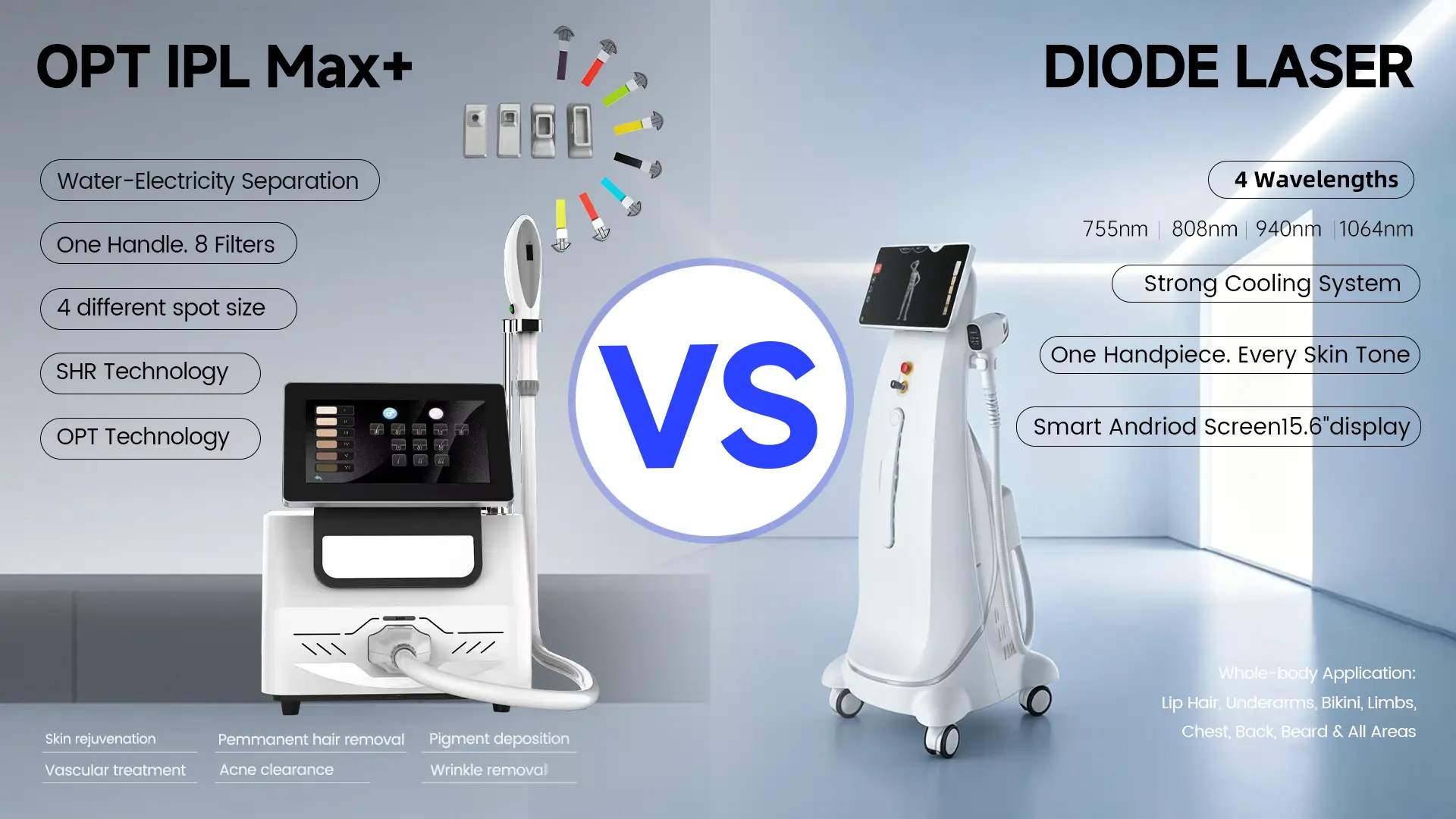
IPL vs Diode Laser for At-Home Hair Removal
| Feature | Home IPL | Home Diode Laser |
|---|---|---|
| Light source | Broad-spectrum intense pulsed light | Laser diode |
| Spectral output | Broadband and filtered | Narrower wavelength range |
| Availability | Very common in consumer devices | Less common in consumer devices |
| Large-area treatment | Often designed with relatively large flash windows | Depends strongly on device design and spot size |
| Precision | Depends on treatment window and attachment | Can provide wavelength-specific laser delivery |
| Cooling | Device-dependent | Device-dependent |
| Skin/hair compatibility | Must follow the individual device’s compatibility guidance | Must follow the individual device’s compatibility guidance |
| Best choice? | Depends on the user’s skin, hair, treatment area, device specifications and safety requirements rather than technology name alone | |
The key takeaway is that IPL is not simply a weaker version of diode laser, and diode laser is not automatically better simply because it is a true laser. They are different technologies, and the quality and suitability of the complete device matter more than the technology label alone.
What About 810nm Home Diode Laser Devices?
The 810 nm wavelength is widely associated with diode laser hair reduction and has consequently become an important search term among consumers comparing home laser devices.
However, two devices operating around 810 nm should not automatically be expected to provide identical performance. The wavelength tells you where the laser operates spectrally, but it does not tell you the device’s fluence, pulse duration, spot size, cooling performance, repetition rate or other operating characteristics.
This becomes particularly important when comparing home-use products with professional diode laser platforms. Professional systems are designed around different operating requirements and should not be treated as equivalent to a consumer device simply because both mention “810 nm.”
We cover this topic separately in our detailed Best 810nm Diode Laser Hair Removal Device at Home guide, including what 810 nm means and what specifications should be considered beyond wavelength.
How to Choose the Best At-Home Laser Hair Removal Device
Product marketing often focuses on flash counts, energy levels, cooling technology or wavelength. These specifications can be useful, but they should not be evaluated in isolation. A good buying decision starts with compatibility and safety before moving on to speed and convenience.
1. Determine Whether the Device Uses IPL or a True Laser
Start by identifying the actual light source. If a product is described as an “IPL laser,” check the technical specifications rather than relying on the marketing name.
An IPL device produces broadband pulsed light. A diode laser device uses semiconductor laser diodes and operates within a much narrower wavelength range.
Knowing which technology you are buying makes it easier to evaluate the rest of the specifications realistically.
2. Check Skin-Tone Compatibility
Skin tone is one of the most important considerations in light-based hair removal because melanin is present not only in hair but also in the epidermis.
Different devices have different approved operating ranges. Some consumer systems use skin-tone sensors to help determine whether a treatment should be delivered, but a sensor should not be treated as permission to ignore the manufacturer’s instructions.
Always follow the specific device’s skin-tone guidance rather than assuming that every IPL or diode device is suitable for every Fitzpatrick skin type.
3. Check Hair-Color Compatibility
Light-based hair reduction relies heavily on optical absorption by melanin. This means hair color can substantially influence treatment response.
Dark, pigmented hair generally provides a stronger melanin target than very light blonde, red, gray or white hair. A device marketed as “laser hair removal” cannot override the basic optical limitations created by very low pigment levels.
Check the manufacturer’s hair-color compatibility information before purchasing rather than assuming that higher energy will compensate for insufficient pigment.
4. Compare Treatment Window or Spot Size
Treatment area influences how practical a home device will be.
A larger window can help cover areas such as the legs more efficiently, while a smaller treatment area can provide better positioning around more localized regions.
Some home systems include multiple attachments or treatment windows for this reason.
5. Compare Pulse or Flash Speed
Repetition speed affects how quickly consecutive treatment areas can be covered. This can become particularly important when treating large areas.
However, faster flashing should not be interpreted as greater treatment effectiveness. It is primarily an important usability and treatment-throughput characteristic.
6. Look for Appropriate Safety Controls
Depending on the device, useful controls may include skin-contact detection, skin-tone sensing, adjustable intensity settings and mechanisms that prevent unintended flashes.
Safety features do not eliminate the need to follow the instructions for use, but they are an important part of consumer-device design.
7. Consider Cooling and Treatment Comfort
Cooling is increasingly emphasized in both consumer and professional hair removal systems. Depending on the device architecture, cooling may help manage skin temperature and improve treatment comfort.
Do not evaluate a device solely because it uses terms such as “ice cooling,” “sapphire cooling” or “pain-free.” Instead, determine what type of cooling is actually used and how it functions during treatment.
8. Do Not Compare Devices by Energy Numbers Alone
A larger advertised number does not automatically mean a better hair removal device.
Energy delivery has to be interpreted together with treatment area, pulse duration, optical design and other parameters. Comparing isolated energy specifications between different technologies can therefore be misleading.
9. Check Which Treatment Areas Are Approved
A device suitable for the legs is not automatically approved for every facial or intimate treatment area.
Before purchasing, check the manufacturer’s instructions for the specific body areas you plan to treat.
10. Consider the Treatment Schedule
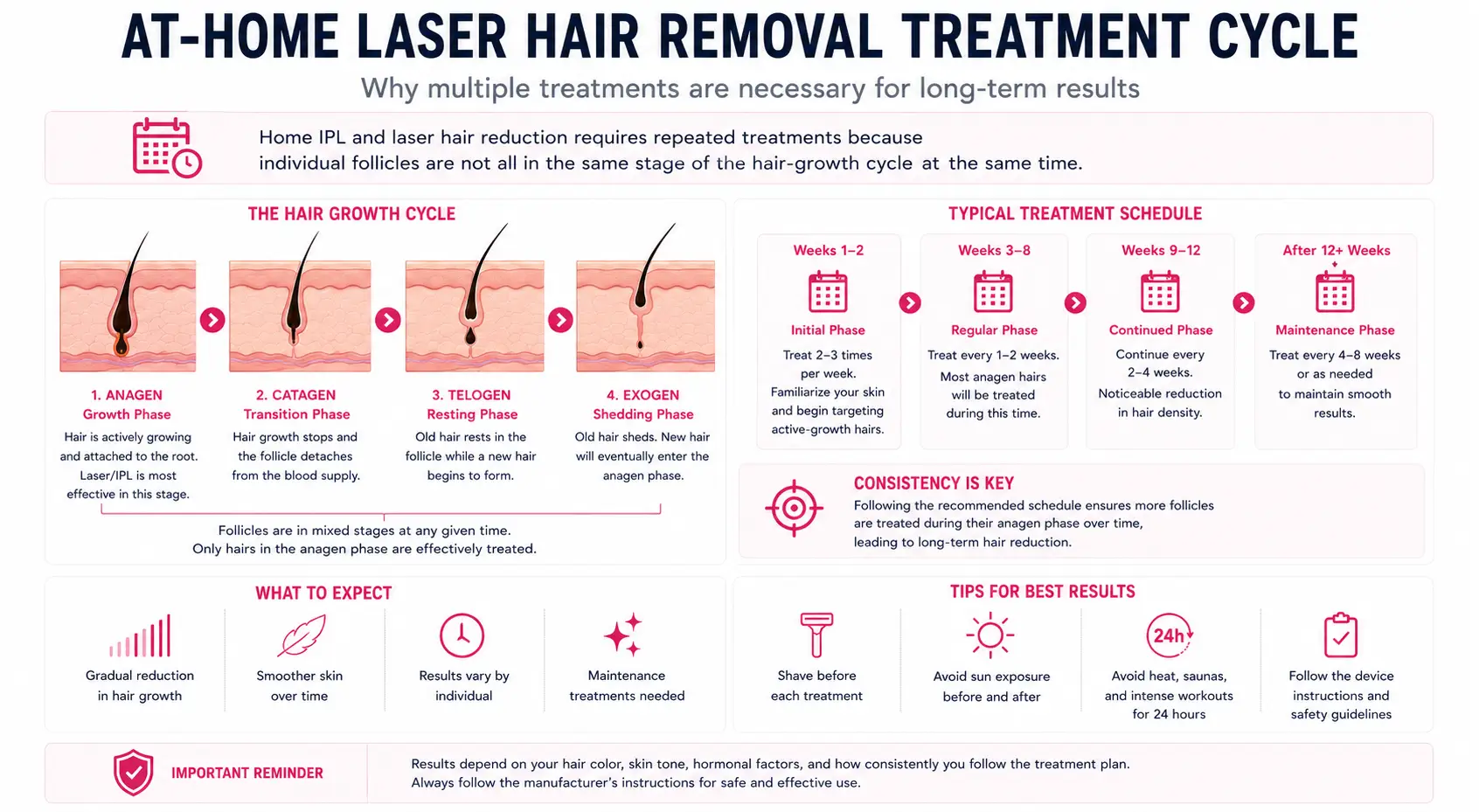
Hair does not grow uniformly at the same time. Hair follicles cycle through different stages, which is one reason light-based hair reduction normally requires repeated treatments rather than one session.
A realistic home device should therefore be judged not only by a single treatment but also by whether you can follow its recommended schedule consistently.
For a deeper explanation, see our Hair Growth Cycle Explained: Why Laser Hair Removal Needs Multiple Sessions .
Best At-Home Laser Hair Removal by Treatment Area
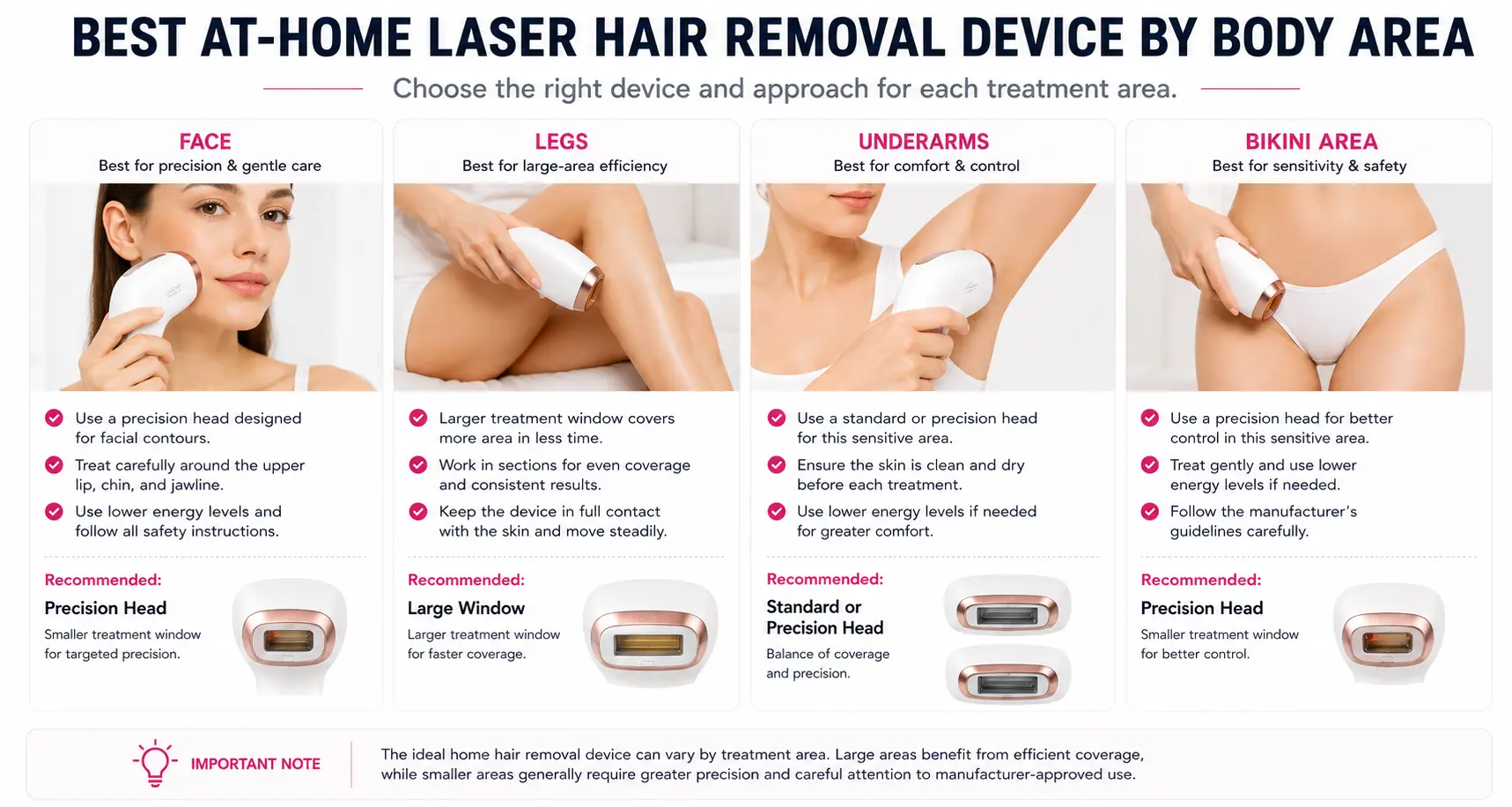
The best at-home laser hair removal device can also depend on where you plan to use it. Treatment-window size, device shape, precision, pulse speed and manufacturer-approved treatment areas all affect how practical a device will be.
Instead of assuming one device is equally suitable for every part of the body, consider the characteristics of the area you actually want to treat.
Best At-Home Laser Hair Removal for Face
Facial hair removal usually requires greater precision than treating large areas such as the legs. A smaller treatment window or dedicated facial attachment can make positioning easier around areas such as the upper lip, chin and jawline.
More importantly, verify that the manufacturer specifically permits use on the facial area you intend to treat. Restrictions can differ between devices, and a system approved for body hair should not automatically be assumed suitable for every part of the face.
For facial use, prioritize appropriate skin and hair compatibility, precise positioning, adjustable intensity and clear manufacturer instructions rather than simply choosing the device with the largest treatment window.
Best At-Home Laser Hair Removal for Legs
Legs are relatively large treatment areas, so coverage efficiency becomes much more important. A device that works well for a small facial area may become inconvenient when hundreds of overlapping treatment positions are required.
For leg hair removal, useful characteristics can include:
- A relatively large treatment window
- Fast pulse or flash repetition
- A glide or continuous-treatment mode when available
- Comfortable handpiece ergonomics
- Reliable skin contact
- A practical cooling system
Treatment speed should still be considered separately from effectiveness. A faster device can improve convenience without necessarily producing greater hair reduction per pulse.
Best At-Home Laser Hair Removal for Underarms
Underarms are smaller than the legs but have curved surfaces that can make consistent device contact more difficult.
A compact treatment window, good contact detection and comfortable handpiece design may therefore be particularly useful. Adjustable intensity can also be valuable because treatment sensation can vary between body areas.
As with every treatment area, follow the device manufacturer’s instructions regarding preparation, treatment frequency and approved anatomical use.
Best At-Home Laser Hair Removal for Bikini Area
For the bikini area, precision and clear anatomical-use instructions are particularly important.
Do not assume that a device marketed for “bikini” or “body” treatment can be used on every intimate area. Manufacturers may define specific areas where treatment is permitted and areas that should not be treated.
A smaller treatment attachment, adjustable energy settings and appropriate cooling can improve usability, but the manufacturer’s intended-use guidance should always take priority.
Best At-Home Hair Removal Device for Large Body Areas
If your primary goal is treating the legs, arms, chest or other large body areas, practical treatment time deserves more attention than it often receives in product comparisons.
Look at the relationship between treatment-window size and pulse repetition rather than evaluating either specification alone. Handpiece ergonomics and whether the system requires frequent pauses can also influence the real-world treatment experience.
Does At-Home Laser Hair Removal Really Work?
At-home IPL and laser devices can produce long-term hair reduction for appropriately selected users when they are used consistently and according to the manufacturer’s instructions.
However, “does it work?” is not a simple yes-or-no question. Results depend on the interaction between the user’s hair, skin, device and treatment schedule.
Important factors include:
- Hair pigmentation
- Hair thickness
- Skin pigmentation
- Device technology
- Optical and pulse characteristics
- Treatment area
- Treatment consistency
- Hair-growth cycle
- Individual biological factors
Darker pigmented hair generally provides a stronger optical target for melanin-based hair reduction than hair containing very little pigment. This is why very light blonde, gray, white and some red hair can be difficult to treat effectively with conventional IPL and laser hair reduction technologies.
It is also important to understand that visible hair does not all respond at the same time. Follicles move through different stages of the hair-growth cycle, which is one reason repeated treatments are required.
What Results Can You Expect?
Results should generally be evaluated as a progressive change in hair growth rather than expecting all visible hair to disappear immediately.
Over an appropriate treatment series, changes may include:
- Slower visible regrowth
- Reduced hair density
- Finer or less noticeable regrowth
- Patchier hair growth in treated areas
- Longer intervals before visible hair returns
The amount and timing of improvement vary between users, so individual before-and-after results should not be interpreted as a guarantee of what another person will experience.
How Long Does At-Home Laser Hair Removal Take to Work?
Home laser or IPL hair removal should normally be judged over a series of treatments rather than after one session.
Some users may begin noticing slower or less dense regrowth during the initial treatment period, while more substantial reduction may require continued use according to the device’s recommended schedule.
There is no universal number of days or weeks that applies to every device because treatment schedules differ and individual hair-growth characteristics vary.
Be cautious with claims that imply a specific home device will produce complete results after only a few days. A more useful question is whether the recommended treatment program is realistic enough for you to follow consistently.
How Often Should You Use At-Home Laser Hair Removal?
The correct treatment frequency is the schedule specified for the individual device.
Consumer IPL and laser devices may recommend an initial treatment phase followed by less frequent maintenance, but schedules vary by product. Using a device more often than recommended should not be assumed to produce faster results.
Hair-growth biology is one reason for this. Increasing treatment frequency does not force every follicle into a more responsive stage of the growth cycle.
Users should therefore follow the instructions for their exact device rather than copying the treatment schedule from another IPL system, a diode device or a professional clinic.
If you are specifically using an IPL device, see our detailed guide: How Often to Use IPL Hair Removal .
Is At-Home Laser Hair Removal Permanent?
It is more accurate to think of at-home IPL and laser treatments as methods for long-term hair reduction rather than assuming that every treated hair will disappear permanently.
Successful treatment may substantially reduce visible regrowth, but some hair can return over time. The amount of regrowth differs between individuals and treatment areas.
Factors that can influence future hair growth include:
- Hair-growth cycling
- Hormonal influences
- Age
- Genetic factors
- Body area
- Treatment consistency
- Individual response
This is also why many home-device protocols include maintenance treatments after the initial treatment series.
Consumers should be cautious with products that imply a short course of treatment can guarantee complete and permanent removal of all future hair.
Is At-Home Laser Hair Removal Safe?
Home IPL and laser devices are designed for consumer operation within their specified conditions of use, but they are not automatically suitable for every person, skin tone or treatment area.
Possible unwanted effects can include:
- Temporary redness
- Warmth or discomfort
- Temporary skin irritation
- Burns or blistering if inappropriate energy is delivered
- Changes in skin pigmentation
- Eye-related risk if device-specific safety instructions are ignored
Risk can be affected by skin pigmentation, recent sun exposure, treatment settings, technique, frequency and whether the device is suitable for the intended treatment area.
Follow the manufacturer’s contraindications, skin-tone compatibility guidance, treatment-area restrictions and recommended schedule for the specific device being used.
Who Should Be Especially Careful?
Contraindications vary between devices, so the product instructions should always be checked before treatment.
Particular caution may be necessary when:
- Your skin tone falls outside the device’s stated compatibility range
- Your skin is recently tanned or sunburned
- The treatment area has active irritation or damaged skin
- You use a medication associated with photosensitivity
- You have a relevant medical or dermatological condition
- The intended body area is excluded by the manufacturer
- You have previously experienced an unusual response to light-based treatment
This is not an exhaustive list. When individual health or skin factors create uncertainty, appropriate professional advice should be sought before treatment.
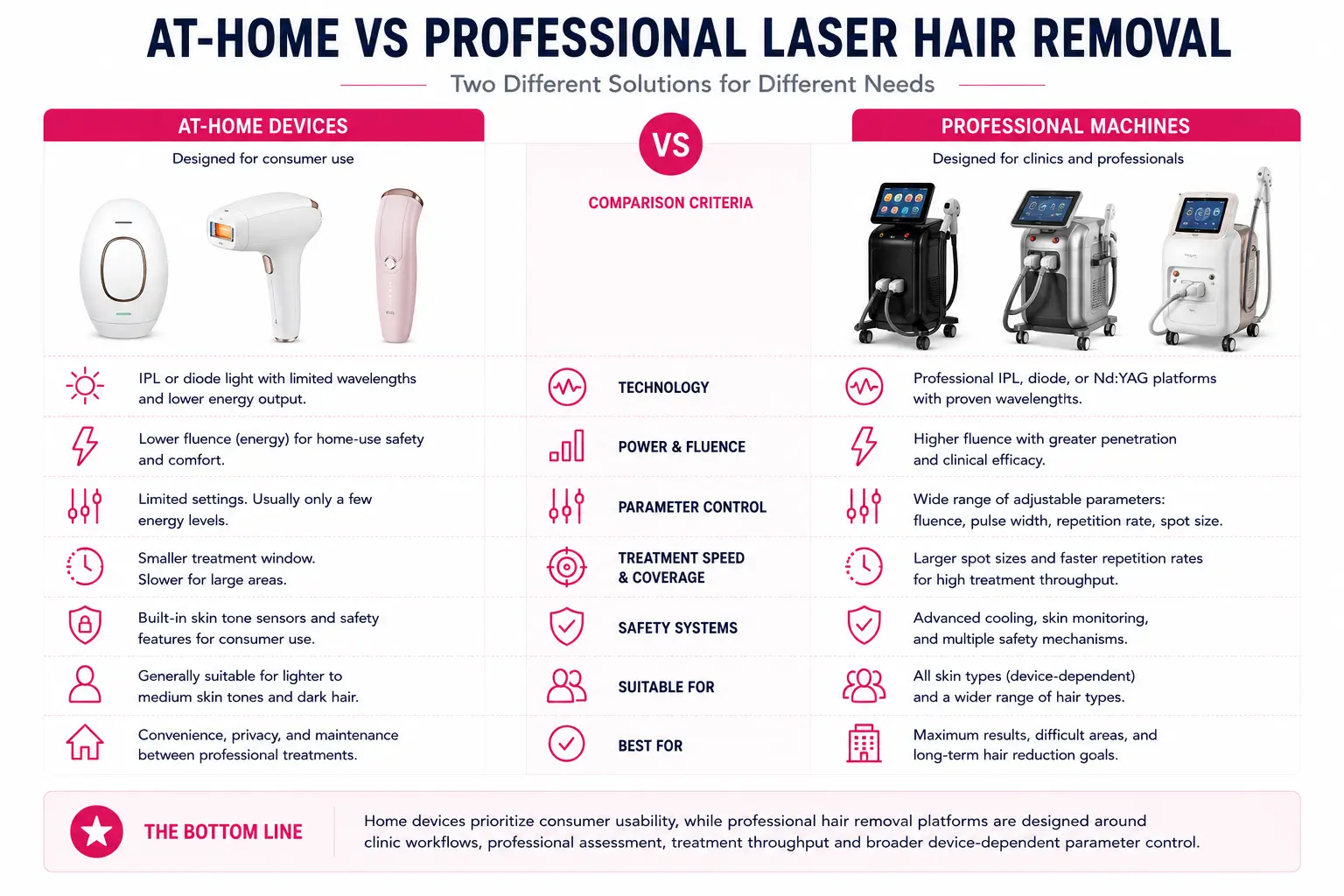
At-Home vs Professional Laser Hair Removal
At-home devices and professional laser hair removal machines are not simply different sizes of the same product.
They are designed for different users, treatment environments and levels of parameter control.
| Factor | At-Home Hair Removal | Professional Hair Removal |
|---|---|---|
| Intended user | Consumer | Professional operator according to applicable requirements |
| Common technologies | Primarily IPL, with some diode laser devices | Diode, Alexandrite, Nd:YAG, IPL and other professional platforms |
| Parameter control | Usually simplified or partially automated | Broader device-dependent professional controls |
| Skin and hair assessment | User screening plus device safeguards | Professional assessment and treatment planning |
| Spot or window options | Consumer-device dependent | Professional systems may offer multiple spot sizes or applicators |
| Cooling | Varies by product | Professional contact and other cooling systems may be available |
| Treatment workflow | Designed for repeated personal use | Designed for clinic or aesthetic-practice workflows |
| Technology selection | Limited to the purchased device | Clinics may select different technologies for different treatment needs |
Professional platforms may allow trained operators to adjust parameters such as fluence, pulse duration, spot size and repetition rate within the capabilities of the particular system. Professional treatment also introduces another important factor that a home device cannot provide by itself: individualized assessment.
Is Professional Laser Hair Removal Better Than At-Home Treatment?
“Better” depends on what the user is trying to achieve.
At-home devices may be attractive for people who prioritize privacy, convenience and repeated self-treatment. Professional treatment may be preferable for people who want access to clinic-based technologies, professional assessment and more individualized treatment parameters.
Professional clinics may also have access to different wavelength technologies. For example, diode, Alexandrite and Nd:YAG laser systems have different optical characteristics and may be selected according to the platform, patient characteristics and treatment strategy.
If you are researching equipment for a clinic, medical spa or aesthetic business rather than a consumer device, see our Best Laser Hair Removal Machine for Professional Clinics guide.
Common Mistakes When Buying an At-Home Hair Removal Device
Product specifications can make home hair removal devices appear easy to compare, but several common shortcuts can lead to poor buying decisions.
Assuming Every “Laser Hair Removal” Device Uses a Laser
Many consumer products marketed around laser hair removal actually use IPL. Check the light source in the technical specifications before comparing devices.
Choosing the Device With the Highest Energy Claim
A single energy number does not describe the complete optical system. Energy delivery must be interpreted alongside treatment area, pulse characteristics and device architecture.
Ignoring Skin-Tone Compatibility
Epidermal melanin can also absorb optical energy. A device that is unsuitable for a user’s skin tone should not be selected simply because it has good reviews or powerful specifications.
Ignoring Hair Color
Conventional IPL and diode hair reduction depend substantially on melanin as a target. Very lightly pigmented hair may therefore respond poorly even when the user’s skin tone is otherwise compatible.
Buying Based on Flash Count Alone
Flash count can be relevant to expected device lifespan, but it does not tell you whether the system is appropriate for your hair, skin or treatment areas.
Assuming 810nm Automatically Means Better
Wavelength matters, but it is only one component of a diode laser system. Two 810nm devices can have very different output, pulse characteristics, spot sizes, cooling systems and operating limits.
Using the Device More Often Than Recommended
More frequent treatment does not automatically mean faster hair reduction. Follow the treatment schedule specified for the individual product.
Expecting Complete Permanent Hair Removal
Long-term hair reduction is a more realistic way to evaluate light-based treatment. Regrowth and maintenance requirements vary between individuals.
Frequently Asked Questions
What is the best at-home laser hair removal device?
The best device depends on your skin tone, hair color, treatment area and preferred technology. Start by checking compatibility, then compare whether the device uses IPL or a true laser, treatment-window size, pulse speed, safety sensors, cooling, energy controls and treatment schedule.
Do at-home laser hair removal devices really work?
At-home IPL and laser devices can produce long-term hair reduction in appropriately selected users when used consistently according to their instructions. Results vary according to hair pigmentation, skin tone, treatment area, device characteristics and individual biology.
Is IPL the same as laser hair removal?
No. IPL produces broad-spectrum pulsed light, while a laser produces light within a much narrower wavelength range. Both can be used for hair reduction, but they are different optical technologies.
Is IPL or diode laser better for at-home hair removal?
Neither technology is universally better. IPL is more common in consumer home devices and can provide convenient large-area coverage. True diode devices offer wavelength-specific laser output. The better choice depends on the complete device, skin and hair compatibility, treatment area and intended use.
Is at-home laser hair removal permanent?
It is more appropriate to describe the expected outcome as long-term hair reduction rather than guaranteed permanent removal of every hair. Some regrowth can occur and maintenance treatments may be needed.
How often should you use at-home laser hair removal?
Follow the schedule specified by the manufacturer of your exact device. Treatment frequency differs between products, and using a device more often than recommended should not be assumed to improve results faster.
Can you use an at-home laser hair removal device on your face?
Only when the specific device is intended for the facial area you want to treat. Check the manufacturer’s anatomical-use restrictions and use any recommended precision attachment or treatment mode.
Is professional laser hair removal better than at-home devices?
Professional treatment offers professional assessment and access to clinic-based technologies and broader device-dependent parameter controls. Home devices prioritize convenience and consumer self-use. Which option is more appropriate depends on the user’s characteristics, goals and treatment requirements.
Final Verdict: Which At-Home Hair Removal Device Is Best?
There is no single best at-home laser hair removal device for every person.
For most buyers, the most important decision is not which brand has the largest flash count or the strongest marketing claim. It is whether the technology and device are appropriate for their skin tone, hair color, treatment area and expected treatment routine.
IPL represents the largest part of the consumer home hair-removal market and can be practical for users who want convenient coverage across relatively large areas. True home diode laser devices provide a different option for consumers specifically interested in wavelength-specific laser technology.
Neither should be selected by technology name alone.
When comparing the best at-home laser hair removal products, prioritize:
- Skin-tone compatibility
- Hair-color compatibility
- IPL vs true laser technology
- Treatment-area suitability
- Treatment-window size
- Pulse speed
- Safety sensors
- Energy controls
- Cooling
- Realistic treatment schedules
- Clear manufacturer instructions
If you have already decided that you specifically want an 810nm home diode system, continue to our Best 810nm Diode Laser Hair Removal Device at Home guide rather than choosing an 810nm device based on wavelength alone.
If you are researching equipment for a clinic, medical spa or professional aesthetic practice, consumer home devices are a different product category. Start instead with our Best Laser Hair Removal Machine for Professional Clinics guide.
Editorial Note: Cocoon Laser develops professional aesthetic and light-based treatment equipment. This guide is intended to explain the technology and selection factors behind consumer at-home hair removal devices rather than recommend a specific consumer brand. Product specifications, intended use, contraindications, treatment schedules and regulatory status vary by manufacturer and market. Always follow the instructions supplied with the specific device.