Hair Growth Cycle Explained: Why Multiple Laser Hair Removal Sessions Are Needed
What Is the Hair Growth Cycle?
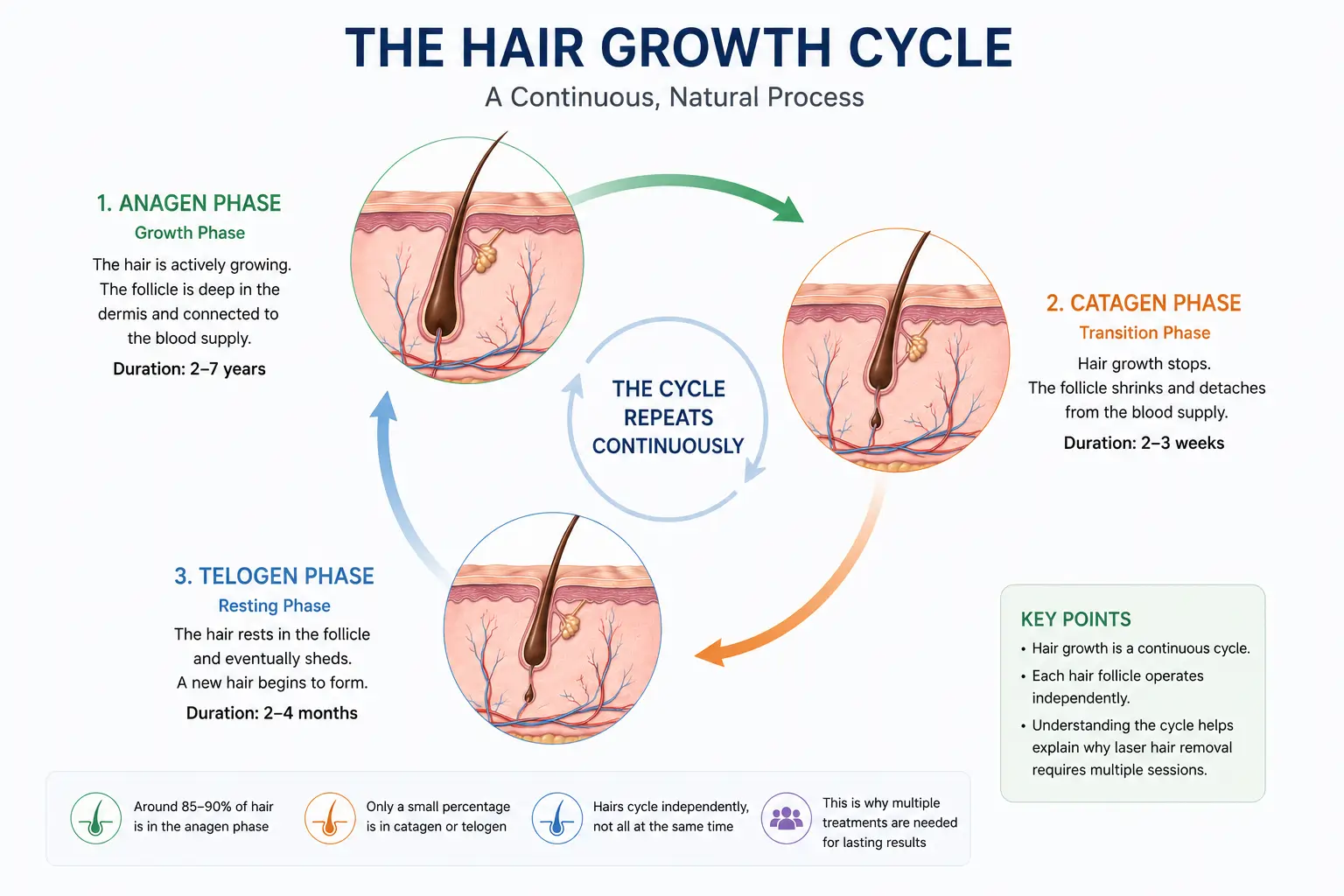
The hair growth cycle is the continuous biological process through which each hair follicle repeatedly grows, regresses, rests, and eventually begins producing new hair again. Unlike many people assume, not all hairs grow at the same time. Every follicle functions independently, meaning neighboring hairs may be in completely different stages of development. This independent cycling explains why unwanted hair is never removed permanently after a single laser treatment. At any given moment, only a proportion of follicles are actively producing hair, while others are transitioning or resting. Modern laser hair reduction protocols are therefore designed around the biology of the follicle rather than the visible hair itself.Understanding Hair Follicle Anatomy
To understand why the hair growth cycle is important, it is helpful to examine the structure of a hair follicle. A follicle is a complex mini-organ located beneath the skin surface that continuously produces new hair fibers throughout life. Although the visible hair shaft extends above the skin, the structures responsible for hair regeneration lie much deeper within the follicle. Major anatomical structures include:- Hair Shaft — the visible portion extending above the skin.
- Hair Root — the section located beneath the skin.
- Hair Bulb — the enlarged base where actively growing cells are located.
- Dermal Papilla — supplies nutrients and growth signals that regulate the hair cycle.
- Outer Root Sheath — supports the follicle structure.
- Sebaceous Gland — produces sebum to lubricate hair and skin.
Why Do Hair Follicles Grow in Cycles?
Hair growth is regulated by genetics, hormones, age, nutrition, and local biological signaling. Rather than growing continuously, follicles alternate between periods of active production, controlled regression, and temporary rest. This cyclical process allows damaged hairs to be replaced while maintaining healthy hair density across different regions of the body. Importantly, each follicle follows its own biological timetable. As a result, thousands of follicles within the same treatment area may be in different stages simultaneously. This asynchronous growth pattern is one of the primary reasons multiple laser treatment sessions are required for long-term hair reduction.The Three Main Phases of the Hair Growth Cycle
Although hair biology is highly complex, the growth cycle is generally divided into three principal stages:| Phase | Main Activity | Laser Response |
|---|---|---|
| Anagen | Active hair growth | Highest treatment effectiveness |
| Catagen | Follicle regression | Reduced effectiveness |
| Telogen | Resting phase | Minimal response |
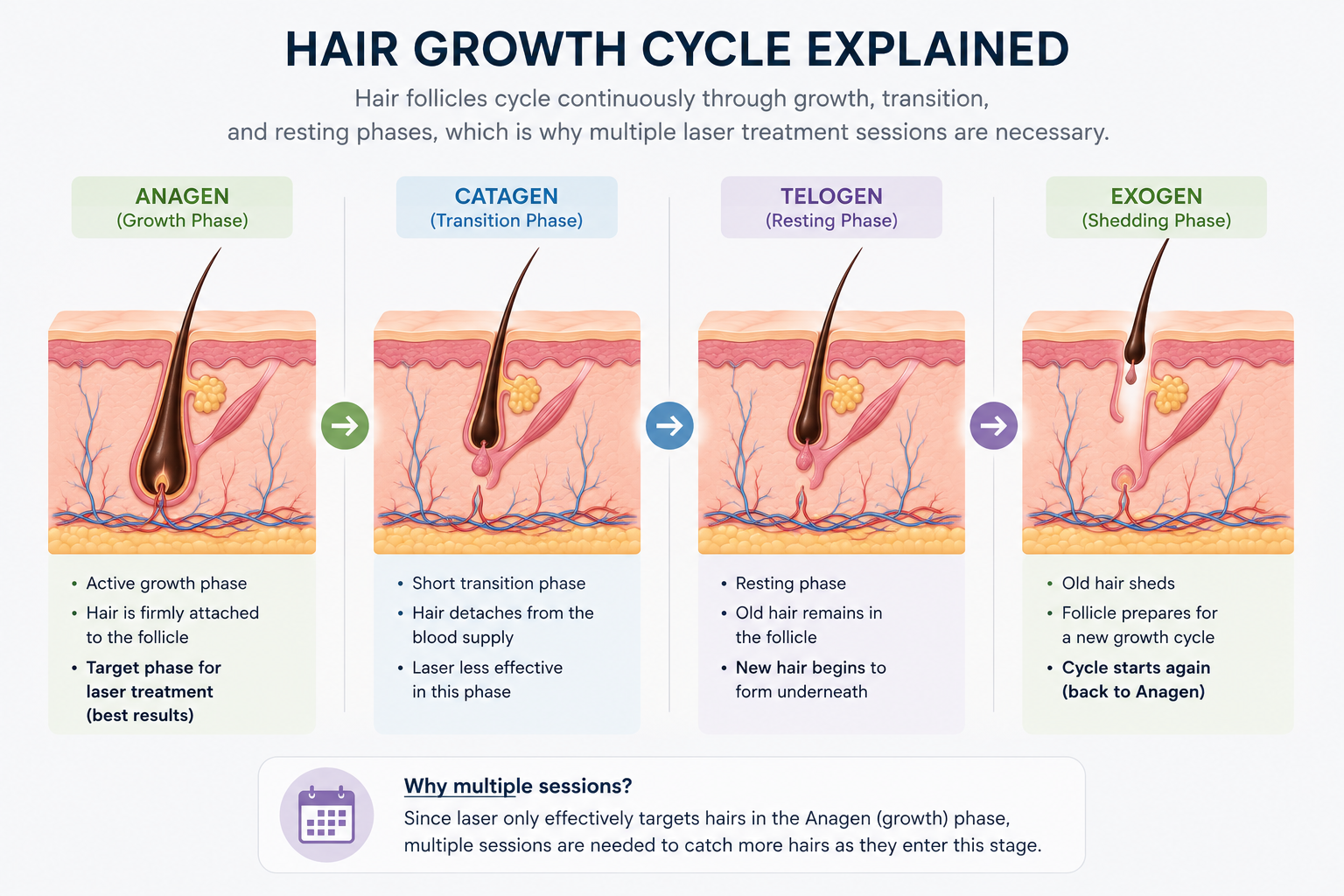
Anagen Phase: The Active Growth Stage
The anagen phase , commonly known as the active growth stage, is the most important phase of the hair growth cycle for professional laser hair reduction. During this period, hair is actively produced within the follicle and maintains a strong biological connection with the dermal papilla and surrounding follicular structures. Because melanin is abundant throughout the growing hair shaft, laser energy can travel efficiently from the visible hair toward the deeper follicle. This allows thermal energy to reach the structures responsible for continued hair production.Characteristics of the Anagen Phase
- Continuous production of new hair cells
- Strong attachment between the hair shaft and follicle
- High melanin concentration within the hair
- Rich blood supply supporting active growth
- Greatest sensitivity to laser treatment
Catagen Phase: The Transition Stage
The catagen phase is a short transitional period during which active hair growth gradually stops. Cellular activity slows, the follicle begins to shrink, and the connection between the hair shaft and the dermal papilla weakens. Because this biological connection is being lost, laser energy can no longer travel as efficiently toward the follicular structures responsible for future hair growth.Characteristics of the Catagen Phase
- Hair growth gradually stops.
- The follicle becomes smaller.
- Blood supply decreases.
- Hair separates from the dermal papilla.
- Laser treatment becomes less effective.
Telogen Phase: The Resting Stage
The telogen phase is the resting stage of the hair growth cycle. Hair follicles temporarily stop producing new hair while the existing hair remains loosely attached before naturally shedding. During this period, little biological activity occurs within the follicle. Since the hair shaft is no longer closely connected to the structures responsible for future growth, laser energy has limited ability to affect the follicle.Characteristics of the Telogen Phase
- Minimal follicular activity.
- Hair remains temporarily at rest.
- Old hair is gradually shed.
- A new growth cycle will eventually begin.
- Lowest response to laser treatment.
Comparison of Hair Growth Phases
| Phase | Follicle Activity | Hair Attachment | Laser Effectiveness |
|---|---|---|---|
| Anagen | Active growth | Strong connection | Excellent |
| Catagen | Regression | Weakening connection | Moderate |
| Telogen | Resting | Minimal connection | Low |
Why Is Laser Hair Reduction Most Effective During the Anagen Phase?
Successful laser hair reduction depends on delivering thermal energy to the follicular structures responsible for future hair production. During the anagen phase, the growing hair shaft acts as an efficient pathway that transfers absorbed heat toward these target structures. In contrast, during the catagen and telogen phases, this biological connection is weakened or absent. Even if laser energy is absorbed by the visible hair, considerably less heat reaches the follicle itself. This explains why treatment timing is critical. Rather than attempting to eliminate all hairs in one session, professional laser protocols schedule treatments over several weeks so that newly activated follicles can be treated as they enter the anagen phase.Why Are Multiple Laser Hair Reduction Sessions Required?
One of the most common questions asked by patients is why professional laser hair reduction cannot permanently reduce all unwanted hair after a single treatment. The answer lies in the biology of the hair growth cycle rather than the performance of the laser itself. At any given time, only a portion of hair follicles are in the anagen phase, while many others remain in the catagen or telogen phases. Because laser treatment is most effective during active growth, only follicles currently in anagen respond optimally during each session. Over the following weeks, previously resting follicles transition into active growth. Subsequent treatment sessions target these newly active follicles, progressively reducing overall hair density and slowing future hair growth.Does the Hair Growth Cycle Differ Across the Body?
Yes. Hair follicles located in different anatomical regions follow different biological cycles. Growth duration, resting periods, follicle density, hormonal influence, and hair thickness all vary depending on the treatment area.| Treatment Area | Typical Hair Characteristics | Clinical Considerations |
|---|---|---|
| Face | Fine to medium hair | Often influenced by hormonal factors. |
| Underarms | Dense coarse hair | Usually responds well to laser treatment. |
| Legs | Medium to coarse hair | Large treatment area requiring efficient scanning. |
| Bikini Area | Coarse pigmented hair | Cooling significantly improves comfort. |
| Chest & Back | Dense coarse hair | Male patients often require additional sessions. |
What Factors Influence the Hair Growth Cycle?
Although the three-stage growth cycle is consistent across all individuals, several biological and environmental factors influence how rapidly hair grows and how follicles respond to treatment.Hormones
Hormonal activity plays a major role in regulating hair growth. Conditions such as polycystic ovary syndrome (PCOS), endocrine disorders, and hormonal fluctuations may influence hair density and regrowth patterns.Genetics
Genetic background influences follicle density, hair color, hair diameter, and growth rate. These inherited characteristics partly explain why treatment responses vary between individuals.Age
Hair growth characteristics gradually change with age. Follicles may produce finer or less dense hair over time, while hormonal changes can also alter growth patterns.Ethnicity
Hair thickness, pigmentation, and follicle density vary among different populations. These differences may influence wavelength selection and treatment planning.Medications and Medical Conditions
Certain medications and medical conditions may accelerate, slow, or alter normal hair growth. Clinical assessment should therefore be performed before treatment rather than assuming identical responses among all patients.Typical Hair Growth Timeline
Although exact durations vary between individuals and treatment areas, the general progression of the hair growth cycle follows a predictable biological sequence.- Active hair growth (Anagen)
- Growth gradually slows (Catagen)
- Hair enters the resting stage (Telogen)
- Old hair naturally sheds (Exogen)
- A new anagen phase begins.
Clinical Implications for Laser Hair Reduction
Understanding the hair growth cycle enables clinicians to design treatment protocols that align with normal follicular biology instead of relying solely on device specifications. Treatment intervals are typically scheduled to coincide with the appearance of new anagen follicles, allowing successive sessions to progressively reduce the population of actively growing hairs.| Biological Principle | Clinical Significance |
|---|---|
| Only anagen follicles respond optimally. | Multiple treatment sessions are necessary. |
| Follicles grow independently. | Treatment timing affects outcomes. |
| Hair density varies by body area. | Protocols should be individualized. |
| Hormonal influences vary. | Maintenance treatments may be appropriate for some patients. |
Common Misconceptions About the Hair Growth Cycle
Myth 1: Laser Hair Reduction Removes Every Hair in One Session
This is one of the most common misconceptions. Professional laser hair reduction targets follicles that are actively growing during the anagen phase. Since only a percentage of follicles are in this stage at any given time, multiple treatment sessions are necessary to progressively reduce overall hair growth.Myth 2: Hair Grows Continuously Without Interruption
Hair follicles are dynamic biological structures that continuously transition through growth, regression, resting, shedding, and renewal. Each follicle follows its own biological timetable rather than growing in synchronization with neighboring follicles.Myth 3: Visible Hair Means the Follicle Is Actively Growing
A visible hair shaft does not necessarily indicate that the follicle is in the anagen phase. Hair may remain visible during catagen, telogen, or exogen, even though active hair production has already stopped.Myth 4: All Body Areas Follow the Same Hair Growth Cycle
Hair growth characteristics differ considerably between facial hair, underarms, legs, bikini areas, chest, back, and scalp. These biological differences influence treatment intervals, expected outcomes, and the number of sessions required.What Is the Exogen Phase?
Although the hair growth cycle is commonly described using three phases—anagen, catagen, and telogen—many modern dermatology references also recognize a fourth stage known as the exogen phase . During exogen, the old hair shaft is naturally released from the follicle and sheds from the skin surface. Shortly afterward, a new anagen phase begins and a replacement hair starts to develop. Some educational resources include exogen within the telogen phase, while others describe it separately. Both approaches are widely accepted, provided the biological process is explained clearly.Key Takeaways
- Hair follicles continuously cycle through growth, regression, resting, and renewal.
- The anagen phase provides the strongest connection between the hair shaft and follicle.
- Laser hair reduction is most effective when follicles are actively growing.
- Only a proportion of follicles are in anagen during each treatment session.
- Multiple treatment sessions are necessary to progressively target newly activated follicles.
- Hair growth patterns vary according to treatment area, genetics, hormones, age, and other biological factors.
Frequently Asked Questions
How many phases are included in the hair growth cycle?
Most educational resources describe three primary phases: anagen, catagen, and telogen. Some dermatology references also identify exogen as a fourth stage representing the natural shedding of old hair.Which hair growth phase is best for laser hair reduction?
The anagen phase is generally the most responsive because the hair shaft remains firmly connected to the follicle, allowing absorbed laser energy to reach target structures more effectively.Why do clinics recommend multiple laser treatments?
Hair follicles grow independently, so only a percentage are in the anagen phase during each appointment. Repeated treatments allow newly active follicles to be treated as they enter the growth phase.Does every part of the body have the same hair growth cycle?
No. Different anatomical regions have different follicle densities, hair thicknesses, growth durations, and hormonal influences, which is why treatment schedules vary between body areas.References
- Paus R, Cotsarelis G. The Biology of Hair Follicles.
- Anderson RR, Parrish JA. Selective Photothermolysis: Precise Microsurgery by Selective Absorption of Pulsed Radiation. Science. 1983.
- American Academy of Dermatology (AAD) – Hair Biology and Laser Hair Removal Resources.
- American Society for Laser Medicine and Surgery (ASLMS).
- Current peer-reviewed dermatology literature on follicular biology and laser hair reduction.