Comparing Thulium Laser vs Erbium Laser for Skin Resurfacing: Clinic Investment FAQ
Overview
For aesthetic clinics evaluating skin resurfacing technologies, the Thulium laser (1927 nm) and Erbium laser (2940 nm) represent two distinct wavelengths with different clinical outcomes, safety profiles, and operational costs. This FAQ addresses pre-sales technical comparisons, post-sales maintenance, and ROI considerations specific to B2B clinic buyers.
Frequently Asked Questions
Q1: What is the fundamental clinical difference between Thulium and Erbium laser for skin resurfacing?
Thulium laser (1927 nm) is a fractional mid-infrared wavelength that provides deeper dermal coagulation with moderate epidermal ablation, while Erbium laser (2940 nm) is highly absorbed by water, creating superficial ablation with minimal thermal damage. This means Erbium produces more precise, shallow resurfacing ideal for fine lines and pigmentation with rapid recovery (3-5 days). Thulium penetrates deeper into the dermis, stimulating collagen remodeling for textured scars and laxity, with slightly longer downtime (5-7 days). Clinics often pair them: Erbium for superficial lesions and Thulium for deeper dermal remodeling.
Q2: Which laser is safer for Fitzpatrick skin types IV-VI in clinical practice?
Thulium 1927 nm is safer and preferred for Fitzpatrick skin types IV-VI due to lower melanin absorption compared to Erbium 2940 nm. The longer wavelength reduces the risk of post-inflammatory hyperpigmentation (PIH). Thulium’s fractional pattern with adjustable density allows operators to safely treat darker skin tones using conservative settings (10-15% coverage, 5-8 mJ). Erbium on darker skin carries higher PIH risk and typically requires pre-treatment with hydroquinone and conservative fluences below 1 J/cm². For clinics serving diverse patient demographics, Thulium offers greater versatility across Fitzpatrick types III-VI.
Q3: What are the handpiece shot lifespan and consumable replacement costs for each laser?
Erbium handpieces typically last 2-3 million shots with factory-replaceable tips costing $1,200-$2,500 per tip, while Thulium handpieces have longer durability at 5-10 million shots with lower consumable frequency. Thulium’s diode pump source degrades gradually (20% power loss over 8,000-10,000 operating hours) with replacement costs of $3,000-$6,000 per module. Erbium flashlamps require replacement every 1-2 million pulses at $800-$1,500. For high-volume clinics (50+ treatments/month), Thulium shows lower annual consumable expenditure ($1,500-$2,500 vs Erbium’s $3,000-$4,500).
Q4: How does downtime and patient recovery compare between Thulium and Erbium resurfacing?
Erbium laser produces shorter downtime of 3-5 days with mild erythema and pinpoint bleeding, resolving by day 4-5. Thulium requires 5-7 days of social downtime due to deeper thermal coagulation causing more pronounced edema and bronzing that peaks at 48-72 hours. Complete re-epithelialization occurs by day 6-7 for Thulium versus day 4 for Erbium. However, Thulium’s collagen remodeling effects produce more durable results for acne scars and rhytides, with patients accepting longer downtime for greater efficacy. Clinics should match laser choice to patient expectations: Erbium for quick recovery, Thulium for deep structural change.
Q5: What is the typical ROI payback period for each laser system in a med spa setting?
An Erbium laser ($35,000-$60,000) achieves ROI in 9-14 months at $350-$550 per full-face treatment with 15-25 procedures monthly. A Thulium laser ($45,000-$75,000) reaches ROI in 12-18 months at $450-$700 per treatment requiring 18-30 monthly sessions. Thulium commands higher per-session pricing (25-40% premium) due to superior scar and laxity outcomes, but Erbium generates higher patient volume from shorter downtime. The optimal clinical portfolio strategy is dual-wavelength investment: Erbium for lunchtime procedures (3-day recovery) and Thulium for deep remodeling (7-day recovery), achieving combined ROI within 10-14 months.
Q6: Which laser requires more intensive clinical training and safety protocols?
Erbium 2940 nm requires stricter operator training (minimum 40 supervised cases) due to its ablative precision — overtreatment causes prolonged crusting or scarring. Erbium’s high water absorption means endpoint visualization is critical: white frosting indicates proper ablation, but gray tissue signals excessive thermal damage. Thulium 1927 nm offers greater safety margin with built-in cooling and slower energy delivery, requiring 25-30 supervised cases. However, Thulium’s deeper dermal heating demands training on proper fractional density adjustment (15-30%) to avoid bulk heating in darker skin. Both require mandatory spot testing on Fitzpatrick IV-VI prior to full-face treatment.
Q7: Can Thulium and Erbium lasers be combined in a single treatment session?
Yes, sequential stacking protocols are clinically validated and increasingly used in high-end clinics. The standard protocol performs Erbium 2940 nm (low fluence 1-2 J/cm², 30% coverage) for epidermal ablation, immediately followed by Thulium 1927 nm (8-12 mJ, 15-20% density) for dermal coagulation. This achieves 40% greater collagen contraction than either laser alone, with only 1-2 days of additional downtime. However, combination treatments require separate handpieces and software integration. Clinics should verify that their manufacturer supports dual-laser sequencing via a unified user interface, as manual switching between devices increases treatment time by 15-20 minutes per patient.
Q8: What technical support and warranty terms should clinics demand for these lasers?
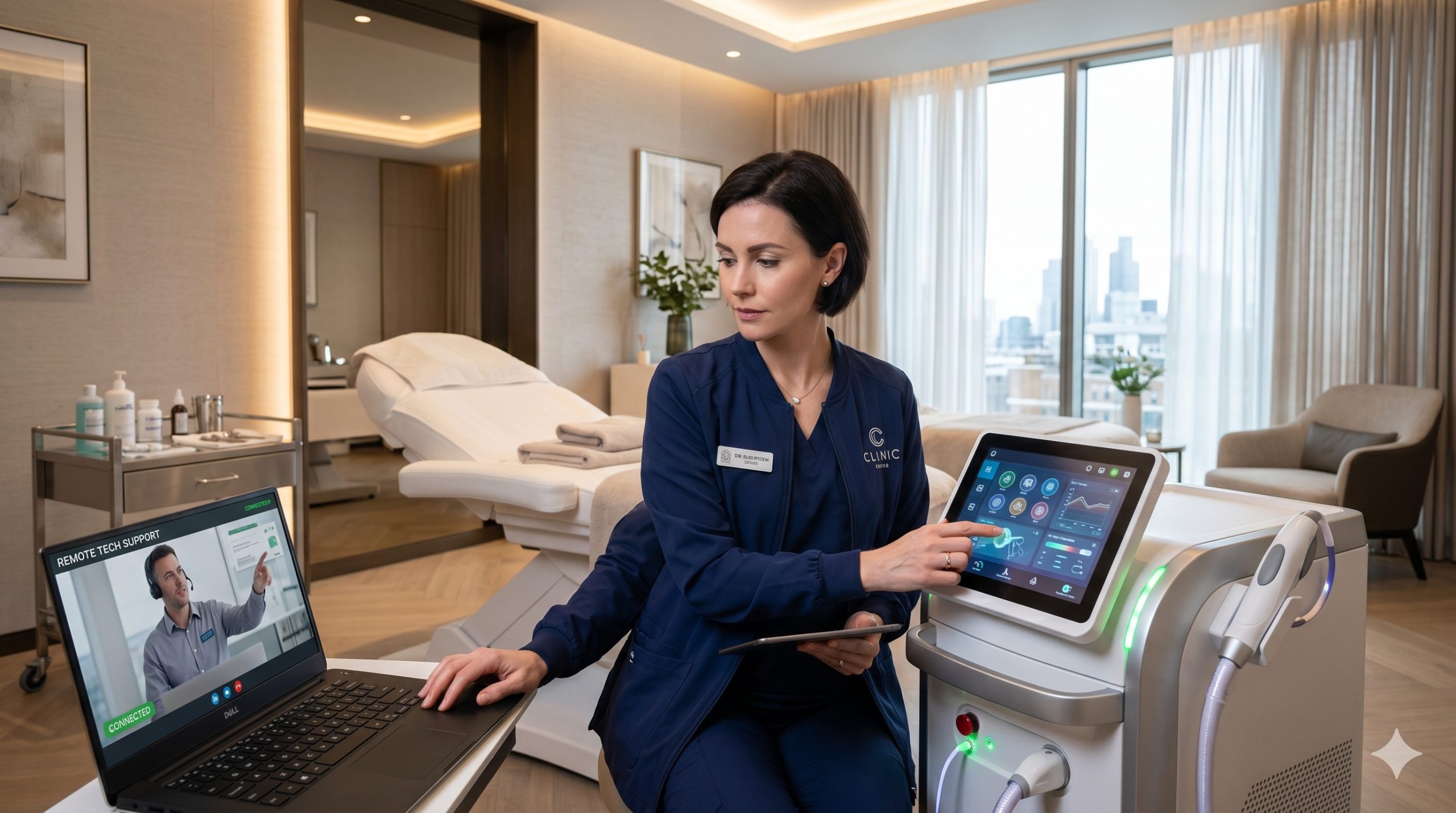
For Thulium systems, demand 24-month comprehensive warranty covering the diode pump module (replacement value $6,000-$8,000) and 5-business-day on-site response guarantee. For Erbium systems, require 12-month warranty with flashlamp prorated replacement (50% coverage at month 8-12) and loaner handpiece availability during repair. Both lasers must include remote diagnostic software allowing technical support to log in and calibrate energy output within ±5% accuracy. Avoid vendors offering only depot repair (ship-to-factory) which causes 3-6 weeks downtime. Premium suppliers provide 7-year extended service plans at 8-12% of system cost annually, essential for high-throughput clinics processing 30+ weekly treatments.