Why Picosecond Laser Outperforms Legacy IPL and Older Aesthetic Lasers
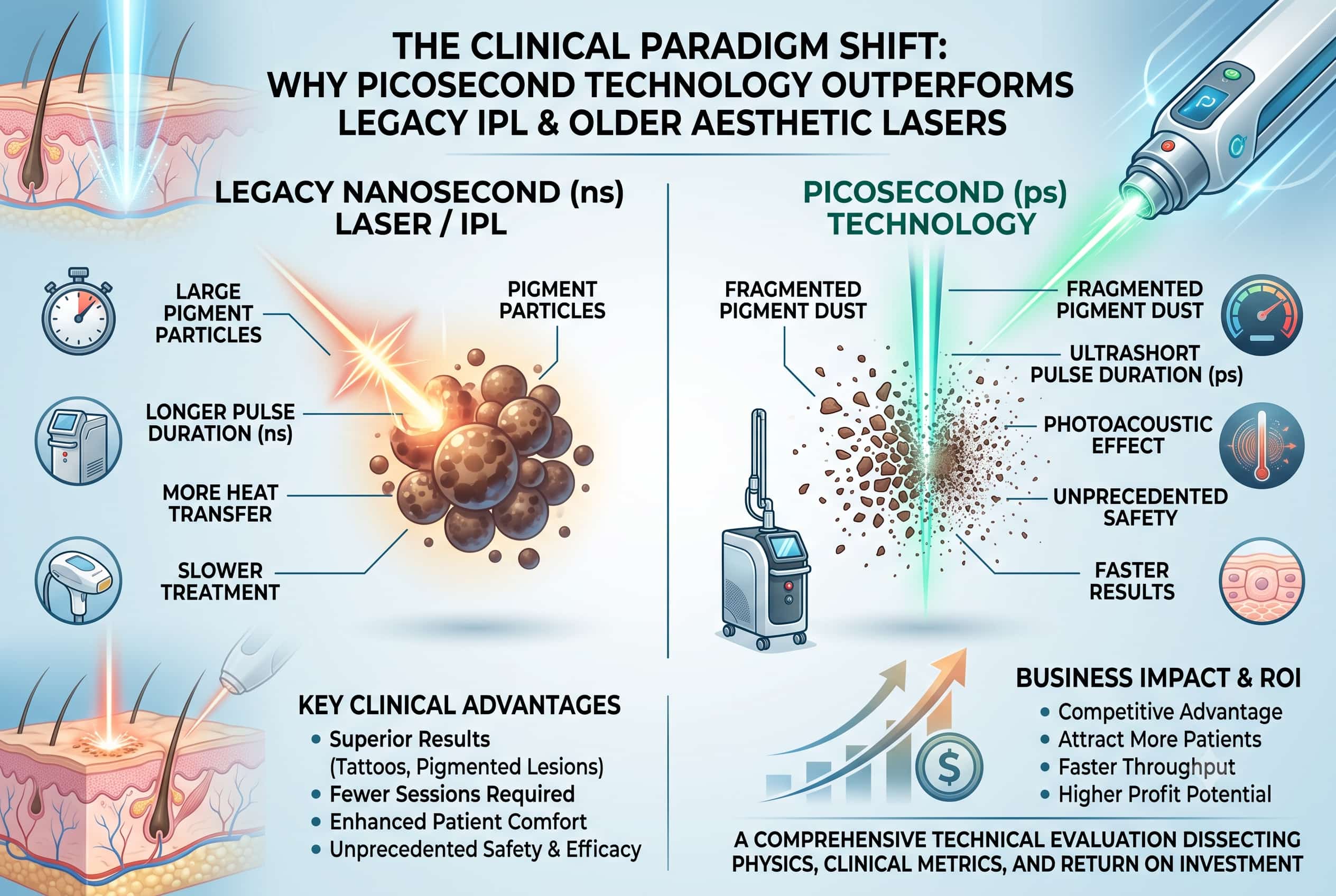
The Clinical Paradigm Shift: Why Picosecond Technology Outperforms Legacy IPL and Older Aesthetic Lasers
For over a decade, nanosecond (ns) lasers and Intense Pulsed Light (IPL) devices have been the cornerstone of aesthetic dermatology. However, the advent of picosecond (ps) laser technology represents a fundamental shift in selective photothermolysis, offering clinics a superior tool for treating pigmented lesions, tattoos, and rejuvenation with unprecedented safety and efficacy. As a clinic owner or medical director, understanding the tangible clinical and business advantages of a picosecond laser versus a nanosecond system is critical for maintaining a competitive edge. This comprehensive technical evaluation dissects the physics, clinical metrics, and return on investment (ROI) to demonstrate why picosecond technology is the definitive upgrade for the modern medical spa.
[IMAGE_1]Physical Mechanisms: Selective Photothermolysis and the Impact of Pulse Duration
The core difference between picosecond and nanosecond lasers lies in the pulse width, which dictates the physical interaction with chromophores. A nanosecond laser delivers energy in 10⁻⁹ seconds, while a picosecond laser delivers it in 10⁻¹² seconds. This 1,000-fold reduction in pulse duration triggers a photoacoustic or photomechanical effect (LIOBs – Laser-Induced Optical Breakdown) rather than the predominantly photothermal effect seen in ns devices. This shift is clinically significant because it allows for the fragmentation of target chromophores (e.g., melanin, tattoo ink) into microscopic particles that are more readily cleared by the lymphatic system, minimizing collateral thermal damage to surrounding dermal tissue. For clinics, this translates to fewer side effects, faster patient recovery, and the ability to treat Fitzpatrick Skin Types I-VI with a reduced risk of post-inflammatory hyperpigmentation (PIH).
Key Parameter Differentiation and Clinical Significance
To evaluate these technologies for your clinic, one must scrutinize the technical specifications. The Pulse Width is the primary differentiator. However, the clinical outcome is also highly dependent on Wavelength and Fluence. Common wavelengths for pigmented lesions and rejuvenation include 532nm, 755nm, and 1064nm. A picosecond device with a 755nm wavelength is exceptionally effective for benign pigmented lesions, while 1064nm is ideal for deeper targets and darker skin types due to its reduced melanin absorption. The following table provides a comparative overview of critical specifications that clinic decision-makers must evaluate.
| Key Parameter | Picosecond Laser (e.g., 755nm/1064nm) | Nanosecond Laser (e.g., 532nm/1064nm) |
|---|---|---|
| Pulse Width (Duration) | ≤ 500 x 10⁻¹² seconds | ≤ 10 x 10⁻⁹ seconds |
| Primary Mechanism | Photomechanical (LIOBs) | Photothermal |
| Peak Power | Very High (e.g., > 1 GW) | Moderate (e.g., < 100 MW) |
| Cooling System | Advanced Sapphire Contact / TEC | Cryogen Spray or Air |
| Typical Spot Size Range | 2mm – 10mm | 1mm – 8mm |
| Ideal Indications | Tattoos, Pigmentation, Rejuvenation | Hair Removal, Vascular |
| Regulatory Status | FDA & Medical CE Clearance | FDA & Medical CE Clearance |
Cooling Systems and Epidermal Protection
Epidermal cooling is paramount for patient comfort and safety. Advanced picosecond systems often integrate sophisticated cooling mechanisms such as Sapphire Contact Cooling, which provides a uniform and efficient thermal shield during the laser pulse. In contrast, older nanosecond systems may rely on less efficient cryogen spray cooling (CSC) or forced air, which can lead to uneven cooling and a higher incidence of burns or blistering. The integration of a high-performance TEC (Thermoelectric Cooler) chiller system ensures that the sapphire window maintains a consistent low temperature, allowing for the safe delivery of high fluences (e.g., up to 1.2 J/cm²) necessary for effective treatment without compromising the epidermal barrier. This emphasis on patient safety and comfort is a direct contributor to higher patient satisfaction scores and repeat bookings.
Clinical Efficacy, Indications, and Versatility
When evaluating treatment outcomes, the clinical superiority of picosecond technology is evident in its ability to treat previously challenging conditions. While nanosecond lasers are effective for hair removal and some vascular lesions, their efficacy in treating multicolored tattoos and stubborn pigmented lesions like melasma is limited. The photoacoustic effect of picosecond lasers excels in shattering tattoo pigments of various colors and is highly effective for skin rejuvenation via the induction of dermal remodeling. This multi-modality capability—from tattoo removal and pigmentation correction to skin texture improvement—maximizes the utilization of the device, increasing the potential revenue streams for a clinic.
[IMAGE_2]The Clinic ROI Analysis: Cost, Speed, and Throughput
From a business consultancy perspective, the transition to picosecond technology is an investment in long-term profitability. While the initial CapEx of a high-quality FDA and Medical CE-cleared picosecond device is higher, the benefits include significantly faster treatment times due to the use of large Spot Sizes (e.g., up to 10mm) and high Frequency (e.g., up to 10Hz). This reduces the per-procedure time, enabling high-volume clinics to increase daily patient throughput. Furthermore, the superior Clearance Rates mean patients require fewer sessions, which enhances the clinic’s reputation and can justify a higher fee-per-session. The reduced risk of complications and associated medicolegal liabilities further solidifies the business case for upgrading to picosecond technology. It is a strategic move that aligns with the market’s demand for safer, more effective, and faster aesthetic solutions.
Conclusion: Elevating Your Clinical Standard
In the competitive landscape of medical aesthetics, settling for outdated technology is no longer viable. Picosecond technology offers a quantifiable leap forward over nanosecond lasers and IPL, delivering superior clinical results across a broader range of indications with a more favorable safety profile. For clinics seeking to lead the market, the upgrade to a picosecond system is not just a purchase; it is a strategic commitment to clinical excellence, patient satisfaction, and sustained business growth.