Post-Treatment Erythema Management for 1927nm Thulium Lasers: Expert FAQ for Clinics
Overview
For B2B clinic owners and dermatologists, managing post-treatment erythema is a critical aspect of patient care and satisfaction when using 1927nm thulium lasers. This FAQ addresses the most common clinical and operational questions regarding erythema prevention and management, ensuring optimal outcomes and patient comfort. Answers are based on clinical evidence and expert guidelines for aesthetic medical device support.
Frequently Asked Questions
Q1: What is the typical duration of post-treatment erythema after a 1927nm thulium laser session?
Post-treatment erythema following a 1927nm thulium laser treatment typically resolves within 1 to 3 days. Clinical data shows that prolonged erythema occurs in only about 1.8% of cases, with most patients experiencing mild to moderate redness that subsides quickly . This short downtime is a significant advantage over more ablative lasers, making it ideal for patients seeking minimal social disruption.
Q2: How does the integrated contact cooling system on 1927nm thulium lasers help reduce erythema?
The integrated contact cooling system is essential for minimizing erythema and preventing epidermal burns. It utilizes a continuous sapphire cooling plate maintained at 0°C to 4°C, which actively conducts heat away from the skin’s surface before thermal diffusion can cause significant inflammation . This mechanism constricts superficial capillaries and creates a reverse thermal gradient, protecting the basal layer and significantly reducing unintended post-procedural redness.
Q3: Are there specific protocols for managing erythema in patients with Fitzpatrick skin types IV-VI?
Yes, while the 1927nm thulium laser is considered safe for all Fitzpatrick skin types, including IV-VI, because its primary chromophore is water and not melanin, specific protocols are crucial. To manage erythema and minimize the risk of post-inflammatory hyperpigmentation (PIH) in darker skin types, it is recommended to use lower energy densities (20-40 mJ/MTZ) and longer pulse widths . Clinicians are also advised to perform a test spot 48 hours before the full treatment to assess individual skin response .
Q4: What is the role of topical skincare in managing post-procedural erythema and inflammation?
Topical skincare, particularly antioxidants, plays a vital role in managing post-procedural erythema. Clinical studies have shown that applying an antioxidant serum, such as one containing silymarin, immediately after a 1927nm thulium laser treatment can help decrease the inflammatory cascade, leading to a statistically significant reduction in inflammation and erythema . This adjunctive approach not only manages acute redness but also contributes to better overall skin texture and clarity.
Q5: How does the 1927nm thulium laser compare to ablative lasers in terms of erythema and downtime?
Compared to ablative fractional lasers (like CO2 or Er:YAG), the 1927nm thulium laser results in up to 60% less post-procedural erythema and significantly shorter social downtime . While ablative lasers can cause erythema lasting 3-14 days and have a PIH incidence of up to 92.3%, the non-ablative 1927nm laser typically limits erythema to 1-2 days, with a PIH risk of approximately 13% . This makes the 1927nm laser a more attractive option for patients seeking quick recovery.
Q6: What technical parameters influence the severity of post-treatment erythema?
Erythema severity is directly influenced by the laser’s energy settings. Clinical protocols often use parameters like 8-10 mJ pulse energy with a 0.8mm spacing to achieve a clinical endpoint of mild erythema . Using higher energy densities or overlapping pulses without adequate cooling can increase thermal injury and prolong erythema. B2B buyers should look for devices offering precise control over pulse energy, power, and spacing to manage these treatment variables effectively.
Q7: What are the long-term maintenance requirements for the cooling system to ensure it effectively manages erythema?
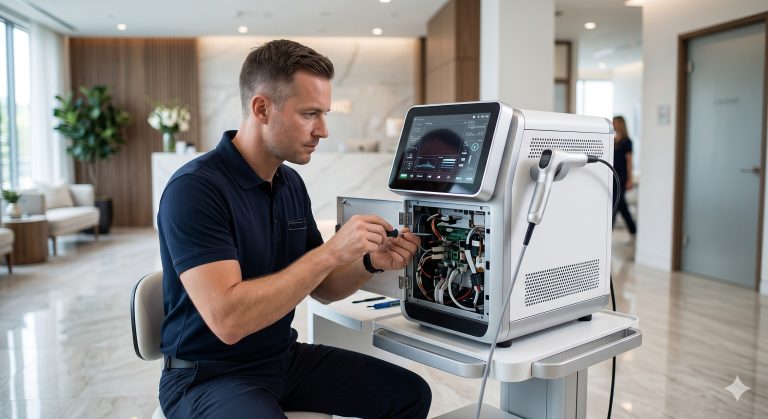
To ensure the cooling system consistently performs its function of minimizing erythema, regular maintenance is required. This includes periodic checks of the closed-loop water chiller system and verification that the real-time skin temperature monitoring (with a cutoff at 42°C) is functioning accurately . Maintenance protocols typically involve cleaning the water circuits and ensuring the coolant levels are adequate to prevent system failure, which could lead to increased thermal injury and erythema.