Diode Laser Hair Removal Machine Price FAQ: Expert Answers for Aesthetic Clinics & Dermatologists
Overview
Investing in a diode laser hair removal machine requires understanding not just the upfront price but the total cost of ownership, clinical efficacy, and long-term reliability. As a medical device engineer, I break down the most critical B2B questions—from Fitzpatrick skin type suitability to consumable costs—to help your clinic secure the best ROI.
Frequently Asked Questions
Q1: What is the typical price range for a professional diode laser hair removal machine?
The typical price for a professional diode laser hair removal machine ranges from $15,000 to $80,000 USD. Entry-level Chinese-manufactured units start near $15,000, while FDA-cleared or CE-MDR certified systems from US/German/Korean brands fall between $35,000 and $60,000. Premium systems with triple wavelengths (755nm, 810nm, 1064nm) and integrated contact cooling can exceed $80,000. B2B buyers should prioritize warranties, service contracts, and handpiece durability over lowest upfront cost.
Q2: Is a diode laser hair removal machine suitable for all Fitzpatrick skin types?
Yes, modern diode laser systems are highly effective and safe for Fitzpatrick skin types I through VI, including tanned and dark skin. This is achieved through longer wavelengths (800-810nm) and adjustable pulse durations that bypass epidermal melanin. For types V-VI, choose a machine with a 1064nm handpiece option, sapphire contact cooling, and a dual-channel skin temperature monitor to prevent burns. Always conduct a test spot before full treatment.
Q3: How does diode laser compare to IPL or older Ruby lasers for hair removal?
Diode lasers are significantly more effective and safer than IPL for permanent hair reduction, especially on professional B2B scales. Unlike IPL (broad spectrum, 500-1200nm), diode lasers use a specific 800-810nm wavelength that is selectively absorbed by melanin in the follicle bulb, requiring fewer sessions (4-6 vs. 8-12). Compared to older Ruby lasers (694nm), diode penetrates deeper and treats darker skin (Fitzpatrick V-VI) with minimal epidermal damage. Clinics should not purchase IPL for medical-grade permanent results.
Q4: What is the average lifespan of a diode laser handpiece and machine?
The average lifespan of a diode laser handpiece is 500,000 to 1,000,000 pulses (shots). After 500,000 shots, energy decay of 10-15% is expected. The main console lasts 8-12 years with proper maintenance. However, the generator’s diode bars degrade faster at high fluence (40-50 J/cm²); always check shot count before a used purchase. Replacing a diode bar set costs $3,000 to $8,000 and should be done by a certified engineer.
Q5: What are the ongoing maintenance and consumable costs?
Annual maintenance costs for a diode laser represent 5-10% of the original purchase price. Typical consumables and service items include: – Sapphire window tips (handpiece lens): Replace every 30,000-50,000 shots, $150-$400 each. – Contact cooling system filters: Replace every 6 months, $80-$150. – Calibration tool and energy meter verification: Annually, $500-$1,200 per site visit. – Distilled water or coolant refill for closed-loop systems: Biannually, $50-$100. Some premium brands offer all-inclusive service plans at $2,000-$4,000/year, which are cost-effective for high-volume clinics.
Q6: Does the treatment hurt, and how does cooling affect pricing?
Yes, diode laser treatment produces a mild to moderate snapping sensation, but integrated cooling systems reduce pain to a 2-4 on a 10-point scale. Machines with sapphire contact cooling (maintained at -4°C to 4°C) or cryogen spray cooling are more expensive (add $5,000-$12,000 to price) but increase patient comfort and safety by protecting epidermis during high fluence. B2B clinics should prioritize integrated cooling over external topical anesthetics for speed and compliance.
Q7: What kind of training and technical support are included?
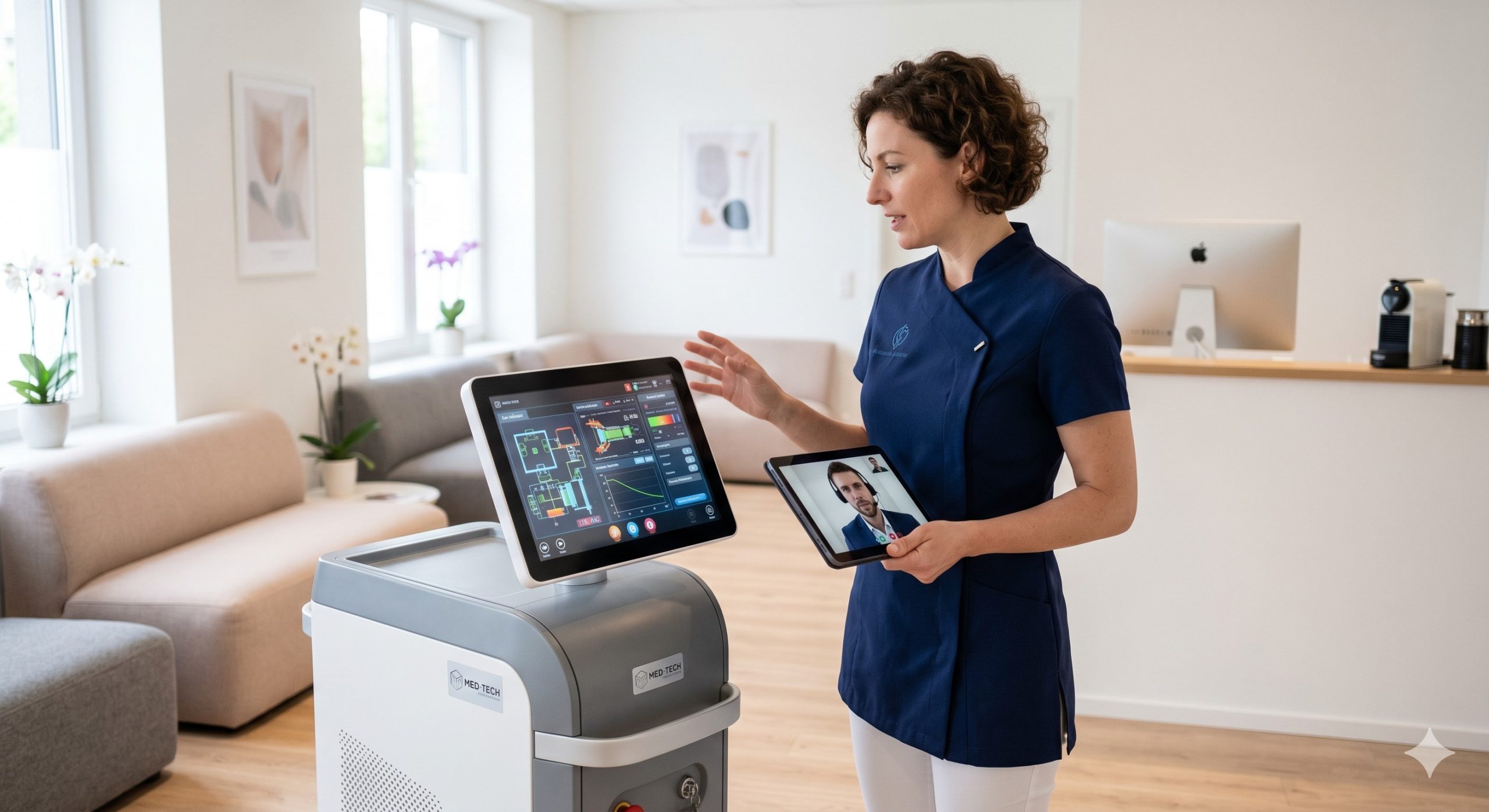
Most reputable manufacturers include two days of on-site clinical training and one remote technical support session for the purchase price. However, advanced technical support (circuit diagrams, firmware updates, spare parts shipping) is often limited to an optional annual support contract costing $1,500-$3,500. Before purchasing, verify whether the supplier has an ISO 13485 certified service network in your country. Chinese budget vendors typically provide only video training; premium EU/US brands include unlimited remote engineering support.
Q8: How many sessions are needed for permanent reduction, and how does that impact profitability?
Average patients need 6 to 8 sessions spaced 4-6 weeks apart for 80-90% permanent hair reduction. For clinics calculating ROI: a $35,000 diode laser amortized over 5 years costs $7,000/year. At $150/session and 15 patients/week (90 sessions/week), weekly revenue is $13,500—break-even occurs in under 3 weeks. However, thicker terminal hair (axilla, bikini) requires higher fluence and more shots per pulse, slightly reducing handpiece lifespan. Use a cost-per-shot calculator before committing to a purchase.