The Clinical Physics and Commercial Strategy of Laser Hair Removal on Tattooed Skin: A Comprehensive B2B Blueprint
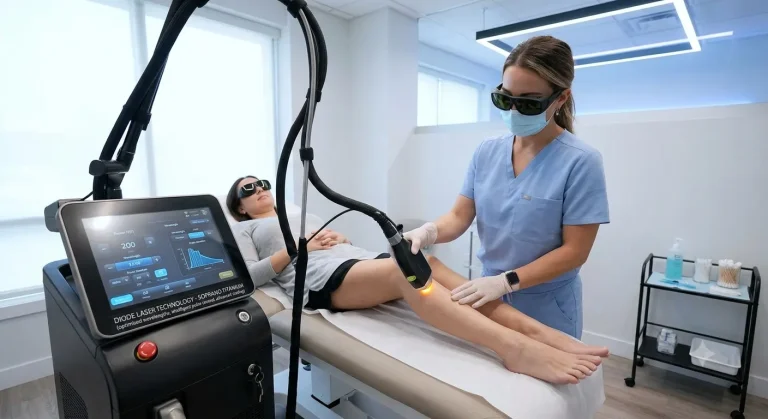
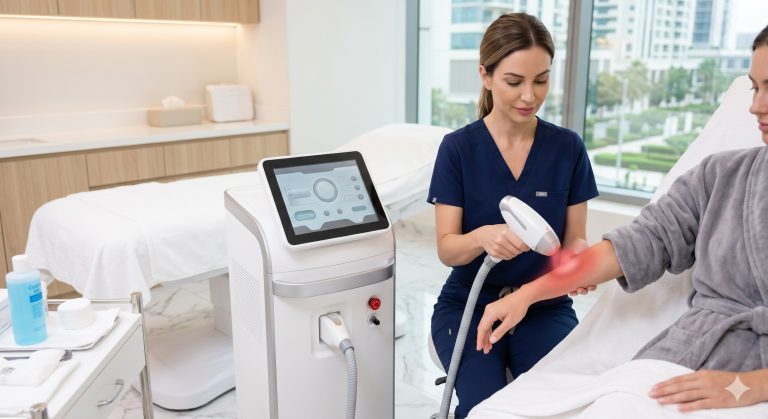
Why Every Modern MedSpa Needs a Commercial Diode Laser Hair Removal Machine
Executive Summary: For MedSpa directors, clinical dermatologists, and aesthetic institution investors, upgrading to a commercial diode laser hair removal machine is a fundamental financial and clinical imperative. This whitepaper analyzes the structural transition from legacy Intense Pulsed Light (IPL) modalities to advanced coherent diode platforms, detailing how the principles of selective photothermolysis achieve permanent hair reduction rather than temporary shedding. We decode the absolute necessity of triple-wavelength synergy (755nm, 808nm, 1064nm) for safely and effectively treating the entire Fitzpatrick Scale, with a critical focus on Types IV-VI. Furthermore, we examine how active TEC Cooling and In-Motion™ delivery systems eliminate patient downtime and procedural pain. By evaluating key operational metrics such as spot size, high repetition rates (Hz), shots count, and stringent regulatory compliances like Medical CE and FDA 510(k), this comprehensive guide provides MedSpa owners with a definitive framework for minimizing Total Cost of Ownership (TCO) and maximizing long-term clinical profitability.
The Shift in Aesthetic Standards: Moving Beyond IPL and Outdated Modalities
The landscape of the global aesthetic industry has matured. Today’s high-net-worth clients are highly educated regarding treatment efficacies and demand definitive, permanent results. For a modern MedSpa, continuing to rely on outdated technologies like Intense Pulsed Light (IPL) or entry-level, low-wattage devices is not merely a clinical compromise; it is a direct catalyst for client attrition. To capture and retain market share, clinics must align their equipment infrastructure with the highest standards of optical physics and dermatological science.
The Clinical Limitations of Intense Pulsed Light (IPL) in 2026
While IPL systems were historically popularized for their low initial capital expenditure and perceived versatility, their fundamental physics render them grossly inadequate for professional-grade hair removal. IPL operates by emitting a broad spectrum of incoherent light (typically ranging from 500nm to 1200nm). This lack of monochromaticity introduces severe clinical limitations.
- Chromophore Competition and Energy Scattering: Because IPL emits a wide band of light, the optical energy is absorbed by multiple competing chromophores within the skin—including hemoglobin and water—rather than being exclusively absorbed by the target melanin in the hair shaft. This scattering dramatically reduces the effective thermal energy delivered to the follicle, resulting in incomplete destruction.
- High Thermal Injury Risk for Darker Skin: In patients with higher baseline epidermal melanin (Fitzpatrick Types IV-VI), the broad-spectrum light is aggressively absorbed by the skin’s surface. This inherently caps the safe energy levels a practitioner can utilize. Pushing the energy higher to achieve hair reduction exponentially increases the risk of severe epidermal burns, blistering, and permanent scarring.
- Inefficacy on Fine and Vellus Hair: As a patient progresses through their treatment plan, terminal hairs transition into finer, lighter structures. IPL lacks the concentrated peak power required to generate the necessary thermal spike in these smaller targets, leading to frustrating efficacy plateaus and incomplete treatment courses.
Why Coherent Diode Technology is the New Industry Baseline
The transition from IPL to a commercial diode laser hair removal machine represents a shift from generalized light therapy to precision photomedicine. Diode lasers are engineered to emit a single, highly concentrated wavelength of coherent light.
- Targeted Selective Photothermolysis: Diode technology adheres strictly to the extended theory of selective photothermolysis. By delivering a specific wavelength (e.g., 808nm) that matches the absorption peak of follicular melanin, the laser acts as a precise thermal weapon. The coherent light bypasses surrounding tissue, traveling down the hair shaft to the follicle bulb and bulge region.
- Permanent Hair Reduction: Unlike IPL, which often merely induces thermal trauma to push the hair into a temporary catagen (resting) phase, high-power diode lasers deliver sufficient fluence within the exact thermal relaxation time (TRT) of the follicle. This induces a localized core temperature of 65°C to 70°C, permanently denaturing the stem cells responsible for hair regeneration. The result is terminal destruction, not a temporary delay in growth.
Expanding Your Client Demographics: The Triple-Wavelength Advantage
A MedSpa’s revenue ceiling is directly dictated by the demographic diversity it can safely treat. Purchasing equipment limited by a single wavelength restricts a clinic’s addressable market. In the contemporary aesthetic market, patients present with a vast array of skin tones and hair morphologies. Meeting this demand requires highly specialized optical engineering.
Beyond 808nm: Engineering for the Complete Fitzpatrick Scale
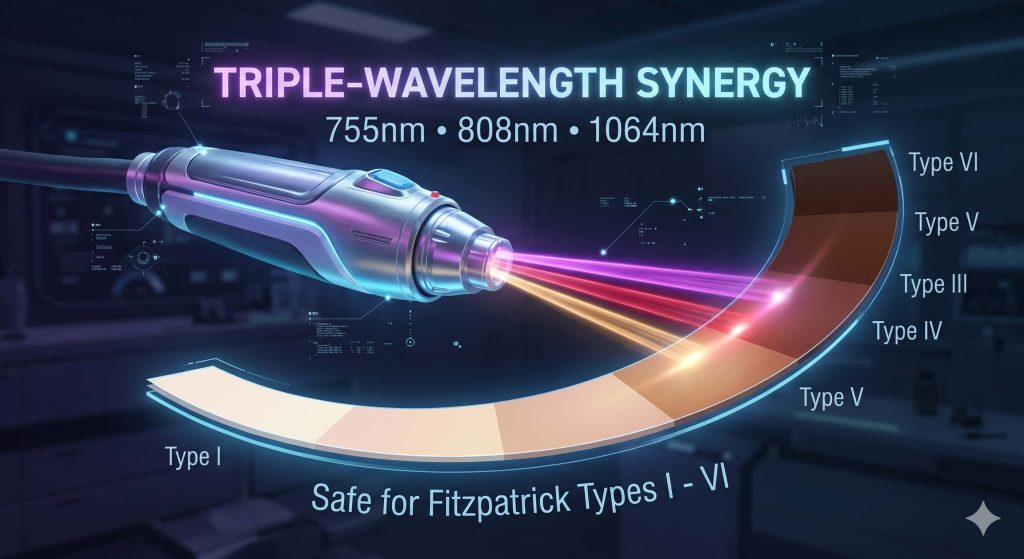
Historically, the 808nm diode was heralded as the “gold standard.” However, standard 808nm systems have clinical boundaries. They can struggle to safely treat deeply pigmented skin (Fitzpatrick V and VI) without risking thermal damage, and they often lack the acute absorption required to eliminate very fine, blonde, or residual hairs (Fitzpatrick I and II) in the final stages of a treatment package. A modern clinic cannot afford to turn away patients based on their genetic background or hair density.
Decoding the 755nm, 808nm, and 1064nm Synergy
To achieve universal efficacy, premium commercial diode laser hair removal machines—such as those manufactured by Cocoon Laser—now utilize an advanced synchronous delivery system that fires three distinct wavelengths simultaneously from a single handpiece. This creates a synergistic, multi-depth targeting mechanism.
- 755nm Alexandrite: Featuring the highest melanin absorption coefficient, the 755nm wavelength is clinically optimized for lighter skin tones (Fitzpatrick I-III). Its superficial penetration depth makes it aggressively effective against fine, light-colored hairs, such as facial peach fuzz or residual hair that deeper wavelengths fail to clear.
- 808nm/810nm Diode: Serving as the foundational workhorse, the 808nm wavelength offers an optimal balance. It provides deep penetration into the dermis while maintaining a moderate melanin absorption rate, allowing for the safe and rapid treatment of standard terminal hair across Fitzpatrick Types I-IV.
- 1064nm Nd:YAG: This wavelength is the mandatory clinical standard for treating darker skin tones (Fitzpatrick IV-VI). The 1064nm spectrum features an extremely low melanin absorption rate, meaning it safely bypasses the heavily pigmented epidermis. Instead, it penetrates profoundly deep into the dermal tissue (up to 4-5mm) to thermally coagulate the vascular micro-supply feeding the hair papilla.
Comparative Analysis of Laser Wavelength Efficacy
| Optical Wavelength | Melanin Absorption | Penetration Depth | Target Follicular Structure | Optimal Fitzpatrick Scale |
| 755nm | Extremely High | Superficial | Bulge region & fine hair shafts | Types I – III |
| 808nm | Moderate / High | Deep | Bulge & Bulb (Standard terminal hair) | Types I – IV |
| 1064nm | Low | Very Deep | Dermal Papilla & Vascular Supply | Types IV – VI |
| Triple-Wavelength | Balanced Spectrum | Multi-Tiered | Comprehensive Destruction | Types I – VI (Universal) |
By integrating this triple-wavelength technology, Cocoon Laser medical devices empower MedSpas to confidently treat every patient profile, effectively doubling the clinic’s serviceable demographic while guaranteeing the highest safety protocols.
Elevating the Patient Experience: Speed, Safety, and Zero Downtime
In the B2B aesthetic sector, clinical efficacy must be paired with exceptional patient comfort. If a treatment is highly effective but agonizingly painful, patients will abandon their package midway and leave negative reviews. Transforming hair removal from a dreaded medical procedure into a comfortable, spa-like experience is the key to driving high retention rates and word-of-mouth referrals.
Eradicating Treatment Pain with Advanced TEC Cooling
The deployment of massive optical power necessitates equally robust thermal management. Outdated cooling methods—such as external forced air or messy cryogen sprays—are insufficient for high-fluence treatments and leave the epidermis vulnerable to heat accumulation.
- The TEC Advantage: Elite commercial systems utilize Thermoelectric Cooling (TEC), a solid-state active cooling technology. By passing an electrical current through a semiconductor junction (the Peltier effect), the system actively extracts heat away from the skin’s surface.
- Sapphire Contact Cooling: This TEC module is directly bonded to a pure sapphire crystal optical waveguide at the tip of the handpiece. Sapphire possesses exceptional thermal conductivity. During treatment, the sapphire tip maintains a constant, frigid temperature between -5°C and 5°C.
- Clinical Outcomes: This continuous epidermal chilling acts as a highly effective localized anesthetic. It pre-cools the skin before the laser pulse, actively cools it during energy emission, and post-cools the tissue immediately after. This completely neutralizes the notorious “rubber-band snap” sensation, effectively eliminating procedural pain and strictly preventing Post-Inflammatory Hyperpigmentation (PIH) and thermal downtime.
The In-Motion™ Delivery System and High Repetition Rates (Hz)
Traditional laser hair removal relied on a “stamping” technique—delivering slow, high-energy pulses one by one. This localized energy dumping caused intense nociceptor activation (pain) and increased the risk of geometric overlapping or missed spots (the “zebra stripe” effect).
- Continuous Thermal Accumulation: Modern systems utilize In-Motion™ technology coupled with high repetition rates ranging from 10Hz to 20Hz (10 to 20 micro-pulses per second). Instead of static stamping, the practitioner continuously glides the chilled sapphire handpiece over a pre-defined grid on the skin.
- Painless Efficacy: This high-frequency sweeping motion gradually and safely builds up thermal energy within the dermis until the target follicle reaches the critical denaturing temperature threshold. Because the energy is delivered cumulatively rather than in a single violent spike, the patient experiences only a mild, soothing warming sensation.
The ROI Equation: Maximizing Profitability for Your MedSpa
From a B2B investment perspective, the procurement of a high-power aesthetic laser must be justified by aggressive and scalable financial returns. Superior engineering directly dictates clinical throughput, which in turn defines the clinic’s daily revenue ceiling.
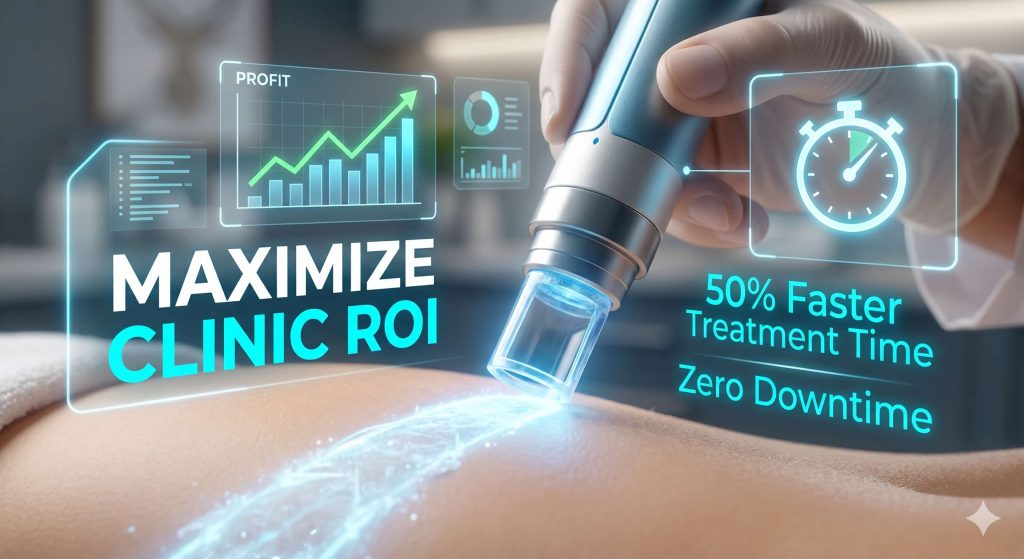
Accelerating Patient Throughput with Large Spot Sizes
Time is the most inelastic and valuable asset in a MedSpa. The physical size of the laser’s output window (spot size) mathematically determines how quickly a technician can complete a procedure.
- The Operational Math: Entry-level devices typically feature small spot sizes (e.g., 1.0 $cm^2$). Treating a large anatomical area like a full back or full legs with a small spot requires thousands of individual pulses and can take 40 to 60 minutes.
- Revenue Acceleration: Upgrading to a commercial platform with a large spot size (e.g., 2.0 to 4.0 $cm^2$) combined with a 20Hz delivery speed fundamentally alters the clinic’s workflow. That same full-back treatment can now be executed flawlessly in 15 to 20 minutes.
- The Bottom Line: Reducing chair time by 40% to 50% allows a clinic to double its daily patient volume without extending operating hours or increasing payroll. This throughput acceleration is the primary driver of rapid ROI in the aesthetic industry.
Analyzing Total Cost of Ownership (TCO) and Consumables
Many clinic owners fall into the trap of purchasing inexpensive, white-label equipment, only to have their profits decimated by hidden operational costs and catastrophic hardware failures. Evaluating the Total Cost of Ownership (TCO) is essential.
TCO Comparison: Budget Devices vs. Premium Commercial Platforms
| Financial Vector | Budget / White-Label Diode Lasers | Premium Commercial Platforms (e.g., Cocoon Laser) |
| Laser Bar Origin | Generic, untraceable macro-channel arrays | Coherent® USA premium micro-channel bars |
| Guaranteed Shots Count | < 5 to 10 Million shots (rapid burnout) | 20 to 50 Million+ shots (extended lifespan) |
| Handpiece Replacement | Frequent (High consumable expense) | Extremely Rare (Near-zero consumable overhead) |
| Cooling Architecture | Prone to overheating, forcing clinic downtime | Continuous 24/7 operational capability |
| Long-Term Profitability | Low (margins eaten by repairs and downtime) | High (stable, uninterrupted revenue generation) |
By investing in high-end internal components—specifically imported Coherent® laser bars—clinics secure an exponentially higher shots count. This durability eradicates the need for constant, expensive handpiece replacements, shielding the clinic’s net profit margins and ensuring that the machine remains an active revenue generator rather than a maintenance liability.
Setting the Benchmark: Integrating Cocoon Laser into Your Practice
The decision to acquire a commercial diode laser hair removal machine is not merely an equipment upgrade; it is a strategic maneuver to position your MedSpa as an authoritative, tier-one medical aesthetic provider. To safeguard this investment, clinics must strictly partner with manufacturers who meet rigorous global engineering standards.
Certifications and Reliability: The Foundation of Medical Practice
In the highly regulated medical aesthetic sector, compliance is non-negotiable. Operating uncertified equipment exposes the clinic director and investors to immense malpractice liabilities.
- Regulatory Imperatives: A premium device must carry foundational certifications to validate its clinical safety and electrical integrity. Look for devices that have achieved Medical CE for European market compliance and FDA 510(k) clearance for the United States.
- Manufacturing Excellence: Ensure the manufacturer operates under strict ISO 13485 quality management systems, guaranteeing that every diode array and cooling module is assembled to exacting medical-grade standards.
Why Partner with Cocoon Laser?
As a leading innovator in optical technologies, Cocoon Laser provides more than just machinery; we provide a complete clinical ecosystem. Our professional medical laser equipment is engineered to resolve the exact pain points MedSpa owners face today. By delivering the undisputed power of triple-wavelength synergy, the safety of advanced TEC cooling, and the unmatched durability of Coherent® USA diodes, we guarantee an infrastructure built for relentless profitability.
Furthermore, integrating a Cocoon Laser system means gaining access to comprehensive clinical training protocols, 24/7 direct-from-manufacturer technical support, and marketing empowerment designed to immediately drive high-ticket patient conversions.
Ready to elevate your MedSpa’s clinical standards and maximize your operational ROI?
- Schedule a Clinical Demonstration with our technical experts.
- Calculate Your Clinic’s projected ROI with our advanced diode systems.
- Download the Full Specifications Brochure at Cocoon Laser and discover why elite clinics worldwide trust our commercial diode laser hair removal machine architecture.
If you need more information, please click “Contact Us”.
If you want to obtain more information, please follow our official website and Facebook.