Safety & Indication FAQ: Is Periorbital Laser Resurfacing Right for All Fitzpatrick Skin Types?
Overview
Periorbital laser resurfacing demands precision, safety, and an understanding of delicate periocular anatomy. For B2B clinic buyers and dermatologists, selecting the right device and protocol directly impacts patient outcomes, safety compliance, and practice profitability. This FAQ addresses pre-sales assessment, intraoperative safety, device maintenance, and ROI considerations specific to periorbital rejuvenation.
Frequently Asked Questions
Q1: Is periorbital laser resurfacing safe for all Fitzpatrick skin types?
Yes, when using a long-pulse erbium-doped or fractional non-ablative laser with integrated contact cooling, periorbital resurfacing is safe for Fitzpatrick skin types I-VI. The key is selecting a wavelength above 1320nm (e.g., 1540nm or 1550nm) or a long-pulse 2940nm erbium with adjustable pulse duration. Darker skin types (IV-VI) require lower fluence (0.5-2.0 J/cm²), longer pulse widths (>5ms), and dynamic cooling to prevent post-inflammatory hyperpigmentation. Always perform a test spot 4 weeks prior to full treatment.
Q2: What epidermal protection mechanisms prevent burns during periorbital treatment?
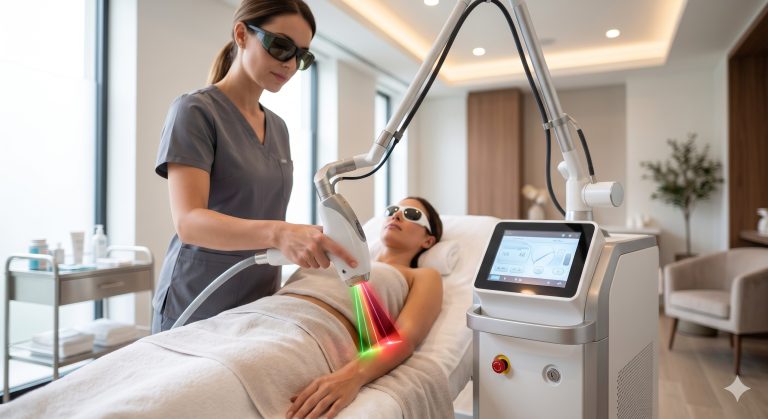
Integrated contact cooling with a sapphire window at 0°C to 5°C is the gold standard for periorbital safety. The cooling tip pre-cools epidermis before laser pulse, maintains cooling during the pulse, and post-cools immediately after. Advanced devices also feature real-time impedance monitoring and automatic fluence shutdown if skin resistance drops below 500 ohms. For periorbital margins, always use metallic corneal eye shields and set initial fluence 20% lower than facial test spot values.
Q3: How many treatment sessions are needed for optimal periorbital rhytid and pigment results?
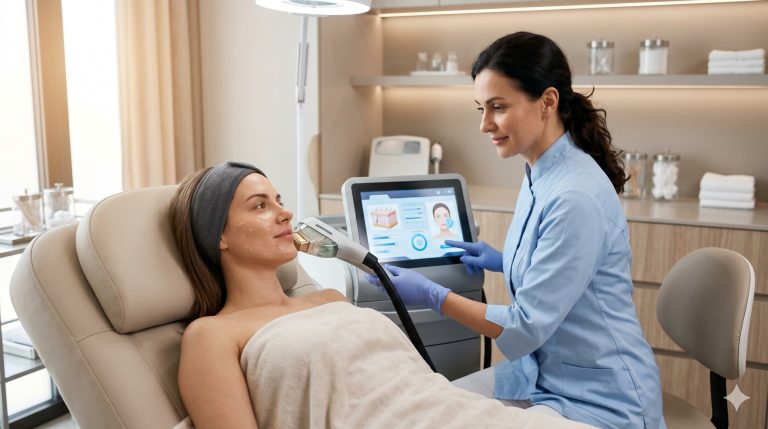
Optimal periorbital results require 3 to 5 sessions spaced 4 to 6 weeks apart. For fine lines and dyspigmentation, 3 sessions of fractional non-ablative laser (1540nm, 10-15 mJ/microbeam, 15-20% density) achieve 60-75% improvement. For moderate to severe rhytids and textural irregularities, 4-5 sessions of fractional ablative erbium (2940nm, 5-10 mJ, 10-15% density) are recommended. Clinical endpoint: mild erythema and pinpoint bleeding (ablative) or warm pink color without epidermal disruption (non-ablative).
Q4: What is the average handpiece lifespan and consumable replacement schedule for periorbital lasers?
The average handpiece lifespan for a periorbital laser is 100,000 to 300,000 shots, depending on the manufacturer and fluence levels used. At 4-5 sessions per patient (approximately 600-1,200 shots per eye area per session), a single handpiece can treat 80-250 patients. Consumables: sapphire cooling tips require replacement every 50-100 patients or when scratches appear; disposable corneal eye shields must be single-use per patient; and internal water filters need replacement every 500 operating hours or annually. Budget approximately $0.08-$0.12 per shot for disposables and handpiece amortization.
Q5: How do I calculate ROI when adding periorbital laser resurfacing to my med spa menu?
Calculate ROI using: (Average fee per session × sessions per patient × patients per month) − (device monthly financing + consumable costs + operator time) = monthly net profit. For periorbital-only treatments: average fee $350-$600 per session; 4 sessions per patient = $1,400-$2,400 per patient; at 8 patients per month = $11,200-$19,200 monthly revenue. Subtract device lease ($1,500-$3,000/month), consumables ($8-$15 per session), and 30 minutes operator time ($45-$75). Break-even typically occurs at 10-14 months. Highest profitability comes from packaging periorbital resurfacing with upper face neuromodulators or platelet-rich plasma (PRP).
Q6: What regulatory certifications should I verify before purchasing a periorbital laser device?
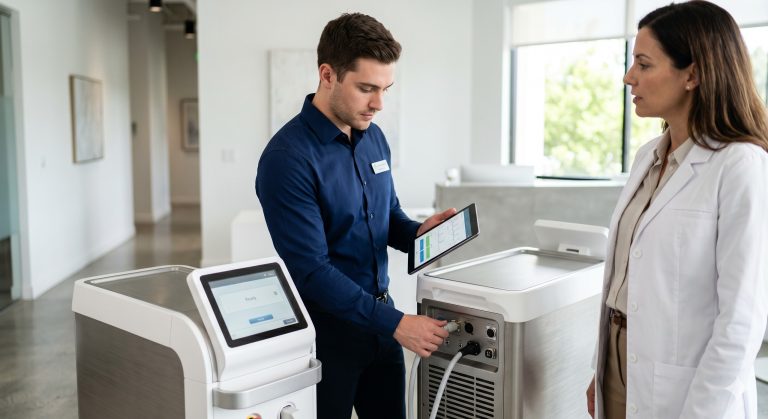
Your periorbital laser must have FDA 510(k) clearance specifically for periorbital rhytids or dyschromia, plus CE Mark (Class IIb or III) for EU markets. Verify ISO 13485:2016 certification for the manufacturer’s quality management system. For clinics in regulated states (e.g., Texas, Florida, California), the device must be listed with the state radiation control program. Critical documentation: laser product report (CDRH), calibration certificate traceable to NIST, and electrical safety IEC 60601-1 and 60601-2-22 (particular requirements for laser equipment). Never accept a device without on-site commissioning and operator training certification.
Q7: What troubleshooting steps resolve low energy output or uneven beam profile during periorbital treatment?
Low energy output (more than 15% below set fluence) is typically caused by three issues: contaminated sapphire cooling window (clean with 70% isopropyl alcohol and lint-free wipes), depleted handpiece shot count exceeding 80% of rated lifespan (replace handpiece), or clogged water circulation filters restricting thermal regulation (replace filters and perform deionized water flush). Uneven beam profile (visible hot spots) indicates failing flash lamp (replace every 50,000-100,000 shots) or misaligned delivery fiber (requires factory service). Always keep an energy meter (e.g., Ophir Nova II) for weekly output verification. Document all fluence readings in your laser logbook.
Q8: Can I combine periorbital laser resurfacing with other aesthetic treatments in the same visit?
Yes, but with strict sequencing protocols. Perform periorbital fractional non-ablative laser first, then immediately follow with topical neuromodulators (e.g., glabellar and lateral canthal lines). Do NOT combine periorbital ablative laser with any filler injection in the same visit due to infection and swelling risks. For combination with intense pulsed light (IPL) for generalized facial redness, always perform IPL 2-3 weeks before periorbital laser, never on the same day. For post-laser recovery, wait 14 days before microneedling or radiofrequency treatments. Contraindications: active herpes simplex (delay treatment), topical retinoid use within 7 days, or oral isotretinoin within 6 months.