Fractional Laser Settings for Atrophic Acne Scars FAQ: Expert Answers for Aesthetic Clinics & Dermatologists
Overview
For aesthetic clinics and dermatologists, optimizing fractional laser parameters for atrophic acne scars requires balancing efficacy with patient safety. This FAQ covers pre-sales assessments, clinical workflows, consumable costs, and technical troubleshooting specifically for B2B buyers seeking high-ROI devices.

Frequently Asked Questions
Q1: What are the recommended starting fractional laser settings for rolling atrophic acne scars on Fitzpatrick skin type III?
Start with an energy density of 15-20 mJ/microbeam and a total density of 5-10% coverage per session. For rolling scars on Fitzpatrick III, use a 1200-1500 μm spot size, stacking 2-3 passes. This minimizes post-inflammatory hyperpigmentation while stimulating neocollagenesis. Adjust up to 25 mJ only if no erythema persists beyond 48 hours.
Q2: Is fractional laser safe for atrophic acne scars on Fitzpatrick skin types V and VI?
Yes, but only with non-ablative fractional lasers or using lower ablative settings (10-12.5 mJ, <5% density). For Fitzpatrick V-VI, pre-treat with hydroquinone 4% for 4 weeks, use a long-pulsed 1064 nm Nd:YAG fractional handpiece, and extend pulse duration to 2-3 ms. Test spot at 5 mJ in a non-visible area 72 hours prior. Epidermal cooling at -5°C to -8°C is mandatory.
Q3: What is the typical handpiece shot lifespan for a fractional laser treating atrophic scars, and when must I replace it?
The handpiece lasts 100,000 to 150,000 effective shots before energy output drops below 85% of initial calibration. Replace immediately when you see spotty fluorescence, inconsistent beam profiles, or when the internal shot counter alerts at 80% of rated life. Daily cleaning of the output window with isopropyl alcohol extends lifespan by 15-20%.
Q4: How does the contact cooling system protect the epidermis during aggressive scar remodeling?
The sapphire contact cooling system actively maintains epidermal temperature between 0°C and +4°C during laser emission. This allows using 20-40% higher fluence (up to 40 mJ) without blistering. The system pre-cools for 300 ms before the pulse and post-cools for 200 ms. For safety, verify coolant flow rate (minimum 50 mL/min) daily and inspect for condensation on the handpiece window.
Q5: What is the typical ROI payback period for a fractional laser dedicated to atrophic acne scars in a mid-sized clinic?
Expect 8-14 months ROI with 8-12 fractional treatments monthly at $350-$600 per session. Consumable costs (handpiece amortization, cooling gel, sterilization wraps) average $12-$18 per patient. At 10 patients/week, net profit exceeds $15,000/month by month 6. Include package deals (3 sessions for $1,200) to reduce patient acquisition costs and accelerate break-even.
Q6: How do I troubleshoot error codes E-21 and E-47 during fractional scar treatment?
Error E-21 (energy delivery inconsistency) is resolved by cleaning the handpiece lens and recalibrating energy output using the built-in power meter. Error E-47 (pump thermal overload) indicates water circulation failure: check the external water filter, ensure ambient temperature is below 28°C, and run the pump self-test. For both errors, cycle power and allow 15 minutes cooling before resuming.
Q7: How many treatment sessions are needed for 50-75% improvement in boxcar acne scars?
Patients require 3-5 sessions spaced 6-8 weeks apart for 50-75% improvement. Boxcar scars respond faster (3-4 sessions) than icepick scars (4-6 sessions plus subcision). Clinical endpoints: mild erythema (2-3 on a 10-point scale) and pinpoint bleeding for ablative settings. If no visible frosting or edema after 2 sessions, increase fluence by 10% or density by 2%.
Q8: What training and certification does the manufacturer provide for my clinical team?
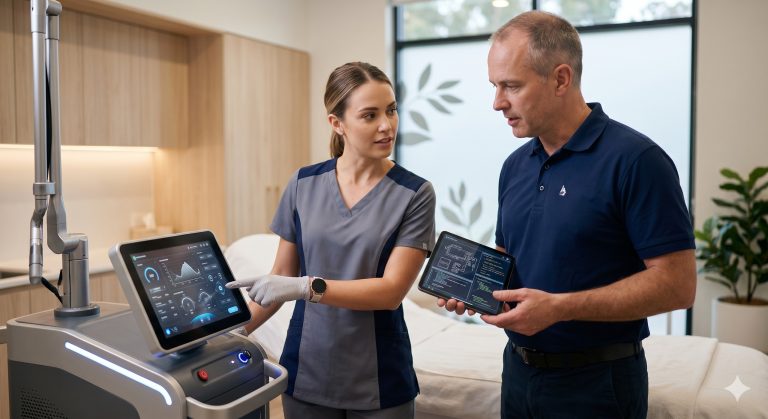
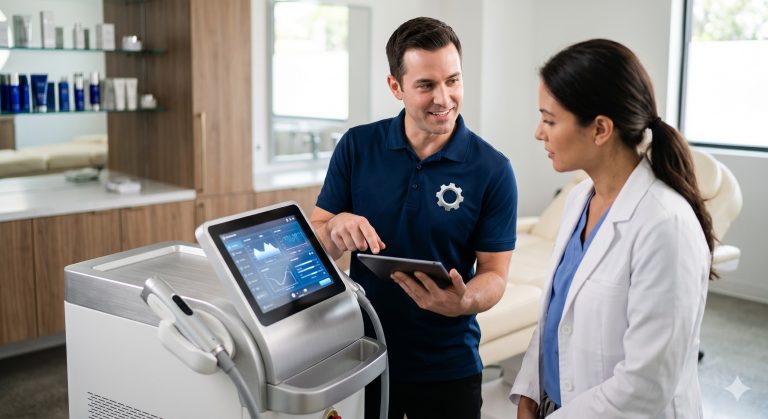
Included B2B training consists of 16 hours on-site: 4 hours physics/safety, 8 hours hands-on with live models (3 scar types), and 4 hours troubleshooting. Certification requires passing a written exam (85% minimum) and demonstrated parameter selection for Fitzpatrick IV-VI. Refresher training is free annually. FDA-cleared devices also include a technical manual with 50+ error codes and maintenance schedules.