HIFU vs Ultherapy: Differences, Results, Cost & Which Is Better?
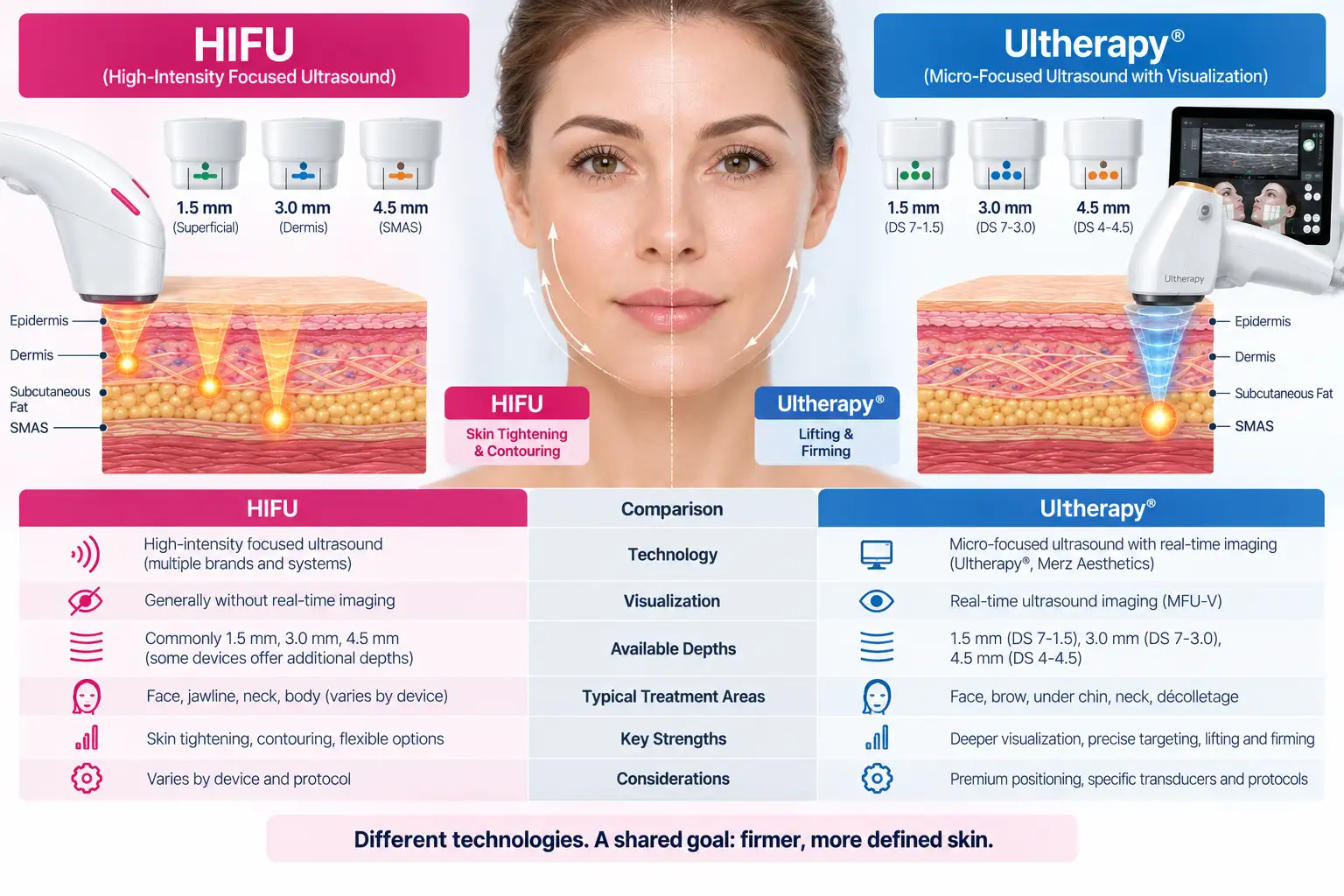
When comparing HIFU vs Ultherapy, it is easy to assume that they are two completely different treatments. In reality, both use focused ultrasound energy to target tissue beneath the skin and are commonly associated with non-surgical skin tightening and facial lifting treatments.
The important difference is that HIFU is a broader technology category, while Ultherapy is a specific branded ultrasound treatment platform. Different professional HIFU systems can vary in treatment depths, transducer design, energy delivery, treatment speed, visualization capabilities and intended applications.
This distinction matters when comparing results, treatment experience and price. Asking whether Ultherapy is better than HIFU is not quite the same as comparing two individual machines with identical specifications.
In this guide, we compare Ultherapy vs HIFU for technology, treatment depth, skin tightening, facial and jawline results, pain, downtime, treatment cost and overall suitability.
Quick Answer: HIFU vs Ultherapy — What Is the Difference?
The main difference between HIFU and Ultherapy is that HIFU describes a category of high-intensity focused ultrasound technology, while Ultherapy is a specific branded ultrasound-based aesthetic system.
Both approaches can deliver focused ultrasound energy beneath the skin with the goal of stimulating a tissue response and progressive collagen remodeling. However, the exact treatment experience and capabilities depend on the specific system being used.
| Feature | HIFU | Ultherapy |
|---|---|---|
| What is it? | A category of focused ultrasound technology | A specific branded ultrasound treatment platform |
| Primary aesthetic goal | Non-surgical tissue tightening and contour improvement, depending on the system | Non-invasive lifting and tightening applications |
| Technology | Focused ultrasound | Microfocused ultrasound with visualization |
| Available systems | Many manufacturers and device configurations | One branded platform and its compatible treatment components |
| Imaging / visualization | Depends on the specific HIFU system | Real-time ultrasound visualization is a defining platform feature |
| Treatment depths | Depend on the device and available cartridges | Uses transducers designed for specific tissue depths |
| Results | Depend on device performance, protocol, patient selection and technique | Depend on patient selection, protocol and technique |
| Price | Can vary widely by system, clinic and market | Often positioned as a premium branded treatment |
What Is HIFU?
HIFU stands for high-intensity focused ultrasound. In aesthetic applications, a HIFU device concentrates ultrasound energy at selected depths beneath the skin rather than treating only the superficial surface.
The focused energy can create controlled thermal coagulation points within targeted tissue. The subsequent healing response can contribute to collagen remodeling and progressive tightening over time.
Importantly, “HIFU” does not identify one machine. There are many professional HIFU systems, and their specifications can differ considerably.
Differences may include:
- Available treatment depths
- Cartridge and transducer design
- Energy adjustment
- Focal characteristics
- Treatment-line length
- Shot or line delivery speed
- Face and body treatment options
- User interface and treatment controls
- Visualization capabilities
Therefore, a general HIFU treatment should not automatically be assumed to perform identically to every other HIFU treatment.
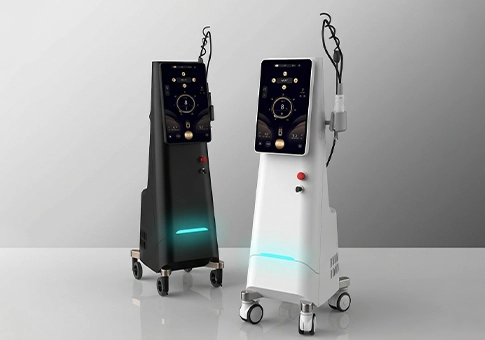
Clinics researching professional focused ultrasound equipment can also explore the AI 360 HIFU system to learn more about Cocoon Laser’s HIFU platform for professional aesthetic applications.
What Is Ultherapy?
Ultherapy is a branded ultrasound-based aesthetic treatment platform rather than the generic name for all focused ultrasound treatments.
One of its distinguishing characteristics is ultrasound visualization, which allows the practitioner to visualize tissue during treatment and helps guide energy delivery at the intended depth.
This is an important distinction in an HIFU vs Ultherapy comparison. A professional HIFU system and Ultherapy may share the broad concept of delivering focused ultrasound energy beneath the skin, but their hardware, treatment workflow, visualization, transducers and operating protocols may differ.
Is Ultherapy the Same as HIFU?
No. Ultherapy and HIFU should not be treated as interchangeable product names.
HIFU is a technology category, while Ultherapy is a specific commercial treatment platform. This is similar to the distinction between a general technology and one particular system designed around that technology.
This also explains why statements such as “HIFU is cheaper than Ultherapy” or “Ultherapy is stronger than HIFU” can be oversimplified. There is no single universal HIFU machine against which every Ultherapy treatment can be compared.
Ultherapy vs HIFU: Technology Comparison
The Ultherapy vs HIFU comparison becomes more useful when the technologies are separated into their actual treatment characteristics rather than treating HIFU as one standardized device.
Focused Ultrasound Energy
Both treatments use ultrasound energy that is focused below the skin surface. The goal is to create controlled effects at predetermined tissue depths while limiting unnecessary disruption to the overlying skin.
This differs from technologies that primarily heat tissue from the surface inward.
Microfocused Ultrasound
Ultherapy is commonly described as using microfocused ultrasound energy. In aesthetic HIFU systems, focused ultrasound is similarly delivered into small treatment zones at selected depths, although device design and focal characteristics vary by manufacturer.
The terminology alone should therefore not be used to predict which treatment will produce better results.
Ultrasound Visualization
Visualization is one of the most important distinctions associated with Ultherapy. The system provides ultrasound imaging that allows the practitioner to view tissue layers during treatment.
Conventional aesthetic HIFU machines do not necessarily provide the same type of real-time visualization. Whether imaging is available depends on the specific platform.
However, visualization is only one component of treatment. Patient selection, anatomical knowledge, appropriate depth selection, energy delivery and treatment coverage remain important regardless of the platform used.
HIFU vs Ultherapy Treatment Depth
Treatment depth is a major factor in focused ultrasound procedures because different facial areas contain different tissue structures and thicknesses.
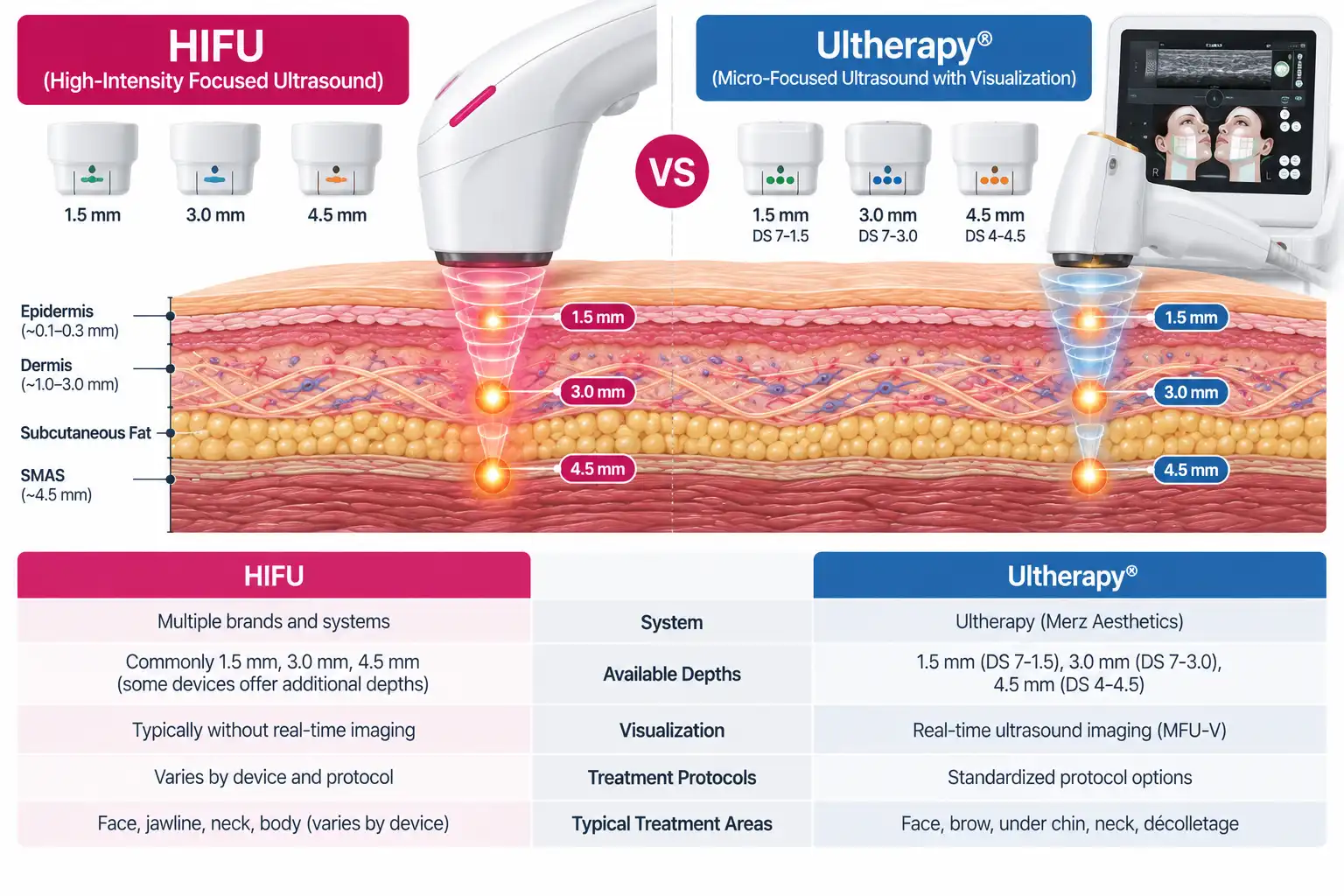
Professional facial ultrasound systems may offer transducers or cartridges designed to focus energy at specific depths. Commonly discussed facial depths include approximately:
| Approximate Depth | General Treatment Consideration |
|---|---|
| 1.5 mm | More superficial treatment targets in appropriately selected areas |
| 3.0 mm | Deeper dermal and subdermal treatment considerations |
| 4.5 mm | Deeper facial tissue targets in suitable anatomical areas |
These depths should not be interpreted as a universal prescription. Facial anatomy varies by treatment area and patient, and different devices may have different specifications.
More depth is also not automatically better. Effective treatment depends on matching the focal depth to the intended anatomical target.
HIFU vs Ultherapy for Skin Tightening
Both HIFU and Ultherapy are associated with non-surgical skin tightening because focused ultrasound can create controlled thermal effects beneath the skin and initiate a remodeling response.
The important question is not simply whether one technology can tighten skin. It is how consistently the selected device can deliver energy to the intended target and whether the patient is an appropriate candidate.
Potential improvements can include:
- Firmer-looking lower-face skin
- Improved jawline definition
- Reduced appearance of mild jowling
- Improved submental contour
- Subtle tightening of selected neck areas
Neither HIFU nor Ultherapy should be expected to reproduce the amount of tissue removal and repositioning possible with surgical lifting.
HIFU vs Ultherapy Results: Which Gives Better Results?
There is no responsible way to say that every HIFU treatment produces better results than Ultherapy, or that every Ultherapy treatment produces better results than every professional HIFU system.
HIFU vs Ultherapy results depend on multiple variables, including:
- The specific device being used
- Energy consistency and focal characteristics
- Available treatment depths
- Treatment-line placement and coverage
- Operator training and anatomical knowledge
- Patient age and skin quality
- Baseline degree of laxity
- Individual collagen response
This means that the brand or technology name alone cannot guarantee the final outcome.
HIFU Results
A well-performed professional HIFU treatment may produce progressive tightening and improved facial contour over the following weeks and months. The extent of improvement depends on the system, treatment protocol and patient.
Because HIFU describes many different systems, published or advertised results from one machine should not automatically be assumed to represent every HIFU platform.
Ultherapy Results
Ultherapy is also intended to create progressive rather than surgical-style immediate results. The tissue response develops after focused ultrasound energy is delivered to selected depths.
As with other energy-based treatments, individual outcomes can vary and should be evaluated using standardized before-and-after photography over an appropriate follow-up period.
HIFU vs Ultherapy for Face and Jawline
The face and jawline are among the most important areas when comparing HIFU and Ultherapy because small changes in lower-face firmness can noticeably affect facial definition.
Both approaches may be considered for appropriately selected people with mild to moderate laxity. Potential treatment areas can include the lower face, jawline, under-chin region and selected areas of the neck.
Which Is Better for the Jawline?
Neither treatment automatically wins for every jawline. If poor definition is primarily caused by mild tissue laxity, focused ultrasound tightening may improve the contour.
If the jawline is poorly defined because of substantial fat, advanced skin laxity or skeletal anatomy, changing from one focused ultrasound platform to another may not solve the underlying problem.
Which Is Better for Mild Jowls?
Mild jowling may respond to tightening when tissue laxity is an important contributing factor. More advanced jowling can involve skin, fat compartments and deeper structural changes that may not respond sufficiently to ultrasound tightening alone.

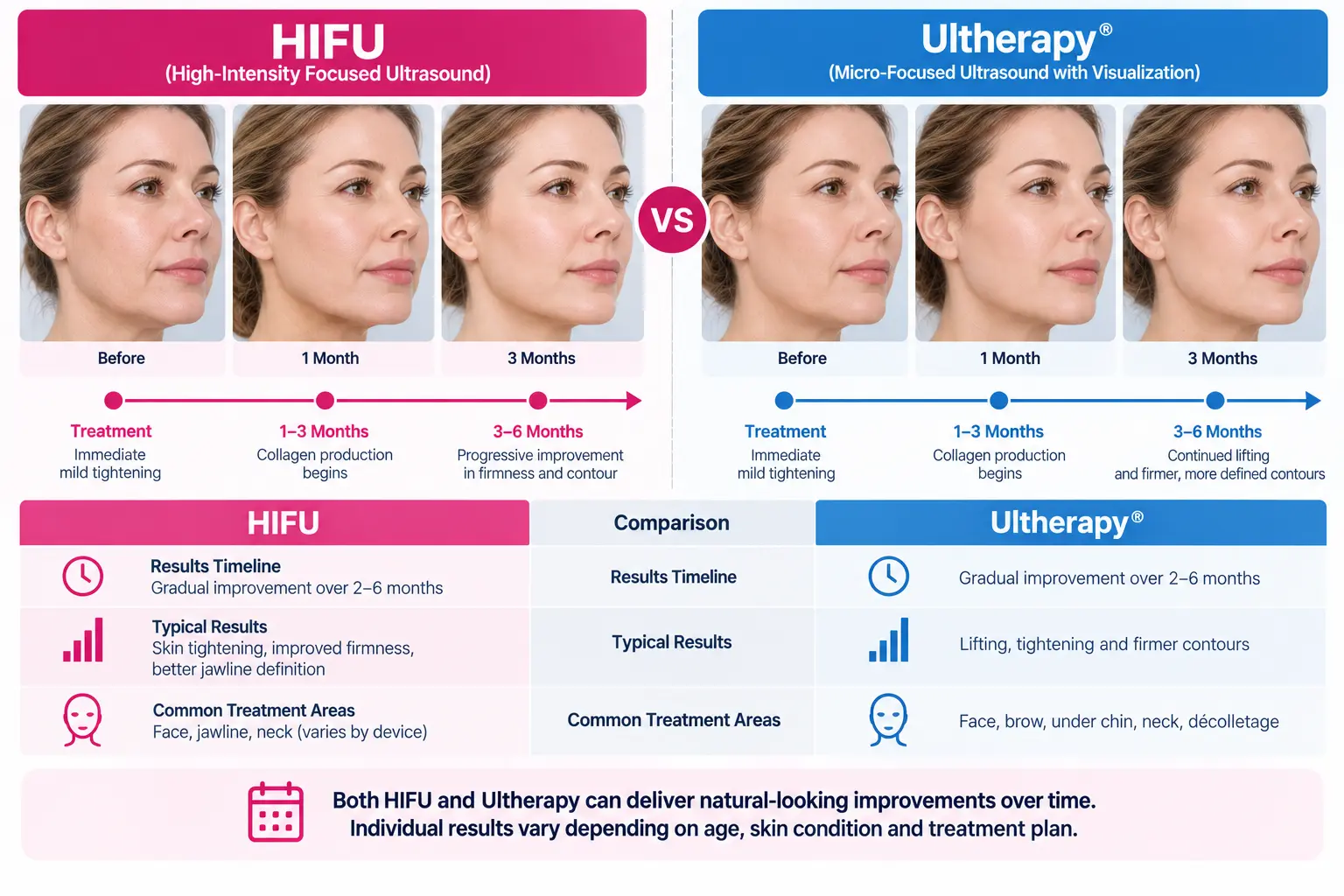
HIFU vs Ultherapy Results Timeline
Neither treatment should be judged solely from an immediate post-treatment photograph. Focused ultrasound treatments rely partly on a progressive tissue-remodeling response.
| Stage | HIFU | Ultherapy |
|---|---|---|
| Immediately After | Possible early firmness and temporary treatment effects | Possible early firmness and temporary treatment effects |
| First Few Weeks | Early remodeling response develops | Early remodeling response develops |
| 1–3 Months | Progressive tightening may become easier to evaluate | Progressive tightening may become easier to evaluate |
| Later Follow-Up | Overall response can be assessed more meaningfully | Overall response can be assessed more meaningfully |
The exact timeline varies between individuals and treatment protocols. Therefore, a fair HIFU vs Ultherapy comparison should use similar follow-up periods rather than comparing an early result from one treatment with a later result from the other.
HIFU vs Ultherapy Pain: Which Treatment Hurts More?
Pain is one of the most common concerns when people compare HIFU vs Ultherapy. Both treatments deliver focused ultrasound energy beneath the skin, so neither should automatically be described as completely painless.
The treatment sensation varies considerably between patients. Some people describe brief pulses of heat, tingling or prickling, while others experience stronger discomfort when energy is delivered over certain facial areas.
Areas close to bone, such as the jawline, chin and forehead, may feel different from areas with more soft tissue.
| Comfort Factor | HIFU | Ultherapy |
|---|---|---|
| Typical sensation | Heat, tingling, prickling or brief discomfort | Heat, tingling, prickling or brief discomfort |
| Intensity | Varies by device, settings, depth and treatment area | Varies by settings, depth, treatment area and individual sensitivity |
| Comfort controls | Depend on the specific HIFU machine and treatment protocol | Depend on the treatment protocol and provider |
| Most sensitive areas | Can include areas near bone | Can include areas near bone |
Therefore, there is no universal answer to HIFU vs Ultherapy pain. Comparing treatment comfort requires more than comparing the technology names. Energy level, cartridge depth, number of treatment lines, anatomy, practitioner technique and individual pain tolerance can all influence the experience.
HIFU vs Ultherapy Downtime
One reason focused ultrasound treatments are popular in aesthetic medicine is that they are generally performed without surgical incisions. As a result, the recovery requirements are typically very different from those associated with a surgical facelift.
For many patients, HIFU vs Ultherapy downtime is relatively limited. Normal activities may often be resumed quickly, although temporary treatment-site reactions can occur.
Depending on the individual and treatment parameters, temporary effects may include:
- Redness
- Mild swelling
- Tenderness
- Tingling
- Sensitivity when touching the treated area
- Temporary altered sensation
The duration and severity of these effects vary. Patients should follow the aftercare instructions provided by the qualified professional performing the treatment.
HIFU vs Ultherapy Side Effects and Safety
Both HIFU and Ultherapy intentionally deliver energy below the skin surface. That makes correct treatment depth, energy selection, anatomical knowledge and patient screening important parts of safe treatment.
Common temporary reactions may include redness, swelling, tenderness or altered sensation. More significant complications are possible when energy-based procedures are performed incorrectly or when an unsuitable patient or treatment area is selected.
A responsible HIFU vs Ultherapy safety comparison should therefore consider more than the device itself.
Important safety factors include:
- Correct patient assessment
- Knowledge of facial anatomy
- Appropriate treatment depth
- Suitable energy settings
- Correct transducer or cartridge selection
- Avoidance of inappropriate anatomical areas
- Proper equipment maintenance
- Practitioner training and experience
People considering treatment should discuss contraindications, medical history and potential adverse effects with an appropriately qualified healthcare or aesthetic professional before undergoing an ultrasound-based procedure.
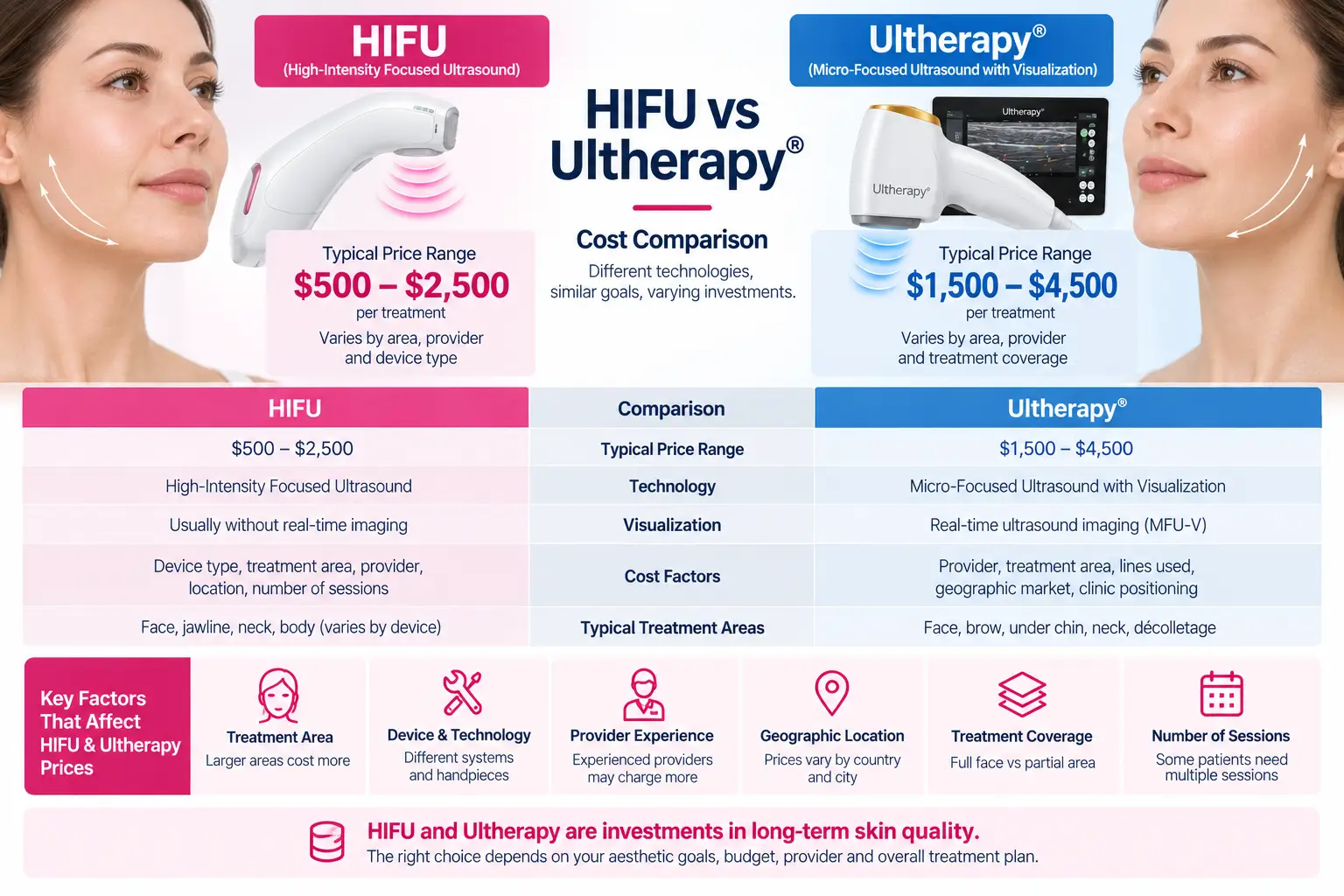
HIFU vs Ultherapy Cost: Which Is More Expensive?
HIFU vs Ultherapy cost can differ substantially because HIFU is not a single standardized treatment or machine. Clinics may use different HIFU platforms with different equipment costs, consumables, protocols and positioning.
Ultherapy, by comparison, is a specific branded platform and is commonly positioned as a premium ultrasound treatment. However, treatment prices still vary according to the clinic, country, treatment area and number of treatment lines required.
| Price Factor | HIFU | Ultherapy |
|---|---|---|
| Equipment category | Many professional systems at different price levels | Specific branded platform |
| Treatment pricing | Varies widely between providers and systems | Often positioned at a premium price point |
| Treatment area | Major influence on total cost | Major influence on total cost |
| Consumables | Depend on device and cartridge design | Platform-specific treatment components |
| Provider expertise | Can influence pricing | Can influence pricing |
| Geographic market | Significant price variation | Significant price variation |
This is why comparing advertised prices without checking the treatment area, number of lines, device being used and provider experience can be misleading.
HIFU Ultherapy Price: What Determines the Treatment Price?
People searching for HIFU Ultherapy price often expect a single number, but there is no universal price for either treatment.
The final price can be affected by:
- Country and city
- Clinic positioning
- Practitioner qualifications and experience
- Size of the treatment area
- Number of treatment lines or shots
- Number and depth of transducers used
- The specific HIFU device
- Consumable costs
- Whether the face, neck or multiple areas are treated
A small targeted jawline treatment, for example, should not be directly compared with a comprehensive full-face and neck protocol.
For consumers, the lowest advertised price should therefore not be the only selection criterion. Ask which device is being used, what areas are included, how treatment coverage is determined and who will perform the procedure.
Why Can HIFU Prices Vary So Much?
HIFU prices can vary more widely because the term covers a large range of aesthetic ultrasound devices rather than one standardized commercial platform.
Two clinics can both advertise “HIFU” while using equipment with different transducers, energy-delivery characteristics, treatment speeds, consumable structures and acquisition costs.
This is an important reason why HIFU vs Ultherapy cost should be evaluated at the level of the actual treatment protocol rather than simply comparing the two names.
How Many HIFU or Ultherapy Treatments Do You Need?
Focused ultrasound treatments are not necessarily performed on the same schedule as treatments that require frequent short-interval sessions.
Some appropriately selected patients may receive a single treatment followed by an extended observation period before deciding whether additional treatment is appropriate. Others may require a different plan depending on age, baseline laxity, treatment goals and response.
More treatments do not automatically mean better results. The treatment plan should account for the biological remodeling process rather than repeatedly delivering energy before the previous response can be evaluated.
How Long Do HIFU and Ultherapy Results Last?
Neither HIFU nor Ultherapy permanently stops facial aging. Ultrasound-induced collagen remodeling may improve firmness and contour, but normal aging continues after treatment.
How long the visible improvement lasts can depend on:
- Age
- Baseline skin laxity
- Skin quality
- Treatment intensity and coverage
- The device and protocol used
- Individual biological response
- Changes in body weight
- Ongoing aging and environmental factors
This is another reason why a promise that one treatment “lasts longer” than another should be interpreted cautiously unless the comparison is based on similar patients, protocols and follow-up periods.
HIFU vs Ultherapy Pros and Cons
Looking at the HIFU vs Ultherapy pros and cons makes the comparison more practical because each option has different advantages depending on the patient, clinic and treatment objectives.
Potential Advantages of HIFU
- Large selection of professional device platforms
- Multiple cartridge and treatment-depth configurations may be available
- Some platforms support both facial and body applications
- Clinics can select equipment according to their treatment portfolio
- Treatment pricing may be available across a wider range of price points
Potential Limitations of HIFU
- Device quality and capabilities vary substantially between manufacturers
- The term “HIFU” alone does not identify the exact equipment being used
- Not every system includes ultrasound visualization
- Treatment outcomes can depend heavily on equipment quality and operator technique
Potential Advantages of Ultherapy
- Established branded treatment platform
- Real-time ultrasound visualization
- Standardized platform identity makes the equipment easier for consumers to identify
- Designed specifically around professional focused ultrasound treatment protocols
Potential Limitations of Ultherapy
- Treatment may be positioned at a higher price point in some markets
- Availability depends on providers offering the branded platform
- Comfort can still be an important consideration
- It is not a substitute for surgery in patients with advanced tissue laxity
HIFU vs Ultherapy: Which Is Better?
So, HIFU vs Ultherapy: which is better?
There is no universal winner. Ultherapy may appeal to patients and providers who specifically value an established branded platform with real-time ultrasound visualization. Professional HIFU systems may appeal to clinics seeking greater equipment choice, different cartridge configurations, broader treatment options or different investment structures.
For patients, the better question is often not simply “Is HIFU or Ultherapy better?” but:
- What is causing my facial or jawline concern?
- Am I an appropriate candidate for focused ultrasound?
- Which exact device will be used?
- Which depths will be treated?
- How much treatment coverage will I receive?
- Who will perform the treatment?
- What result is realistic for my degree of laxity?
A well-selected patient treated appropriately with a suitable professional device may be more important than choosing a treatment based only on the name printed on the machine.
Who May Be a Good Candidate for HIFU?
Professional HIFU may be considered for appropriately assessed adults seeking non-surgical improvement in mild to moderate tissue laxity.
Depending on the device and treatment plan, common aesthetic concerns may include:
- Mild lower-face laxity
- Reduced jawline definition
- Early jowling
- Mild under-chin laxity
- Selected neck-tightening concerns
- Patients who prefer a non-surgical approach
HIFU is not automatically appropriate for every face. Patients with advanced laxity, significant volume changes or concerns caused primarily by other anatomical factors may require a different treatment strategy.
Who May Prefer Ultherapy?
Ultherapy may be particularly attractive to someone who wants treatment using a recognizable branded platform and values ultrasound visualization during energy delivery.
However, brand recognition does not remove the need to evaluate the practitioner, treatment plan and suitability of the procedure for the individual patient.
HIFU vs Ultherapy for Clinics and Aesthetic Practices
The comparison looks different from the perspective of an aesthetic clinic. A patient primarily evaluates treatment results, safety, comfort and price, while a clinic must also consider equipment investment, treatment flexibility, consumables, training and operating economics.
| Clinic Consideration | Professional HIFU | Ultherapy |
|---|---|---|
| Equipment choice | Wide range of manufacturers and configurations | Specific branded ecosystem |
| Initial investment | Varies substantially by manufacturer and system | Depends on branded platform acquisition terms |
| Treatment flexibility | Depends on available cartridges and applications | Defined by the platform’s supported transducers and protocols |
| Visualization | Device-dependent | Integrated ultrasound visualization |
| Consumables | Device-dependent | Platform-specific |
| Brand recognition | Varies by manufacturer | Strong branded treatment identity |
Clinics evaluating a professional HIFU machine should therefore compare the actual technical specifications, treatment capabilities, training, support and operating requirements of each system rather than evaluating equipment only by purchase price.
For clinics researching a professional platform, the AI 360 HIFU provides additional information about Cocoon Laser’s focused ultrasound system and available professional aesthetic applications.
HIFU vs Ultherapy Comparison: Quick Decision Guide
| If Your Priority Is… | What to Consider |
|---|---|
| A recognized branded treatment | Ultherapy may be easier to identify as a standardized commercial platform |
| Real-time ultrasound visualization | Ultherapy is specifically associated with integrated visualization |
| More device choices | HIFU provides a much broader range of professional equipment options |
| Different cartridge configurations | Compare the specific HIFU system and its available treatment depths |
| Lower treatment price | Compare actual clinic quotes; HIFU pricing varies widely |
| Best facial result | Prioritize patient selection, device quality, protocol and practitioner expertise |
| Advanced skin laxity | Neither option should automatically be considered equivalent to surgical lifting |
Ultimately, the most useful Ultherapy vs HIFU decision is based on the specific device, treatment protocol, anatomy, provider and realistic treatment objective—not on a generic assumption that one name is always superior to the other.
Common Mistakes When Comparing HIFU vs Ultherapy
A fair HIFU vs Ultherapy comparison requires more than looking at marketing claims or one before-and-after photo. Several common mistakes can make the comparison less useful.
Assuming Every HIFU Machine Is the Same
HIFU is a technology category, not one standardized device. Different systems can vary in focal depth, cartridge design, energy delivery, treatment speed, software and available applications.
Assuming Ultherapy Is Simply Another Generic HIFU Machine
Ultherapy is a specific branded platform with its own treatment workflow and ultrasound visualization features. It should not be treated as a generic synonym for every focused ultrasound system.
Comparing Price Without Comparing Treatment Coverage
A lower HIFU Ultherapy price does not automatically mean better value. Compare which areas are being treated, how many lines are delivered, which depths are used and who performs the procedure.
Expecting Surgical Facelift Results
Both HIFU and Ultherapy are non-surgical ultrasound-based treatments. Neither should be expected to reproduce the same degree of tissue repositioning and skin removal as facelift surgery.
Judging Results Too Early
Focused ultrasound results develop progressively. Comparing one treatment immediately after the procedure with another treatment several months later creates an unfair comparison.
常见问题
What is the difference between HIFU and Ultherapy?
The main difference is that HIFU is a broad category of high-intensity focused ultrasound technology, while Ultherapy is a specific branded ultrasound-based aesthetic platform. Ultherapy is also associated with integrated ultrasound visualization during treatment.
Is Ultherapy the same as HIFU?
No. Ultherapy uses focused ultrasound technology, but HIFU refers to a much broader category of systems. Different HIFU machines can have different cartridges, treatment depths, controls and capabilities.
Which is better, HIFU or Ultherapy?
There is no universal answer to HIFU vs Ultherapy which is better. Ultherapy may appeal to people who want a recognizable branded platform with real-time ultrasound visualization, while professional HIFU systems offer a wider range of device configurations and treatment options. The better choice depends on the patient, device, treatment plan and provider.
Does Ultherapy give better results than HIFU?
Not necessarily. HIFU vs Ultherapy results depend on the specific device, treatment depth, energy delivery, coverage, practitioner technique and patient selection. The technology name alone does not guarantee a better outcome.
Is HIFU cheaper than Ultherapy?
HIFU may be offered at lower prices in some markets because many different professional systems exist. However, HIFU vs Ultherapy cost varies substantially by clinic, treatment area, device and treatment coverage.
What is the average HIFU Ultherapy price?
There is no single universal HIFU Ultherapy price. Prices vary by country, clinic, treatment area, number of treatment lines, device, practitioner and whether the face, neck or multiple areas are included.
Which hurts more, HIFU or Ultherapy?
Pain varies by individual, treatment area, depth, energy setting and device. Both treatments can cause heat, tingling or brief discomfort, so neither can be described as universally more painful.
Which has less downtime, HIFU or Ultherapy?
Both generally have limited downtime compared with surgical procedures. Temporary redness, swelling, tenderness or altered sensation may occur after either treatment.
Is HIFU or Ultherapy better for the jawline?
Either may be considered when mild tissue laxity contributes to poor jawline definition. The better option depends on anatomy, device capabilities, treatment depth and practitioner technique rather than the treatment name alone.
Is HIFU or Ultherapy better for skin tightening?
Both can be used for non-surgical skin tightening. A meaningful comparison should focus on the actual device, treatment protocol, candidate selection and intended tissue target.
How long do HIFU and Ultherapy results last?
Results vary between individuals and are not permanent because natural aging continues. Duration depends on age, skin quality, baseline laxity, treatment protocol and individual biological response.
How many HIFU or Ultherapy treatments are needed?
Some patients may receive one focused ultrasound treatment followed by reassessment after the remodeling period. Others may later receive additional treatment. The number of sessions should be individualized rather than assumed to be the same for everyone.
Final Verdict: HIFU vs Ultherapy — Which Should You Choose?
HIFU vs Ultherapy is not a simple comparison between one generic machine and one branded treatment. HIFU describes a broad family of focused ultrasound technologies, while Ultherapy is a specific commercial platform with integrated ultrasound visualization.
For patients, the more important questions are whether focused ultrasound is appropriate for the concern, which exact device will be used, which treatment depths are planned and who will perform the procedure.
For clinics, the Ultherapy vs HIFU decision also involves equipment cost, treatment flexibility, cartridges or transducers, consumables, training, visualization, operating economics and the type of treatments the practice wants to offer.
Ultherapy may be attractive when a recognized branded platform and integrated visualization are priorities. Professional HIFU platforms may be attractive when clinics want broader device choices, different cartridge configurations and more flexible equipment investment options.
Ultimately, results depend more on patient selection, device quality, treatment planning and practitioner technique than on assuming that one technology name is universally superior.
Clinics researching professional focused ultrasound equipment can learn more about the AI 360 HIFU system for face and body aesthetic applications.