Thulium Laser Treatment: Benefits, Uses, Downtime & Results
1927nm Thulium Laser Guide
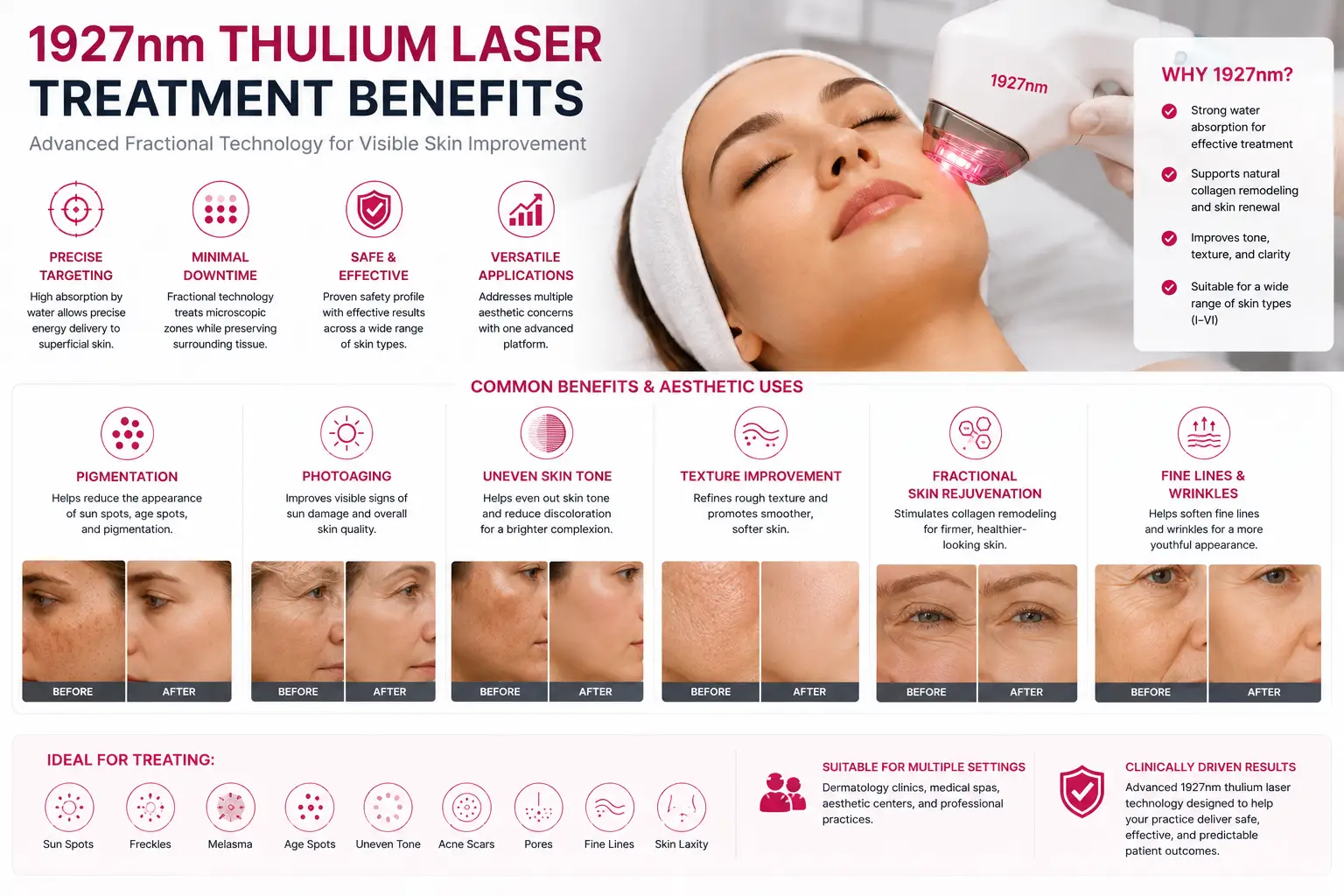
Thulium laser treatment is an aesthetic skin treatment commonly associated with fractional laser systems operating around 1927nm. This wavelength is used for superficial skin resurfacing and treatments targeting concerns such as uneven pigmentation, sun-related skin changes, texture, and overall skin appearance.
This guide explains how 1927nm thulium laser treatment works, its common aesthetic uses, potential benefits, expected downtime, treatment results, and the technology clinics should understand when evaluating professional thulium laser systems.
Quick Answer: What Is Thulium Laser Treatment?
Thulium laser treatment is a laser-based skin treatment commonly performed with fractional systems operating at approximately 1927nm. The wavelength is strongly absorbed by water in superficial skin tissue, allowing controlled thermal treatment to be delivered to targeted areas of the skin.
In aesthetic practice, 1927nm thulium laser technology is commonly associated with treatment of pigmentation, sun-related skin changes, uneven skin tone, texture, and skin rejuvenation. Fractional delivery creates microscopic treatment zones while leaving surrounding tissue untreated, supporting a controlled healing response.
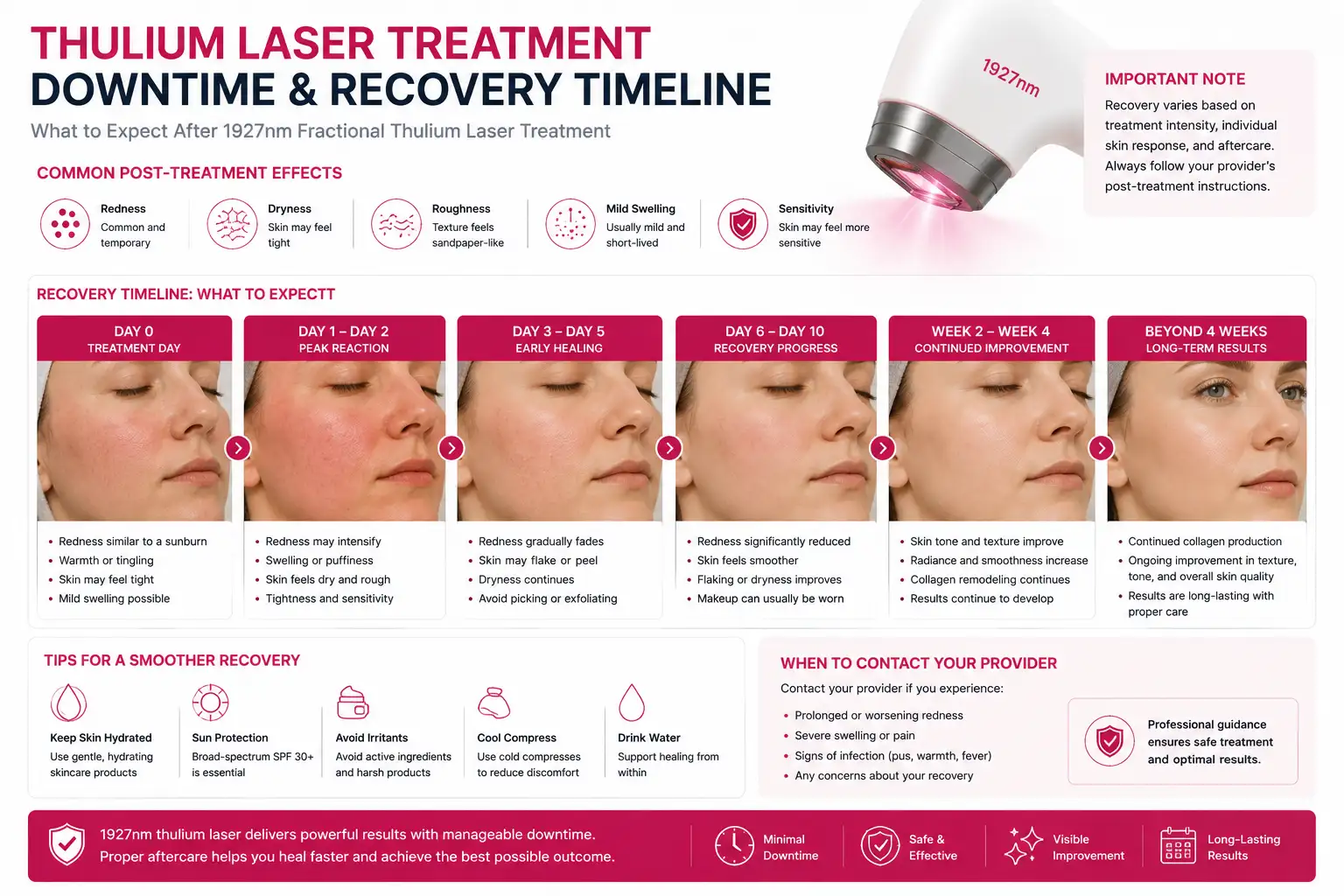
Downtime depends on the device and treatment settings, but patients may experience temporary redness, warmth, dryness, roughness, or mild swelling during the first several days. Visible changes usually develop progressively rather than immediately, and treatment plans vary according to the skin concern, device, treatment intensity, and professional assessment.
What Is a Thulium Laser Treatment?
A thulium laser is a laser system that uses thulium-based laser technology to generate light in the near-infrared region. In aesthetic dermatology, one of the most recognized wavelengths associated with thulium technology is 1927nm.
The 1927nm wavelength interacts strongly with water, an important chromophore in skin tissue. Because water is present throughout the skin, this wavelength can be used to create controlled thermal effects within relatively superficial tissue.
Many aesthetic 1927nm systems use fractional delivery. Instead of treating the entire skin surface uniformly, fractional technology divides the laser energy into many microscopic treatment zones.
This approach allows treated and untreated tissue to exist next to one another, which is one reason fractional laser technology is widely used for controlled skin resurfacing and rejuvenation procedures.
1927nm in Simple Terms
The key concept behind aesthetic thulium laser treatment is: 1927nm wavelength + water absorption + controlled thermal effect + fractional delivery.
The actual tissue response depends on the device architecture, delivered energy, treatment density, pulse characteristics, treatment technique, cooling, and other system parameters.
How Does 1927nm Thulium Laser Treatment Work?
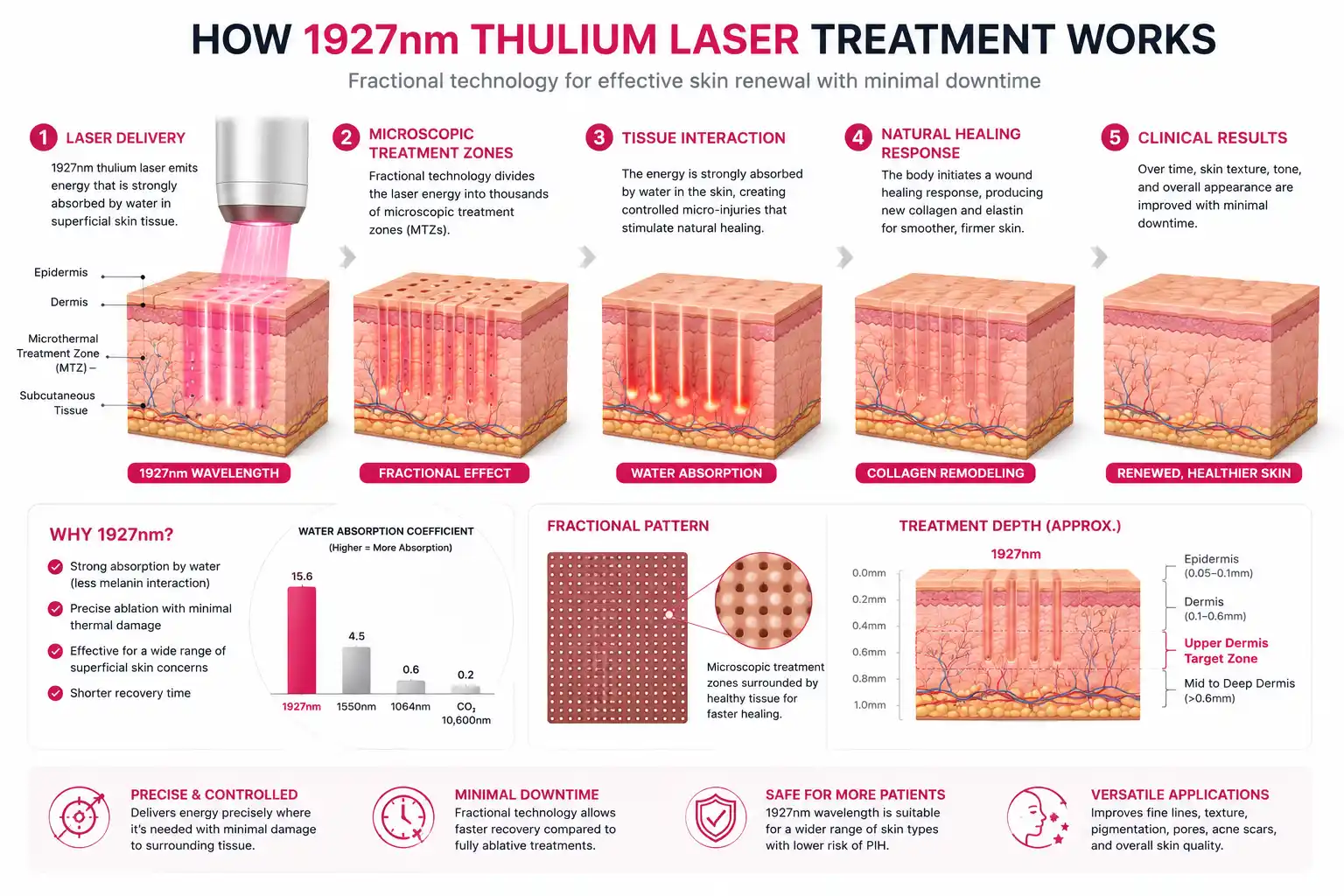
To understand thulium laser treatment, it helps to separate the process into three elements: wavelength, tissue absorption, and fractional delivery.
1. The Laser Produces Energy Around 1927nm
The wavelength of a laser influences how its energy interacts with different chromophores in tissue. At approximately 1927nm, water becomes an important absorber of the delivered laser energy.
2. Water Absorbs the Laser Energy
When the laser energy reaches the skin, part of that energy is absorbed by water-containing tissue and converted into heat.
This controlled photothermal interaction is fundamentally different from pigment-targeting technologies such as many picosecond or Q-switched laser applications, where melanin or tattoo pigment may be the primary optical target.
3. Fractional Delivery Creates Microscopic Treatment Zones
In fractional thulium systems, the laser does not create the same thermal effect across every point of the treatment area. Instead, energy is distributed into microscopic treatment zones surrounded by untreated tissue.
Treatment density, energy, passes, scanning pattern, and other parameters influence the intensity and distribution of these zones.
4. A Controlled Healing Response Follows
Following treatment, the skin undergoes a healing and renewal process. Temporary redness, warmth, dryness, roughness, or mild swelling can occur as the treated tissue recovers.
Changes in skin appearance develop over time rather than being determined solely by what the skin looks like immediately after treatment.
What Are the Benefits of Thulium Laser Treatment?
The potential benefits of thulium laser treatment depend on the device, treatment parameters, skin characteristics, treatment indication, and treatment plan. In aesthetic applications, 1927nm fractional systems are commonly considered for improving several aspects of skin appearance.
Improvement in Uneven Pigmentation
One of the most recognized applications of 1927nm fractional laser technology is the treatment of superficial pigmentation and uneven skin tone.
Because the wavelength creates controlled thermal effects in relatively superficial skin tissue, it is frequently incorporated into treatment strategies addressing visible pigment irregularities.
Sun-Damaged Skin and Photoaging
Accumulated ultraviolet exposure can contribute to visible changes such as uneven pigmentation, rough texture, and an irregular complexion. Fractional thulium laser treatment may be used as part of an aesthetic treatment strategy for photoaged skin.
Skin Texture
Fractional treatment creates controlled microscopic treatment zones and a subsequent healing response. For this reason, thulium laser technology is also used in procedures intended to improve the appearance of skin texture and surface quality.
Overall Skin Rejuvenation
Some treatment protocols use 1927nm thulium laser technology as part of broader skin rejuvenation programs where the objective is improvement in tone, texture, and overall skin appearance rather than correction of a single isolated concern.
Fractional Treatment Approach
Fractional delivery allows the practitioner to treat microscopic zones while leaving surrounding tissue untreated. This provides a different resurfacing approach from fully ablative technologies that remove a continuous area of surface tissue.

What Is Thulium Laser Treatment Used For?
In professional aesthetic practice, the applications of a thulium laser depend on the specific device and its intended use. Common areas of interest include the following.
| Skin Concern | Why 1927nm May Be Considered |
|---|---|
| Uneven Pigmentation | 1927nm fractional technology creates controlled thermal effects in relatively superficial water-containing skin tissue. |
| Sun Damage | Frequently used in skin resurfacing strategies addressing visible photodamage and uneven tone. |
| Uneven Skin Tone | May be incorporated into treatment plans focused on improving overall complexion and visible tone irregularity. |
| Skin Texture | Fractional treatment creates microscopic thermal zones followed by a controlled healing response. |
| Skin Rejuvenation | Can be used as part of broader aesthetic protocols targeting tone, texture, and overall skin appearance. |
| Melasma | 1927nm technology may be considered in selected professional treatment strategies, but melasma is complex and treatment suitability requires careful professional assessment. |
The presence of a particular wavelength does not mean that every device is appropriate for every indication. Clinics should follow the intended use, treatment protocols, training, and regulatory status applicable to the specific system.
Is Thulium Laser the Same as Fractional Laser?
Not exactly. Thulium describes the laser technology and is commonly associated with wavelengths such as 1927nm, while fractional describes how laser energy is spatially delivered to the skin.
A 1927nm thulium system can use fractional delivery, which is why the terms “fractional thulium laser” and “1927nm fractional laser” are often seen together. But wavelength and fractional delivery describe two different characteristics of the device.
This distinction becomes especially important when comparing thulium technology with other fractional laser systems operating at different wavelengths.
How Much Downtime Does Thulium Laser Treatment Have?
Thulium laser downtime is commonly measured in days rather than weeks, but the exact recovery period depends on the device, treatment intensity, fractional density, number of passes, treatment area, and individual skin response.
After a fractional 1927nm thulium laser treatment, temporary redness, warmth, mild swelling, dryness, roughness, or a sandpaper-like skin texture may occur. These effects generally change progressively as the skin recovers.
| Approximate Timeline | What May Occur |
|---|---|
| Immediately After Treatment | Redness, warmth, and temporary sensitivity may be noticeable. |
| Day 1–2 | Mild redness or swelling may continue. Skin can begin to feel dry or tight. |
| Day 2–5 | Dryness, roughness, or a fine sandpaper-like texture may become more noticeable as treated skin progresses through recovery. |
| Around Day 5–7 | Many temporary surface effects may be substantially improved, although recovery varies according to treatment intensity and individual response. |
| Following Weeks | Changes in tone and texture may become progressively more noticeable as the skin continues its renewal process. |
This timeline is a general educational reference rather than a guaranteed recovery schedule. More intensive treatments can produce more noticeable post-treatment effects and longer downtime.
What Results Can You Expect from Thulium Laser Treatment?
Thulium laser results are usually evaluated progressively rather than immediately after treatment. Early post-treatment redness or dryness is part of the recovery period and should not be confused with the final aesthetic result.
Depending on the treatment indication and protocol, changes may include improvement in the appearance of:
- Uneven skin tone
- Superficial pigmentation
- Visible sun-related skin changes
- Rough or irregular skin texture
- Overall skin clarity and appearance
Some visible changes may appear after the initial recovery period, while additional changes can develop over the following weeks as the skin undergoes renewal.
Results vary considerably between individuals. Skin condition, treatment indication, treatment intensity, number of sessions, treatment interval, post-treatment care, sun exposure, and the specific laser system can all influence the outcome.
How Many Thulium Laser Treatments Are Needed?
There is no universal number of thulium laser sessions that is appropriate for every patient. Some treatment plans may involve a single session, while others use a series of treatments performed at professionally determined intervals.
The number of sessions depends on factors such as:
- The condition being addressed
- Severity and distribution of the concern
- Skin characteristics
- The specific 1927nm laser system
- Treatment energy and fractional density
- Response to previous sessions
- The desired treatment endpoint
Clinics should therefore avoid presenting a fixed session number as universally applicable. Treatment planning should be based on professional assessment and the instructions and protocols associated with the specific device.
What Are the Possible Side Effects of Thulium Laser Treatment?
Like other fractional laser procedures, thulium laser treatment can produce temporary post-treatment effects. Their intensity depends partly on the device and treatment parameters.
Common temporary reactions can include:
- Redness
- Warmth or a sunburn-like sensation
- Mild swelling
- Dryness or tightness
- Rough or sandpaper-like texture
- Temporary sensitivity
- Temporary changes in visible pigmentation
Laser procedures can also carry less common but more significant risks, including prolonged pigment alteration, irritation, infection, or other adverse skin responses. Risk varies with patient characteristics, treatment parameters, technique, post-treatment care, and sun exposure.
Appropriate patient assessment, professional training, parameter selection, eye protection, treatment technique, and post-treatment instructions are therefore important components of professional laser use.
Who May Be a Candidate for Thulium Laser Treatment?
Aesthetic 1927nm thulium laser treatment may be considered for people seeking professional treatment of concerns such as uneven pigmentation, visible photodamage, uneven skin tone, or texture.
However, suitability cannot be determined from the treatment name alone. Professional assessment should consider factors such as skin characteristics, pigmentation tendency, active skin conditions, medications, recent sun exposure, previous procedures, treatment goals, and other relevant history.
This is particularly important when treating pigmentation disorders such as melasma, where treatment response and recurrence can be complex.
Thulium Laser vs Other Skin Resurfacing Lasers
Thulium laser treatment is one option within a much broader group of laser and energy-based skin treatments. It should not be assumed to be interchangeable with CO2, erbium, 1550nm fractional, picosecond, or other laser technologies.
| Technology | Typical Wavelength | General Technical Characteristic |
|---|---|---|
| Thulium Fractional Laser | 1927nm | Strong water interaction and relatively superficial fractional thermal treatment |
| 1550nm Fractional Laser | Approximately 1550nm | Fractional non-ablative technology with different penetration and absorption characteristics from 1927nm |
| Er:YAG Laser | 2940nm | Very strong water absorption and commonly associated with ablative resurfacing |
| CO2 Laser | 10,600nm | Strong water absorption and commonly used for ablative or fractional ablative resurfacing |
| Picosecond Laser | Varies by system | Ultrashort pulse technology commonly associated with pigment and tattoo applications, with some systems also offering fractional applications |
The most appropriate technology depends on the treatment objective, desired treatment depth, downtime considerations, skin characteristics, and the specific device.
Why Is 1927nm Important in Thulium Laser Treatment?
The 1927nm wavelength is central to many aesthetic thulium laser systems because of its interaction with water in skin tissue and its use in relatively superficial fractional treatment.
But the wavelength alone does not define a professional laser system. Two machines operating around 1927nm can differ significantly in their laser source, fractional delivery method, energy range, treatment density, scanning technology, handpiece design, user interface, and available treatment modes.
For clinics evaluating equipment, understanding the wavelength is therefore only the first step. The complete system architecture and intended applications should also be compared.
We explore the wavelength in greater detail in our 1927nm Thulium Laser Technology Guide.
Thulium Laser Treatment FAQ
What does thulium laser treatment do?
Aesthetic thulium laser treatment commonly uses approximately 1927nm laser energy to create controlled thermal effects in superficial water-containing skin tissue. Fractional systems are used for applications involving pigmentation, photodamage, uneven tone, texture, and skin rejuvenation.
How long is the downtime after thulium laser treatment?
Downtime varies with treatment intensity and individual response. Temporary redness, warmth, mild swelling, dryness, or roughness can occur during the first several days, with recovery progressing afterward.
When do you see results from thulium laser treatment?
Results develop progressively. Some changes may become visible after the initial recovery period, while additional improvement in skin appearance may develop over the following weeks.
Is 1927nm thulium laser ablative?
Many aesthetic 1927nm thulium systems are described as fractional non-ablative technologies, but device architecture varies. Buyers and practitioners should confirm the operating mechanism and intended use of the specific laser system.
Can thulium laser be used for pigmentation?
1927nm fractional thulium technology is commonly associated with aesthetic treatment strategies for superficial pigmentation and uneven skin tone. Suitability depends on the type of pigmentation, skin characteristics, device, and professional assessment.
Can thulium laser be used for melasma?
1927nm thulium laser technology may be considered in selected professional treatment strategies for melasma, but melasma is a complex and recurrent pigmentary condition. Treatment suitability, parameters, and expectations require careful professional assessment.
Final Verdict: Is Thulium Laser Treatment Worth Understanding?
Thulium laser treatment, particularly fractional technology operating around 1927nm, has become an important part of the professional aesthetic laser landscape for applications involving superficial pigmentation, sun-related skin changes, uneven tone, texture, and skin rejuvenation.
Its defining technical characteristic is the interaction between 1927nm laser energy and water-containing skin tissue, often combined with fractional delivery to create controlled microscopic treatment zones.
Downtime is generally associated with temporary redness, dryness, roughness, warmth, or mild swelling over the first several days, while visible results typically develop progressively during and after recovery. The exact experience depends on treatment intensity, device, patient characteristics, and treatment plan.
For clinics evaluating thulium technology, the wavelength should not be considered in isolation. Fractional delivery, treatment controls, system architecture, intended applications, reliability, training, warranty, and manufacturer support are also important when comparing professional 1927nm laser systems.
Professional 1927nm Laser Technology
Explore Professional Thulium Laser Systems
Cocoon Laser provides professional aesthetic laser equipment for clinics, medical spas, distributors, and OEM partners. Contact our team to discuss available 1927nm thulium configurations, technical specifications, applications, customization options, and pricing.
Request Specifications & Quote