Diode Laser Cooling System FAQ: Expert Answers for Aesthetic Clinics & Dermatologists
Overview
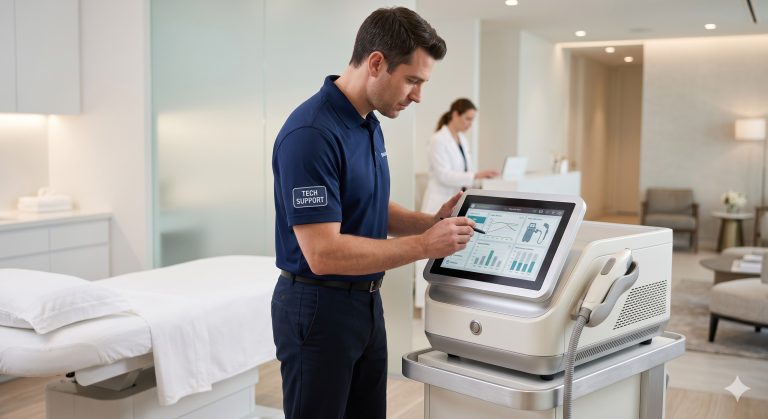
For B2B clinic owners and dermatologists, understanding the cooling system in a diode laser is critical for ensuring patient safety, comfort, and treatment efficacy. Unlike older laser technologies, modern diode lasers integrate advanced contact cooling to protect the epidermis during high-fluence hair removal and vascular treatments. This FAQ addresses pre-sales and post-sales technical concerns, from skin type suitability to maintenance protocols, helping you make an informed investment.

Frequently Asked Questions
Q1: What type of cooling system is used in modern diode lasers and how does it protect the epidermis?
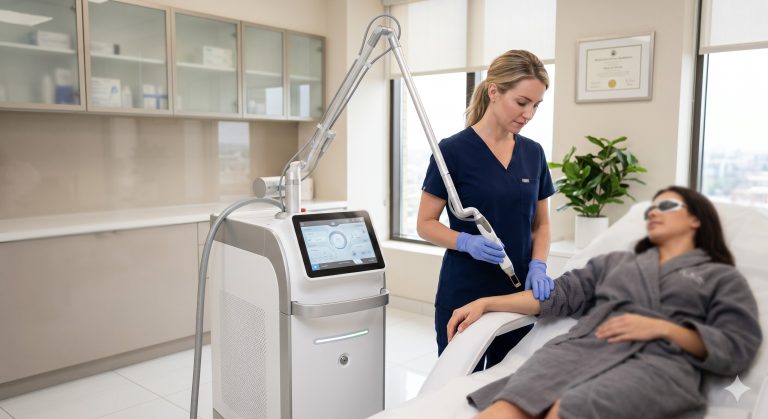
Modern diode lasers use a sapphire-tip contact cooling system with thermoelectric (TEC) technology. This active cooling mechanism rapidly lowers the skin’s surface temperature to approximately -5°C to +5°C before, during, and after the laser pulse. By maintaining epidermal cooling while allowing the deep dermis to reach coagulation temperatures (55°C-65°C), the system prevents burns, reduces pain, and enables safe treatment across Fitzpatrick skin types IV-VI.
Q2: Is a diode laser with contact cooling suitable for all Fitzpatrick skin types (I-VI)?
Yes, a diode laser equipped with a high-performance sapphire contact cooling system is safe and effective for Fitzpatrick skin types I through VI. The key is that continuous cryogen-free cooling preserves the epidermis during the thermal relaxation time. For darker skin types (V-VI), operators should use longer pulse widths (30-100ms) and lower fluences (8-14 J/cm²), but the cooling system remains the primary safety barrier against post-inflammatory hyperpigmentation.
Q3: What is the typical handpiece shot lifespan before the cooling system degrades?
The typical handpiece shot lifespan is 500,000 to 1,000,000 full-energy pulses before the TEC cooling modules or sapphire window require replacement. Professional-grade diode lasers use industrial TEC elements rated for 8,000+ hours of continuous operation. However, if you notice uneven cooling, longer skin recovery time, or patient complaints of excessive heat after 400,000 shots, it is time for a preventative handpiece service or replacement.
Q4: How does contact cooling compare to spray cryogen or cold gel for painless treatments?
Contact cooling is superior to spray cryogen or cold gel for diode laser treatments because it provides continuous, uniform epidermal protection throughout the pulse duration. While spray cryogen (e.g., DCD) offers a brief cold burst that may wear off mid-pulse, sapphire contact cooling maintains constant -5°C to 0°C surface temperature. Cold gels add no active cooling. For large treatment areas like full back or legs, contact cooling reduces patient anxiety, eliminates the need for topical anesthetics in most cases, and increases clinic throughput by 25-35%.
Q5: Does the cooling system require routine maintenance or water circuit cleaning?
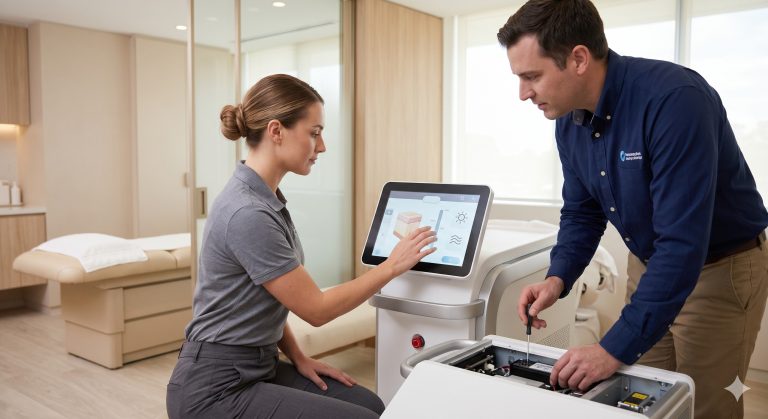
Yes, diode lasers with internal water circulation for TEC heat dissipation require quarterly maintenance. The closed-loop water circuit and radiator fans must be inspected for dust accumulation and coolant levels every 3-6 months. Signs that maintenance is needed include: reduced cooling power (patient feels hot), longer cooldown times between pulses, or an error code on the touchscreen. Use only distilled water and a biocide additive (e.g., Propylene Glycol 15-25%) to prevent algae or corrosion. Neglect leads to TEC failure and expensive handpiece replacement.
Q6: What is the clinical ROI benefit of an advanced cooling system for my med spa?
The advanced cooling system directly increases clinic ROI by enabling higher fluences (up to 40-50 J/cm²) with zero downtime, reducing required sessions from 8-10 to 4-6 for full hair clearance. Faster per-pulse rates (2-3 seconds per shot) combined with pain-free treatments increase daily patient volume by 30-40%. Additionally, no consumable costs (cryogen gas refills or gels) save $2,000-$5,000 annually. Most clinics recoup the premium for an enhanced cooling system within 6-9 months through higher patient retention and word-of-mouth referrals.
Q7: What technical errors indicate a failing cooling system, and how do I troubleshoot?
Three common errors indicate cooling system failure: error code E01 (TEC overheat), E12 (water flow sensor fault), or E24 (sapphire tip temperature >15°C). Troubleshooting steps: First, check the water level and refill with distilled water if low. Second, clean all air intake filters and radiator fins. Third, verify the ambient room temperature is below 25°C. Fourth, test the TEC voltage (normally 12V-24V DC). If errors persist after these steps, the TEC module or water pump requires factory service. Running a laser with a degraded cooling system will burn patients and void your warranty.
Q8: What certification standards must a diode laser’s cooling system meet for FDA/CE compliance?
For FDA 510(k) clearance and CE Mark (MDR 2017/745), the diode laser cooling system must pass IEC 60601-2-22 (laser safety) and IEC 60601-1 (medical electrical equipment). Specific tests include: maximum surface temperature not exceeding 43°C at the patient interface, no single-point cooling failure leading to thermal injury, and redundant thermal sensors with automatic laser shutdown. Always request the IEC 60601-2-22 test report from your supplier; compliance ensures legal liability protection and insurance acceptance for your clinic.