Comparing 808nm vs 755nm vs 1064nm Lasers: Clinic Investment FAQ
Overview
For clinic owners and dermatologists, selecting the optimal diode laser wavelength directly impacts treatment efficacy, patient safety across Fitzpatrick skin types, and long-term ROI. This FAQ compares the three dominant wavelengths—808nm (diode), 755nm (alexandrite), and 1064nm (Nd:YAG)—addressing pre-sales assessment, clinical workflows, maintenance, and profitability. All answers are structured for evidence-based procurement decisions.
Frequently Asked Questions
Q1: Which wavelength—808nm, 755nm, or 1064nm—is safest for dark skin (Fitzpatrick IV-VI)?
The 1064nm wavelength is safest for Fitzpatrick IV-VI due to its deeper penetration and lower melanin absorption, which minimizes epidermal injury risk. 755nm has high melanin absorption, making it suitable only for Fitzpatrick I-III. 808nm offers a mid-range safety profile effective for Fitzpatrick I-IV when combined with advanced contact cooling. For darker skin types, always prioritize 1064nm with longer pulse durations to avoid post-inflammatory hyperpigmentation.
Q2: What is the typical handpiece shot lifespan for 808nm, 755nm, and 1064nm machines?
High-quality 808nm diode handpieces deliver 5-10 million shots before diode degradation, while 755nm alexandrite handpieces average 1-3 million shots, and 1064nm Nd:YAG handpieces range from 3-5 million shots. The 808nm wavelength benefits from semiconductor diode arrays that provide longer operational life and lower consumable expenditure per treatment. Replace handpieces when energy output drops below 80% of initial fluence.
Q3: How many treatment sessions are typically required for 90% hair reduction with 808nm vs 755nm?
808nm achieves 90% hair reduction in 6-8 sessions for Fitzpatrick I-IV, while 755nm requires 8-10 sessions but offers faster per-session results on light, coarse hair. The 808nm wavelength targets melanin in the hair follicle bulb more uniformly across anagen phases, reducing total sessions for mixed patient populations. For clinics treating diverse skin types, 808nm provides more predictable session counts and higher patient compliance.
Q4: What cooling system is integrated into 808nm devices to enable painless treatments?
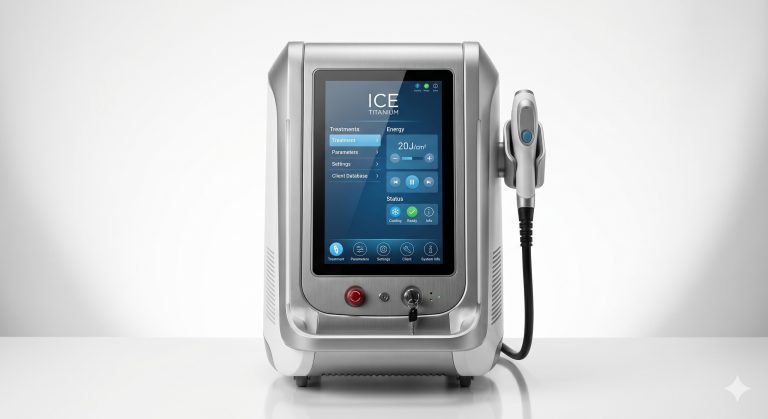
Medical-grade 808nm lasers utilize a sapphire contact cooling system with thermoelectric coolers (TECs) that achieve 0°C to 4°C skin surface temperature during energy delivery. This protects the epidermis while allowing high fluences (up to 120 J/cm²) for deep follicle coagulation. Unlike 755nm systems that rely on slower cryogen spray, 808nm contact cooling provides continuous, uniform cooling without patient shivering or spray-related discomfort.
Q5: What is the typical ROI payback period for an 808nm diode laser compared to 755nm or 1064nm?
An 808nm diode laser typically achieves ROI in 6-12 months for high-volume clinics, compared to 12-18 months for 755nm or 1064nm systems. This faster payback results from lower consumable costs (no expensive flashlamps or cryogen gas), higher throughput (larger spot sizes up to 15mm x 15mm), and fewer required maintenance intervals. Calculate payback using $150-300 per treatment session and 15-25 sessions per week.
Q6: Which wavelength offers the most versatile clinical workflow for combining hair removal, vascular, and pigmented lesions?
The 808nm wavelength alone is optimized primarily for hair removal, but multi-wavelength platforms combining 755nm, 808nm, and 1064nm in a single handpiece provide the most versatile workflow. For pure hair removal clinics, 808nm achieves best-in-class efficacy. For practices treating vascular lesions (leg veins, rosacea), add 1064nm. For epidermal pigmentation (lentigines, freckles), add 755nm. Prioritize systems allowing wavelength switching without handpiece changes.
Q7: What are the daily maintenance requirements for 808nm vs 1064nm water cooling circuits?
808nm diode lasers require distilled water replacement every 3-6 months and monthly radiator filter cleaning, while 1064nm Nd:YAG systems need weekly distilled water checks and quarterly pump inspections. The 808nm‘s closed-loop water circulation system operates at lower thermal loads, reducing scaling risk and pump wear. Always use medical-grade distilled water with conductivity below 5 µS/cm to prevent mineral deposits in the laser cavity cooling plate.
Q8: Does the 808nm wavelength require medical CE or FDA clearance for clinical use?
Yes, all commercial 808nm diode lasers must have valid Medical CE (MDR Class IIb or III) for European markets and FDA 510(k) clearance for the United States. Verify that the device includes IEC 60825-1 laser safety certification and ISO 13485 manufacturing compliance. Unlike 755nm systems which face stricter regulatory scrutiny due to higher epidermal risk, 808nm devices with integrated cooling often achieve faster regulatory approvals while maintaining full clinical safety standards.