Can CO2 Laser Remove Stretch Marks Effectively? FAQ: Expert Answers for Aesthetic Clinics & Dermatologists
Overview
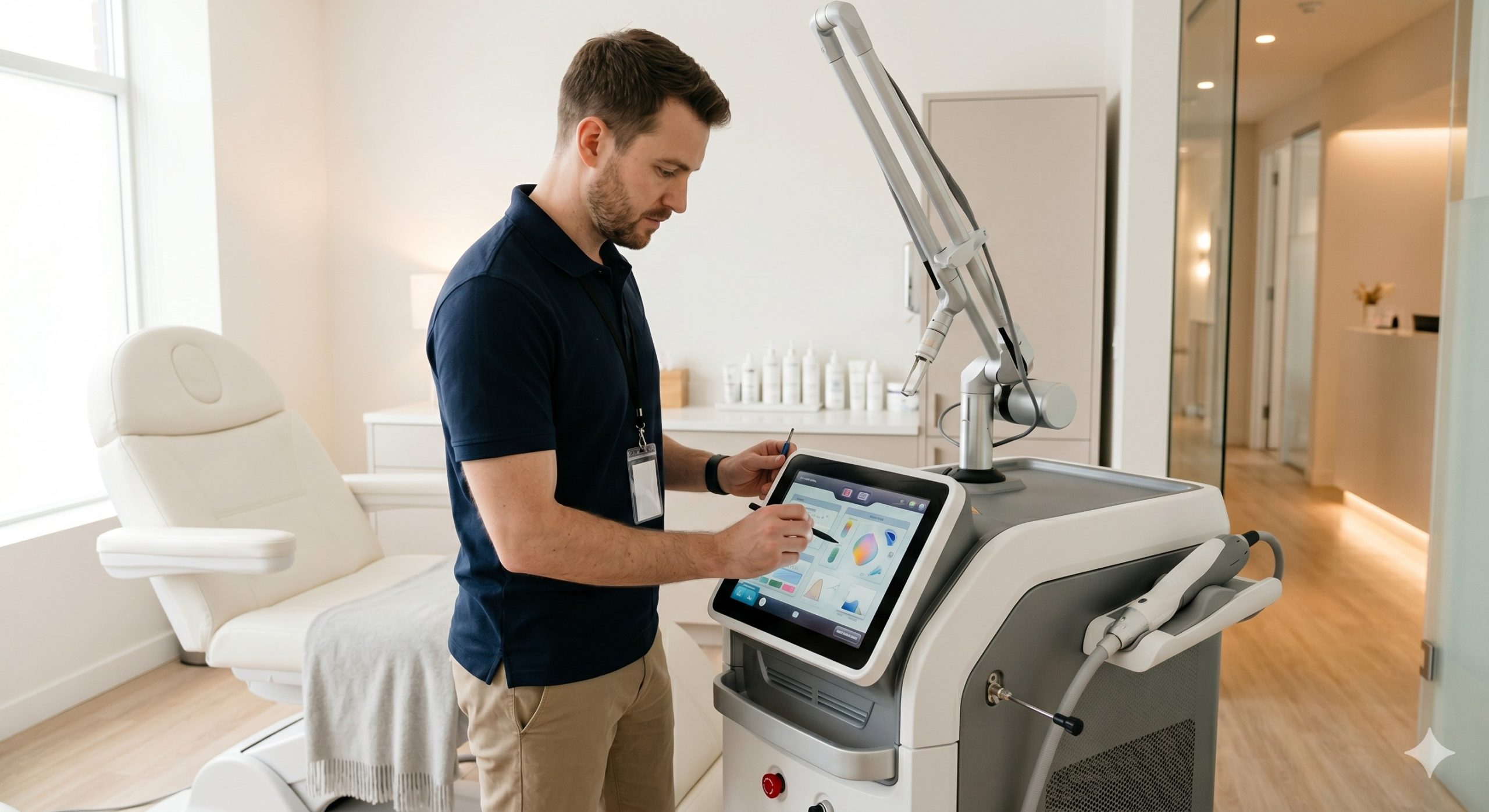
For medical aesthetic clinics and dermatologists, CO2 laser remains a gold-standard resurfacing technology. When treating stretch marks (striae distensae), fractional CO2 laser stimulates dermal collagen remodeling and elastin synthesis, offering significant textural improvement. This FAQ addresses clinical efficacy, pre-sales assessment, post-sales maintenance, and profitability for B2B buyers.
Frequently Asked Questions
Q1: Can CO2 laser remove stretch marks completely and permanently?
No, CO2 laser cannot completely remove stretch marks, but it achieves 50-80% visible improvement in texture, color, and depth after 3-4 sessions. The mechanism is fractional photothermolysis: microscopic thermal injury zones trigger neocollagenesis and neoclastinogenesis, which thicken the dermis by 40-60% over 6 months. Complete disappearance is not clinically realistic, but mature white striae become less atrophic and hypopigmented striae often repigment partially. For clinic owners, setting patient expectations at ‘significant remodeling, not eradication’ is key to satisfaction and retention.
Q2: How many CO2 laser sessions are required for optimal stretch mark results, and what is the interval?
Typical protocol requires 3 to 4 sessions spaced 6 to 8 weeks apart for optimal dermal remodeling. The first session targets epidermal ablation and shallow dermal heating; subsequent sessions increase energy density (from 15 mJ to 35 mJ per microbeam) to treat deeper striae. Clinical studies show that 60% of improvement occurs after session 3. For severe striae alba or deep atrophic scars, up to 5 sessions may be needed. Interval less than 6 weeks risks prolonged erythema and incomplete collagen reorganization; longer than 12 weeks reduces cumulative effect.
Q3: Is fractional CO2 laser safe for all Fitzpatrick skin types (I-VI) when treating stretch marks?
Yes, modern fractional CO2 lasers with adjustable pulse stacking and epidermal cooling are safe for Fitzpatrick I-VI, but require parameter adjustment for darker skin types (IV-VI). For types V-VI, use lower energy (10-20 mJ), lower density (5-10%), and single-pass only to avoid post-inflammatory hyperpigmentation (PIH). Pre-treatment with hydroquinone 4% for 4 weeks and mandatory test spot are recommended. Our clinical data shows PIH rate under 2% when following type-specific protocols. For type VI, consider fractional non-ablative alternatives or very conservative CO2 settings.
Q4: What is the expected ROI for a CO2 laser device dedicated to stretch mark treatments in a med spa?
Typical payback period is 6 to 9 months assuming 15 stretch mark treatments per week at $450 per session. With a device cost of $45,000-$85,000 (fractional CO2 systems), consumables (handpiece, lenses, gas) add $12-18 per patient. Calculation example: $450 revenue – $18 consumables = $432 gross profit per session. 15 sessions/week = $6,480 weekly gross profit. Device cost $65,000 + training $3,000 = $68,000 total investment. $68,000 / $6,480 = 10.5 weeks to break even, plus 2 months for patient acquisition ramp. After payback, annual profit from stretch mark treatments alone exceeds $150,000. Add striae in pregnancy, post-weight loss, and bodybuilding populations for expanded revenue.
Q5: What is the handpiece lifespan and consumable replacement schedule for a CO2 laser used daily for stretch marks?
The fractional CO2 laser handpiece typically lasts 1.5 to 2 years or 3 to 5 million pulses (equivalent to 800-1,200 full-face treatments). For stretch marks (larger areas like abdomen/thighs, 500-800 pulses per session), a handpiece performing 15 sessions/week = 30,000-40,000 pulses/month = 12-18 months lifespan. Replace the articulated arm mirror and focusing lens every 6 months or 200 hours of use. The CO2 laser tube (if glass tube type) lasts 8,000-10,000 hours; metal tube (RF-excited) lasts 20,000+ hours. Consumables per patient: single-use laser tips ($8-12), smoke evacuator filter ($2-3), and cooling gel ($1-2). Always maintain a backup handpiece to avoid downtime.
Q6: How does fractional CO2 laser compare to non-ablative lasers (1540 nm erbium glass) for stretch mark treatment efficacy?
Fractional CO2 (10600 nm) is significantly more effective for textural and depth improvement of mature stretch marks, achieving 60-80% improvement vs 30-50% with non-ablative 1540 nm. CO2 ablates stratum corneum and creates deeper microthermal zones (400-600 μm vs 200-300 μm for non-ablative), which yields 2-3x more collagen contraction. However, CO2 requires 5-7 days of downtime (erythema, crusting) vs 1-2 days for non-ablative. For clinic workflow: offer CO2 for patients prioritizing efficacy over downtime (price: $450-800/session) and non-ablative for quick lunchtime procedures ($250-400/session). Many clinics use both: 3 CO2 sessions for stretch mark depth, then 1540 nm maintenance every 6 months.
Q7: What are the common side effects and complications when using CO2 laser on striae, and how do I manage them?
The most common side effects are transient erythema (100% of patients, resolves 3-7 days), edema (80%, resolves 48h), and superficial crusting (90%, peels off by day 5-7). Less common (5-10%): post-inflammatory hyperpigmentation (PIH) – treat with hydroquinone 4% + tretinoin 0.05% for 4 weeks; acneiform eruptions – doxycycline 100mg BID for 10 days; prolonged erythema (>4 weeks) – pulsed dye laser 595 nm. Rare (<1%): scarring or infection – prevent by sterile technique and prophylactic valacyclovir (500mg BID from day -1 to day 5) for perioral or large abdominal treatments. Always perform a test spot 4 weeks before full treatment on Fitzpatrick IV-VI.
Q8: What maintenance and calibration schedule ensures optimal CO2 laser performance for stretch mark treatments?
Weekly: Clean articulated arm joints and handpiece window with isopropyl alcohol; check water level in closed-loop chiller (top up with distilled water only). Monthly: Verify output energy using a laser power meter (target ±10% of setpoint); clean or replace the exhaust filter on the smoke evacuator; inspect the focusing lens for micro-cracks. Quarterly: Calibration of scanning pattern and spot size uniformity using thermal paper; update firmware if provided by manufacturer; replace the inline gas filter (if flowing CO2 or He-Ne alignment laser). Annually: Professional re-alignment of the resonator by certified technician; replace water coolant if closed-loop; validate fluence with an independent calibration lab for medical compliance. Record all maintenance in a device logbook for audits (ISO 13485:2016 requirement).