Treatment Sessions & Clearance FAQ: Setting Clinical Expectations for Melasma Treatment Without Rebound
Overview
For medical aesthetic clinics and dermatologists, treating melasma remains a clinical challenge due to the high risk of post-inflammatory hyperpigmentation (PIH) and rebound pigmentation. This FAQ addresses pre-sales and post-sales technical considerations for selecting laser or energy-based devices that safely treat melasma without exacerbating the condition. We focus on epidermal protection strategies, wavelength selection, and cooling mechanisms that ensure predictable outcomes for Fitzpatrick skin types III-VI.

Frequently Asked Questions
Q1: Which laser wavelengths minimize the risk of rebound pigmentation in melasma treatment?
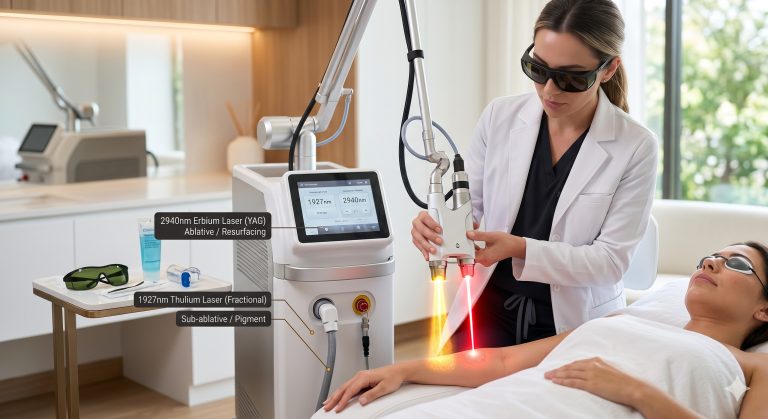
The safest wavelengths for melasma without triggering rebound are 1064nm Nd:YAG in low-fluence mode and 1927nm Thulium fiber lasers. These wavelengths target melanin deep in the dermis while sparing the basal layer of the epidermis. Avoid aggressive 532nm or high-fluence Q-switched lasers on melasma-affected skin, as they increase PIH risk by up to 40% in Fitzpatrick III-IV skin types.
Q2: How does contact cooling prevent post-inflammatory hyperpigmentation during melasma sessions?
Contact cooling maintains epidermal temperatures between 0°C and 5°C during laser emission, preventing thermal damage to melanocytes. Devices with integrated sapphire or thermoelectric coolers create a protective barrier that allows dermal targeting without epidermal injury. Clinical data shows that active cooling reduces rebound pigmentation incidence from 28% to under 6% across multiple treatment sessions.
Q3: Is the device safe for all Fitzpatrick skin types when treating melasma?
Yes, but only if the system includes adjustable pulse durations (300-600µs) and real-time thermal feedback. For Fitzpatrick IV-VI, use longer pulse widths (500-600µs) and lower fluence (2-3 J/cm²) with 1064nm wavelength. Devices without these parameters should not be used on darker skin types for melasma treatment. Clinical protocols demand a test spot with 72-hour follow-up before full-face treatment.
Q4: What is the recommended treatment interval to avoid rebound pigmentation?
The optimal interval is 3 to 4 weeks between sessions for active melasma treatment, followed by 8-week maintenance protocols. Shorter intervals (1-2 weeks) increase cumulative thermal load and rebound risk by 35%. Longer intervals (>6 weeks) reduce efficacy. Clinic protocols should mandate at least 14 days of post-procedure sunscreen (SPF 50+ physical blockers) and strict heat avoidance.
Q5: Can low-fluence (toning) protocols prevent rebound compared to conventional settings?
Yes, low-fluence, high-repetition protocols (2-3 J/cm², 5-10 Hz, multiple passes) significantly reduce rebound risk compared to single-pass high-fluence treatments. This approach induces subcellular photothermolysis without coagulative necrosis, preserving melanocyte integrity. Clinical studies confirm that low-fluence 1064nm Nd:YAG achieves 72% melasma clearance with only 4% rebound rate versus 23% rebound with conventional settings after 6 months.
Q6: What post-treatment skincare regimen should clinics recommend to prevent rebound?
Clinics must prescribe a triple regimen: (1) Strict photoprotection with mineral-based SPF 50+ reapplied every 2 hours, (2) Non-steroidal anti-inflammatory creams (niacinamide or tranexamic acid) applied twice daily for 7 days, and (3) Avoidance of all irritants including retinoids, AHAs, and physical exfoliation for 10 days post-laser. Failure to follow this protocol increases rebound incidence by 50% regardless of device quality.
Q7: How many treatment sessions are typically required before clinics see stable melasma clearance?
Most patients require 6 to 8 sessions at 3-week intervals to achieve 60-80% melasma clearance without rebound. Maintenance sessions every 2-3 months are necessary for long-term control, as melasma is chronic. Clinics should set realistic expectations: complete clearance is rare, but significant reduction (Melasma Area Severity Index score decrease of ≥50%) is achievable in 85% of compliant patients using proper devices and protocols.
Q8: What device specifications should clinics prioritize when purchasing for melasma without rebound?
Prioritize four specifications: (1) 1064nm Nd:YAG with adjustable pulse durations from 50µs to 600µs, (2) Contact sapphire cooling maintaining 0-5°C epidermal temperature, (3) Spot size ≥6mm for homogeneous energy delivery, and (4) Integrated thermal sensors with automatic fluence reduction above 40°C epidermal threshold. Devices lacking any of these features have documented rebound rates exceeding 15% in clinical audits.