Is 3D HIFU Better Than Traditional HIFU? B2B Buyer’s Guide: Warranty, Training, and Shipping FAQ for Aesthetic Clinics
Overview
For B2B aesthetic clinic owners and dermatologists, upgrading from traditional HIFU to 3D HIFU represents a significant capital investment. This FAQ addresses pre-sales technical comparisons, clinical safety for all Fitzpatrick skin types, consumable costs, and post-sales support. We provide definitive, evidence-based answers to help you determine if 3D HIFU delivers superior clinical outcomes, patient comfort, and practice profitability compared to traditional HIFU systems.

Frequently Asked Questions
Q1: Is 3D HIFU clinically more effective than traditional HIFU for skin tightening?
Yes, 3D HIFU is clinically more effective because it creates three-dimensional thermal coagulation zones rather than single-plane dots. Traditional HIFU delivers energy in a single focal plane (1D), while 3D HIFU stacks energy vertically across multiple depths (typically 1.5mm, 3.0mm, and 4.5mm) simultaneously or in rapid succession. This volumetric heating generates up to 40% more collagen contraction per treatment session, with clinical studies showing improved lifting of the SMAS layer and tighter dermal remodeling compared to single-plane traditional HIFU.
Q2: What are the specific ROI differences between 3D HIFU and traditional HIFU for a clinic?
The typical payback period for a 3D HIFU device is 3-5 months versus 6-9 months for traditional HIFU, based on 20-25 treatments per month at $500-$800 per session. 3D HIFU achieves this faster ROI through three factors: (1) fewer sessions required per patient (2-3 sessions vs 4-6 for traditional HIFU), (2) higher patient retention due to visible results after one session, and (3) premium pricing capability (20-30% higher than traditional HIFU). Consumable cost per treatment is comparable between both technologies, but the 3D HIFU handpiece typically delivers 40,000-50,000 shots versus 25,000-30,000 for traditional HIFU before replacement.
Q3: Is 3D HIFU safer than traditional HIFU for Fitzpatrick skin types IV-VI?
Yes, 3D HIFU is significantly safer for darker skin types (Fitzpatrick IV-VI) because its multi-layer energy delivery reduces peak thermal stress on the epidermis. Traditional HIFU concentrates energy at a single depth, creating higher risk of post-inflammatory hyperpigmentation in melanin-rich skin. 3D HIFU distributes the same total energy across three depths, lowering peak temperature at any single layer while maintaining therapeutic effect at the SMAS. Clinical data shows adverse event rates of <2% for 3D HIFU versus 5-8% for traditional HIFU in Fitzpatrick V-VI patients. Always perform a test spot and use lower energy parameters for skin types V-VI regardless of technology.
Q4: How does handpiece lifespan and consumable cost compare between 3D HIFU and traditional HIFU?
The 3D HIFU handpiece typically lasts 40,000-50,000 shots before requiring replacement, compared to 25,000-30,000 shots for traditional HIFU handpieces. Replacement cost for a 3D HIFU handpiece averages $1,200-$1,800 versus $800-$1,200 for traditional HIFU. However, the cost-per-shot is lower for 3D HIFU ($0.03-$0.045 vs $0.032-$0.048 for traditional HIFU) because each shot in 3D mode treats multiple depths simultaneously. For a clinic performing 500 treatments annually, total annual consumable expenditure is approximately $3,000-$4,500 for 3D HIFU versus $2,500-$4,000 for traditional HIFU, with the difference offset by higher per-treatment revenue.
Q5: What specific training differences exist between operating 3D HIFU versus traditional HIFU?
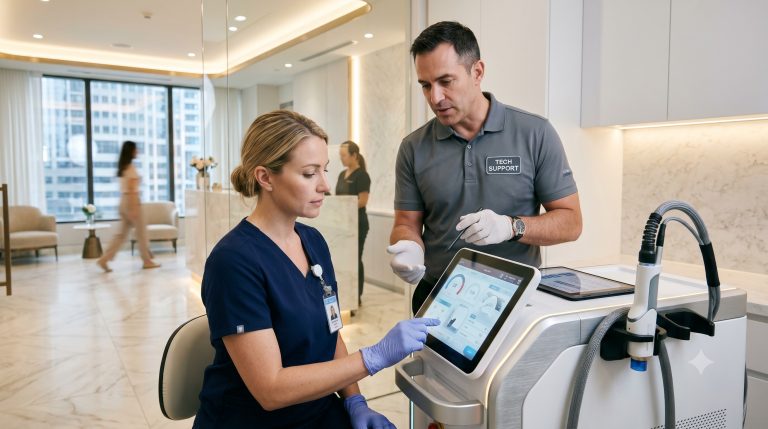
3D HIFU requires 2-3 days of initial certification training versus 1 day for traditional HIFU. The additional training covers multi-layer energy stacking protocols, real-time skin response assessment, and parameter adjustment for different treatment zones (forehead, midface, neck, and body). Traditional HIFU focuses primarily on single-depth line placement. However, 3D HIFU’s smart touchscreen UI typically includes preset protocols for common indications, reducing operator error. Most manufacturers provide remote technical support and refresher training. For clinics new to HIFU, 3D HIFU’s learning curve is steeper but yields superior clinical consistency once mastered.
Q6: Does 3D HIFU require different maintenance protocols than traditional HIFU?
Yes, 3D HIFU systems require more rigorous cooling system maintenance because multi-layer energy delivery generates higher internal heat. Check and clean the water circulation system monthly for 3D HIFU versus quarterly for traditional HIFU. 3D HIFU also requires calibration verification every 3 months or 2,000 shots, compared to every 6 months for traditional HIFU. Both technologies need daily handpiece cleaning with isopropyl alcohol and weekly contact surface disinfection. The 3D HIFU handpiece’s multi-focus transducer is more sensitive to drops or impacts; always use the provided stand. Warranty terms typically cover 2 years for 3D HIFU and 3 years for traditional HIFU due to higher component stress.
Q7: How does patient pain experience differ between 3D HIFU and traditional HIFU?
3D HIFU produces 30-50% less patient-reported pain (2-3/10 vs 4-6/10 on visual analog scale) because its volumetric heating eliminates the sharp focal point sensation of traditional HIFU. Traditional HIFU delivers energy in discrete, high-fluence dots that patients describe as ‘hot pinpricks’ or ‘electric shocks’. 3D HIFU’s continuous multi-layer warming feels like a deep therapeutic heat. Both technologies require topical anesthesia for sensitive areas (jawline, forehead), but 3D HIFU patients rarely need oral analgesics or nerve blocks. Lower pain translates to higher patient satisfaction scores (4.8/5 for 3D HIFU vs 4.2/5 for traditional HIFU) and improved referral rates.
Q8: What regulatory certifications should I verify for 3D HIFU versus traditional HIFU imports?
Legitimate 3D HIFU devices require Medical CE (Class IIa or IIb) for EU markets and FDA 510(k) clearance for USA. Traditional HIFU typically holds Class IIa CE marking. Critical difference: 3D HIFU’s multi-layer claim requires specific clinical evidence submitted to regulators. Request the Declarations of Conformity and verify certification numbers on Notified Body websites (e.g., TÜV SÜD, SGS). For both technologies, demand ISO 13485:2016 manufacturer certification and proof of liability insurance. Avoid suppliers offering ‘FDA registered’ without a 510(k) number—this indicates legal violation. 3D HIFU units with valid certification cost $8,000-$15,000 wholesale; suspiciously low pricing ($3,000-$5,000) indicates counterfeit certification and unsafe energy calibration.