Dual Fractional Thulium Laser FAQ: Expert Answers for Aesthetic Clinics & Dermatologists
Overview
For B2B aesthetic clinics and dermatology practices, the dual fractional thulium laser represents a significant investment in resurfacing technology. This FAQ addresses technical, clinical, and financial concerns from pre-sales compatibility to post-sales maintenance, helping you make an informed procurement decision.
Frequently Asked Questions
Q1: Is the dual fractional thulium laser suitable for all Fitzpatrick skin types?
Yes, the dual fractional thulium laser is safe and effective for Fitzpatrick skin types I through VI. Unlike older ablative CO2 lasers, thulium’s 1927 nm wavelength targets water in the epidermis with minimal melanin absorption, drastically reducing post-inflammatory hyperpigmentation risk in darker skin tones. For type V-VI skin, use lower fluences (5-10 mJ) and wider spot sizes to maximize safety.
Q2: How painful is a treatment session, and what anesthesia is required?
Most patients describe the sensation as a light pinprick or warm rubber band snap, with pain scores typically 2-4 out of 10. Topical lidocaine 4-5% applied 30 minutes pre-treatment is usually sufficient, though no anesthesia is required for superficial modes. The dual-wavelength design (1940 nm + 1927 nm) allows deeper coagulation with less surface heat, significantly reducing discomfort compared to erbium or CO2 lasers.
Q3: What is the typical lifespan of the dual fractional thulium laser handpiece?
The handpiece lifespan is 5-8 years or 10-15 million pulses under normal clinical use (15-20 treatments per week). The diode pump source degrades slowly — expect <15% power loss after 5 years. Monitor energy output monthly with a built-in calibration test; most manufacturers guarantee 2-3 years on the thulium crystal before efficiency drops below 80% of original spec.
Q4: What are the main advantages over IPL or older CO2 fractional lasers?
The dual fractional thulium laser offers three key advantages: (1) Zero melanin competition — works on tanned or dark skin where IPL fails; (2) Fractional microbeams leave healthy tissue bridges, healing in 24-48 hours versus 7-10 days for CO2; (3) Dual-mode capability — superficial mode for melasma/texture, deep mode for scars/rhytides. Older CO2 has higher risk of scarring and prolonged erythema.
Q5: What consumable costs should we budget for annually?
Annual consumable costs typically range $800-$2,500. You will replace: (a) Sapphire tip window every 150-200 treatments ($120-200); (b) Purified water for closed-loop cooling (quarterly, $50-100/year); (c) Handpiece piezoelectric motor every 500 operating hours ($300-600). No disposable tips or gels are required — only standard ultrasound coupling gel. Budget $0.50-$1.50 per patient for consumables.
Q6: How often is routine maintenance required, and by whom?
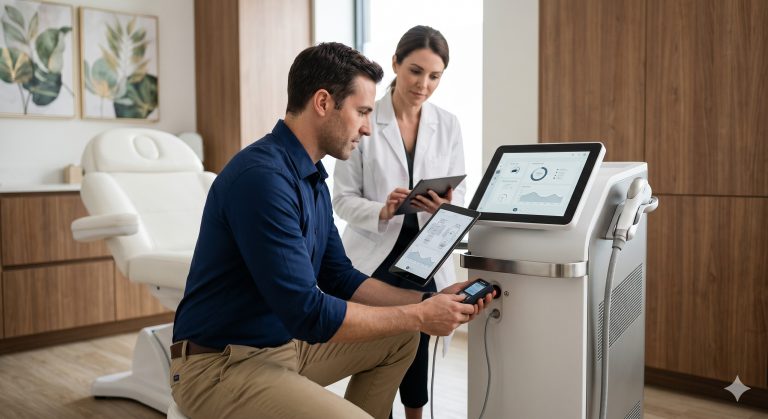
Routine maintenance is required every 6 months or 500 treatment sessions. This includes: cleaning the optical window, checking handpiece motor alignment, recalibrating energy output, and replacing water filters. A certified biomedical engineer can perform this in 90 minutes; in-house nurses cannot. Most B2B suppliers offer a maintenance contract ($1,200-$2,000/year) including one preventive visit and priority phone support.
Q7: What post-sales training is provided for our clinical team?
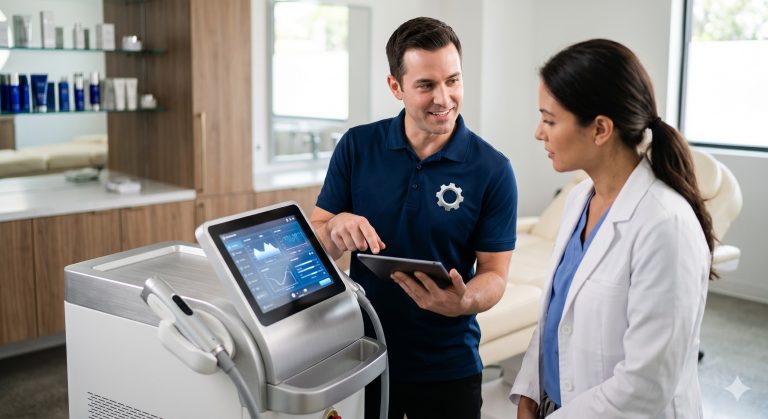
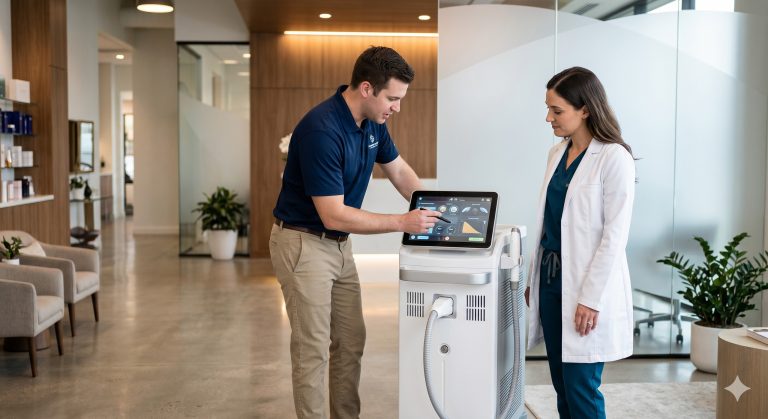
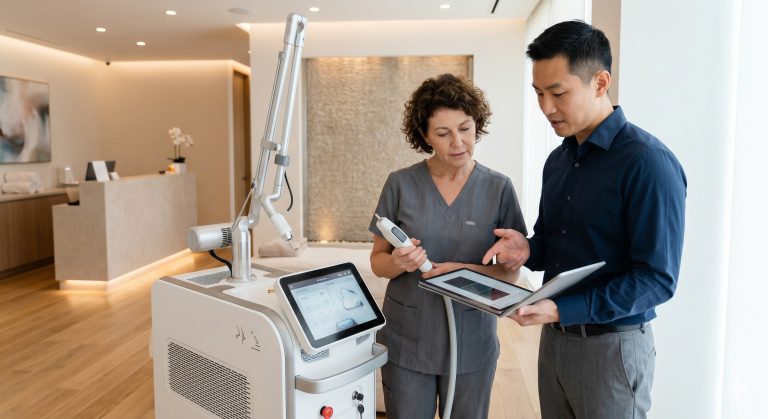
Standard B2B packages include 8 hours of on-site training: 2 hours didactic (skin optics, contraindications, Fitzpatrick protocols), 4 hours live patient demonstration (superficial and deep modes), and 2 hours hands-on supervised treatments. Certification requires 5 successful patient cases. Cloud-based refresher modules and quarterly webinars are often included; advanced scar-pigmentation courses are available for $1,500 per clinician.
Q8: Can the dual fractional thulium laser treat active acne and acne scars?
Yes, it is FDA-cleared for both active acne and atrophic acne scars. For active acne, the 1927 nm wavelength suppresses sebaceous gland activity after 3-4 sessions (30% reduction in sebum output). For rolling/boxcar scars, use deep fractional mode (300 µm penetration) with 30-40% density — improvement typically 50-70% after 3 sessions spaced 6 weeks apart. Combine with topical retinoids for better scar remodeling.
Disclaimer: Always consult the device manual and your clinical protocols. Individual results may vary.