Cost of professional CO2 laser machine FAQ: Expert Answers for Aesthetic Clinics & Dermatologists
Overview
Investing in a professional CO2 laser machine requires understanding not just the initial price tag, but the total cost of ownership. This FAQ addresses the most common pre-sales and post-sales questions from clinic owners and dermatologists—covering skin type suitability, treatment pain levels, machine lifespan, maintenance expenses, and how modern CO2 lasers differ from IPL or older ablative models. Read on for definitive, data-driven answers designed to help you make a confident B2B purchase.
Frequently Asked Questions
Q1: Is a professional CO2 laser machine suitable for all Fitzpatrick skin types?
Yes, modern fractional CO2 laser machines are safe and effective for Fitzpatrick skin types I through VI when operated with appropriate settings. This is achieved through adjustable pulse energy, stacking techniques, and longer pulse durations that minimize post-inflammatory hyperpigmentation risk. For darker skin types (IV-VI), experienced practitioners use lower fluences and increased time between passes. Unlike older fully ablative CO2 lasers, today’s fractional systems leave islands of untreated skin, significantly accelerating healing and reducing adverse event rates across all skin phototypes.
Q2: What is the typical pain level during a CO2 laser treatment?
Most patients describe the sensation as a series of hot pinpricks or a rubber band snapping against the skin, with a pain score of 4-6 out of 10. However, professional clinics always apply topical anesthetic cream (lidocaine 23%/tetracaine 7%) for 45-60 minutes prior to treatment, which reduces discomfort to a mild prickling sensation (2-3/10). For deep ablative or full-face resurfacing, nerve blocks or even light sedation are optional. The machine’s built-in cooling (cryogen or cold air) further minimizes pain. Post-treatment, patients feel a sunburn-like sensation lasting 2-4 hours.
Q3: What is the average lifespan of a professional CO2 laser machine handpiece and tube?
The ceramic CO2 laser tube itself typically lasts 20,000 to 40,000 hours of actual firing time, equivalent to 8-12 years of regular clinic use. The handpiece’s internal optics and scanning mechanism generally require replacement every 3-5 years or after approximately 500-800 treatment sessions. Most manufacturers provide a 12-24 month warranty on the tube and 12 months on the handpiece. With proper maintenance (regular cleaning of optics, using distilled water in the cooling system), the main console can exceed 10 years of operational life, making CO2 lasers one of the longest-lasting investments in aesthetic devices.
Q4: How much do consumables and maintenance cost per year for a CO2 laser machine?
Annual consumables and maintenance for a professional CO2 laser machine typically range from $1,500 to $5,000 USD. The recurring costs include: – Laser tube gas recharge (if refillable): $800-$2,000 every 2-3 years – Handpiece window/focusing lens replacement: $200-$400 annually – Distilled water and cooling system antibacterial filters: $100-$200/year – Annual calibration and preventive maintenance service: $800-$1,500/year – Tip or pattern slide replacements (if applicable): $30-$80 per patient use for disposable tips Fractional handpieces with disposable tips increase consumable costs, while fixed-focus handpieces have lower recurring expenses.
Q5: What is the key difference between a professional CO2 laser machine and IPL (Intense Pulsed Light)?
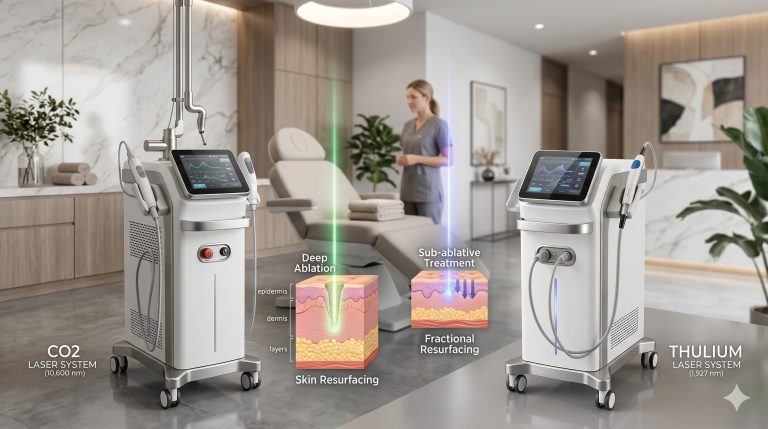
A CO2 laser emits a single, highly focused wavelength of 10,600 nanometers that is strongly absorbed by water in the skin, making it the gold standard for ablative resurfacing, deep wrinkles, and acne scars. IPL delivers a broad spectrum of light (500-1200nm) that targets pigment and hemoglobin, but it cannot vaporize or ablate skin tissue. CO2 lasers penetrate 100-500 micrometers deep and cause controlled thermal injury to stimulate collagen remodeling, requiring 5-14 days of downtime. IPL is non-ablative with zero to minimal downtime but offers only modest results for textural issues and deep scars. For severe photoaging, deep rhytides, and atrophic scars, CO2 lasers are significantly more effective than IPL.
Q6: Does the manufacturer or supplier include training with the purchase of a professional CO2 laser machine?
Yes, 95% of reputable B2B suppliers include on-site or virtual certification training for 2-4 clinical staff as part of the purchase package (typically a $2,000-$5,000 value). Standard training comprises 1-2 days covering: laser physics and safety (ANSI Z136.3 standards), Fitzpatrick skin typing, test spots, parameter selection for different indications (wrinkles, scars, pigmentation), handpiece handling, and emergency protocols. Advanced training on fractional vs. ablative modes, stacking techniques, and combination therapies may be offered at an additional cost. Always verify that training leads to a recognized certificate for insurance and medico-legal compliance. Post-payment, most suppliers also provide unlimited online support and refresher webinars for 12 months.
Q7: What is the total cost of ownership for a professional CO2 laser machine over 5 years?
The total 5-year cost of ownership for a mid-tier fractional CO2 laser machine ranges from $45,000 to $95,000 USD. This includes: – Initial purchase price: $25,000 – $60,000 (entry-level domestic units vs. premium imported systems) – Maintenance & consumables (5 years): $7,500 – $25,000 (see Q4 above) – Training & certification: $2,000 – $6,000 if not included in purchase – Laser safety officer (LSO) fees and annual calibration: $2,500 – $6,000 – Electricity & cooling system operation: $500 – $1,500/year High-usage clinics performing 500+ treatments annually can achieve a cost per session of $15-$30, making ROI positive within 12-18 months. Lower-usage clinics should prioritize lower tube depreciation models or lease options.
Q8: How often does the CO2 laser tube need replacement, and what is the cost?
The CO2 laser tube (the sealed gas chamber) typically needs replacement every 3-7 years depending on usage hours, not calendar time. Replacement cost ranges from $3,500 to $8,000 USD for a new factory-sealed tube (including installation and recalibration). Some manufacturers offer tube exchange programs (send back old tube, receive refurbished or new tube) for $2,000-$4,500. Tubes with a ‘hard seal’ ceramic construction last longer (40,000 hours) than glass tubes (15,000 hours). To minimize tube wear, always perform energy calibration monthly, keep the cooling system at 18-22°C, and avoid unnecessary dry-firing. Many clinics budget a tube replacement as a capital expense in year 4 or 5 of ownership.