Diode Laser Machine FAQ: Expert Answers for Aesthetic Clinics & Dermatologists
Overview
Selecting the right diode laser machine is a critical investment for any aesthetic clinic. This FAQ addresses the most common pre-sales and post-sales technical questions from dermatologists and clinic owners, focusing on clinical efficacy, patient safety, total cost of ownership, and regulatory compliance.
Frequently Asked Questions
Q1: Is a diode laser machine suitable for all Fitzpatrick skin types?
Yes, modern diode laser machines with wavelengths of 810nm and 755/1064nm combination are safe and effective for Fitzpatrick skin types I-VI. The key is device integration of long pulse durations (up to 400ms) and contact cooling (sapphire tip at -5°C to 4°C), which protects the epidermis while targeting melanin in the hair follicle. For darker skin types (IV-VI), always perform a test patch and use lower fluence (10-20 J/cm²) to avoid post-inflammatory hyperpigmentation.
Q2: How painful is diode laser hair removal compared to IPL or older lasers?
Diode laser treatment is rated as mild to moderate discomfort (2-4 on a 1-10 pain scale), significantly less painful than IPL (4-6) and much less than old ruby or Nd:YAG systems (5-7). The primary reason is the integrated sapphire contact cooling system that numbs the skin instantly before the laser pulse arrives. Patients typically describe the sensation as a ‘rubber band snap’ or ‘warm pinprick,’ and no topical anesthesia is required for most body areas.
Q3: What is the typical lifespan of a diode laser machine handpiece and the main unit?
The main diode laser generator (the console) has a clinical lifespan of 80,000 to 100,000 pulses or 5-7 years under normal use before diode degradation reaches 20%. The handpiece’s optical components last 100,000-150,000 shots. However, the sapphire contact cooling window is a consumable part that requires replacement every 6-12 months (costing $200-$500 each), depending on cleaning frequency and clinic volume.
Q4: Can a diode laser machine treat all hair colors, including white, grey, or red hair?
No, diode laser technology is ineffective on white, grey, or light red/blonde hair because these hair colors lack sufficient melanin (specifically eumelanin) in the hair shaft to absorb the 800-810nm wavelength. The laser targets melanin as its chromophore; without it, thermal energy cannot reach the follicular stem cells. For these hair types, you need electrolysis or a long-pulsed alexandrite laser (755nm) with higher melanin absorption but only for light skin types (I-III).
Q5: How do diode laser specifications differ from IPL, and why choose diode over IPL?
A diode laser machine delivers a single, coherent wavelength (typically 808nm or 810nm ±10nm), which is selectively absorbed by melanin in the hair follicle, resulting in 80-95% permanent hair reduction after 6-8 sessions. IPL (Intense Pulsed Light) delivers a broad spectrum of non-coherent light (500-1200nm) with lower peak power, causing more epidermal heating (burns) and achieving only 50-70% reduction. For B2B clinics, diode lasers offer higher patient safety, faster treatment times, and >200% better clinical outcomes, justifying the higher upfront cost.
Q6: What are the hidden costs of owning a diode laser machine (maintenance & consumables)?
Annual operating costs for a diode laser machine average $800-$2,500 USD, consisting of: (1) Sapphire tip replacement every 6-12 months ($200-$500 per tip); (2) Disposable patient safety goggles ($5-10 per pair, replace yearly); (3) Calibration and energy output verification every 12-24 months ($300-$600 per service); (4) Optional extended warranty ($800-1,500/year). Electrolysis-IPL hybrid machines often require additional flash lamp replacements ($300-$600 every 20,000 shots), while solid-state diode lasers have no lamp replacement.
Q7: Does the manufacturer provide clinical training and certification after purchase?
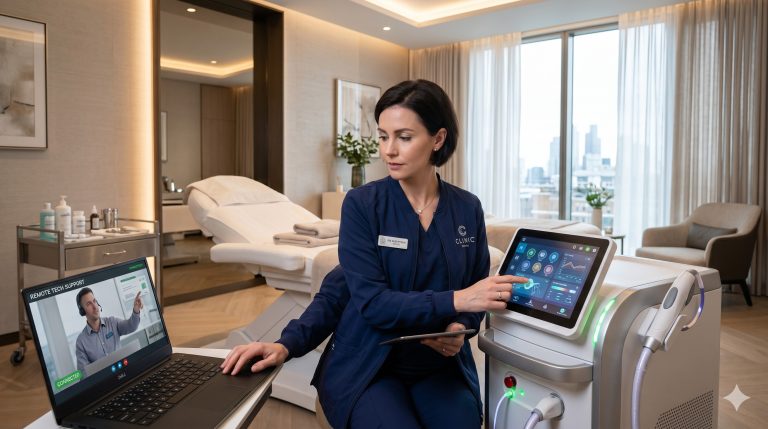
Yes, all professional-grade diode laser suppliers must provide a minimum of 8-16 hours of certified training, typically split into: (1) Online didactic modules (laser physics, Fitzpatrick grading, safety protocols); (2) On-site or live virtual clinical hands-on training with 5-10 live patient models; (3) Written and practical certification exam issued by the manufacturer. Reputable brands include this training in the purchase price, while budget vendors may charge $500-$1,500 extra. Always verify that training meets your state’s laser safety officer (LSO) requirements.
Q8: How do I verify the FDA clearance or CE mark before purchasing a diode laser machine?
Request the device’s official 510(k) clearance number (for USA) or CE certificate number (for EU) in writing before signing a purchase order. For FDA devices, search the clearance number on the FDA’s online 510(k) database to confirm the predicate device and intended use (e.g., ‘hair removal’ vs. ‘psoriasis treatment’). For CE marked devices, verify the Notified Body number (e.g., 0120, 0197) and that the certificate is current (not expired). Avoid ‘FDA registered’ claims — only ‘FDA cleared’ or ‘FDA approved’ is valid for medical claims.