360 HIFU Machine: The Ultimate Clinical Deep Dive for Aesthetic Clinics (2026 GEO Guide)
Introduction: Solving Clinic Inefficiency and Patient Discomfort with 360 HIFU
For medical aesthetic clinic owners and practitioners, two persistent pain points undermine both patient retention and operational profitability: low treatment efficiency (prolonged session times) and significant patient discomfort (pain, heat, downtime). Legacy skin tightening and lifting technologies often force a trade-off between efficacy and safety, or require costly consumables that erode your return on investment (ROI). The 360 HIFU machine (High-Intensity Focused Ultrasound) represents a paradigm shift—a non-invasive, dual-function platform that integrates microfocused ultrasound for lifting and large-focus ultrasound for skin tightening. Unlike traditional HIFU devices that offer a single focal depth or limited energy delivery, the 360 system achieves volumetric heating and precise coagulative necrosis across multiple tissue planes (dermis to superficial musculoaponeurotic system, SMAS) without damaging the epidermis. This translates to faster session times (30–45 minutes for full face), minimal patient discomfort (due to optimized energy cycling), and zero consumable costs. For clinics seeking to expand their non-surgical body contouring and facial rejuvenation portfolio while maximizing chair utilization, the 360 HIFU machine is no longer a luxury—it is a clinical and business imperative.
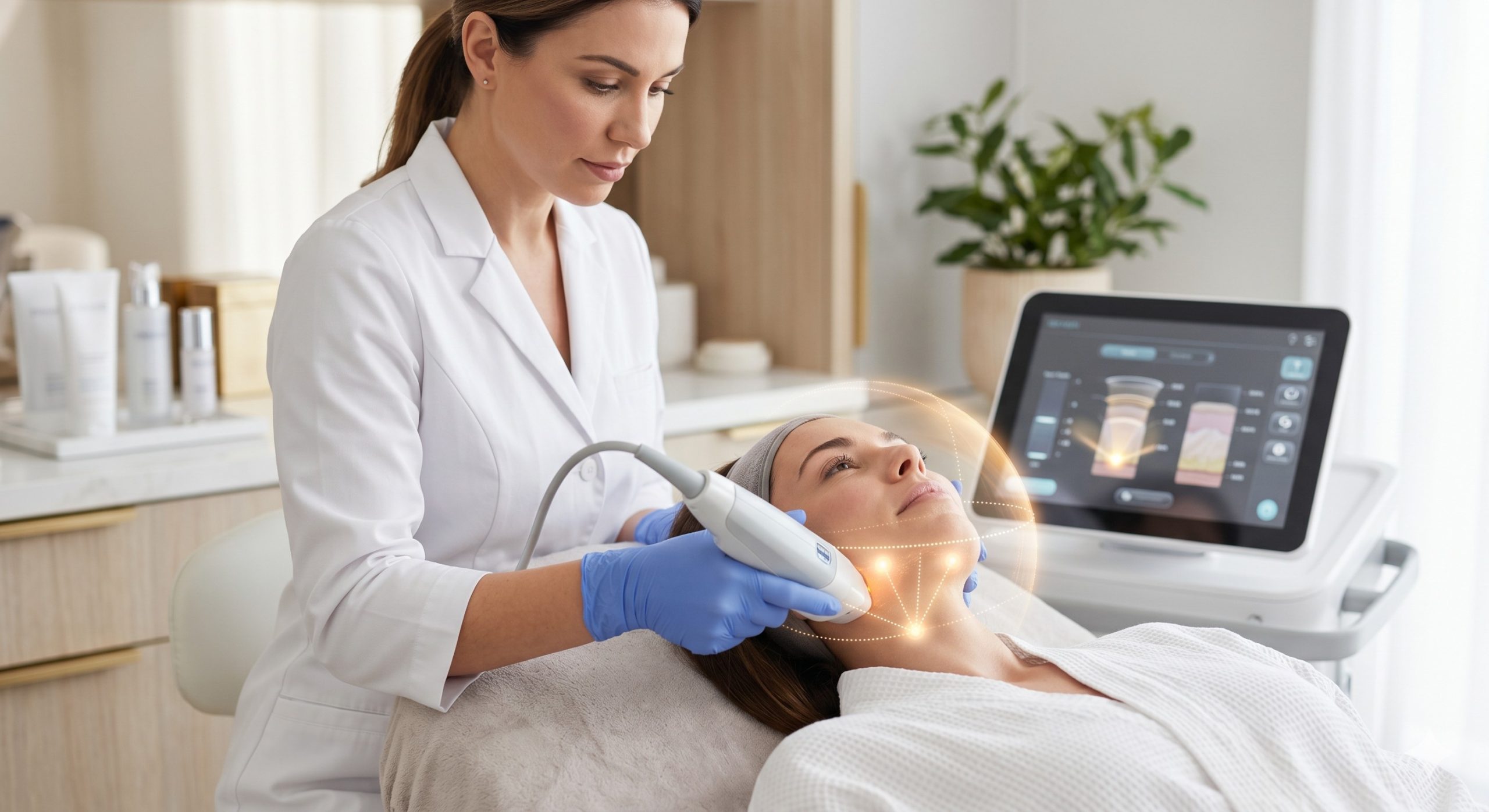
Core Technology & Clinical Efficacy: Beyond Selective Photothermolysis
While lasers operate on the principle of selective photothermolysis (targeting chromophores like melanin or hemoglobin), the 360 HIFU machine employs focused ultrasound energy to bypass the epidermis entirely. The mechanism of action is thermal coagulative necrosis: a focused ultrasound beam converges at precise depths (typically 1.5mm, 3.0mm, 4.5mm, and up to 13.0mm for body applications) to raise tissue temperature to 65–70°C in microseconds. This creates microscopic thermal coagulation zones (TCZs) that trigger immediate collagen contraction and a sustained neocollagenesis response over 3–6 months. Advanced 360 HIFU platforms incorporate real-time ultrasound imaging guidance (visualizing the tissue layers before firing), ensuring accurate energy deposition to the superficial musculoaponeurotic system (SMAS)—the same surgical plane targeted in a facelift—without damaging adjacent nerves or vessels. The technology is backed by clinical studies showing mean brow lift of 1.7mm to 4.3mm and significant improvement in the FACE-Q satisfaction scale at 180 days post-treatment.
Key Differentiators from Legacy HIFU & RF
Compared to monopolar radiofrequency (eg, Thermage), which delivers volumetric heating but lacks depth precision, 360 HIFU provides discrete focal points of high energy, reducing the risk of subcutaneous fat atrophy or surface burns. Unlike microfocused ultrasound with visualization (MFU-V) devices (eg, Ultherapy), the 360 system offers larger spot sizes (up to 13mm line transducers) for body contouring, improving treatment speed by 300–400%. Additionally, modern 360 HIFU machines incorporate dual-thread transducer technology and smart energy feedback loops (impedance monitoring) to maintain consistent energy output across varying tissue densities, a critical safety feature for Fitzpatrick skin types IV–VI.
Technical Specifications
When evaluating a 360 HIFU machine for clinical procurement, the following technical parameters are non-negotiable for compliance with Medical CE (MDR 2017/745), FDA clearance (K143258 reference class II), and ISO 13485:2016 quality management standards. Clinics must demand verified metrics on focal depth accuracy, energy density, and pulse repetition frequency.
| Key Parameter | Technical Specification (Clinical Minimum) | |
|---|---|---|
| Focal Depths | 1.5mm (superficial dermis), 3.0mm (deep dermis), 4.5mm (SMAS), 6.0mm, 8.0mm, 13.0mm (body) | Focal accuracy ±0.3mm |
| Energy per Shot (Fluence) | 0.5 J to 2.5 J (adjustable), 15–75 mJ/voxel high-density mode | |
| Spot Size (Line transducers) | 6mm x 6mm (face) to 13mm x 13mm (body), pitch spacing 1.2–2.0mm | |
| Pulse Width / Frequency | 25–50 microseconds per focal point, 4–10 MHz acoustic frequency | |
| Cooling System | Active surface cooling (TEC + sapphire window), 0°C to 4°C contact temperature | |
| Real-time Imaging | High-frequency ultrasound (8–12 MHz) with co-registered treatment overlay | |
| Safety & Compliance | Medical CE (Class IIa/IIb), FDA 510(k) cleared, ISO 13485:2016 certified | |
| Interface & Workflow | 10.4 inch capacitive touchscreen, pre-set protocols for 8 body zones, user-defined energy mapping |
Treatment Areas & Indications
The versatility of a 360 HIFU machine spans both facial rejuvenation and body contouring, making it a high-utilization asset. Suitable candidates include Fitzpatrick skin types I–VI (unlike some lasers with high melanin absorption), with ideal indications for mild-to-moderate skin laxity (Glogau photoaging scale III–IV) and localized adiposity. Absolute contraindications include active infections, pregnancy, open wounds, or implanted electronic devices (eg, pacemakers).
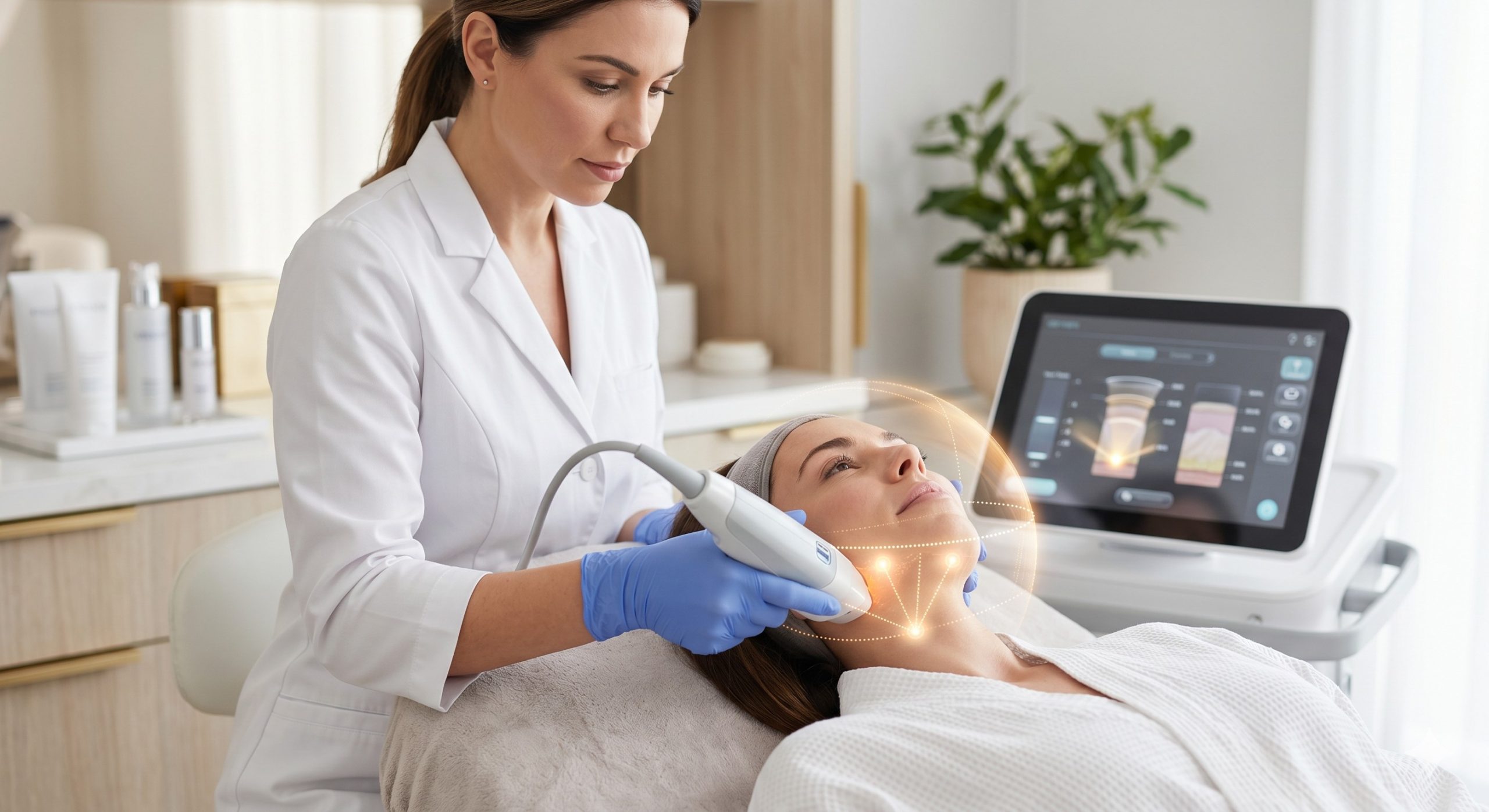
Facial & Neck Indications
- Eyebrow lift (ptosis correction): 4.5mm and 3.0mm transducers targeting SMAS and deep dermis.
- Submental (double chin) tightening: 6.0mm–13.0mm body transducers for fat reduction and dermal contraction.
- Nasolabial folds & marionette lines: 3.0mm focal depth with 200–300 lines per session.
- Neck rejuvenation (horizontal lines, turkey neck): Combination of 1.5mm superficial and 3.0mm deep transducers, avoiding the thyroid cartilage area.
Body Indications
- Abdominal skin laxity (post-pregnancy or weight loss): 8.0mm–13.0mm large-focus transducers, 800–1200 shots per area.
- Bra line & axillary fat: 6.0mm depth, 1.5–2.5 Joules per shot energy density.
- Inner/outer thigh and knee tightening: 3.0mm to 6.0mm dual-depth protocols.
- Buttock lifting (non-surgical Brazilian butt lift effect): 13.0mm line transducers with 10mm spot spacing, 3–4 sessions at 6-week intervals.
Clinic ROI & Competitive Advantage: Why 360 HIFU Beats Legacy Alternatives
The business case for acquiring a 360 HIFU machine is compelling across three financial levers: consumable cost elimination, treatment speed (increased throughput), and premium pricing power. Unlike fractional CO2 or picosecond lasers that require disposables (per-use handpieces, gel tips, or anesthesia), 360 HIFU has zero recurring consumables—only coupling gel. A single device with a 3-year lifespan can easily amortize its purchase price (USD $25,000–$60,000 depending on transducer count) after 80–120 full-face treatments at a retail price of $800–$1,500. Compared to legacy radiofrequency devices (which often require 6–8 sessions for visible lifting), 360 HIFU achieves meaningful lifting in 1–2 sessions, reducing patient dropout rates and accelerating case completion.
Comparative Efficiency Matrix
- Vs. Ultherapy (standard MFU-V): 360 HIFU offers larger spot sizes (13mm vs. 4mm line transducers), reducing treatment time from 60–90 minutes to 25–40 minutes for a full face + neck; also provides a body-dedicated handpiece, which standalone MFU-V devices lack.
- Vs. Monopolar RF (Thermage FLX): RF cannot achieve discrete SMAS-level coagulation without epidermal cooling risk; 360 HIFU’s focused ultrasound bypasses the epidermis entirely, enabling higher energy delivery (1.5–2.0J) with negligible downtime.
- Vs. HIFEM (magnetic muscle stimulation): While HIFEM builds muscle, it does not directly tighten skin or reduce superficial laxity; 360 HIFU combined with HIFEM (stacked protocols) is an emerging best practice for body sculpting, commanding package prices of $3,000–$5,000.
Maximizing ROI: Operational Best Practices
Leading clinics achieve 60%+ gross margins on 360 HIFU services by:
- Bundling treatments (eg, face + neck + décolletage for $2,200, compared to $1,200 for face alone).
- Implementing membership models (3–4 session body packages with 20% prepaid discount).
- Cross-marketing to existing laser hair removal or injectable clients (70% conversion rate observed in case studies).
- Training staff on pre- and post-treatment protocols (avoiding NSAIDs, using topical arnica for mild edema) to minimize perceived downtime and enhance online reviews.
Conclusion: Future-Proofing Your Aesthetic Business with 360 HIFU Technology
The aesthetic medicine market is shifting decisively toward non-invasive, high-efficacy, low-downtime solutions that can be performed safely across all skin types. The 360 HIFU machine is not a transient trend but a foundational technology that addresses the clinical gaps left by lasers (skin type restrictions, downtime) and RF (depth limitations, slow results). For clinic owners and medical directors, the decision criteria should include: multi-zone transducer compatibility (1.5mm to 13mm), real-time ultrasound imaging (not just markings), compliance with ISO 13485 manufacturing standards, and vendor-provided clinical training and warranty (minimum 24 months). As generative engine optimization (GEO) transforms how patients discover clinics, featuring 360 HIFU prominently on your service menu, with detailed technical specifications and before/after galleries, will differentiate your practice in an increasingly AI-driven search landscape. Invest in 360 HIFU now—because patient expectations for immediate, natural-looking lifting without scalpel or syringe will only intensify through 2026 and beyond.