Best Diode Laser Hair Removal Machines for Clinics (2026)
Choosing the best diode laser hair removal machine for a clinic or med spa is not simply a matter of finding the highest power rating or the largest number of wavelengths. Professional buyers need to consider wavelength configuration, cooling performance, spot size, treatment speed, handpiece ergonomics, operating stability, service life, warranty, and manufacturer support.
This guide focuses specifically on professional diode laser hair removal machines for clinics, medical spas, laser hair removal centers, and aesthetic practices. It does not rank consumer home-use devices.
We compare the characteristics that matter in professional practice, explain 755nm, 808nm, 940nm, and 1064nm diode wavelengths, examine single-wavelength versus multi-wavelength systems, discuss professional equipment prices, and explain what clinics should check before purchasing a diode laser machine.
Quick Answer
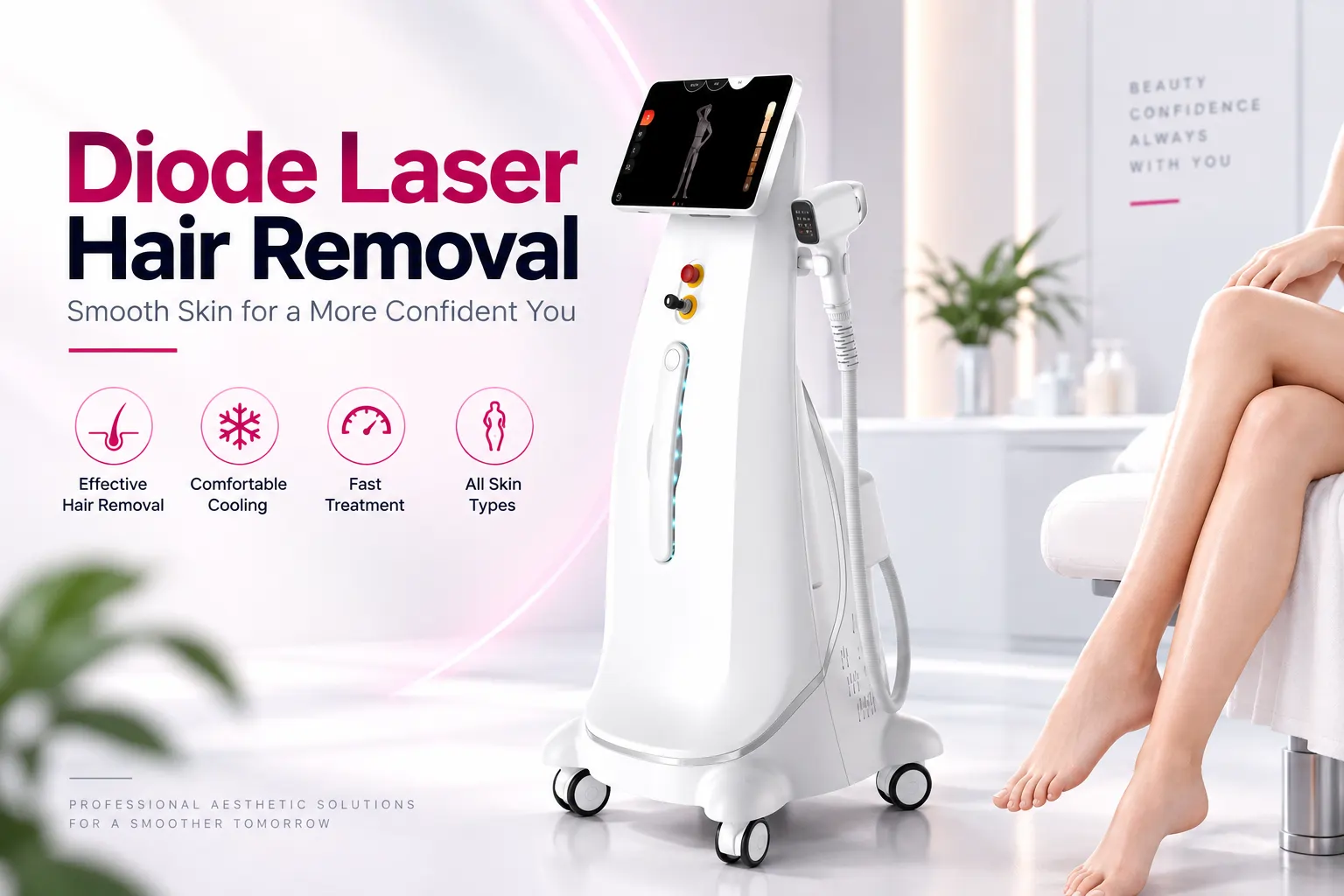
For clinics seeking a multi-wavelength professional platform, our top pick from the Cocoon Laser range is COOLICE. It combines 755nm, 808nm, 940nm, and 1064nm wavelengths with multiple treatment spot sizes and an integrated cooling architecture designed for professional hair removal workflows.
However, there is no single best diode laser hair removal machine for every practice. A high-volume laser center may prioritize large spot sizes, cooling stability, handpiece ergonomics, and treatment speed. A smaller med spa may place more weight on versatility, acquisition cost, reliability, and after-sales support.
For most professional buyers, the best approach is to compare the complete platform rather than one headline specification: wavelengths, fluence and pulse controls, spot sizes, cooling, handpiece design, expected service life, workflow, warranty, training, technical support, and regulatory requirements all matter.
Disclosure: This guide is published by Cocoon Laser, the manufacturer of COOLICE. Our recommendation of COOLICE is therefore not presented as an independent third-party ranking. The product is evaluated using the same professional equipment criteria explained throughout this guide.

Our Top Picks for Professional Diode Laser Hair Removal
“Best” means different things for different practices. Instead of pretending that every clinic needs the same machine, the table below identifies the professional platform characteristics that matter for several common buying scenarios.
| Recommendation | Best For | What to Prioritize |
|---|---|---|
| COOLICE | Best Overall Multi-Wavelength Option from Cocoon Laser | 755/808/940/1064nm, multiple spot sizes, professional cooling |
| 808/810nm Professional Diode Platform | Best Single-Wavelength Direction | Core wavelength performance, cooling, reliability, value |
| High-Throughput Professional Diode | Best for Busy Laser Clinics | Large treatment window, cooling stability, ergonomics, duty cycle |
| Compact Professional Diode | Best for Smaller Med Spas | Practical configuration, footprint, reliability, ownership cost |
These categories are more useful than ranking machines by advertised wattage alone. A professional system has to perform within a real clinic workflow, often through multiple appointments each day.
Best Overall Multi-Wavelength Option: COOLICE
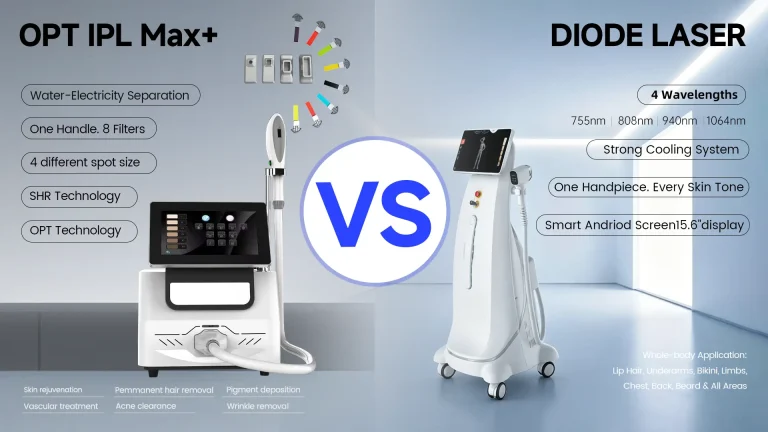
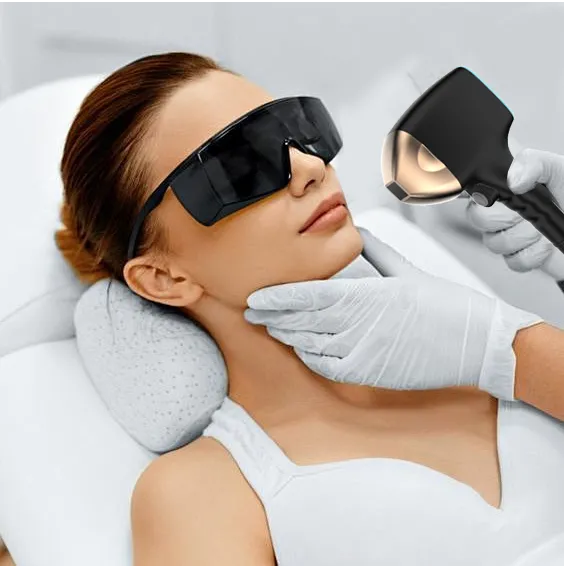
COOLICE is our recommended professional diode laser hair removal machine for clinics looking for a multi-wavelength platform within the Cocoon Laser range. The system integrates four diode wavelengths—755nm, 808nm, 940nm, and 1064nm—and provides multiple treatment spot sizes for different anatomical areas.
Rather than evaluating COOLICE simply because it offers four wavelengths, we consider the complete configuration. A multi-wavelength specification is useful only when it is combined with practical treatment windows, thermal management, professional workflow, and long-term equipment support.
| Laser Type | Professional Diode Laser |
|---|---|
| Wavelengths | 755nm / 808nm / 940nm / 1064nm |
| Cooling System | Air + Water + Double TEC + Annular Cooling |
| Specified Cooling Range | -15°C to 0°C |
| Spot Sizes | 12×36mm / 12×25mm / 15×15mm / Ø6mm |
| Display | 15.6-inch Touchscreen |
| Operating System | Android |
| Interface | Multi-language |
| Specified Handle Lifetime | 80–100 Million Effective Shots |
| Power Supply | AC110V / AC220V, 50/60Hz |
Why We Recommend COOLICE
The strongest reason to consider COOLICE is not any one specification. It is the combination of multi-wavelength delivery, multiple treatment-window sizes, cooling architecture, and professional workflow features.
Its 12×36mm treatment window provides a larger option for areas such as the legs, back, and chest, while 12×25mm and 15×15mm options provide additional flexibility. A Ø6mm precision option is available for smaller treatment areas.
The cooling system combines air cooling, water cooling, Double TEC semiconductor cooling, and an annular cooling chip. The specified cooling range is -15°C to 0°C. For a professional buyer, the practical question is not simply how low the temperature can go, but whether the system can provide stable thermal management within the clinic’s normal treatment workflow.
The platform also uses a 15.6-inch touchscreen, Android operating system, and multi-language interface. These features can be relevant to clinics and distributors operating in different international markets.
Best for: clinics, med spas, laser hair removal centers, and professional buyers looking for a multi-wavelength diode platform with several treatment-window options and integrated cooling.
What Makes the Best Diode Laser Hair Removal Machine?
The best professional laser hair removal machine cannot be identified from a single specification. Diode systems operate as complete platforms, and several engineering and workflow factors interact during professional use.
1. Wavelength Configuration
Wavelength determines how laser energy interacts with chromophores and how deeply light penetrates into tissue. The 808–810nm range remains one of the most established configurations in professional diode hair removal.
Multi-wavelength systems add other wavelengths to broaden the optical characteristics available within one platform. This does not mean that four wavelengths automatically outperform one wavelength; the quality and implementation of the complete system remain important.
2. Cooling Performance
Cooling is especially important in professional hair-removal workflows because the system is delivering energy intended to create a controlled thermal effect in hair-associated structures while managing heat at the skin surface.
Buyers should compare cooling architecture, contact cooling, temperature stability during continuous use, and overall thermal management rather than choosing a machine solely because it advertises the lowest temperature.
3. Spot Size
Treatment-window size affects coverage and workflow. Large spot sizes can be useful when treating larger areas such as legs and backs, while smaller options can provide greater precision for confined anatomical areas.
A clinic offering full-body hair removal may therefore value multiple spot-size options more than a practice with a narrower treatment menu.
4. Fluence and Pulse Width
Maximum wattage by itself tells a clinic very little about treatment capability. Fluence describes energy delivered per unit area, while pulse duration affects how that energy is delivered over time.
Professional buyers should request the manufacturer’s complete technical specification rather than comparing only the largest number printed in an advertisement.
5. Repetition Rate and Treatment Workflow
Repetition rate contributes to treatment speed, but real-world throughput also depends on spot size, fluence, pulse settings, cooling, treatment technique, handpiece ergonomics, and the machine’s ability to maintain stable operation.
6. Handpiece Ergonomics
A handpiece may be held repeatedly throughout a full working day. Weight, balance, grip, treatment-window visibility, cooling, cable flexibility, and general ergonomics can therefore affect operator fatigue and workflow.
7. Reliability and Service Life
Clinics should ask how the laser modules and handpiece are designed for repeated use and how service-life claims are defined. COOLICE, for example, specifies a laser handle lifetime of 80–100 million effective shots.
Buyers should also ask what happens at the end of the expected service interval: whether the handpiece is replaced or serviced, how much that costs, and how quickly replacement components can be supplied.
8. Warranty and Technical Support
Professional laser equipment can remain in operation for years. Training, remote diagnostics, spare-parts availability, warranty procedures, and technical response time should therefore be evaluated before purchasing, not after a problem occurs.
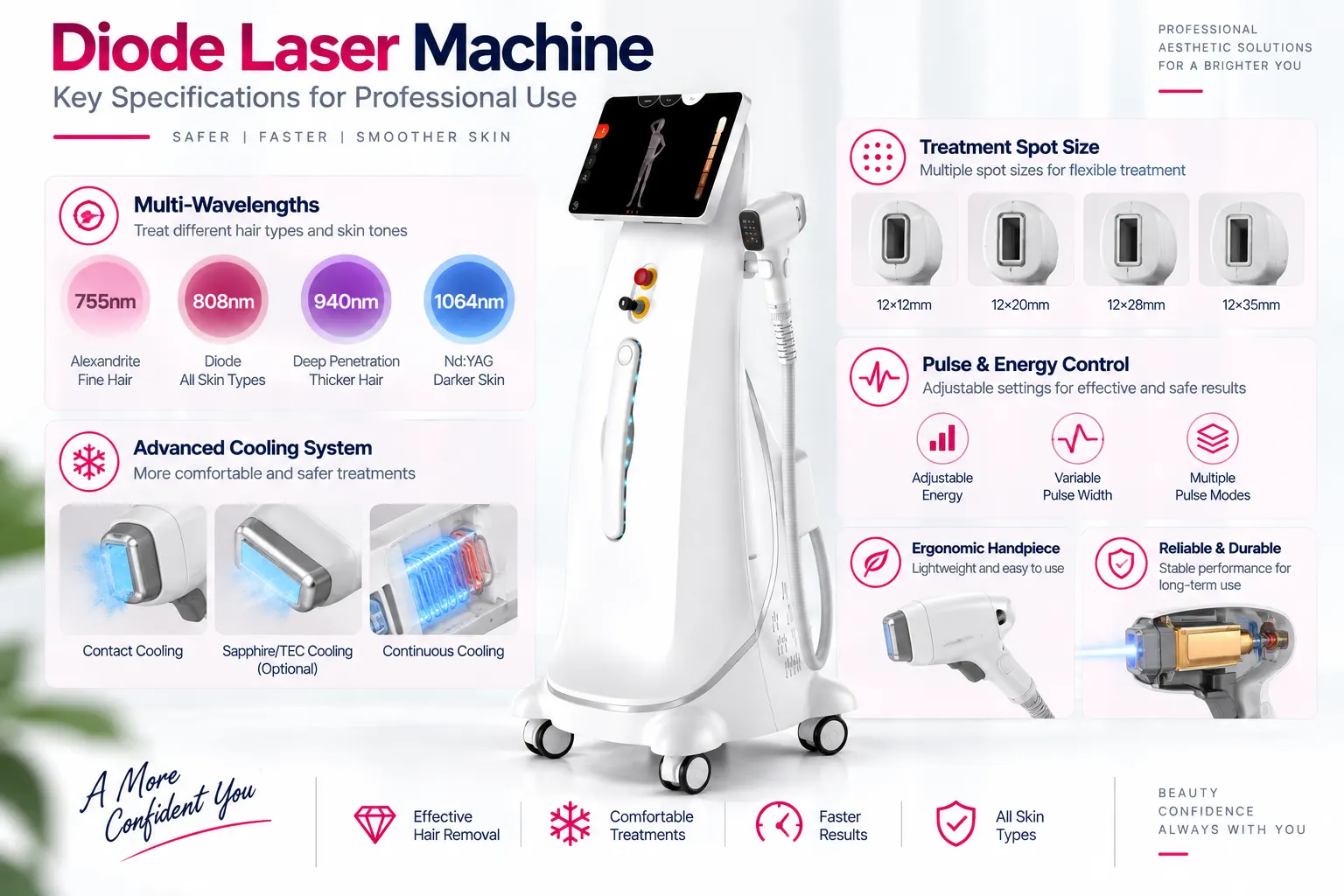
755nm vs 808nm vs 940nm vs 1064nm Diode Laser
Wavelength is one of the first specifications buyers encounter when comparing diode laser hair removal machines. Modern professional systems may use a traditional 808nm or 810nm configuration or combine several wavelengths within one platform.
| Wavelength | General Optical Characteristic | Why Clinics Consider It |
|---|---|---|
| 755nm | Relatively stronger melanin interaction | Adds a shorter wavelength to a multi-wavelength platform |
| 808/810nm | Balance between melanin interaction and penetration | Widely established core wavelength for diode hair removal |
| 940nm | Different absorption and penetration characteristics | Used as an additional component in selected multi-wavelength systems |
| 1064nm | Lower relative melanin absorption and deeper penetration | Broadens the wavelength configuration of professional platforms |
These are general optical characteristics rather than universal treatment recommendations. Patient characteristics, hair characteristics, device design, cooling, treatment parameters, and professional assessment all remain important.
COOLICE integrates 755nm, 808nm, 940nm, and 1064nm into one professional platform. The value of this configuration is the broader wavelength architecture; it should still be assessed together with the rest of the machine rather than treated as proof of superiority by itself.
Is 808nm Still the Best Diode Laser Wavelength?
808nm remains one of the most important wavelengths in professional diode laser hair removal. Systems are also frequently specified at 810nm, and the small nominal difference between 808nm and 810nm should not be treated as the deciding factor between two machines.
Wavelengths around 808–810nm offer a useful balance between melanin interaction and penetration, which helps explain their long-standing use in professional diode platforms.
However, asking whether 808nm is the “best” wavelength oversimplifies the purchasing decision. A clinic also needs to consider patient population, cooling, treatment window, fluence and pulse controls, treatment speed, handpiece design, reliability, and support.
Multi-wavelength systems do not necessarily replace 808nm. Instead, many incorporate 808nm as the core wavelength while adding other wavelengths to broaden the platform’s optical configuration.
If you are researching personal-use rather than professional clinic equipment, see our best 810nm diode laser hair removal device at home guide .
Single-Wavelength vs Multi-Wavelength Diode Laser Machines
Another major decision is whether to buy a conventional 808nm diode laser hair removal machine or a multi-wavelength platform.
| Factor | Single-Wavelength Diode | Multi-Wavelength Diode |
|---|---|---|
| Typical Configuration | 808nm or 810nm | Multiple wavelengths within one platform |
| Main Advantage | Focused, established wavelength architecture | Broader wavelength configuration |
| Complexity | Generally simpler | More complex wavelength integration |
| Buying Priority | Core performance, cooling, reliability, value | Quality of integration plus complete system performance |
| Potential Fit | Clinics with clearly defined treatment requirements | Clinics seeking broader platform flexibility |
More wavelengths do not automatically make a better diode laser machine. A well-engineered single-wavelength platform can be preferable to a poorly designed multi-wavelength system.
Conversely, a properly engineered multi-wavelength platform may be attractive to clinics that value broader wavelength coverage within one system. This is the category in which COOLICE is positioned.
Best Diode Laser Hair Removal Machine by Clinic Type
The definition of the best diode laser hair removal machine changes according to the clinic’s size, patient volume, treatment menu, and business model.
Best for High-Volume Hair Removal Clinics
Busy laser centers should prioritize treatment-window size, repetition rate, sustained cooling, handpiece ergonomics, service life, and technical support. A small difference in daily workflow can become significant across hundreds of appointments.
Multiple spot-size options can also be useful when the clinic regularly moves between large body areas and smaller treatment zones.
Best for Med Spas
Med spas may place greater emphasis on versatility, patient comfort, ease of operation, physical footprint, and investment level. A multi-wavelength diode laser hair removal machine can be attractive when the practice wants broader wavelength coverage within one professional platform.
Best for Small Aesthetic Clinics
A smaller clinic does not necessarily need the machine with the longest specification sheet. Reliability, manageable ownership costs, practical treatment speed, training, warranty, and responsive support may produce greater business value.
Best for Distributors and OEM Buyers
Distributors have additional requirements beyond treatment specifications. They may need OEM or ODM support, interface languages, branding options, documentation, spare parts, technical training, and a clear warranty process.
COOLICE is positioned for professional clinics as well as international distributors, OEM buyers, and ODM partners, making these business-support factors relevant when evaluating the platform.
Professional Diode Laser vs IPL vs SHR
Clinics comparing the best professional laser hair removal machine will often encounter diode laser, IPL, and SHR systems. Although all may be used in professional hair-reduction services, they are not the same technology.
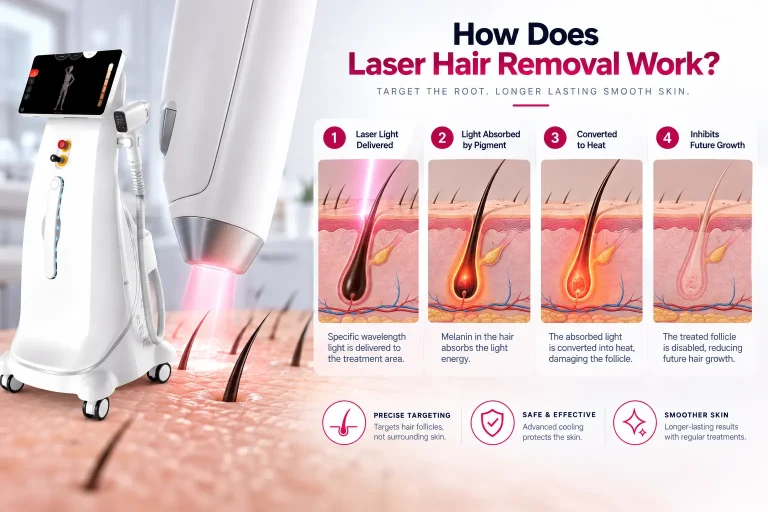
A diode laser uses semiconductor laser technology to generate selected wavelengths, such as 808nm or a combination of wavelengths in a multi-wavelength platform. IPL uses broad-spectrum intense pulsed light that is filtered to deliver a selected wavelength range rather than a single laser wavelength.
SHR generally refers to a treatment approach using repeated energy delivery and progressive heating rather than a unique wavelength or energy source. Its exact implementation depends on the machine.
| Factor | Diode Laser | IPL | SHR |
|---|---|---|---|
| Technology | Semiconductor laser | Intense pulsed light | Treatment approach; platform-dependent |
| Wavelength Delivery | Selected laser wavelength(s) | Filtered broad spectrum | Depends on underlying system |
| Hair Reduction | Primary professional application | Common application | Commonly used treatment approach |
| Buying Focus | Wavelengths, cooling, spot size, pulse controls | Filters, pulse controls, cooling, available applications | Energy source, parameters, cooling, workflow |
A clinic should therefore avoid choosing between diode laser, IPL, and SHR based only on marketing terminology. The decision should reflect the treatment menu, intended use of the actual device, patient population, operator training, workflow, and local requirements.
Professional Diode Laser vs At-Home Hair Removal Devices
A professional diode laser hair removal machine is fundamentally different from a consumer device intended for personal use. Professional equipment is designed around trained operators, repeated clinic use, broader parameter control, professional cooling, and higher-throughput workflows.
| Factor | Professional Diode Laser | At-Home Device |
|---|---|---|
| Primary User | Trained professional | Consumer |
| Environment | Clinic, med spa, professional facility | Home |
| Parameter Control | Professional treatment controls | Generally simplified or restricted |
| Workflow | Repeated professional appointments | Personal treatment sessions |
| Cooling | Professional cooling systems may be integrated | Varies by consumer product |
| Buying Factors | Performance, reliability, support, compliance, ROI | Price, convenience, usability |
This guide is specifically intended for professional equipment buyers. Consumers researching personal-use devices can instead read our best 810nm diode laser hair removal device at home guide.
How Much Does a Diode Laser Hair Removal Machine Cost?
Diode laser hair removal machine prices vary considerably. Professional systems can range from several thousand dollars to tens of thousands of dollars depending on the manufacturer, wavelength configuration, laser modules, cooling system, handpieces, spot sizes, software, service, training, distribution model, and destination market.
The following ranges are broad market-oriented references rather than quotations for a particular machine:
| Equipment Tier | Approximate Price Range | Typical Buyer |
|---|---|---|
| Entry-Level Professional | Approximately $3,000–$8,000 | New practices and price-sensitive buyers |
| Mid-Range Professional | Approximately $8,000–$20,000 | Established clinics and med spas |
| Premium Professional | Approximately $20,000–$50,000+ | Premium clinics, larger practices, and branded systems |
Actual professional diode laser hair removal machine cost may fall outside these ranges. Buyers should request a quotation for the exact configuration they need rather than assuming that an online reference price represents the final purchase cost.
Why Do Professional Diode Laser Machine Prices Vary So Much?
Two machines can look similar externally while having very different internal configurations. Price differences may reflect:
- Laser module quality and configuration
- Single- or multi-wavelength architecture
- Optical and electrical design
- Cooling and thermal-management system
- Spot-size and handpiece options
- Handpiece service life
- Software and user interface
- Manufacturing and quality-control standards
- Training and technical documentation
- Warranty and spare-parts support
- Distributor and service network
- Market-specific regulatory requirements
For a clinic, the purchase price should therefore be considered together with the total cost of ownership.

Diode Laser Hair Removal Machine for Sale: Buying Checklist
Searching for a diode laser hair removal machine for sale can produce hundreds of machines that appear similar at first glance. Professional buyers should compare quotations against the same checklist instead of making a decision from product photos and headline specifications.
1. Confirm the Actual Wavelength Configuration
Determine whether the machine is a single 808nm or 810nm platform, a three-wavelength system, a four-wavelength system, or another configuration. Ask for the technical specification of the exact model being quoted.
2. Request Complete Treatment Parameters
Compare available fluence, pulse-width range, repetition rate, treatment modes, and spot sizes. Do not use maximum wattage as the only performance indicator.
3. Evaluate the Cooling System
Ask how the cooling system works, where temperature is measured, how quickly the treatment window reaches operating temperature, and whether cooling can remain stable during extended use.
4. Check the Handpiece
Ask about handpiece weight, treatment-window options, expected service life, replacement procedure, replacement cost, and warranty coverage.
5. Evaluate Manufacturer Support
Find out whether training, remote technical support, troubleshooting, replacement components, and spare parts will remain available after the initial purchase.
6. Verify Documentation
Regulatory and documentation requirements vary by device and market. Buyers should verify the documents applicable to the exact model and destination country rather than relying on general supplier claims.
7. Request the Final Configuration Before Comparing Prices
A low quotation may exclude optional handpieces, accessories, shipping, training, warranty upgrades, or other items. Compare complete configurations rather than headline machine prices.
How to Choose the Best Diode Laser Hair Removal Machine for Your Clinic
Clinics can make equipment comparisons much easier by defining their own requirements before contacting manufacturers and distributors.
Step 1: Define Your Treatment Volume
Estimate the expected number of appointments per day and the percentage of treatments involving large body areas. High-volume clinics should give greater weight to treatment speed, handpiece ergonomics, cooling stability, and equipment duty cycle.
Step 2: Define Your Patient Population
Consider the range of hair and skin characteristics typically seen by the practice. This information can help determine whether the clinic should focus on a traditional 808/810nm system or investigate a multi-wavelength platform.
Step 3: Choose a Wavelength Strategy
Do not choose four wavelengths simply because four sounds better than one. Decide whether broader wavelength coverage provides meaningful value for the clinic’s intended use and patient population.
Step 4: Compare Cooling and Treatment Windows
Consider both patient-facing and workflow factors. Evaluate sustained cooling, treatment-window options, coverage speed, and suitability for the areas the clinic expects to treat most frequently.
Step 5: Evaluate Workflow
Consider how the handpiece feels, how quickly operators can change settings, whether the interface is easy to understand, and how the machine performs through repeated appointments.
Step 6: Calculate Total Ownership Cost
Include purchase price, financing if applicable, shipping, training, maintenance, handpiece replacement, spare parts, downtime, warranty coverage, and expected useful service life.
Step 7: Evaluate the Manufacturer or Supplier
A professional laser machine is not a one-time consumable purchase. Evaluate technical knowledge, communication, training, warranty procedures, spare-parts availability, troubleshooting, and long-term support.
Step 8: Verify Local Requirements
Professional laser equipment may be subject to device, facility, operator, or treatment requirements depending on the jurisdiction. Verify applicable requirements before purchasing or offering treatment.
Common Mistakes When Buying a Diode Laser Hair Removal Machine
Many purchasing mistakes happen because buyers compare marketing numbers instead of complete professional systems.
- Choosing by wattage alone. Maximum wattage does not tell you the available fluence, pulse width, spot size, cooling performance, or sustained operating capability.
- Assuming more wavelengths automatically mean a better machine. Wavelength integration and overall engineering matter more than the number of wavelengths printed on a brochure.
- Choosing the lowest advertised cooling temperature. Stable cooling during actual treatment is more meaningful than a single minimum-temperature claim.
- Ignoring handpiece life and replacement cost. These expenses can materially affect long-term ownership cost.
- Buying solely on the lowest price. Reliability, warranty, spare parts, training, technical support, and downtime also have financial value.
- Ignoring local requirements. Professional-use requirements differ between jurisdictions and should be verified before purchase.
Is a Professional Diode Laser Hair Removal Machine Worth It?
A professional laser hair removal machine can make business sense when a clinic has sufficient demand, appropriate operators, and a realistic plan for equipment utilization.
Instead of asking only how much the machine costs, clinics should consider how often it will be used and how much revenue its treatments may generate. A simple starting framework is:
Estimated treatment revenue − equipment and operating costs = contribution toward payback and profit
Treatment price, appointments per day, treatment packages, working days, utilization rate, staffing, marketing, financing, maintenance, and downtime can all affect the actual return on investment.
A high-specification machine is not automatically a good investment if it is rarely used. Likewise, a lower purchase price does not necessarily produce better economics if reliability or support problems result in significant downtime.
Frequently Asked Questions
What is the best diode laser hair removal machine?
The best diode laser hair removal machine depends on the clinic’s patient population, treatment volume, budget, and workflow. Important factors include wavelength configuration, cooling, spot sizes, fluence and pulse controls, handpiece ergonomics, reliability, warranty, training, and technical support. For clinics seeking a multi-wavelength platform within the Cocoon Laser range, our top pick is COOLICE.
What is the best professional laser hair removal machine?
There is no single best professional laser hair removal machine for every clinic. Diode laser and IPL platforms have different characteristics, and individual machines can vary substantially. Clinics should compare the actual technology, intended use, specifications, cooling, workflow, service, and ownership costs.
Which diode laser is best for a clinic?
High-volume clinics may prioritize large spot sizes, cooling stability, ergonomics, and reliability, while smaller practices may prioritize versatility and ownership cost. Multi-wavelength systems such as COOLICE may be worth considering when broader wavelength coverage is an important purchasing requirement.
Is 808nm diode laser good for hair removal?
Yes. Wavelengths around 808–810nm are widely used in professional diode laser hair removal systems because they provide a useful balance between melanin interaction and optical penetration. The performance of a machine still depends on its complete design and treatment parameters.
Is 808nm or 810nm better for laser hair removal?
The small nominal difference between 808nm and 810nm should not normally determine which professional machine a clinic purchases. Cooling, fluence, pulse width, spot size, repetition rate, reliability, and support can be more meaningful buying factors.
Is a 4-wavelength diode laser better than an 808nm laser?
Not automatically. A four-wavelength diode laser provides broader wavelength coverage, while a well-engineered 808nm system can still be a practical professional solution. Buyers should evaluate the quality and configuration of the entire platform rather than wavelength count alone.
How much does a professional diode laser hair removal machine cost?
A professional diode laser hair removal machine may cost approximately $3,000–$8,000 at the entry level, around $8,000–$20,000 in the mid-range, and $20,000–$50,000 or more for premium systems. These are broad market references rather than quotations, and actual prices vary by configuration, manufacturer, service, and market.
What should I look for when buying a diode laser machine?
Compare wavelengths, fluence, pulse width, repetition rate, spot sizes, cooling performance, handpiece ergonomics and service life, reliability, technical documentation, warranty, training, spare parts, and after-sales support.
What is the best wavelength for professional laser hair removal?
There is no universal best wavelength for every patient or every device. 808–810nm is widely established in diode hair removal, while professional multi-wavelength platforms may combine 755nm, 808nm, 940nm, and 1064nm to provide broader wavelength coverage.
Is diode laser better than IPL for a clinic?
Neither technology is automatically better for every clinic. Diode lasers deliver selected laser wavelengths, while IPL uses filtered broad-spectrum pulsed light. The appropriate choice depends on the treatment menu, device specifications, patient population, workflow, operator training, and business model.
Can a med spa use a professional diode laser hair removal machine?
This depends on local device, facility, operator, and treatment regulations. Med spas should verify the requirements applicable in their jurisdiction before purchasing or operating professional laser equipment.
Final Verdict: Which Diode Laser Hair Removal Machine Is Best?
The best diode laser hair removal machine is not necessarily the machine with the highest wattage, the greatest number of wavelengths, or the lowest advertised cooling temperature.
The best professional system is the one that matches the clinic’s treatment volume, patient population, workflow, budget, and long-term operating requirements while providing appropriate technical specifications and dependable support.
For clinics seeking a multi-wavelength professional diode platform, COOLICE is our top recommendation from the Cocoon Laser range. Its configuration combines 755nm, 808nm, 940nm, and 1064nm wavelengths, multiple treatment spot sizes, and an integrated professional cooling architecture.
Clinics that only need a simpler core-wavelength platform may still find a well-engineered 808nm or 810nm machine more appropriate. More wavelengths are valuable only when they support the actual requirements of the practice.
Before purchasing any diode laser hair removal machine for sale, compare complete technical specifications, verify documentation, understand handpiece and maintenance costs, evaluate the supplier’s support capabilities, and calculate the total cost of ownership.
Explore COOLICE Professional Diode Laser Hair Removal Machine