HIFU Facial Treatment: Benefits, Results, Skin Tightening & Safety
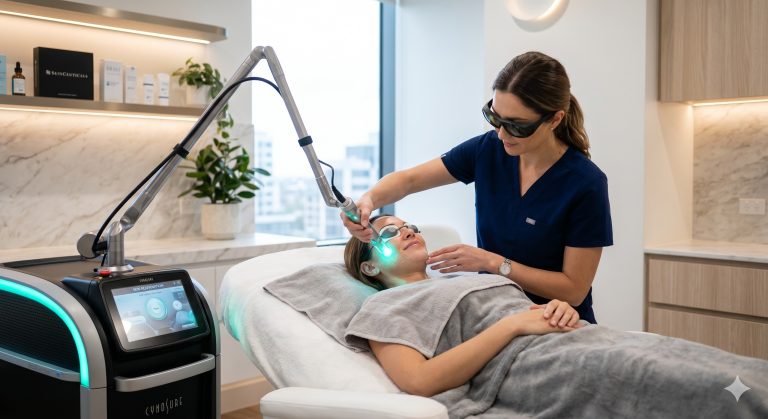
A HIFU facial is a non-surgical aesthetic treatment that uses high-intensity focused ultrasound energy to deliver controlled thermal energy beneath the skin surface. Rather than removing or resurfacing the outer layer of skin, HIFU targets selected tissue depths to stimulate a wound-healing and collagen-remodeling response.
A professional HIFU facial treatment is commonly used for facial skin tightening, improving the appearance of mild skin laxity, defining the jawline and supporting a more lifted appearance of the face and neck. Different treatment cartridges can focus ultrasound energy at different depths according to the treatment area and intended tissue target.
However, HIFU is not the same as a surgical facelift, and results vary according to age, skin condition, degree of laxity, treatment parameters and individual tissue response. Understanding what HIFU can—and cannot—do is important before deciding whether it is the right facial treatment.
Quick Answer: What Is a HIFU Facial Treatment?
A HIFU facial treatment uses high-intensity focused ultrasound to deliver controlled energy beneath the skin, stimulating collagen remodeling and producing gradual skin-tightening and lifting effects without surgical incisions.
A HIFU treatment for face may be used on areas such as the jawline, jowls, cheeks, brow, under-chin area and neck. Professional systems typically use different treatment depths so ultrasound energy can be focused within selected tissue layers while minimizing disruption to the skin surface.
HIFU does not normally create an instant surgical-style lift. Some tightening may become noticeable earlier, but collagen remodeling develops progressively over the following weeks and months.
HIFU is therefore best understood as a non-surgical skin-tightening and facial lifting treatment, not a replacement for surgery in people with substantial skin laxity.
What Is a HIFU Facial?
HIFU stands for High-Intensity Focused Ultrasound. A HIFU facial applies this focused ultrasound technology to aesthetic treatment of the face and surrounding areas.
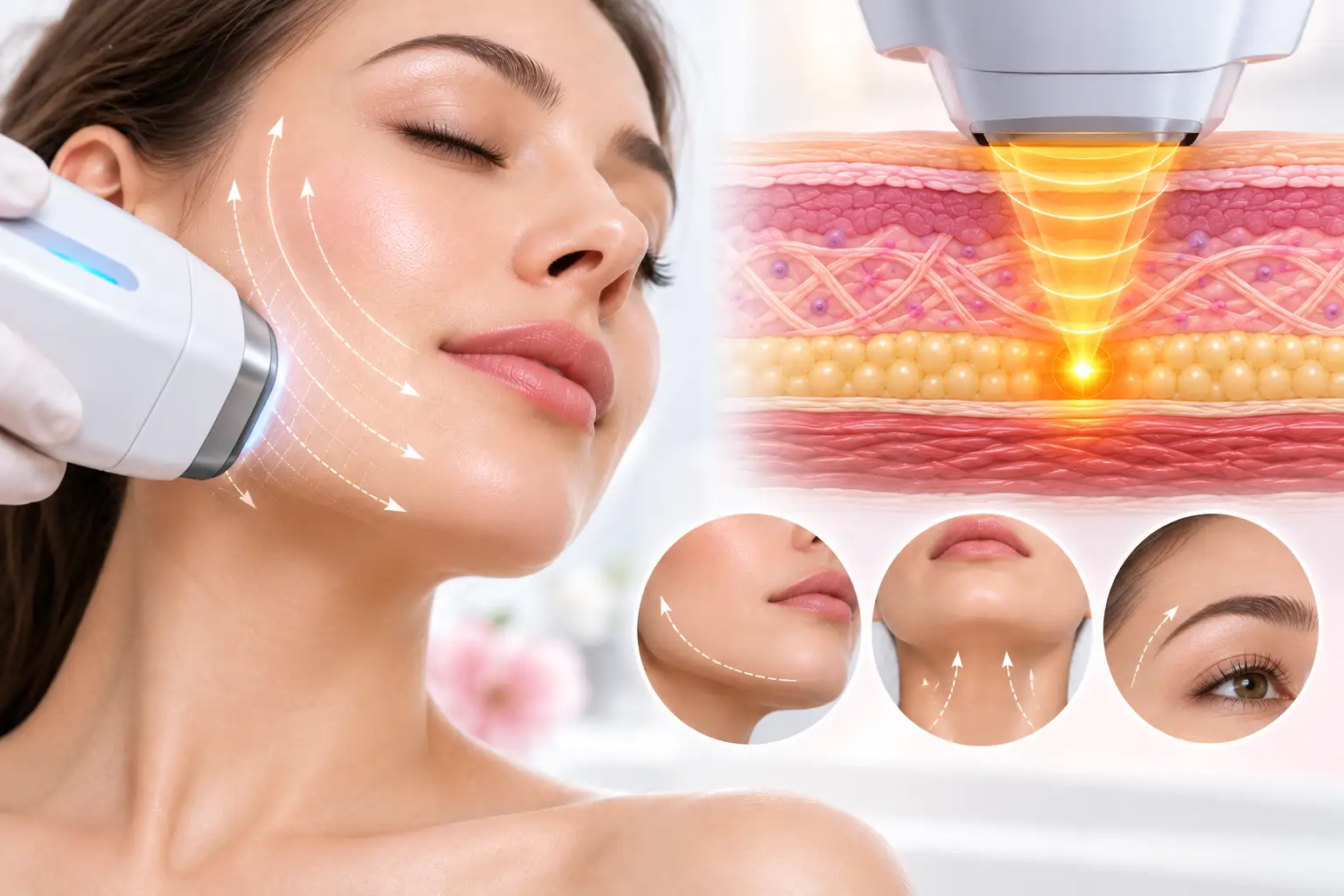
Unlike technologies that primarily act at or near the skin surface, focused ultrasound can concentrate energy at predetermined depths beneath the surface. At the focal point, absorbed acoustic energy produces localized heating within a small treatment zone.
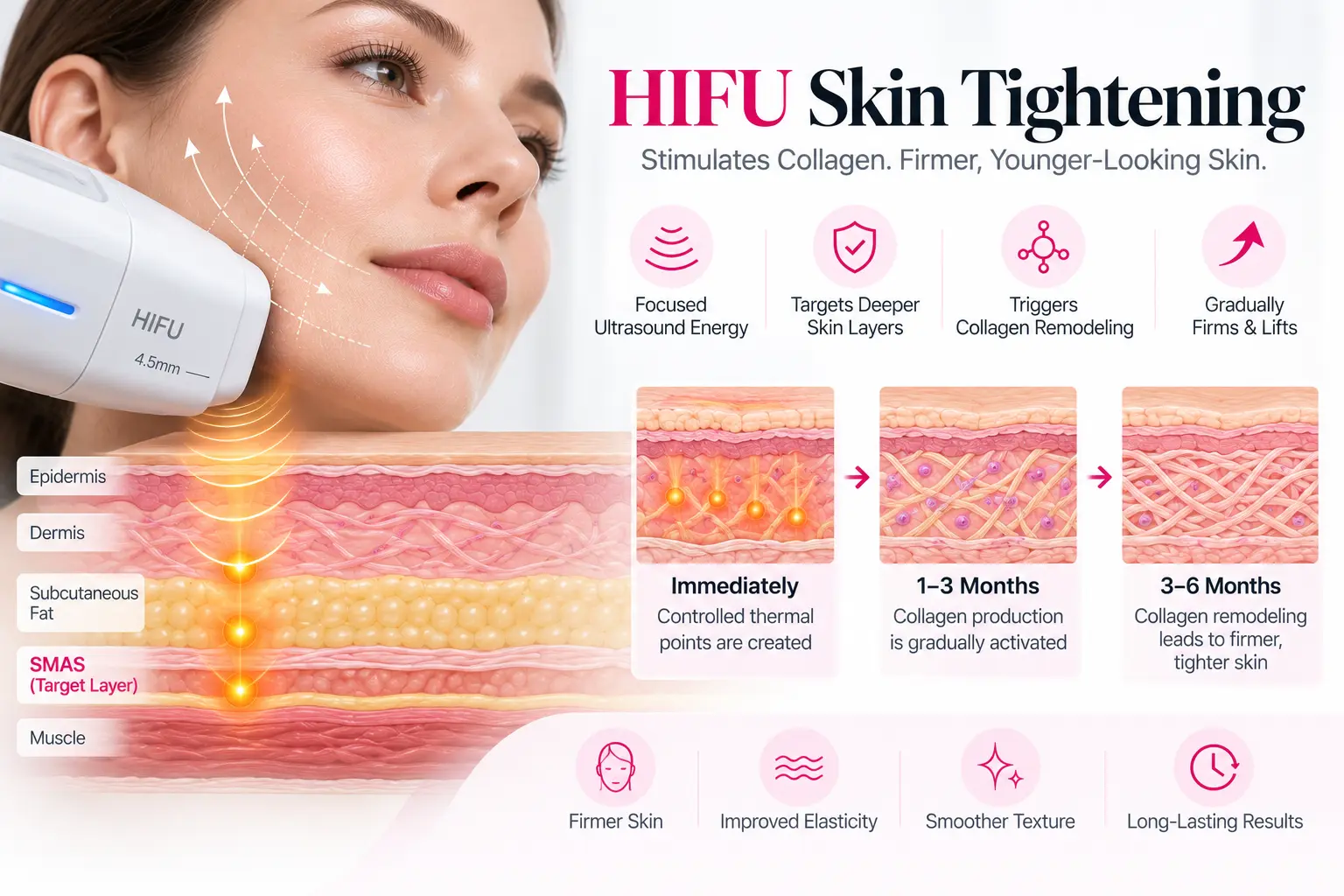
These controlled thermal zones initiate a biological repair response that can contribute to collagen contraction, new collagen formation and longer-term tissue remodeling.
This is why terms such as HIFU therapy face, HIFU therapy for face, HIFU face treatment and HIFU skin tightening often refer to closely related aesthetic applications of focused ultrasound technology.
HIFU also has medical applications outside aesthetics. However, aesthetic facial HIFU should not be confused with focused-ultrasound procedures used for medical conditions. The treatment goals, equipment, energy delivery and clinical protocols can be very different.
How Does HIFU Facial Treatment Work?
The central principle behind a HIFU facial treatment is focusing acoustic energy below the skin rather than heating the entire path through which the ultrasound travels.
The treatment handpiece delivers ultrasound energy into the tissue. The energy converges at a selected focal depth, where it produces small, controlled thermal coagulation points. Multiple treatment lines or focal points can be placed across the planned treatment area.
This creates a very different treatment pattern from technologies that broadly heat tissue from the surface inward.
High-Intensity Focused Ultrasound Explained
Ultrasound is mechanical acoustic energy. In HIFU, the energy is concentrated so that its highest intensity occurs at a defined focal point beneath the skin.
A useful way to understand the concept is to imagine energy traveling through superficial tissue before converging within a much smaller target zone. The tissue at the focal region receives substantially more concentrated energy than tissue outside that focal region.
This allows high intensity focused ultrasound for skin tightening to target selected depths without intentionally removing the epidermis.
How HIFU Creates Thermal Coagulation Points
When focused ultrasound energy reaches the target, part of that acoustic energy is converted into heat. This produces small thermal coagulation zones at predetermined tissue depths.
Rather than uniformly heating an entire volume of tissue, HIFU creates multiple discrete treatment points. The surrounding untreated tissue participates in the subsequent healing response.
The exact treatment pattern depends on factors including cartridge depth, energy setting, line spacing, treatment area and device design.
What Happens to Collagen After HIFU?
Collagen is a major structural protein within the skin and connective tissue. Controlled thermal exposure can cause an immediate response in existing collagen while also initiating a longer remodeling process.
Over the following weeks, the body’s repair mechanisms can support collagen remodeling and neocollagenesis. This gradual biological response is one reason HIFU results are usually assessed over time rather than immediately after treatment.
The intended aesthetic effect is firmer, tighter-looking tissue rather than resurfacing, peeling or removing the outer layer of skin.
HIFU Treatment for Face: What Areas Can Be Treated?
A HIFU treatment face protocol is not normally applied as one identical setting across the entire face. Facial anatomy, tissue thickness and treatment goals vary between regions.
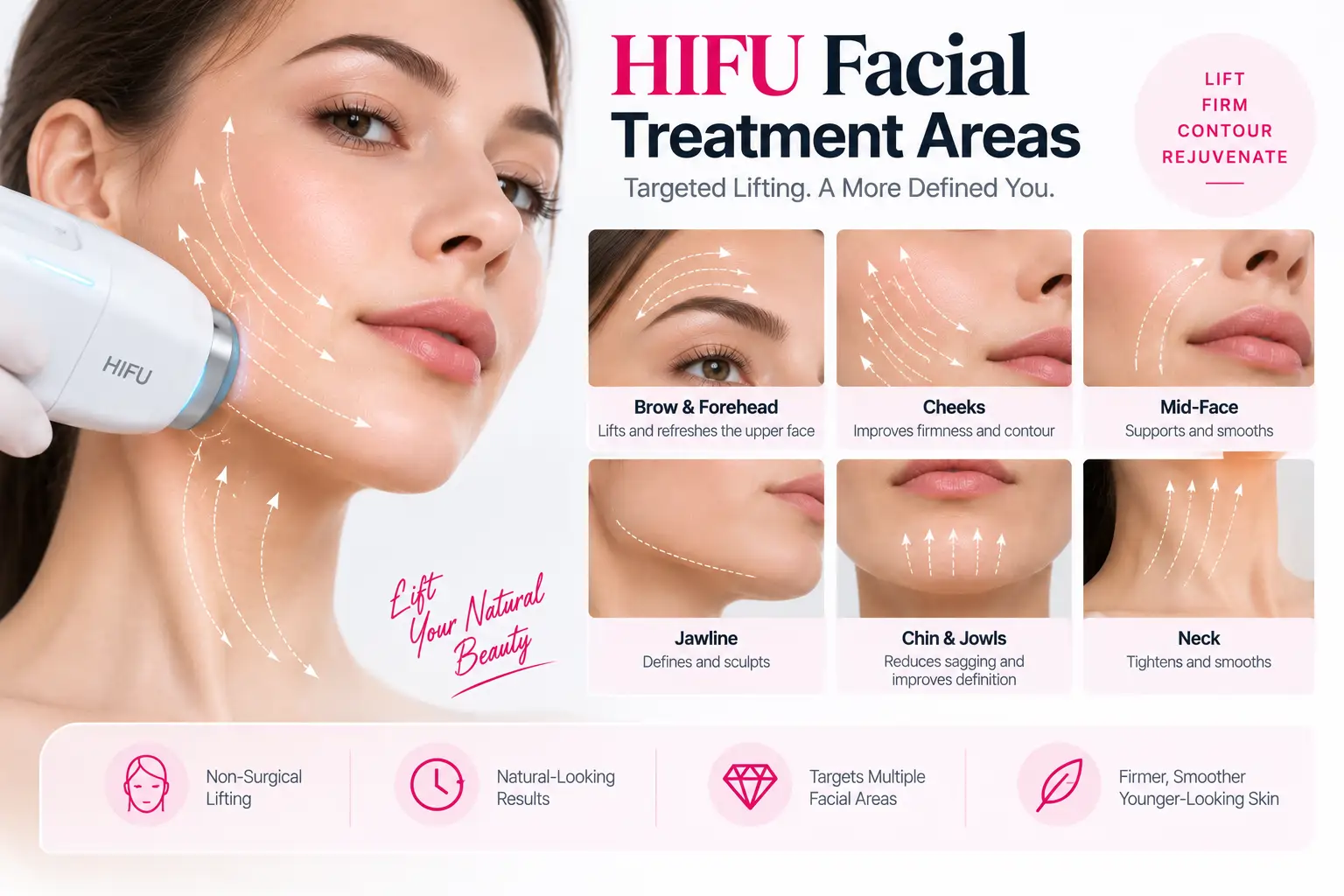
Depending on the device and professional assessment, a HIFU face treatment may include the jawline, lower face, cheeks, submental area, neck and selected upper-face regions.
| Treatment Area | Common Aesthetic Goal | General Consideration |
|---|---|---|
| Jawline | Improve definition and tighten lax tissue | Treatment follows facial anatomy and tissue depth |
| Jowls | Improve the appearance of mild lower-face laxity | Best suited to appropriate degrees of laxity |
| Under Chin | Support a firmer-looking submental contour | Requires assessment of tissue composition |
| Cheeks | Support tightening and facial contour | Depth and treatment pattern should be selected carefully |
| Neck | Improve the appearance of mild skin laxity | Anatomical assessment is important |
| Brow / Upper Face | Support a subtle lifting effect | Requires precise treatment planning |
HIFU for the Jawline
The jawline is one of the most common areas associated with aesthetic HIFU. Mild tissue laxity around the lower face can reduce visible jawline definition, particularly as skin and supporting tissues change with age.
Focused ultrasound may be used along planned treatment lines to stimulate tissue remodeling and support a tighter-looking lower facial contour.
HIFU does not physically recreate the structural changes achieved through surgery, so the degree of improvement should be considered in the context of a non-surgical treatment.
HIFU for Jowls
Jowls are another common reason people investigate HIFU. When lower-face laxity is mild to moderate, controlled ultrasound treatment may help improve the appearance of loose tissue through gradual remodeling.
More advanced jowling caused by substantial tissue descent may not respond to a non-surgical treatment to the same degree as mild laxity.
HIFU for Double Chin and Under the Chin
The area beneath the chin requires careful assessment because fullness can result from different combinations of skin laxity, subcutaneous fat and underlying anatomy.
HIFU skin-tightening treatment may support improved contour when lax tissue contributes to the appearance. However, skin tightening and dedicated fat-reduction procedures are not automatically interchangeable.
HIFU for the Cheeks
HIFU may be applied to selected cheek regions to support tightening and contouring. Treatment planning is particularly important because facial tissue thickness and fat distribution vary substantially between individuals.
More energy or deeper treatment is not automatically better. Appropriate depth selection should reflect the actual anatomical target.
HIFU for the Neck
HIFU can also be used for selected neck areas when the objective is improvement in mild skin laxity. The face and neck are often considered together because aging changes can affect the continuity of the jawline and cervical contour.
HIFU for Brow and Upper-Face Lifting
Carefully planned HIFU treatment may be used in selected upper-face areas to support a subtle lifting effect. Because important anatomical structures are present throughout the face, correct treatment zones and professional technique are essential.
HIFU Skin Tightening: How Does It Tighten the Face?
HIFU skin tightening is based on controlled thermal stimulation beneath the skin followed by a biological remodeling response.
Unlike ablative resurfacing procedures, HIFU does not need to remove the outer skin layer to reach its intended treatment depth. Focused ultrasound energy can be concentrated beneath the surface, where thermal coagulation points stimulate tissue repair.
During the following weeks and months, collagen remodeling can gradually improve tissue firmness and the appearance of mild laxity.
This is also the principle behind the term HIFU ultrasound skin tightening. The ultrasound itself is the energy-delivery mechanism; the visible tightening develops largely through the tissue response that follows.
High intensity focused ultrasound for skin tightening should therefore be viewed as a progressive treatment rather than an instant transformation.
HIFU Facelift: Is HIFU Really a Non-Surgical Face Lift?
Terms such as HIFU facelift, HIFU face lift, HIFU face lifting and HIFU lifting are widely used to describe the tightening and lifting appearance that can follow facial HIFU.
However, these terms can be misleading if they imply that HIFU produces the same result as facelift surgery.
A surgical facelift can reposition and remove tissue through an invasive surgical procedure. HIFU does not surgically reposition facial structures or remove excess skin.
Instead, a high intensity focused ultrasound face lift refers to a non-surgical treatment intended to stimulate tightening within selected tissue layers.
For suitable candidates with mild to moderate laxity, the resulting improvement may create a more defined or lifted appearance. The magnitude of change is generally more subtle than surgical lifting.
HIFU Face Lifting vs Surgical Facelift
Comparing high intensity focused ultrasound for face lifting with a surgical facelift helps clarify what HIFU is designed to achieve.
| Comparison | HIFU Face Lifting | Surgical Facelift |
|---|---|---|
| Procedure Type | Non-surgical energy-based treatment | Invasive surgical procedure |
| Incisions | No surgical incisions | Required |
| Primary Mechanism | Focused thermal stimulation and tissue remodeling | Surgical repositioning and removal of tissue |
| Typical Degree of Change | Subtle to moderate, depending on candidate and treatment | Potentially much greater structural change |
| Downtime | Generally limited | Substantial recovery period |
| Best Suited To | Appropriate patients seeking non-surgical improvement of mild laxity | Patients requiring greater correction of significant facial laxity |
For this reason, describing HIFU as a “non-surgical facelift” can be useful for explaining its general aesthetic goal, but it should not imply equivalence with facelift surgery.
HIFU Facial Benefits
The main HIFU facial benefits are related to non-surgical skin tightening and gradual improvement in the appearance of mild to moderate facial laxity. Because focused ultrasound can deliver energy beneath the skin surface, treatment can target selected tissue depths without surgical incisions or ablative resurfacing.
Depending on the treatment area, individual anatomy and treatment plan, potential benefits of a HIFU facial treatment may include:
- Improved appearance of mild facial skin laxity
- Firmer-looking skin
- Improved jawline definition
- A more lifted appearance of the lower face
- Improvement in the appearance of mild jowls
- Subtle tightening around selected cheek areas
- Improvement in mild neck laxity
- Gradual collagen remodeling
- No surgical incisions
- Generally limited downtime compared with surgery
One of the most important advantages of HIFU therapy for face is that the treatment does not depend on removing the epidermis to initiate tissue remodeling. This distinguishes it from many resurfacing procedures.
However, HIFU facial benefits should be described realistically. The treatment is generally intended to create gradual and relatively subtle improvement rather than the dramatic structural repositioning possible with cosmetic surgery.
What Results Can You Expect From HIFU Facial Treatment?
HIFU facial results vary considerably between individuals. Age, baseline skin laxity, tissue thickness, treatment area, device performance, energy settings and treatment technique can all influence the outcome.
For an appropriate candidate, visible changes may include a firmer-looking jawline, subtle improvement in lower-face laxity, tighter-looking skin and gradual improvement in facial contour.
The key word is gradual. HIFU relies substantially on the body’s remodeling response, so the final result cannot normally be judged immediately after the procedure.
| Possible Change | What HIFU May Do | What HIFU Does Not Guarantee |
|---|---|---|
| Skin Tightening | Support gradual improvement in mild laxity | Complete elimination of loose skin |
| Jawline | Improve visible definition in suitable candidates | Surgical-level repositioning |
| Jowls | Improve the appearance of mild jowling | Correction of severe tissue descent |
| Facial Lift | Create a subtle lifted appearance | The same result as facelift surgery |
| Skin Quality | Support collagen remodeling and firmness | Replacement for every resurfacing treatment |
When Do HIFU Face Treatment Results Appear?
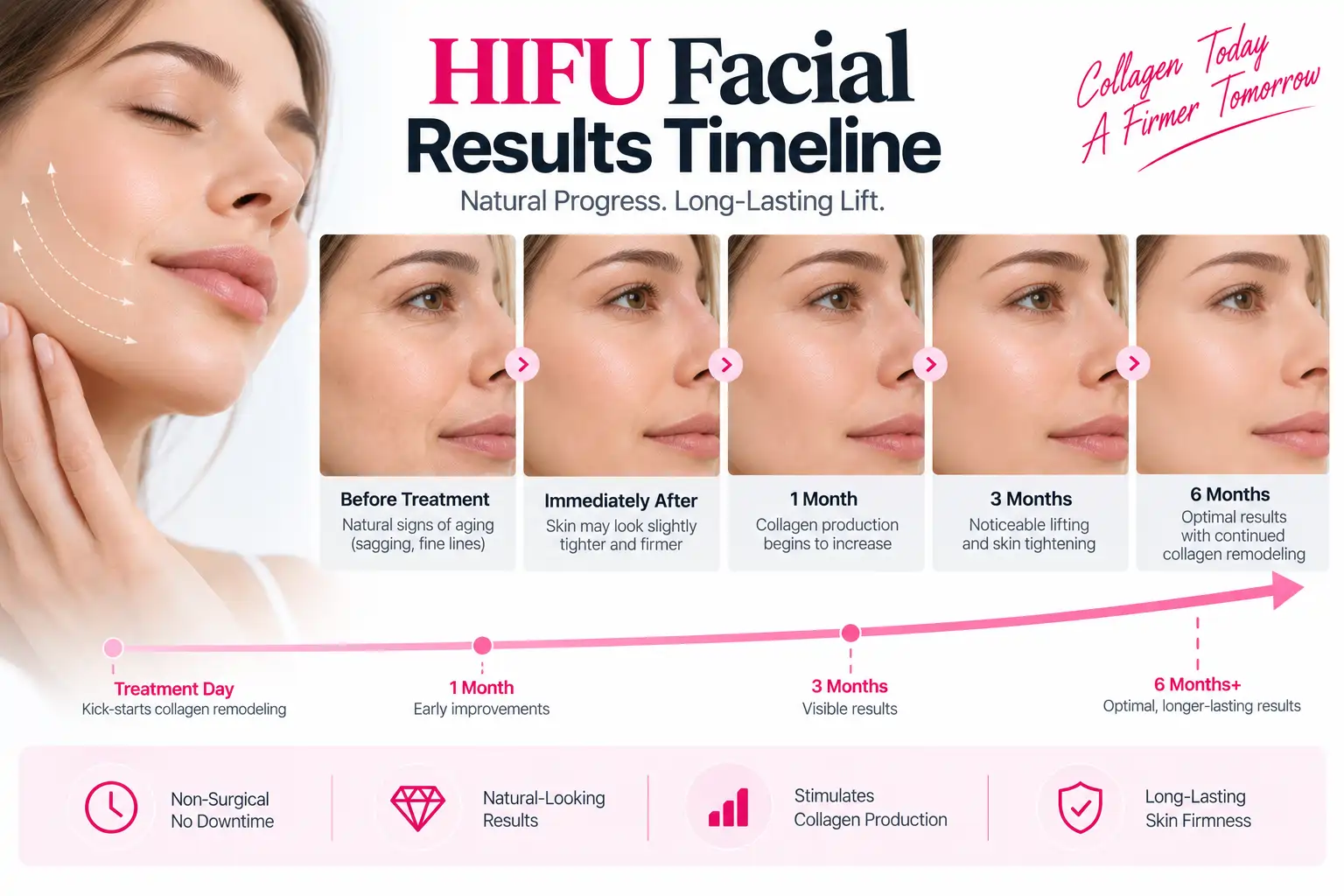
The results of a HIFU face treatment generally develop in stages rather than appearing all at once.
Some people may notice an early sensation or appearance of tightening after treatment. However, this should not be confused with the complete biological response.
Collagen remodeling continues after the procedure, which means visible improvement may become more noticeable during the following weeks and months.
| Approximate Period | What May Be Happening |
|---|---|
| Immediately After Treatment | Temporary tightness, redness or mild swelling may occur |
| First Few Weeks | Early tissue response and remodeling begin |
| 1–3 Months | Collagen remodeling may make tightening and contour changes more noticeable |
| Following Months | Results may continue to mature depending on individual response |
This timeline is only a general guide. Individual results and the speed at which changes become visible can vary.
How Long Do HIFU Facial Results Last?
There is no single duration that applies to every HIFU facial. Results are influenced by the patient’s age, baseline skin condition, degree of laxity, lifestyle, treatment parameters and natural aging process.
HIFU does not stop biological aging. Even when a treatment produces a visible tightening effect, collagen and supporting tissues continue to change over time.
For this reason, it is more accurate to think of HIFU as producing a period of improvement rather than a permanent facial lift.
Some patients may later choose maintenance treatment after professional reassessment, but maintenance frequency should not be treated as a universal schedule.
How Many HIFU Treatments for Face Do You Need?
The number of HIFU treatments for face required depends on the individual and the treatment objective. Some suitable patients may receive a single treatment followed by assessment after the remodeling period, while others may be advised to undergo additional treatment.
More sessions do not automatically produce better results. Repeating treatment too aggressively without allowing sufficient time for tissue response may not be appropriate.
A professional treatment plan should consider:
- Age and skin condition
- Degree of facial laxity
- Thickness and distribution of facial tissue
- Treatment area
- Previous aesthetic procedures
- Device and cartridge specifications
- Energy and treatment-line parameters
- Response to previous HIFU treatment
The decision to repeat treatment should therefore be based on assessment rather than a fixed assumption that every patient requires the same number of sessions.
HIFU Facial Treatment Depths: 1.5 mm, 3.0 mm and 4.5 mm
One of the most important concepts in professional HIFU facial treatment is treatment depth.
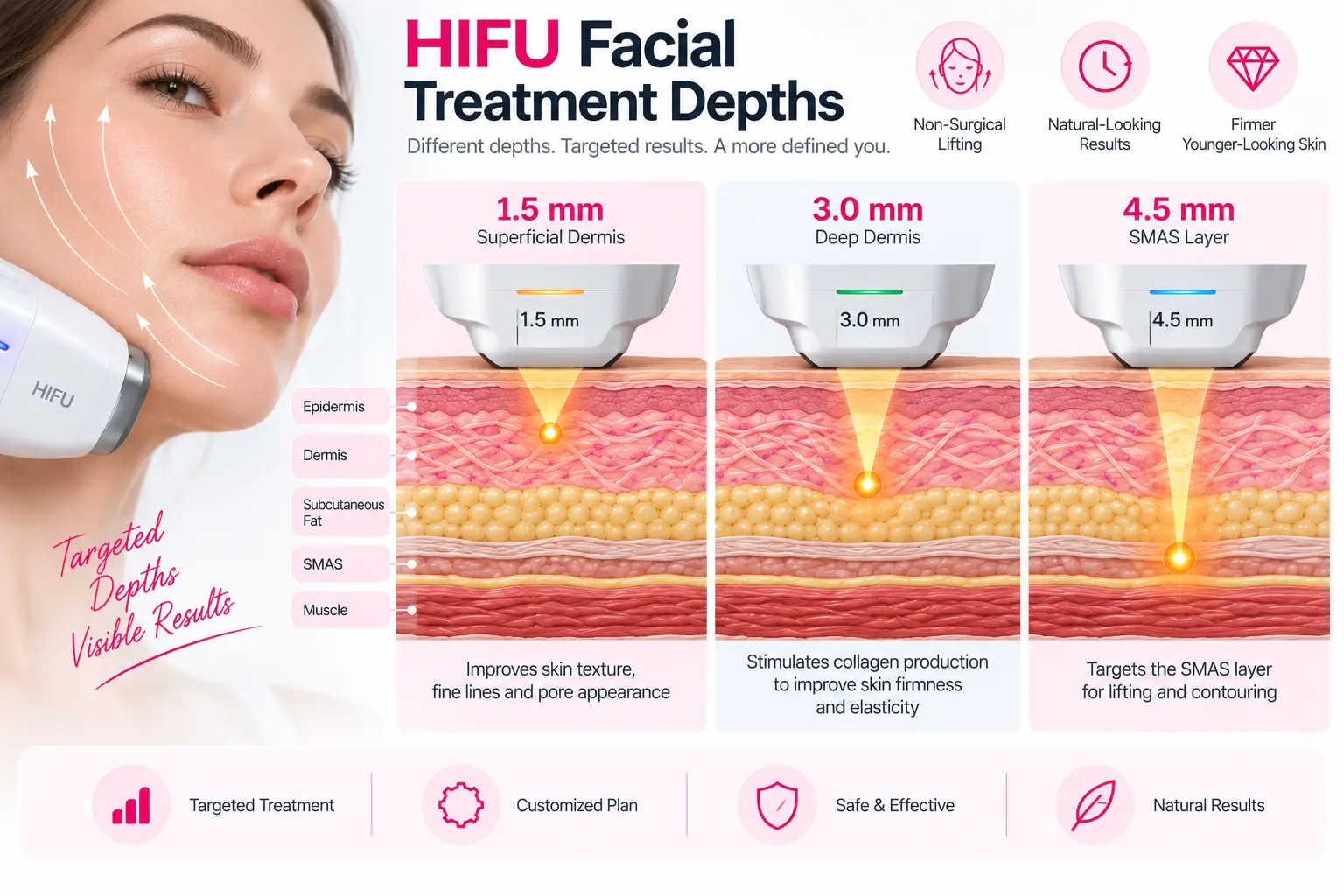
HIFU systems can use different transducers or cartridges designed to create focal zones at specified depths. Common facial cartridge depths include 1.5 mm, 3.0 mm and 4.5 mm, although available depths vary by device.
These depths should not be interpreted as interchangeable settings. Each is intended to address a different approximate tissue level, and actual anatomy varies between treatment areas and individuals.
| Typical HIFU Depth | General Target Level | Typical Aesthetic Purpose |
|---|---|---|
| 1.5 mm | More superficial tissue level | Selected superficial tightening applications |
| 3.0 mm | Deeper dermal / subdermal level depending on anatomy | Collagen remodeling and skin tightening |
| 4.5 mm | Deeper facial tissue level | Deeper tightening and lifting applications in appropriate areas |
These descriptions are simplified. A cartridge labeled with a particular focal depth does not mean that the same depth is suitable everywhere on the face.
Facial anatomy can vary significantly between the forehead, cheeks, jawline, submental area and neck. Treatment depth should therefore be selected according to anatomy and treatment goals rather than simply choosing the deepest available cartridge.
HIFU and the SMAS Layer
The term SMAS frequently appears in discussions about HIFU face lifting. SMAS stands for the superficial musculoaponeurotic system, a fibromuscular tissue network associated with facial soft-tissue structure.
Deeper aesthetic HIFU treatment is often discussed in relation to tissue planes around the SMAS level because certain transducers are designed to create focal energy at deeper facial depths.
However, saying that a device has a 4.5 mm cartridge does not mean every treatment line will automatically and precisely target the same anatomical structure in every person.
Facial thickness varies by location and patient. This is one reason anatomical knowledge, appropriate cartridge selection and treatment planning are important.
Important: Deeper HIFU is not automatically more effective. The correct treatment depth is the depth appropriate for the intended target and the patient’s anatomy.
Who Is a Good Candidate for HIFU Facial Treatment?
A good candidate for HIFU facial treatment is generally someone seeking non-surgical improvement in skin firmness or mild to moderate facial laxity and who has realistic expectations about the degree of improvement.
Potential candidates may include adults concerned about:
- Mild loss of jawline definition
- Early or moderate lower-face laxity
- Mild jowling
- Loose-looking skin beneath the chin
- Mild neck laxity
- Gradual loss of skin firmness
- A desire for a non-surgical facial tightening option
HIFU may be particularly appealing to people who want a treatment with less downtime than surgery and who understand that the resulting lift is usually more subtle.
Suitability cannot be determined from age alone. Two people of the same age can have very different skin thickness, facial fat distribution, laxity and treatment requirements.
Who May Not Be Suitable for HIFU Face Treatment?
A HIFU face treatment is not appropriate for every person or every type of facial aging.
Professional assessment is especially important when a person has active skin problems, significant facial laxity, unusual tissue characteristics, relevant medical conditions or previous procedures that may affect treatment planning.
Situations that may require treatment to be avoided, postponed or specifically assessed can include:
- Active infection in the intended treatment area
- Open wounds or significant skin damage
- Certain implanted medical or electronic devices
- Relevant metallic implants in or near the treatment area
- Significant underlying medical conditions requiring clinical assessment
- Pregnancy, depending on device guidance and clinical policy
- Recent procedures that may interact with the planned treatment
- Severe facial laxity where non-surgical treatment is unlikely to meet expectations
Contraindications vary between devices and jurisdictions. The manufacturer’s instructions for use and applicable professional or medical guidance should therefore take precedence over generalized treatment lists.
Is HIFU Facial Treatment Suitable for Severe Loose Skin?
HIFU is generally better positioned as a treatment for mild to moderate skin laxity than as a solution for substantial excess or severely descended tissue.
If significant skin and deeper facial structures have descended, the amount of tightening achievable through collagen remodeling may not be sufficient to produce the desired change.
This is an important distinction when evaluating a HIFU facelift. A person who expects surgical-level correction from a non-surgical ultrasound procedure is more likely to be disappointed even if the HIFU treatment itself is performed correctly.
Candidate selection and realistic expectations are therefore as important as the technology used.
Is HIFU Facial Safe?
A professional HIFU facial is a non-invasive energy-based treatment, but non-invasive does not mean risk-free. Safety depends on appropriate candidate selection, correct treatment depth, suitable energy parameters, knowledge of facial anatomy and proper operation of the HIFU system.
During treatment, focused ultrasound energy is delivered beneath the skin to create controlled thermal zones. Because facial anatomy contains nerves, blood vessels, bone and regions with very different tissue thicknesses, treatment should not simply use identical settings across every part of the face.
A properly planned HIFU facial treatment should consider the treatment area, tissue thickness, cartridge depth, energy level and the manufacturer’s recommended operating protocol.
Safety principle: More energy, more treatment lines and greater depth do not automatically produce better HIFU results. Appropriate energy delivery is more important than maximizing treatment intensity.
HIFU Facial Side Effects
Most expected HIFU facial side effects are temporary treatment responses, although their intensity and duration can vary between individuals.
Possible short-term reactions may include:
- Temporary redness
- Mild swelling
- Tenderness
- Tingling or sensitivity
- Temporary discomfort during or after treatment
- Temporary numbness or altered sensation in some cases
These effects do not occur in every patient and should not be interpreted as guaranteed responses.
Less common complications can occur when treatment parameters, depth or anatomical placement are inappropriate. For this reason, persistent pain, weakness, unusual sensory changes, burns or other unexpected symptoms should not simply be treated as normal post-treatment reactions.
Can HIFU Go Wrong?
Searches for HIFU gone wrong or HIFU treatment gone wrong often involve concerns about burns, prolonged discomfort, nerve-related symptoms, unwanted contour changes or excessive treatment of facial tissue.
These concerns illustrate why device quality and operator technique matter. HIFU is capable of depositing concentrated energy beneath the skin, and incorrect treatment planning can expose inappropriate tissue to energy.
One concern sometimes discussed with facial energy treatments is unwanted facial volume change. HIFU treatment intended primarily for tightening should not automatically be treated as a facial fat-reduction procedure. Treatment depth and energy should correspond to the intended tissue target.
Because this topic involves a different search intent, complications and adverse outcomes are better examined separately in a dedicated guide rather than assuming that every temporary post-treatment reaction represents a complication.
Does HIFU Hurt?
The sensation experienced during a HIFU face treatment varies significantly between patients and treatment areas.
People may describe brief heat, tingling, prickling or deeper pulses of discomfort when ultrasound energy is delivered. Areas close to bone or with different tissue thickness may feel different from softer facial regions.
Treatment comfort can also depend on:
- Energy level
- Cartridge depth
- Treatment area
- Number and density of treatment lines
- Individual pain sensitivity
- Device characteristics
- Operator technique
HIFU should therefore not automatically be advertised as completely painless. A more accurate description is that discomfort varies and should be managed according to the treatment protocol and individual response.
HIFU Facial Downtime and Recovery
One reason people choose a HIFU facial treatment is its relatively limited downtime compared with surgical facial lifting.
Because HIFU does not intentionally remove the epidermis, there is generally no resurfacing-style healing period involving widespread peeling or an open skin surface.
Some patients may experience temporary redness, tenderness or swelling after treatment. Depending on the individual response, many people can return to normal daily activities relatively quickly.
However, “no downtime” should not be interpreted as “no biological response.” Tissue remodeling continues beneath the surface even when the skin looks relatively normal.
HIFU Facial vs Other Skin Tightening Treatments
HIFU is one of several technologies used for non-surgical facial rejuvenation and skin tightening. It is not automatically the best treatment for every concern.
The most appropriate technology depends on the tissue target, degree of laxity, skin condition, treatment objective and available professional system.
HIFU vs RF Skin Tightening
HIFU vs RF is a common comparison because both technologies can be used for non-surgical skin tightening, but they deliver energy differently.
HIFU uses focused acoustic energy to create thermal treatment zones at selected depths. Radiofrequency treatments use electrical energy to generate heat within tissue.
| Feature | HIFU | Radiofrequency (RF) |
|---|---|---|
| Energy Type | Focused ultrasound | Radiofrequency electrical energy |
| Energy Pattern | Focused treatment points at selected depths | Heating pattern depends on RF technology and electrode configuration |
| Primary Goal | Deep and selected-depth tissue tightening | Tissue heating and collagen remodeling |
| Skin Surface Removal | No intentional ablation with standard aesthetic HIFU | Usually non-ablative for conventional RF tightening |
| Best Choice | Depends on anatomy, treatment goal, device and professional assessment | |
Therefore, asking whether HIFU or RF is universally better oversimplifies the decision. They are different energy-delivery technologies and may be selected for different treatment strategies.
HIFU vs Ultherapy
HIFU vs Ultherapy is another frequent search because the terms are sometimes incorrectly used as synonyms.
HIFU is a broad technological category referring to high-intensity focused ultrasound. Ultherapy is a specific branded ultrasound-based aesthetic treatment platform rather than the generic name for every HIFU system.
Therefore, the comparison should consider the specific device, imaging capabilities, transducers, treatment depths, energy-delivery characteristics, regulatory status, professional training and intended use rather than comparing only the words “HIFU” and “Ultherapy.”
A separate HIFU vs Ultherapy comparison is more appropriate for buyers or patients specifically deciding between these treatment approaches.
HIFU vs Laser Treatment
The phrase HIFU laser is commonly searched, but HIFU is not a laser.
HIFU uses focused ultrasound energy. Laser systems use electromagnetic light energy at specific wavelengths.
This distinction matters because the technologies interact with tissue differently. Depending on the laser, a laser treatment may target pigment, vascular structures, water, hair follicles or other chromophores. HIFU instead relies on focused acoustic energy and localized thermal effects at selected tissue depths.
| Technology | Energy | Common Aesthetic Applications |
|---|---|---|
| HIFU | Focused ultrasound | Skin tightening and lifting applications |
| RF | Radiofrequency electrical energy | Skin tightening and tissue heating |
| Laser | Specific wavelengths of light | Depends on wavelength and device: resurfacing, pigment, vascular, hair and other applications |
Common HIFU Facial Treatment Mistakes
Good HIFU facial results depend on more than owning a high-energy machine. Several treatment-planning mistakes can reduce effectiveness or increase risk.
1. Assuming Higher Energy Is Always Better
Increasing energy does not guarantee greater lifting. Energy should be sufficient for the intended treatment effect while remaining appropriate for the tissue and treatment area.
2. Using the Same Depth Across the Entire Face
Facial tissue thickness varies considerably. A depth appropriate for one region may be unsuitable for another. Professional HIFU treatment should account for anatomical differences.
3. Treating Every Patient With the Same Protocol
Age, tissue thickness, laxity, facial volume and treatment history vary. A standardized one-protocol-fits-all approach ignores these differences.
4. Expecting Surgical Facelift Results
A HIFU face lift is still a non-surgical treatment. It may support tightening and a subtle lifting effect, but it does not surgically remove excess skin or reposition facial tissues.
5. Judging the Final Result Immediately
HIFU results develop progressively. Evaluating treatment immediately after the session ignores the collagen-remodeling process that occurs over subsequent weeks and months.
6. Ignoring Facial Anatomy
HIFU deposits concentrated energy beneath the skin. Understanding treatment zones, tissue thickness and structures that should be avoided is therefore fundamental to safe treatment planning.
常见问题
What is a HIFU facial?
A HIFU facial is a non-surgical aesthetic treatment that uses high-intensity focused ultrasound to create controlled thermal zones beneath the skin. The resulting tissue response can stimulate collagen remodeling and gradually improve skin firmness and mild facial laxity.
What is HIFU facial treatment used for?
HIFU facial treatment is commonly used for non-surgical skin tightening, jawline definition, improvement in mild jowling and support of a firmer or more lifted appearance of the face and neck.
Does HIFU really tighten the face?
HIFU can support facial skin tightening in suitable candidates by creating controlled thermal treatment zones that stimulate collagen remodeling. Results vary and are generally more subtle than surgical lifting.
Is HIFU good for skin tightening?
HIFU skin tightening can be appropriate for people with mild to moderate laxity who want a non-surgical treatment. It is less likely to provide sufficient correction for substantial loose skin or severe tissue descent.
Is HIFU a facelift?
HIFU is sometimes called a HIFU facelift or non-surgical face lift, but it is not equivalent to facelift surgery. HIFU stimulates tissue tightening without surgically removing skin or repositioning facial structures.
How long does HIFU facial treatment take to work?
Some early tightening may be noticeable, but the main remodeling response develops progressively. Visible HIFU facial results may become more apparent during the following weeks and months.
How long do HIFU facial results last?
There is no universal duration. Results depend on age, skin condition, degree of laxity, treatment parameters and natural aging. HIFU does not permanently stop the aging process.
How many HIFU treatments for face are needed?
The number of HIFU treatments for face varies. Some patients may undergo one treatment followed by reassessment after the remodeling period, while others may later receive additional or maintenance treatment according to professional evaluation.
What are the 1.5 mm, 3.0 mm and 4.5 mm HIFU depths?
These numbers describe common focal depths available with facial HIFU cartridges. Different depths are intended for different approximate tissue levels. The appropriate cartridge depends on facial anatomy, treatment area and the intended tissue target.
Is HIFU the same as laser treatment?
No. HIFU uses focused ultrasound energy, while laser treatments use light at specific wavelengths. Although both can produce thermal effects in tissue, their energy sources, targets and clinical applications are different.
Which is better, HIFU or RF?
Neither is universally better. HIFU uses focused ultrasound, while RF uses radiofrequency energy. The better option depends on the treatment goal, tissue target, skin condition, device and professional assessment.
What is the difference between HIFU and Ultherapy?
HIFU is a general technology category describing high-intensity focused ultrasound. Ultherapy is a specific branded ultrasound-based aesthetic platform. Comparing them requires evaluation of the actual devices, treatment features and intended applications.
Can HIFU damage your face?
HIFU is an energy-based procedure and complications are possible. Appropriate candidate selection, anatomical knowledge, correct treatment depth and suitable energy settings are important. Persistent or unusual symptoms after treatment should be professionally evaluated rather than assumed to be normal.
Final Verdict: Is HIFU Facial Treatment Worth It?
A HIFU facial treatment can be a useful non-surgical option for suitable people seeking gradual improvement in facial skin firmness, mild laxity, jawline definition and a more lifted appearance.
Its main advantage is the ability to focus ultrasound energy at selected depths beneath the skin without surgical incisions or intentional removal of the epidermis. The resulting thermal response can stimulate collagen remodeling over the following weeks and months.
However, HIFU should not be presented as a replacement for every facial rejuvenation treatment. A HIFU facelift generally produces a subtler degree of change than surgical lifting, and HIFU is not the same technology as RF or laser treatment.
Ultimately, successful HIFU treatment for face depends on appropriate candidate selection, realistic expectations, correct treatment depth, suitable energy parameters, device performance and professional understanding of facial anatomy.