Home Diode Laser vs IPL: Which Is Better?
Choosing between a home diode laser and an IPL hair removal device is one of the biggest decisions buyers face today. Both technologies aim to reduce unwanted hair, but they work differently, perform differently and suit different users. In this guide, we explain the real differences between diode laser and IPL, compare their strengths and limitations, and help you determine which technology is the better investment for your skin tone, hair color and long-term goals.
Editorial Policy: This comparison is based on publicly available technical documentation, scientific literature, manufacturer specifications and current dermatology guidance. Unless explicitly stated, we do not present manufacturer claims as independently verified test results.
Affiliate Disclosure: Some links may earn us a commission at no additional cost to you. Our recommendations are determined by editorial evaluation rather than affiliate relationships.
Quick Answer
For most people seeking true laser technology, a home diode laser is the better choice. It delivers a single laser wavelength that targets the hair follicle more precisely than IPL. However, premium IPL devices remain excellent options for users who prioritize treatment comfort, faster sessions and lower purchase costs.
- Choose a Diode Laser if: You want genuine laser technology and long-term hair reduction.
- Choose IPL if: You prefer faster treatments with excellent cooling and easier operation.
- Best Overall Home Diode Laser: DermRays V8S
- Best Premium IPL: Ulike Air 10
Key Differences at a Glance
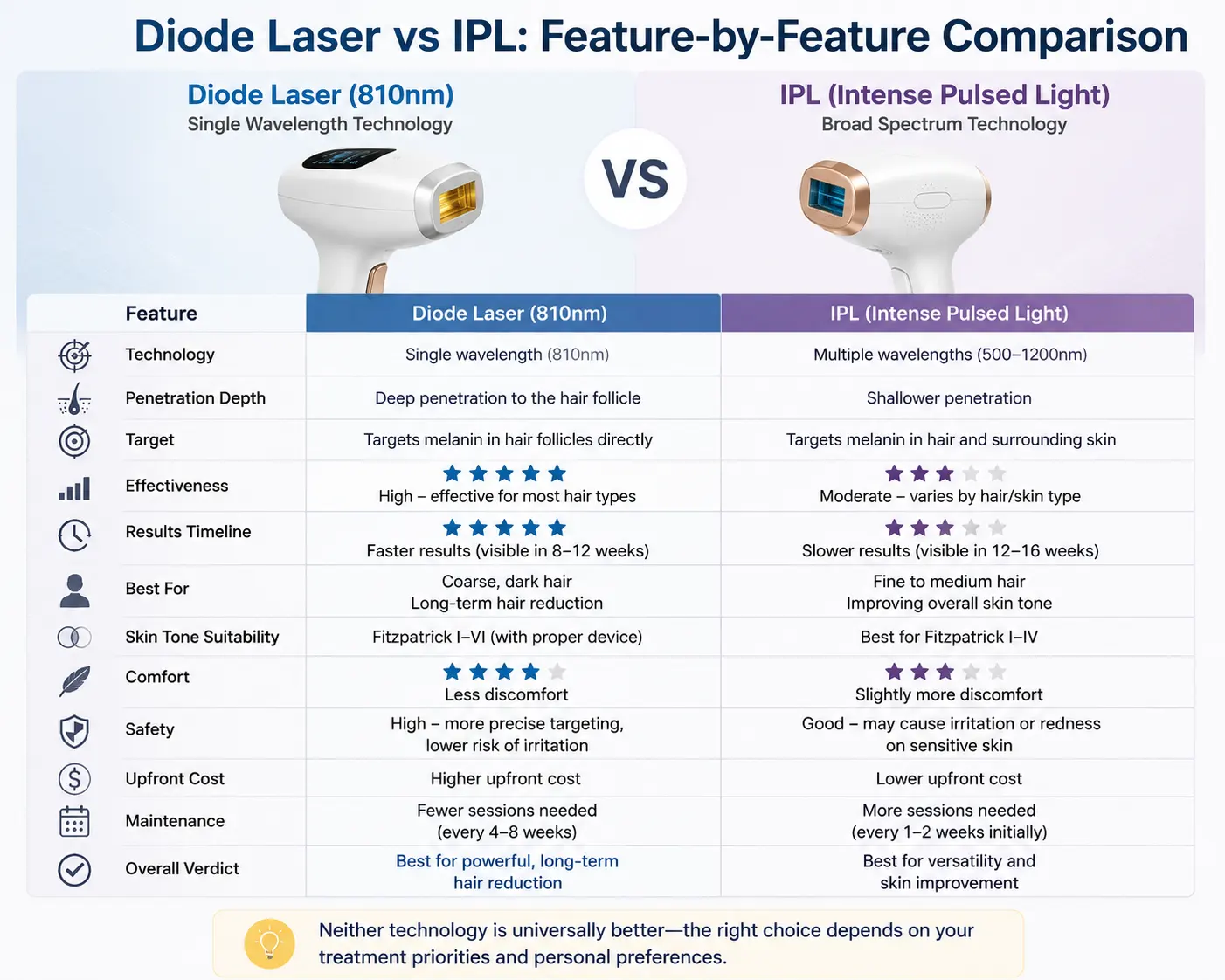
| Feature | Home Diode Laser | IPL |
|---|---|---|
| Light Source | Single laser wavelength | Broad-spectrum light |
| Precision | ★★★★★ | ★★★★☆ |
| Treatment Comfort | ★★★★☆ | ★★★★★ |
| Treatment Speed | ★★★★☆ | ★★★★★ |
| Best For | Users wanting genuine laser technology | Users prioritizing comfort and convenience |
| Typical Price | Higher | Lower to Medium |
Diode Laser vs IPL: Which One Wins?
| Category | Winner | Why |
|---|---|---|
| Technology | 🏆 Diode Laser | Uses a concentrated laser wavelength instead of broad-spectrum light. |
| Precision | 🏆 Diode Laser | Better suited for targeting individual hair follicles. |
| Comfort | 🏆 IPL | Modern sapphire cooling systems significantly improve comfort. |
| Treatment Speed | 🏆 IPL | Larger treatment windows often reduce session time. |
| Long-Term Investment | 🏆 Diode Laser | Preferred by users specifically seeking true laser technology. |
| Beginner Friendliness | 🏆 IPL | Simpler operation and lower entry cost. |
Why You Can Trust This Comparison
One of the biggest problems in the home hair removal market is confusing marketing terminology. Many products are promoted as “laser hair removal devices” even though they actually use Intense Pulsed Light (IPL). While both technologies can reduce unwanted hair, they should not be treated as identical.
Instead of comparing advertising slogans, this guide evaluates each technology according to its operating principle, treatment characteristics, typical user experience, safety considerations and long-term suitability. Wherever possible, we distinguish documented technical information from manufacturer marketing claims so readers can make informed purchasing decisions.
Independent Editorial Approach
Rankings and conclusions are based on editorial analysis rather than sponsorship or affiliate relationships.
Technology First
Every recommendation begins with identifying the actual light source before comparing comfort, performance or convenience.
Balanced Recommendations
We highlight situations where IPL may actually be the better choice instead of assuming a laser device is automatically superior for every user.
Evidence-Based Information
Scientific principles are explained using current dermatology knowledge while avoiding exaggerated or unsupported performance claims.
What Is a Home Diode Laser?
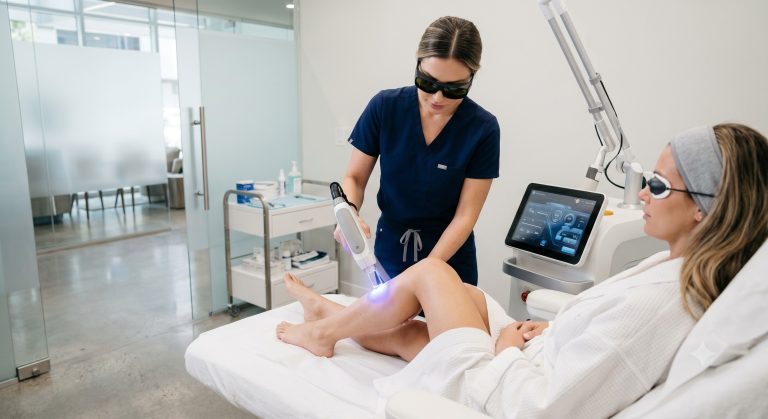
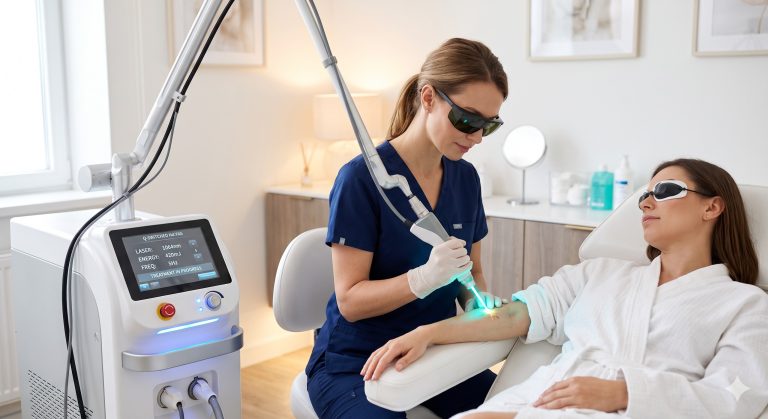
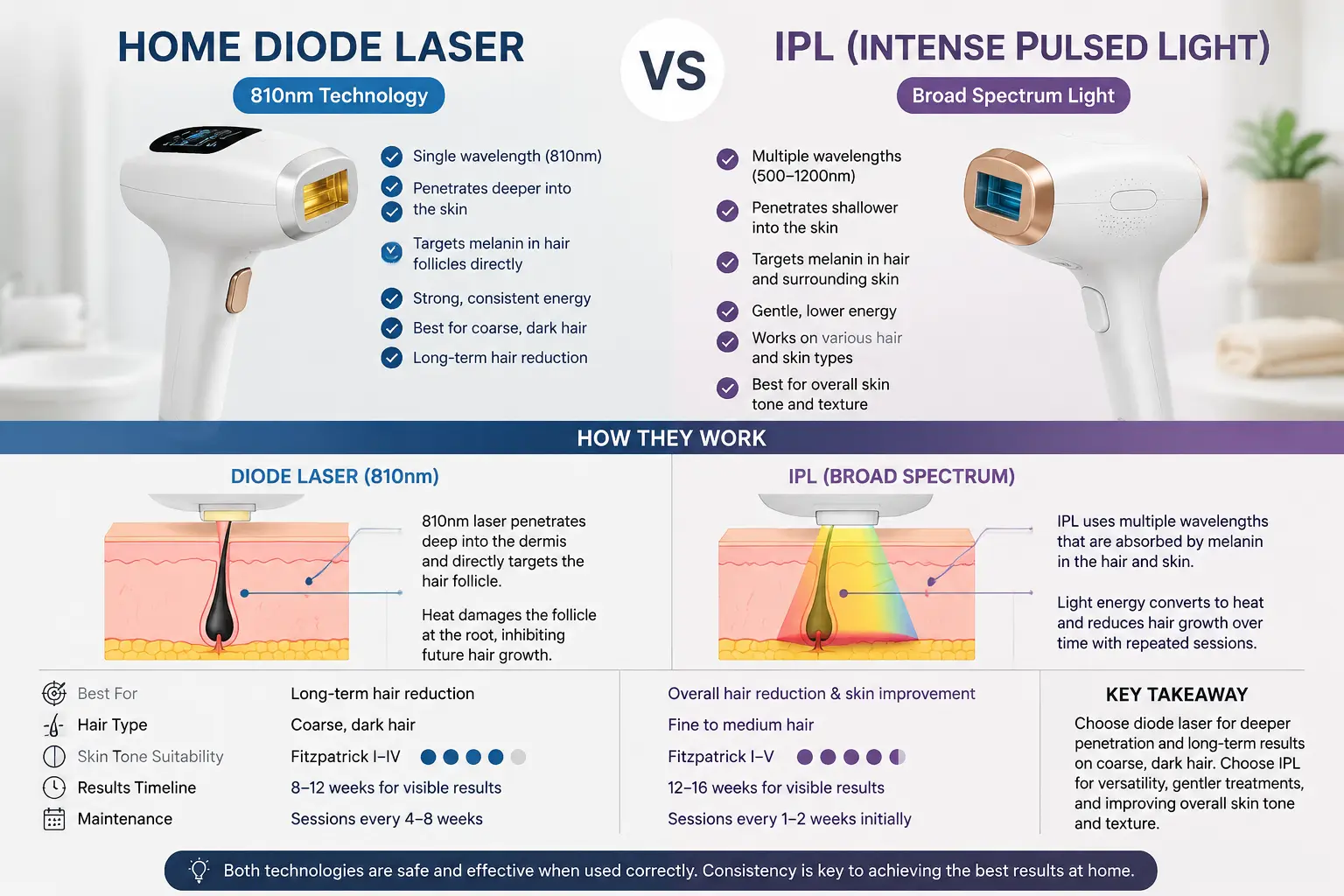
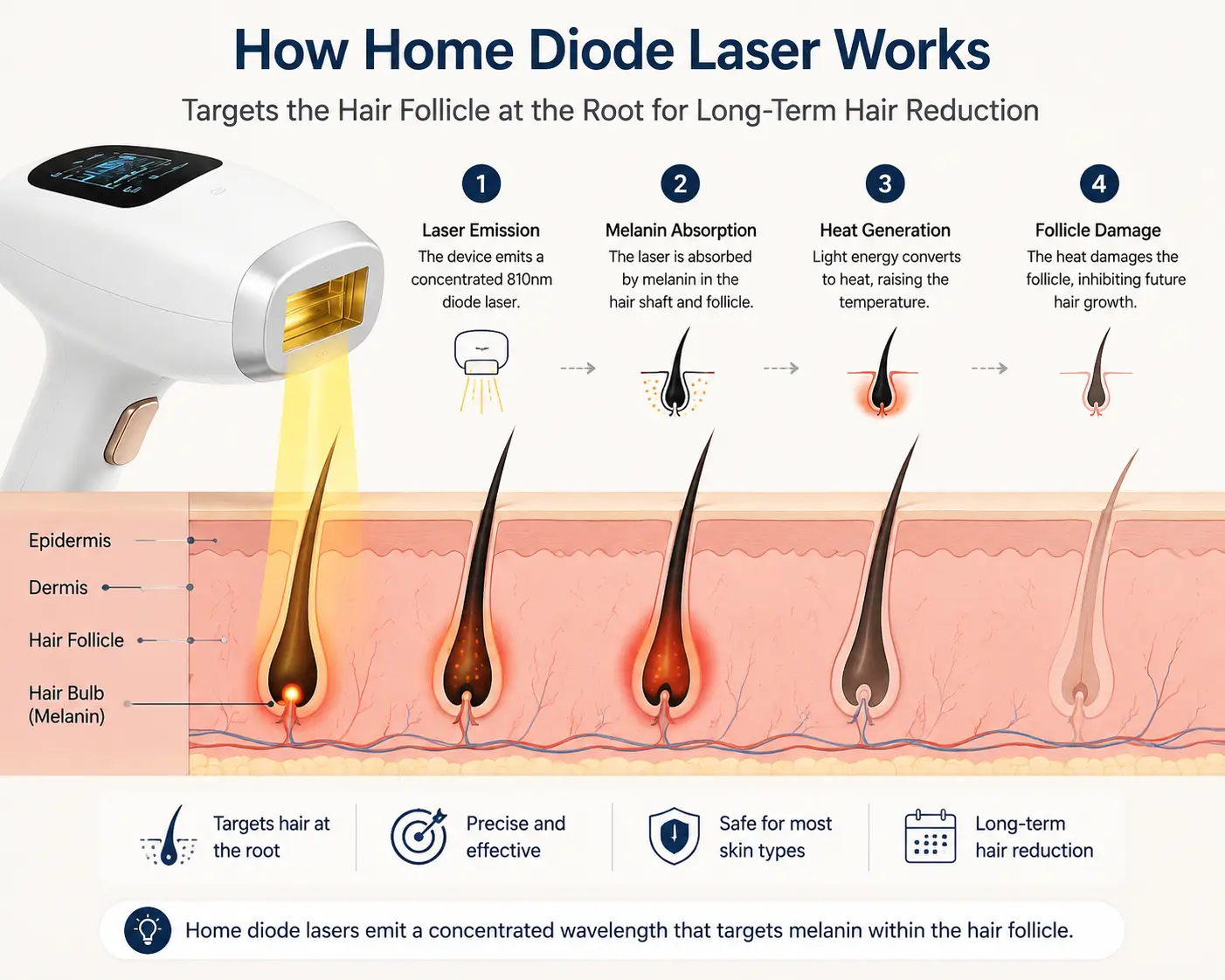
A home diode laser hair removal device uses a semiconductor laser to produce a concentrated wavelength of light, typically around 810nm , which is one of the most widely used wavelengths in professional laser hair reduction systems. Unlike IPL, which emits multiple wavelengths, a diode laser delivers a single, targeted beam designed to reach melanin within the hair follicle.
This focused approach allows laser energy to be directed toward the hair root while minimizing unnecessary exposure to surrounding tissue. Although home-use devices operate at significantly lower energy levels than professional medical systems, they follow the same basic principle of selective photothermolysis —using light energy to selectively heat pigmented hair follicles while helping preserve nearby skin.
Advantages of Home Diode Lasers
- Uses genuine laser technology rather than broad-spectrum light.
- More precise energy delivery to pigmented hair follicles.
- Often preferred by users specifically looking for professional-inspired laser technology.
- Suitable for long-term maintenance when used according to manufacturer instructions.
Limitations
- Usually more expensive than IPL devices.
- Treatment sessions may take longer depending on the treatment window.
- Not every model includes advanced cooling.
- Not effective for every skin tone or hair color.
What Is IPL?
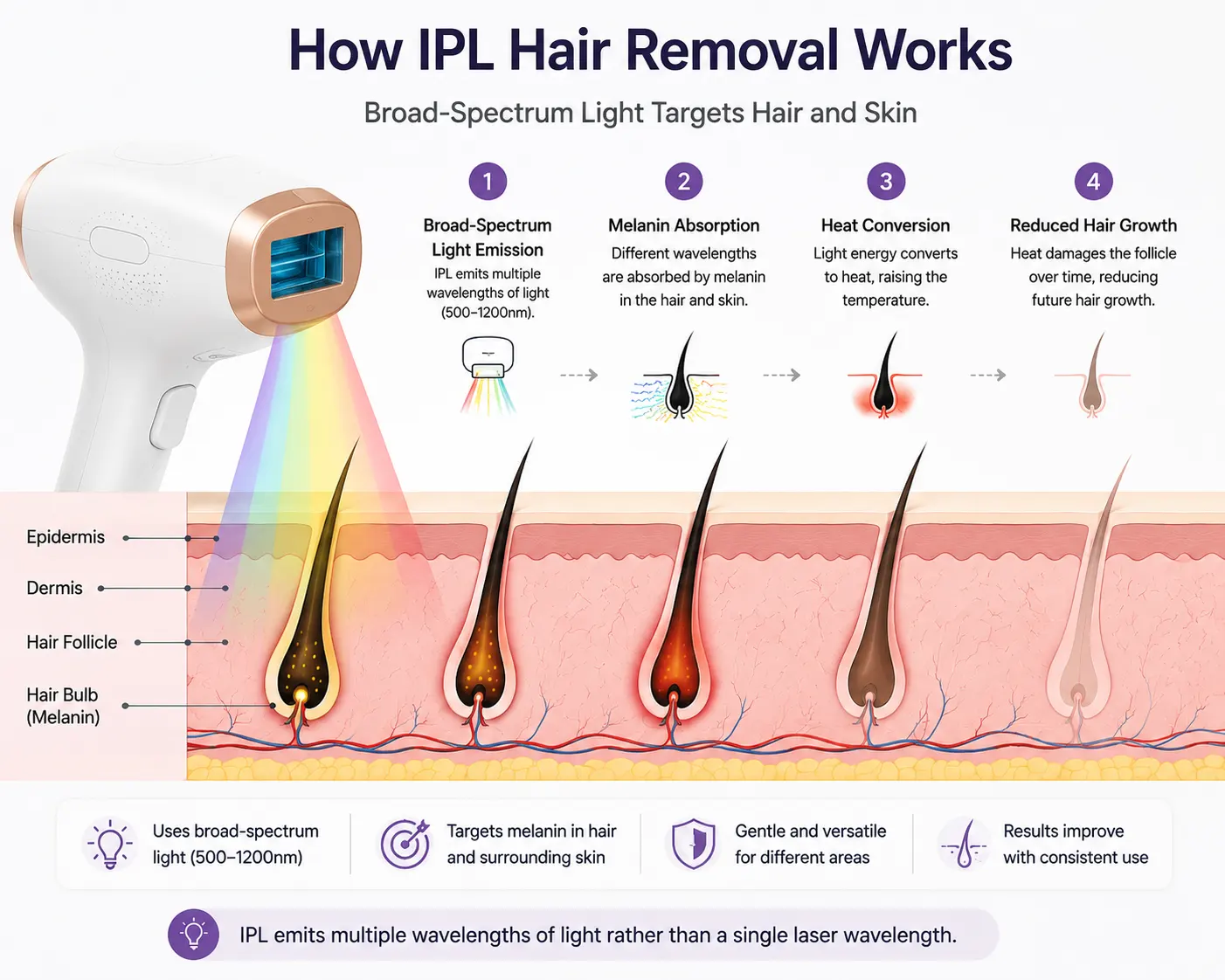
IPL stands for Intense Pulsed Light . Rather than producing a single laser wavelength, an IPL device emits a broad spectrum of filtered light. This light also targets melanin within the hair shaft and follicle, but because multiple wavelengths are involved, the energy is distributed differently than with a true laser.
Modern IPL devices have improved significantly in recent years. Many now include sapphire contact cooling, intelligent skin sensors and larger treatment windows, making them easier and more comfortable for full-body treatments at home.
Advantages of IPL
- Generally lower purchase price.
- Larger treatment windows for faster body coverage.
- Excellent comfort when combined with sapphire cooling.
- Widely available from many established brands.
Limitations
- Not a true laser technology.
- Precision is generally lower than diode lasers.
- Performance varies more depending on hair and skin characteristics.
Home Diode Laser vs IPL: Side-by-Side Comparison
Although both technologies are designed to reduce unwanted hair, they achieve this goal in different ways. Understanding these practical differences is far more valuable than simply comparing marketing claims.
1. Technology
| Winner | 🏆 Diode Laser |
|---|
A diode laser produces a concentrated wavelength specifically designed to target melanin in the hair follicle, whereas IPL distributes energy across multiple wavelengths. Buyers looking specifically for laser technology should therefore choose a diode laser rather than an IPL device.
2. Treatment Comfort
| Winner | 🏆 IPL |
|---|
Premium IPL devices often integrate advanced sapphire cooling systems that help reduce surface heat during treatment. While some diode lasers also include cooling, comfort depends more on the device’s cooling design than on the technology alone.
3. Treatment Speed
| Winner | 🏆 IPL |
|---|
Many IPL devices feature larger treatment windows and rapid flash intervals, allowing users to cover legs, arms and other large body areas more quickly. Home diode lasers with smaller treatment windows may require more precise positioning and therefore longer treatment sessions.
4. Precision
| Winner | 🏆 Diode Laser |
|---|
When treating smaller areas such as the upper lip, chin or bikini-line edges, diode lasers generally provide greater precision because of their focused beam and smaller treatment aperture.
5. Long-Term Value
| Winner | 🏆 Depends on Your Priorities |
|---|
If your goal is owning genuine laser technology, a diode laser is likely the better long-term investment. However, users who prioritize comfort, ease of use and faster treatments may find that a premium IPL device better matches their expectations.

Which One Should You Buy?
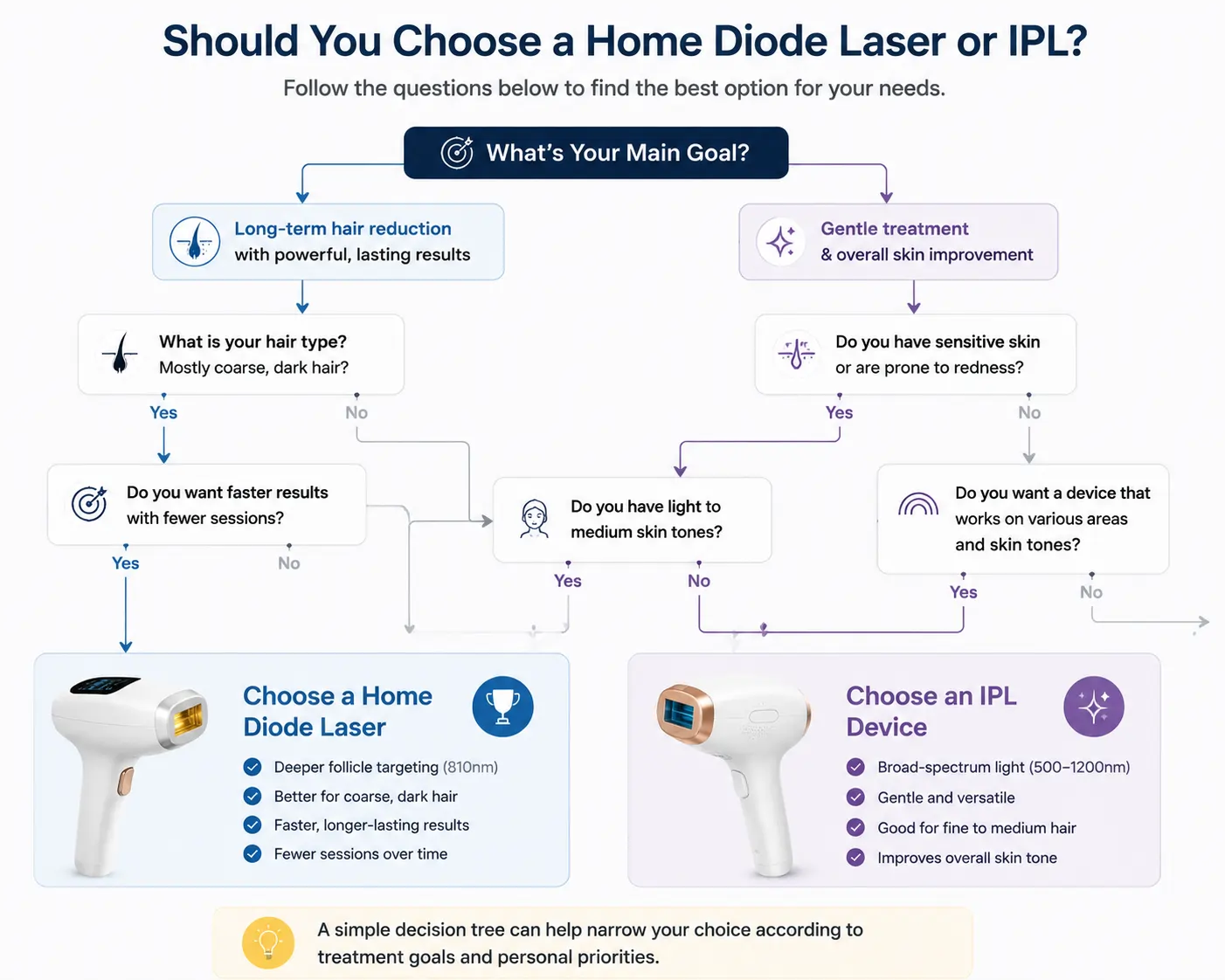
There isn’t a universal winner because the best choice depends on your expectations, treatment areas and budget. Rather than asking which technology is “better,” ask which one better matches the way you plan to use it.
| If You Want… | Choose | Recommended Device |
|---|---|---|
| True laser technology | Home Diode Laser | DermRays V8S |
| The easiest device for beginners | Home Diode Laser | CurrentBody Skin Laser |
| Precision for facial treatments | Home Diode Laser | Tria Hair Removal Laser 4X |
| Maximum comfort | IPL | Ulike Air 10 |
| Fast full-leg treatments | IPL | Ulike Air 10 |
| Professional-inspired laser technology | Home Diode Laser | DermRays V8S |
Real-World Buying Scenarios
Many buyers don’t identify with technical specifications—they identify with real-life situations. The examples below show which technology is generally the better fit for different priorities.
Scenario 1: “I want technology that’s as close as possible to professional laser treatment.”
Recommendation: Home Diode Laser
A genuine diode laser uses the same basic laser principle found in many professional systems, although at lower output levels suitable for home use.
Scenario 2: “I’m worried that treatments will hurt.”
Recommendation: Premium IPL
Modern IPL devices equipped with sapphire cooling often provide a more comfortable treatment experience, especially during larger body sessions.
Scenario 3: “I mainly want to treat my upper lip or chin.”
Recommendation: Home Diode Laser
Smaller treatment windows and greater precision make diode lasers more suitable for facial areas requiring careful positioning.
Scenario 4: “I want to finish my legs as quickly as possible.”
Recommendation: IPL
Larger treatment windows and faster flash intervals generally reduce treatment time on larger body areas.
Common Mistakes When Choosing Between Laser and IPL
- Assuming every “laser hair removal” device is actually a laser. Many consumer devices advertised as laser products are technically IPL systems.
- Choosing based only on energy claims. Cooling, treatment window size, ergonomics and consistency often have a greater impact on the overall user experience.
- Ignoring skin tone compatibility. Always read the manufacturer’s recommended Fitzpatrick skin type guidance before purchasing.
- Expecting permanent results after only a few sessions. Both technologies generally require repeated treatments followed by occasional maintenance sessions.
- Buying the cheapest option available. Long-term manufacturer support, warranty and product documentation are often worth paying for.
Frequently Asked Questions
Is a diode laser more effective than IPL?
A diode laser uses a single laser wavelength, while IPL uses broad-spectrum light. Neither technology is universally better, but diode lasers are generally preferred by buyers specifically seeking true laser technology.
Does IPL permanently remove hair?
Home IPL devices are generally intended for long-term hair reduction rather than guaranteed permanent hair removal. Maintenance treatments are typically required.
Which technology hurts less?
Comfort depends on the individual device, cooling system and treatment settings. Premium IPL devices with sapphire cooling are often perceived as more comfortable.
Can I use either technology on my face?
Some home diode lasers and IPL devices are approved for facial treatment. Always follow the manufacturer’s instructions regarding approved treatment areas and eye safety.
Which is better for beginners?
Many first-time users find premium IPL devices easier to learn because of their larger treatment windows and simplified operation. However, buyers who specifically want laser technology may still prefer a beginner-friendly home diode laser.
Final Verdict
If your goal is to own a genuine home laser device that follows the same basic treatment principle used in many professional systems, a home diode laser is the better choice. Its focused wavelength makes it attractive for buyers who value precision and authentic laser technology.
On the other hand, if your priority is treatment comfort, speed and ease of use, a premium IPL device may provide a better overall ownership experience—particularly for users treating larger body areas on a regular basis.
Ultimately, neither technology is objectively “best.” The right choice is the one that aligns with your skin type, hair characteristics, treatment goals and expectations.