Q-switched laser for melasma FAQ: Expert Answers for Aesthetic Clinics & Dermatologists
Overview
As a clinic owner or dermatologist, selecting the right laser for melasma treatment requires understanding both clinical outcomes and long-term operational costs. This FAQ addresses high-intent technical and commercial questions about Q-switched Nd:YAG and Ruby lasers, covering safety across all skin types, patient comfort, device longevity, and post-sales support. Below, we answer 7 critical questions to help you make an informed B2B purchase.
Frequently Asked Questions
Q1: Is Q-switched laser for melasma suitable for all Fitzpatrick skin types (I-VI)?
Yes, the Q-switched laser is safe and effective for Fitzpatrick skin types I through VI when using the correct wavelength (1064nm for darker skin). Unlike IPL or older ablative lasers, Q-switched technology delivers nanosecond pulses that selectively target melanin without excessive thermal damage to the epidermis. For types IV-VI, always start with low fluence (2-4 J/cm²) and use longer 1064nm wavelength to minimize post-inflammatory hyperpigmentation risk.
Q2: How painful is Q-switched laser melasma treatment for patients?
Treatment discomfort is mild to moderate – most patients describe it as a light rubber band snap against the skin. No topical anesthesia is required for the low-fluence ‘laser toning’ protocol commonly used for melasma, though a cooling handpiece or air cooler reduces sensation further. For higher fluence settings in resistant melasma, a topical numbing cream applied 30 minutes prior is sufficient.
Q3: What is the expected lifespan of a Q-switched laser handpiece and main unit?
The typical lifespan of a Q-switched laser handpiece is 5-10 million pulses (roughly 5-8 years for a busy clinic performing 20-30 treatments weekly). The main laser cavity and power supply last 8-12 years with proper maintenance. Key failure points are the flash lamp (replace every 2-3 years or 500k pulses) and the articulating arm joints. Premium manufacturers offer handpiece refurbishment services at 40% of replacement cost.
Q4: How does Q-switched laser compare to IPL or older nanosecond lasers for melasma?
Q-switched lasers are clinically superior to IPL for melasma because they emit a single, high-energy wavelength (532nm or 1064nm) with pulse widths of 5-20 nanoseconds, while IPL delivers broad-spectrum light (500-1200nm) with longer microsecond pulses. This precision reduces epidermal heating and post-inflammatory hyperpigmentation risk. Compared to older Q-switched models from the 1990s, modern units feature flat-top beam profiles and adjustable spot sizes (2-8mm) that eliminate ‘hot spots’ and deliver more uniform energy distribution.
Q5: What is the typical consumable cost and required maintenance schedule?
Routine maintenance costs average $1,200-$2,500 annually per device. Two critical consumables require replacement: the deionized water filters (every 6 months, $80-$150) and the flash lamp (every 2-3 years or 500,000 pulses, $450-$900). Annual preventive maintenance by a certified engineer costs $600-$1,200 and includes energy output calibration, mirror cleaning, and articulating arm alignment. Some B2B suppliers offer all-inclusive service contracts at $1,800/year covering parts and labor.
Q6: What technical training is included for clinic staff?
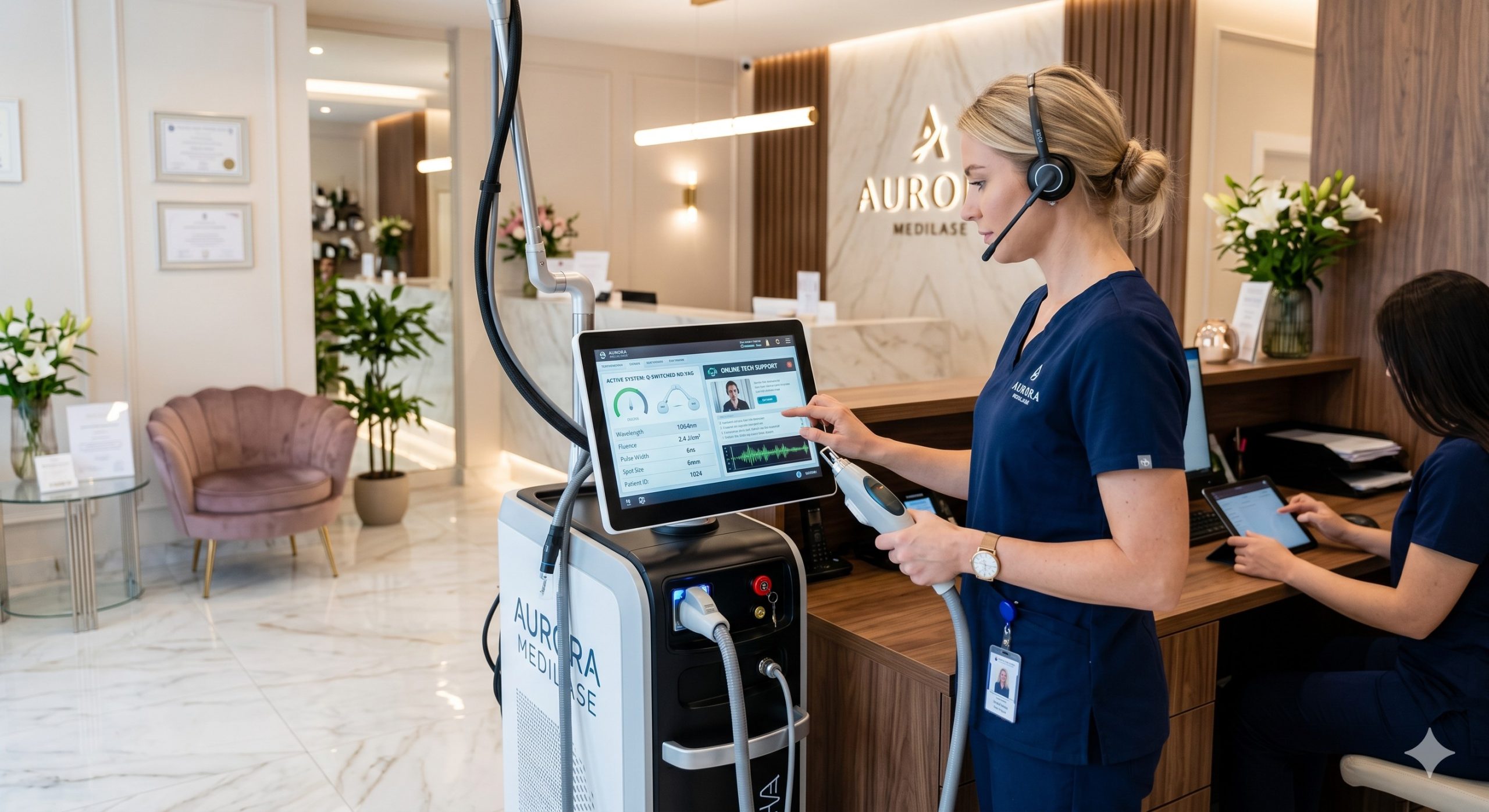
Most B2B suppliers provide 2 days of on-site training covering Fitzpatrick parameter setting, spot size selection, adverse effect management, and maintenance logging. The training package includes a certification exam for up to 4 staff members, a 200-page operations manual, and 6 months of remote technical support. Advanced courses (available for $1,500) cover combination therapies like Q-switch plus tranexamic acid microinjections for refractory melasma.
Q7: Can the same Q-switched laser device treat other pigmented lesions?
Yes, a medical-grade Q-switched laser is a multipurpose platform for nevus of Ota, café-au-lait macules, freckles, lentigines, and traumatic tattoos. The 532nm wavelength targets reds, yellows, and epidermal lesions, while 1064nm reaches deeper dermal pigmentation. This versatility increases your clinic’s ROI by enabling 8-12 additional treatment categories beyond melasma, with typical session pricing ranging from $200-$600 depending on lesion size and complexity.