Q-Switch Nd:YAG Laser Tattoo Removal Efficacy Whitepaper – Official Clinical Overview & Technical Datasheet
EXECUTIVE SUMMARY
This document provides a comprehensive clinical and technical overview of the Q-Switched Nd:YAG laser system for tattoo removal. As the gold standard in aesthetic pigment clearance, this platform leverages the principles of selective photothermolysis to achieve safe and effective fragmentation of dermal ink particles. The 1064nm wavelength offers deep tissue penetration with minimal epidermal melanin absorption, making it suitable for a broad range of Fitzpatrick skin types. Recent clinical evidence highlights that advanced treatment protocols, such as the two-pass or R15 methods, can significantly enhance clearance rates without compromising patient safety, achieving up to 85% clearance in as few as two sessions . This whitepaper details the clinical architecture, technical specifications, and operational protocols that define this premium aesthetic solution.
 CLINICAL ARCHITECTURE & DESIGN
The Q-Switched Nd:YAG laser operates on the principle of selective photothermolysis, utilizing high-peak-power pulses in the nanosecond domain to generate a strong photoacoustic effect. This mechanism mechanically shatters tattoo pigment particles into smaller fragments, which are subsequently eliminated by the body’s lymphatic system. The system architecture is engineered to deliver precise energy transmission, ensuring consistent fluence across the entire treatment spot for predictable clinical outcomes.
**Optical Source & Laser Bars**
The core of the system consists of a solid-state Nd:YAG crystal that produces a 1064nm wavelength in Q-switched mode. This wavelength is specifically absorbed by black, blue, and dark green tattoo inks, while being relatively spared by melanin, thus reducing the risk of dyspigmentation. The integrated optics ensure a high beam quality (M2 < 1.3) and a uniform spatial profile to prevent hot spots and ensure even energy distribution across the treatment area .
**Epidermal Protection Mechanisms**
To preserve the integrity of the epidermis during high-fluence treatments, the system features an advanced cooling mechanism. Utilizing a combination of contact sapphire cooling, thermoelectric cooling (TEC), and water circulation, the system ensures continuous epidermal cooling before, during, and after the laser pulse. This protects the skin from thermal injury, enhances patient comfort, and allows for the use of higher, more clinically effective fluencies.
KEY INDICATIONS & CAPABILITIES
The system is primarily indicated for the removal of unwanted tattoos, including:
- **Amateur and Professional Tattoos:** Highly effective on blue-black pigmentation, with studies showing >75% clearance in 77% of black tattoos after four sessions .
– **Traumatic Tattoos:** Effective for clearing pigment embedded due to abrasion or injury.
– **Multicolored Tattoos:** While the 1064nm wavelength is optimal for dark inks, the system’s architecture supports the integration of additional wavelengths (e.g., 532nm via KTP) for targeting red, orange, and yellow pigments .
– **Diverse Skin Types:** The longer 1064nm wavelength and advanced cooling allow for safe and effective treatment across a wide range of skin phototypes, including darker skin types (III-VI) .
COMPLIANCE & STANDARDS
This device is manufactured in accordance with the highest international standards for medical devices. It is CE-marked and complies with the essential requirements of the Medical Device Regulation (MDR). The system also meets the rigorous safety and performance benchmarks set by the FDA for laser products, including 21 CFR 1040.10 and 1040.11. The unit is designed with multiple redundant safety interlocks, including a patient activation switch and a key-lock system, to ensure operator and patient safety.
TECHNICAL SPECIFICATIONS
The following table outlines the verified performance parameters for the Q-Switched Nd:YAG laser system. Values are typical and may vary slightly depending on system configuration and calibration.
CLINICAL ARCHITECTURE & DESIGN
The Q-Switched Nd:YAG laser operates on the principle of selective photothermolysis, utilizing high-peak-power pulses in the nanosecond domain to generate a strong photoacoustic effect. This mechanism mechanically shatters tattoo pigment particles into smaller fragments, which are subsequently eliminated by the body’s lymphatic system. The system architecture is engineered to deliver precise energy transmission, ensuring consistent fluence across the entire treatment spot for predictable clinical outcomes.
**Optical Source & Laser Bars**
The core of the system consists of a solid-state Nd:YAG crystal that produces a 1064nm wavelength in Q-switched mode. This wavelength is specifically absorbed by black, blue, and dark green tattoo inks, while being relatively spared by melanin, thus reducing the risk of dyspigmentation. The integrated optics ensure a high beam quality (M2 < 1.3) and a uniform spatial profile to prevent hot spots and ensure even energy distribution across the treatment area .
**Epidermal Protection Mechanisms**
To preserve the integrity of the epidermis during high-fluence treatments, the system features an advanced cooling mechanism. Utilizing a combination of contact sapphire cooling, thermoelectric cooling (TEC), and water circulation, the system ensures continuous epidermal cooling before, during, and after the laser pulse. This protects the skin from thermal injury, enhances patient comfort, and allows for the use of higher, more clinically effective fluencies.
KEY INDICATIONS & CAPABILITIES
The system is primarily indicated for the removal of unwanted tattoos, including:
- **Amateur and Professional Tattoos:** Highly effective on blue-black pigmentation, with studies showing >75% clearance in 77% of black tattoos after four sessions .
– **Traumatic Tattoos:** Effective for clearing pigment embedded due to abrasion or injury.
– **Multicolored Tattoos:** While the 1064nm wavelength is optimal for dark inks, the system’s architecture supports the integration of additional wavelengths (e.g., 532nm via KTP) for targeting red, orange, and yellow pigments .
– **Diverse Skin Types:** The longer 1064nm wavelength and advanced cooling allow for safe and effective treatment across a wide range of skin phototypes, including darker skin types (III-VI) .
COMPLIANCE & STANDARDS
This device is manufactured in accordance with the highest international standards for medical devices. It is CE-marked and complies with the essential requirements of the Medical Device Regulation (MDR). The system also meets the rigorous safety and performance benchmarks set by the FDA for laser products, including 21 CFR 1040.10 and 1040.11. The unit is designed with multiple redundant safety interlocks, including a patient activation switch and a key-lock system, to ensure operator and patient safety.
TECHNICAL SPECIFICATIONS
The following table outlines the verified performance parameters for the Q-Switched Nd:YAG laser system. Values are typical and may vary slightly depending on system configuration and calibration.
CLINICAL PROTOCOLS
**Treatment Parameters**
Optimal clinical outcomes depend on appropriate parameter selection based on tattoo characteristics and skin type. The following are general guidelines derived from clinical studies:
– **Spot Size:** A larger spot size (e.g., 6mm) allows for deeper penetration of the laser energy, which is crucial for targeting ink in the deeper dermis. A 4mm spot size may be used for more precise targeting of smaller tattoos or resistant areas .
– **Fluence:** Clinical efficacy is dose-dependent, with higher fluences (e.g., 10-12 J/cm²) yielding better clearance. However, fluence should be adjusted based on patient skin type and immediate tissue response (the “frosting” effect) to minimize the risk of adverse events .
– **Pulse Repetition:** The system operates at frequencies up to 5-10 Hz, enabling rapid coverage of large tattoo areas. Treatment of professional tattoos typically requires 4-8 sessions to achieve significant clearance, whereas amateur tattoos may respond faster .
**Advanced Protocol Recommendations**
Recent comparative trials have demonstrated that administering multiple passes within a single session can significantly enhance clinical efficacy.
– **Two-Pass Method:** A study showed that a two-pass laser treatment with a 15-minute interval achieved the highest clearance degree (3.47 ± 0.68) compared to a single-shot method (2.72 ± 0.62) . This protocol leverages the resolution of the “frosting” effect (gas bubbles in the dermis) between passes to allow the laser energy to penetrate to successively deeper layers.
– **R15 Method:** This three-pass, one-session procedure (15-minute intervals) using a 1064nm QS Nd:YAG laser is recommended for thread-like tattoos. The method is less time-consuming and reduces the frequency of patient visits, with comparable efficacy to conventional monthly single-pass regimens. However, caution is advised for dense, band-like tattoos due to an increased risk of blistering and scarring .
**Post-Treatment Care**
Following treatment, patients may experience transient erythema, edema, and a whitening of the skin (frosting) that usually resolves within 20-30 minutes. Application of a cold compress or topical antibiotic ointment is recommended to soothe the skin and prevent infection. Patients should be advised to avoid sun exposure to the treated area and use a high-SPF sunscreen to prevent post-inflammatory hyperpigmentation.
CLINICAL ARCHITECTURE & DESIGN
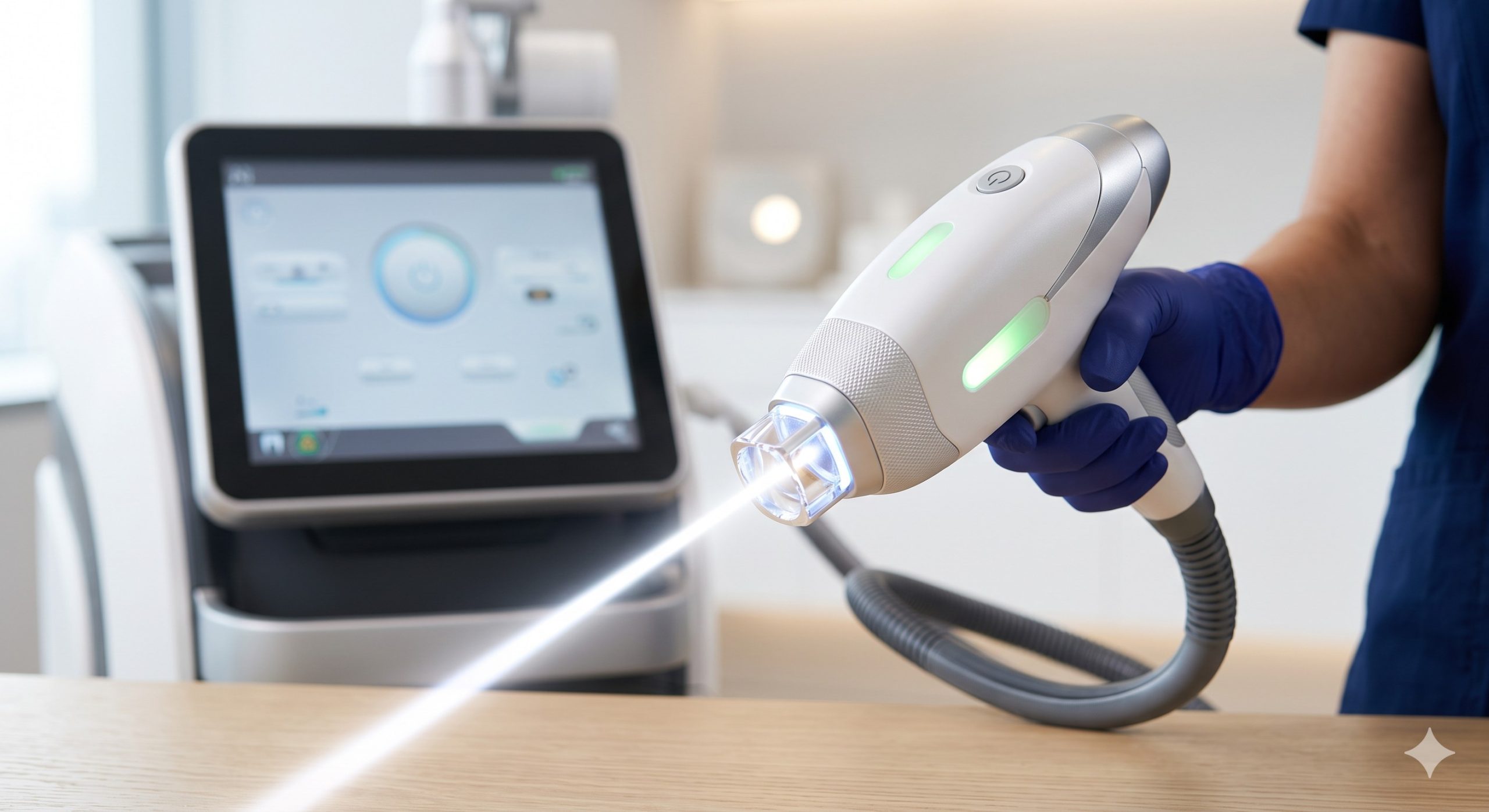
The Q-Switched Nd:YAG laser operates on the principle of selective photothermolysis, utilizing high-peak-power pulses in the nanosecond domain to generate a strong photoacoustic effect. This mechanism mechanically shatters tattoo pigment particles into smaller fragments, which are subsequently eliminated by the body’s lymphatic system. The system architecture is engineered to deliver precise energy transmission, ensuring consistent fluence across the entire treatment spot for predictable clinical outcomes.
**Optical Source & Laser Bars**
The core of the system consists of a solid-state Nd:YAG crystal that produces a 1064nm wavelength in Q-switched mode. This wavelength is specifically absorbed by black, blue, and dark green tattoo inks, while being relatively spared by melanin, thus reducing the risk of dyspigmentation. The integrated optics ensure a high beam quality (M2 < 1.3) and a uniform spatial profile to prevent hot spots and ensure even energy distribution across the treatment area .
**Epidermal Protection Mechanisms**
To preserve the integrity of the epidermis during high-fluence treatments, the system features an advanced cooling mechanism. Utilizing a combination of contact sapphire cooling, thermoelectric cooling (TEC), and water circulation, the system ensures continuous epidermal cooling before, during, and after the laser pulse. This protects the skin from thermal injury, enhances patient comfort, and allows for the use of higher, more clinically effective fluencies.
KEY INDICATIONS & CAPABILITIES
The system is primarily indicated for the removal of unwanted tattoos, including:
- **Amateur and Professional Tattoos:** Highly effective on blue-black pigmentation, with studies showing >75% clearance in 77% of black tattoos after four sessions .
– **Traumatic Tattoos:** Effective for clearing pigment embedded due to abrasion or injury.
– **Multicolored Tattoos:** While the 1064nm wavelength is optimal for dark inks, the system’s architecture supports the integration of additional wavelengths (e.g., 532nm via KTP) for targeting red, orange, and yellow pigments .
– **Diverse Skin Types:** The longer 1064nm wavelength and advanced cooling allow for safe and effective treatment across a wide range of skin phototypes, including darker skin types (III-VI) .
COMPLIANCE & STANDARDS
This device is manufactured in accordance with the highest international standards for medical devices. It is CE-marked and complies with the essential requirements of the Medical Device Regulation (MDR). The system also meets the rigorous safety and performance benchmarks set by the FDA for laser products, including 21 CFR 1040.10 and 1040.11. The unit is designed with multiple redundant safety interlocks, including a patient activation switch and a key-lock system, to ensure operator and patient safety.
TECHNICAL SPECIFICATIONS
The following table outlines the verified performance parameters for the Q-Switched Nd:YAG laser system. Values are typical and may vary slightly depending on system configuration and calibration.
| Parameter | Specification |
|---|---|
| Laser Type / Wavelength | Q-Switched Nd:YAG / 1064 nm (with optional 532 nm via KTP) |
| Pulse Duration | ≤ 10 ns (Nanosecond Domain) |
| Spot Size (Adjustable) | 2 – 8 mm (optimized for dermal penetration) |
| Maximum Fluence | Up to 12 J/cm² (dose-dependent for efficacy) |
| Repetition Rate | 1 – 10 Hz |
| Cooling System | Integrated Contact Sapphire + TEC + Water Circulation |
| Beam Quality (M²) | < 1.3 (ensures uniform energy distribution) |
| Power Supply | 100-240 VAC, 50/60 Hz |
| Dimensions (Approx.) | 450 x 180 x 95 mm (console) |
| Weight (Approx.) | 10 kg (head unit) |
📥 Download Technical Specification
Click the button below to view or download the full official PDF datasheet.
⬇️ Download Official PDF