
Monopolar RF Skin Tightening Machine – Official Clinical Overview & Technical Datasheet
DEVICE IDENTIFICATION & ROLE IN DERMATOLOGY
The Monopolar RF Skin Tightening Machine represents a Class IIa medical device engineered for non-invasive dermal remodeling. Operating on the principle of volumetric resistive heating, the device delivers controlled deep dermal coagulation while preserving the epidermal layer. This platform is indicated for mild-to-moderate skin laxity reduction on the face, neck, abdomen, and extremities.
 INTERNAL HARDWARE TOPOLOGY
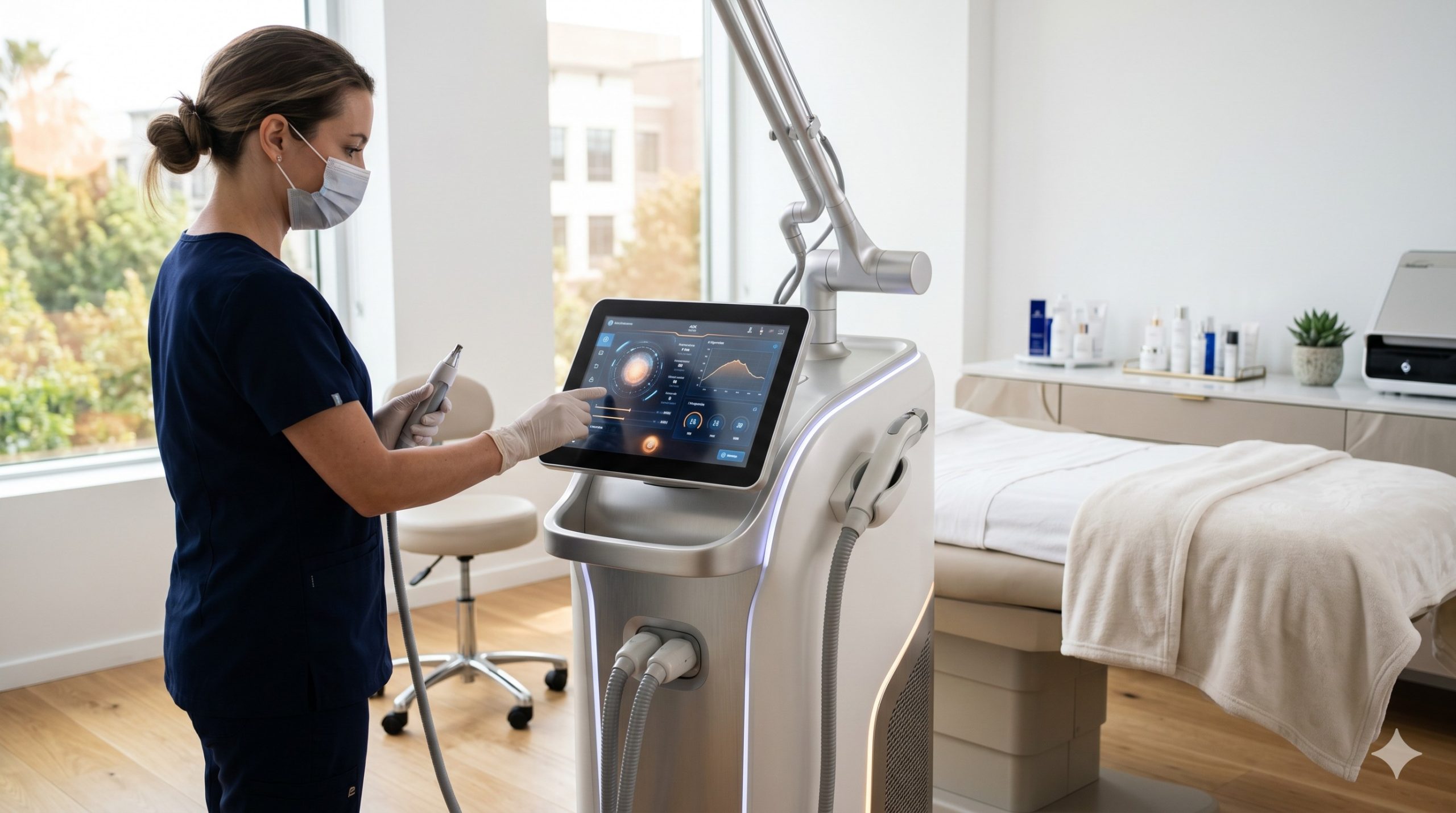
The system integrates a high-efficiency 1.0 MHz – 4.0 MHz tunable RF generator coupled with a closed-loop impedance monitoring circuit. The mainboard architecture includes an isolated power supply unit (PSU), a capacitive touch interface controller, and dual-channel temperature feedback processors. Energy is transmitted through a single-pole active electrode handpiece, with a large dispersive return pad ensuring complete circuit closure. An onboard microcontroller performs 1,000+ impedance readings per second to modulate energy output in real-time, preventing localized hotspots.
EPIDERMAL PROTECTION MECHANISMS
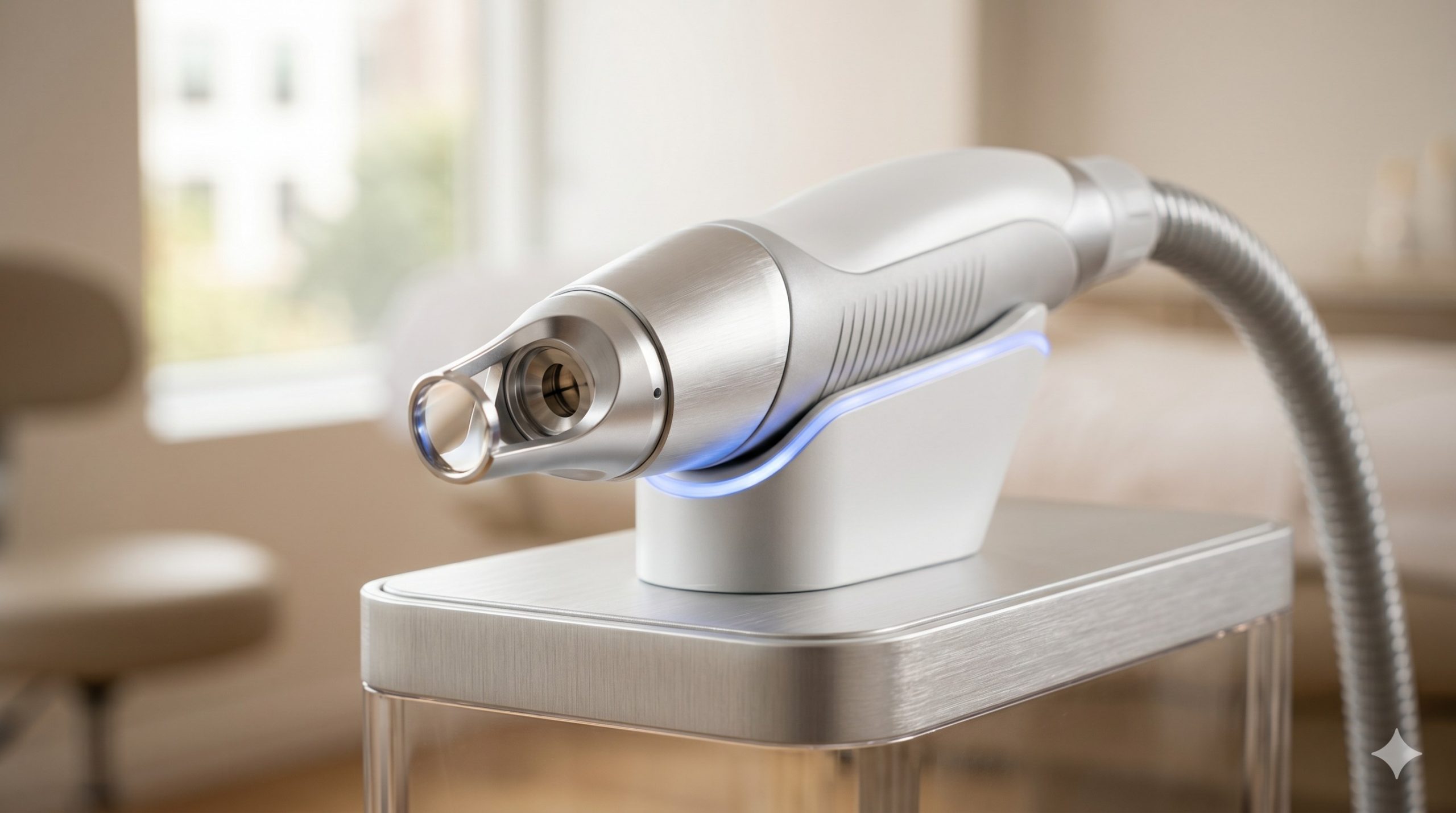
To ensure patient safety across Fitzpatrick skin types I-VI, the device employs a contact-cooled sapphire tip (0°C to +4°C) integrated into the treatment handpiece. This active cooling system creates a thermal gradient: the epidermis remains below 42°C while the target dermal layer reaches therapeutic temperatures of 55°C to 65°C. Additional safety layers include: (1) automatic energy shut-off if skin impedance rises above 180 ohms, (2) real-time temperature monitoring via an infrared thermopile, and (3) a motion detection sensor that halts RF output if the handpiece remains stationary for >0.5 seconds.
TREATMENT ADVANTAGES
– Immediate collagen contraction (primary effect) followed by neocollagenesis over 3-6 months
– Uniform volumetric heating up to 5mm – 8mm penetration depth
– Zero post-treatment downtime with minimal patient discomfort
– Applicable to periorbital, submental, and body contouring zones
– No consumable gels required beyond standard conductive gel
SPECIFICATION MATRIX
INTERNAL HARDWARE TOPOLOGY
The system integrates a high-efficiency 1.0 MHz – 4.0 MHz tunable RF generator coupled with a closed-loop impedance monitoring circuit. The mainboard architecture includes an isolated power supply unit (PSU), a capacitive touch interface controller, and dual-channel temperature feedback processors. Energy is transmitted through a single-pole active electrode handpiece, with a large dispersive return pad ensuring complete circuit closure. An onboard microcontroller performs 1,000+ impedance readings per second to modulate energy output in real-time, preventing localized hotspots.
EPIDERMAL PROTECTION MECHANISMS
To ensure patient safety across Fitzpatrick skin types I-VI, the device employs a contact-cooled sapphire tip (0°C to +4°C) integrated into the treatment handpiece. This active cooling system creates a thermal gradient: the epidermis remains below 42°C while the target dermal layer reaches therapeutic temperatures of 55°C to 65°C. Additional safety layers include: (1) automatic energy shut-off if skin impedance rises above 180 ohms, (2) real-time temperature monitoring via an infrared thermopile, and (3) a motion detection sensor that halts RF output if the handpiece remains stationary for >0.5 seconds.
TREATMENT ADVANTAGES
– Immediate collagen contraction (primary effect) followed by neocollagenesis over 3-6 months
– Uniform volumetric heating up to 5mm – 8mm penetration depth
– Zero post-treatment downtime with minimal patient discomfort
– Applicable to periorbital, submental, and body contouring zones
– No consumable gels required beyond standard conductive gel
SPECIFICATION MATRIX
REGULATORY COMPLIANCE
The device holds CE Mark (MDR 2017/745) and 510(k) clearance for over-the-counter secondary sale in specific markets. Compliance includes IEC 60601-1 (Medical Electrical Equipment Safety), IEC 60601-2-2 (High Frequency Surgical Equipment), and IEC 60601-1-11 (Home Healthcare Environment). The system is manufactured under ISO 13485:2016 certified facilities, with full electromagnetic compatibility (EMC) testing per CISPR 11 Group 1 Class A.
 CLINICAL PROTOCOLS (EXCERPT)
– Pre-treatment: Remove all metal jewelry and apply 2-3mm layer of conductive gel.
– Parameter initiation: 15-30W for facial applications; 30-50W for body.
– Technique: slow circular passes (0.5-1 cm/sec) with continuous skin contact.
– Endpoint: mild erythema (1-2/10) and surface temperature of 39°C-41°C.
– Session duration: 20-40 minutes per anatomical area.
– Protocol: 3-6 sessions spaced 4 weeks apart; maintenance every 6 months.
CLINICAL PROTOCOLS (EXCERPT)
– Pre-treatment: Remove all metal jewelry and apply 2-3mm layer of conductive gel.
– Parameter initiation: 15-30W for facial applications; 30-50W for body.
– Technique: slow circular passes (0.5-1 cm/sec) with continuous skin contact.
– Endpoint: mild erythema (1-2/10) and surface temperature of 39°C-41°C.
– Session duration: 20-40 minutes per anatomical area.
– Protocol: 3-6 sessions spaced 4 weeks apart; maintenance every 6 months.
INTERNAL HARDWARE TOPOLOGY
The system integrates a high-efficiency 1.0 MHz – 4.0 MHz tunable RF generator coupled with a closed-loop impedance monitoring circuit. The mainboard architecture includes an isolated power supply unit (PSU), a capacitive touch interface controller, and dual-channel temperature feedback processors. Energy is transmitted through a single-pole active electrode handpiece, with a large dispersive return pad ensuring complete circuit closure. An onboard microcontroller performs 1,000+ impedance readings per second to modulate energy output in real-time, preventing localized hotspots.
EPIDERMAL PROTECTION MECHANISMS
To ensure patient safety across Fitzpatrick skin types I-VI, the device employs a contact-cooled sapphire tip (0°C to +4°C) integrated into the treatment handpiece. This active cooling system creates a thermal gradient: the epidermis remains below 42°C while the target dermal layer reaches therapeutic temperatures of 55°C to 65°C. Additional safety layers include: (1) automatic energy shut-off if skin impedance rises above 180 ohms, (2) real-time temperature monitoring via an infrared thermopile, and (3) a motion detection sensor that halts RF output if the handpiece remains stationary for >0.5 seconds.
TREATMENT ADVANTAGES
– Immediate collagen contraction (primary effect) followed by neocollagenesis over 3-6 months
– Uniform volumetric heating up to 5mm – 8mm penetration depth
– Zero post-treatment downtime with minimal patient discomfort
– Applicable to periorbital, submental, and body contouring zones
– No consumable gels required beyond standard conductive gel
SPECIFICATION MATRIX
| Parameter | Specification |
|---|---|
| RF Frequency | 1.0 MHz ± 10% (Tunable to 4.0 MHz optional) |
| Maximum Output Power | 200W (Continuous wave) |
| Impedance Range | 20 – 180 Ω (Auto-adjusting) |
| Cooling System | TEC + Sapphire contact cooling (0°C to +20°C adjustable) |
| Handpiece Active Tip Area | 3.0 cm² (Standard); 1.5 cm² (Periorbital optional) |
| Penetration Depth | 5-8 mm (At 1.0 MHz) |
| Temperature Monitoring | Dual IR sensors (±0.5°C accuracy) |
| Display | 8-inch Capacitive Touchscreen, 1280×800 resolution |
| Power Supply | AC 110-240V, 50/60Hz, 600VA max |
| Unit Dimensions (WxDxH) | 380mm x 420mm x 180mm |
| Weight | 12.5 kg (Main console only) |
CLINICAL PROTOCOLS (EXCERPT)
– Pre-treatment: Remove all metal jewelry and apply 2-3mm layer of conductive gel.
– Parameter initiation: 15-30W for facial applications; 30-50W for body.
– Technique: slow circular passes (0.5-1 cm/sec) with continuous skin contact.
– Endpoint: mild erythema (1-2/10) and surface temperature of 39°C-41°C.
– Session duration: 20-40 minutes per anatomical area.
– Protocol: 3-6 sessions spaced 4 weeks apart; maintenance every 6 months.
📥 Download Technical Specification
Click the button below to view or download the full official PDF datasheet.
⬇️ Download Official PDF