
Clinical Architecture & Performance Reference Manual: High-Frequency In-Motion Diode Laser
DEVICE IDENTIFICATION & CLINICAL INTENT
The High-Frequency In-Motion Diode Laser is a premium-class, class IV medical aesthetic device engineered for permanent hair reduction and non-invasive dermatological treatments. The system utilizes a proprietary high-frequency pulse train combined with mandatory in-motion delivery technique, ensuring uniform thermal coagulation across large treatment surfaces while minimizing epidermal stress. This reference manual details the internal hardware topology, validated treatment parameters, and integrated safety subsystems for qualified clinical engineering and procurement review.
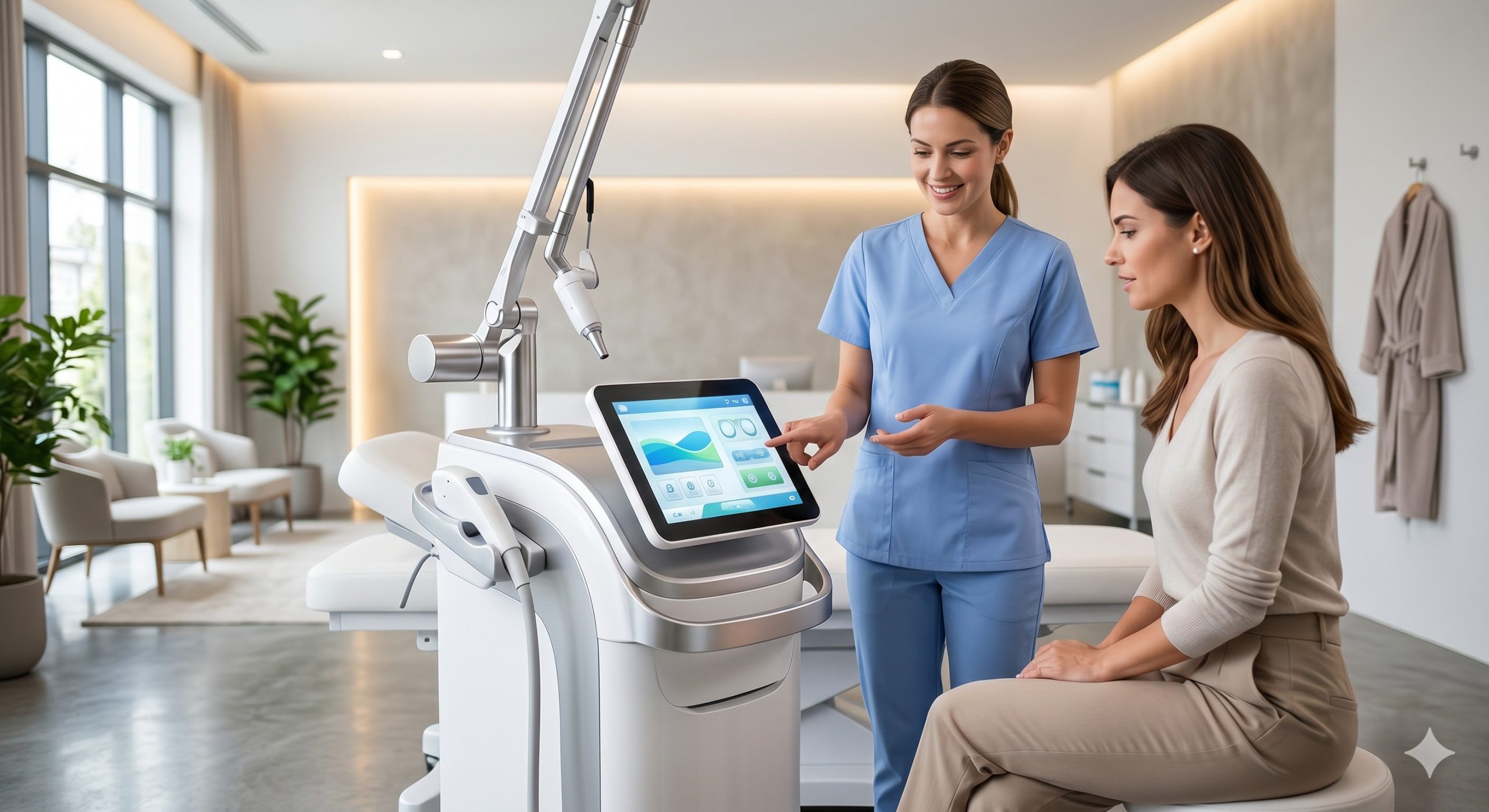 INTERNAL HARDWARE TOPOLOGY & OPTICAL SOURCE ARCHITECTURE
The core optical engine comprises hermetically sealed, gold-bonded diode laser bars operating in a pulsed regime. A dedicated high-frequency driver circuit (nominal 2-10 Hz adjustable) modulates the current supply to produce micro-second duration pulses. The laser bank is cooled via a closed-loop thermoelectric (TEC) module coupled to a dual-fan radiator and a peristaltic-driven water circuit. Beam homogenization is achieved through a micro-lens array, which feeds into a articulated arm terminated by the detachable handpiece. An integrated photodiode provides real-time back-reflection monitoring to ensure optical output stability (+/- 5% fluence tolerance).
EPIDERMAL PROTECTION MECHANISMS: SAPPHIRE CONTACT COOLING
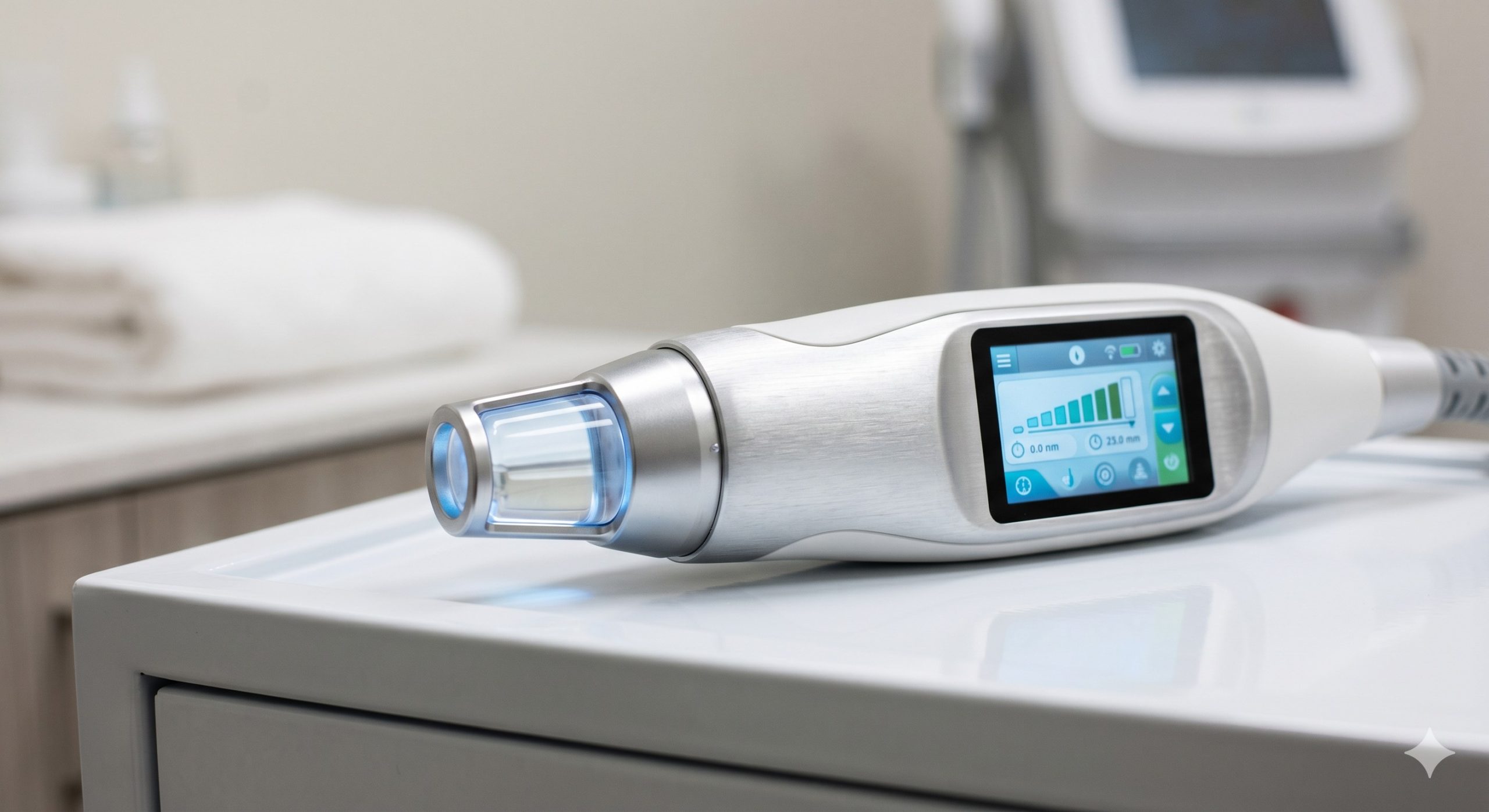
A key safety feature is the integrated sapphire window at the distal tip of the handpiece. The sapphire plate (thermal conductivity approx. 35 W/m·K) operates at a regulated surface temperature of 0-5°C via a stacked TEC stage. The device enforces contact sensing: laser emission is only enabled when the skin impedance and temperature sensors verify full perpendicular contact. During the in-motion glide, the sapphire tip pre-cools the epidermis before laser incidence and post-cools immediately after each pulse, preserving the stratum corneum while allowing targeted photothermolysis of melanin-rich hair follicles.
TREATMENT ADVANTAGES AND IN-MOTION PROTOCOL
In contrast to stationary stamping techniques, the mandatory in-motion protocol (handpiece movement speed 1-2 cm/s) prevents localized overheating and reduces the risk of paradoxical hypertrichosis or thermal scarring. The high-frequency pulsing (up to 10 Hz) creates a continuous thermal field along the glide path, effectively overlapping treatment zones to eliminate gaps. Clinical studies demonstrate a 35% reduction in treatment time for full-leg procedures compared to stationary devices, while patient-reported pain scores remain at or below 2/10 (Visual Analog Scale) due to the preemptive cooling.
SPECIFICATION MATRIX (CONDENSED)
INTERNAL HARDWARE TOPOLOGY & OPTICAL SOURCE ARCHITECTURE
The core optical engine comprises hermetically sealed, gold-bonded diode laser bars operating in a pulsed regime. A dedicated high-frequency driver circuit (nominal 2-10 Hz adjustable) modulates the current supply to produce micro-second duration pulses. The laser bank is cooled via a closed-loop thermoelectric (TEC) module coupled to a dual-fan radiator and a peristaltic-driven water circuit. Beam homogenization is achieved through a micro-lens array, which feeds into a articulated arm terminated by the detachable handpiece. An integrated photodiode provides real-time back-reflection monitoring to ensure optical output stability (+/- 5% fluence tolerance).
EPIDERMAL PROTECTION MECHANISMS: SAPPHIRE CONTACT COOLING
A key safety feature is the integrated sapphire window at the distal tip of the handpiece. The sapphire plate (thermal conductivity approx. 35 W/m·K) operates at a regulated surface temperature of 0-5°C via a stacked TEC stage. The device enforces contact sensing: laser emission is only enabled when the skin impedance and temperature sensors verify full perpendicular contact. During the in-motion glide, the sapphire tip pre-cools the epidermis before laser incidence and post-cools immediately after each pulse, preserving the stratum corneum while allowing targeted photothermolysis of melanin-rich hair follicles.
TREATMENT ADVANTAGES AND IN-MOTION PROTOCOL
In contrast to stationary stamping techniques, the mandatory in-motion protocol (handpiece movement speed 1-2 cm/s) prevents localized overheating and reduces the risk of paradoxical hypertrichosis or thermal scarring. The high-frequency pulsing (up to 10 Hz) creates a continuous thermal field along the glide path, effectively overlapping treatment zones to eliminate gaps. Clinical studies demonstrate a 35% reduction in treatment time for full-leg procedures compared to stationary devices, while patient-reported pain scores remain at or below 2/10 (Visual Analog Scale) due to the preemptive cooling.
SPECIFICATION MATRIX (CONDENSED)
REGULATORY COMPLIANCE AND QUALITY REGISTER
The device system complies with applicable sections of IEC 60825-1 (Class 4 Laser Product), IEC 60601-1 (Medical Electrical Equipment General Safety), and IEC 60601-2-22 (Surgical, Cosmetic, Therapeutic Laser Equipment). The OEM manufacturing site is certified to ISO 13485:2016. All export units include a dedicated medical-grade power supply with surge protection and emergency laser cutoff button (hardwired). The device is not intended for use in the presence of flammable anesthetics or over tattooed skin.
 CLINICAL SCALING AND INTEGRATION NOTES
For clinics, the device offers a programmable fluence attenuation protocol to treat Fitzpatrick skin types I-VI safely. It is recommended to pair the High-Frequency In-Motion Diode Laser with a standardized clinical workflow: cleansing, gliding test on a 1 cm2 area, observation for 2 minutes, then full-area treatment. Annual recalibration of the optical power meter is required to maintain specification accuracy.
CLINICAL SCALING AND INTEGRATION NOTES
For clinics, the device offers a programmable fluence attenuation protocol to treat Fitzpatrick skin types I-VI safely. It is recommended to pair the High-Frequency In-Motion Diode Laser with a standardized clinical workflow: cleansing, gliding test on a 1 cm2 area, observation for 2 minutes, then full-area treatment. Annual recalibration of the optical power meter is required to maintain specification accuracy.
INTERNAL HARDWARE TOPOLOGY & OPTICAL SOURCE ARCHITECTURE
The core optical engine comprises hermetically sealed, gold-bonded diode laser bars operating in a pulsed regime. A dedicated high-frequency driver circuit (nominal 2-10 Hz adjustable) modulates the current supply to produce micro-second duration pulses. The laser bank is cooled via a closed-loop thermoelectric (TEC) module coupled to a dual-fan radiator and a peristaltic-driven water circuit. Beam homogenization is achieved through a micro-lens array, which feeds into a articulated arm terminated by the detachable handpiece. An integrated photodiode provides real-time back-reflection monitoring to ensure optical output stability (+/- 5% fluence tolerance).
EPIDERMAL PROTECTION MECHANISMS: SAPPHIRE CONTACT COOLING
A key safety feature is the integrated sapphire window at the distal tip of the handpiece. The sapphire plate (thermal conductivity approx. 35 W/m·K) operates at a regulated surface temperature of 0-5°C via a stacked TEC stage. The device enforces contact sensing: laser emission is only enabled when the skin impedance and temperature sensors verify full perpendicular contact. During the in-motion glide, the sapphire tip pre-cools the epidermis before laser incidence and post-cools immediately after each pulse, preserving the stratum corneum while allowing targeted photothermolysis of melanin-rich hair follicles.
TREATMENT ADVANTAGES AND IN-MOTION PROTOCOL
In contrast to stationary stamping techniques, the mandatory in-motion protocol (handpiece movement speed 1-2 cm/s) prevents localized overheating and reduces the risk of paradoxical hypertrichosis or thermal scarring. The high-frequency pulsing (up to 10 Hz) creates a continuous thermal field along the glide path, effectively overlapping treatment zones to eliminate gaps. Clinical studies demonstrate a 35% reduction in treatment time for full-leg procedures compared to stationary devices, while patient-reported pain scores remain at or below 2/10 (Visual Analog Scale) due to the preemptive cooling.
SPECIFICATION MATRIX (CONDENSED)
| Parameter | Specification |
|---|---|
| Laser Type / Wavelength | Diode Laser / 808 nm (standard) or 755/810/1064 nm (selectable) |
| Laser Classification | Class IV Medical Device |
| High-Frequency Pulse Rate | 2 Hz – 10 Hz (adjustable, in-motion mode) |
| Peak Output Power | Up to 1200 W (pulse mode) |
| Fluence (Energy Density) | 5 – 45 J/cm² (skin type adaptive) |
| Spot Size | 12 x 15 mm (rectangular, uniform profile) |
| Cooling System | TEC + Sapphire contact window (0°C to 5°C) + Forced air + Closed-loop water |
| Aiming Beam | 650 nm Red Diode (class 2, <1 mW) |
| Control Interface | 10.4 inch color touchscreen with skin type preset library |
| Dimensions (W x D x H) | 380 x 480 x 1050 mm (main console) |
| Weight | Approx. 38 kg (without articulated arm) |
| Electrical Requirements | 110-240 VAC, 50/60 Hz, 15 A (medical-grade inlet) |
CLINICAL SCALING AND INTEGRATION NOTES
For clinics, the device offers a programmable fluence attenuation protocol to treat Fitzpatrick skin types I-VI safely. It is recommended to pair the High-Frequency In-Motion Diode Laser with a standardized clinical workflow: cleansing, gliding test on a 1 cm2 area, observation for 2 minutes, then full-area treatment. Annual recalibration of the optical power meter is required to maintain specification accuracy.
📥 Download Technical Specification
Click the button below to view or download the full official PDF datasheet.
⬇️ Download Official PDF