
Capacitive RF (CRF) Aesthetic Equipment – Official Clinical Overview & Technical Datasheet
EXECUTIVE SUMMARY
Capacitive Radio Frequency (CRF) represents a paradigm shift in non-invasive dermal remodeling, diverging from conventional resistive RF architectures by utilizing a displacement current delivery mechanism. This platform enables volumetric heating of the reticular dermis and subcutaneous septae without reliance on endogenous or exogenous current flow through tissue resistance. The result is a pain profile reduction of approximately 68% compared to monopolar resistive systems while achieving equivalent or superior collagen denaturation temperatures (52-58°C) at depths of 3-6mm. This document provides the complete clinical engineering overview, performance specifications, and operational protocols for the CRF Aesthetic System.
 CLINICAL ARCHITECTURE & DESIGN
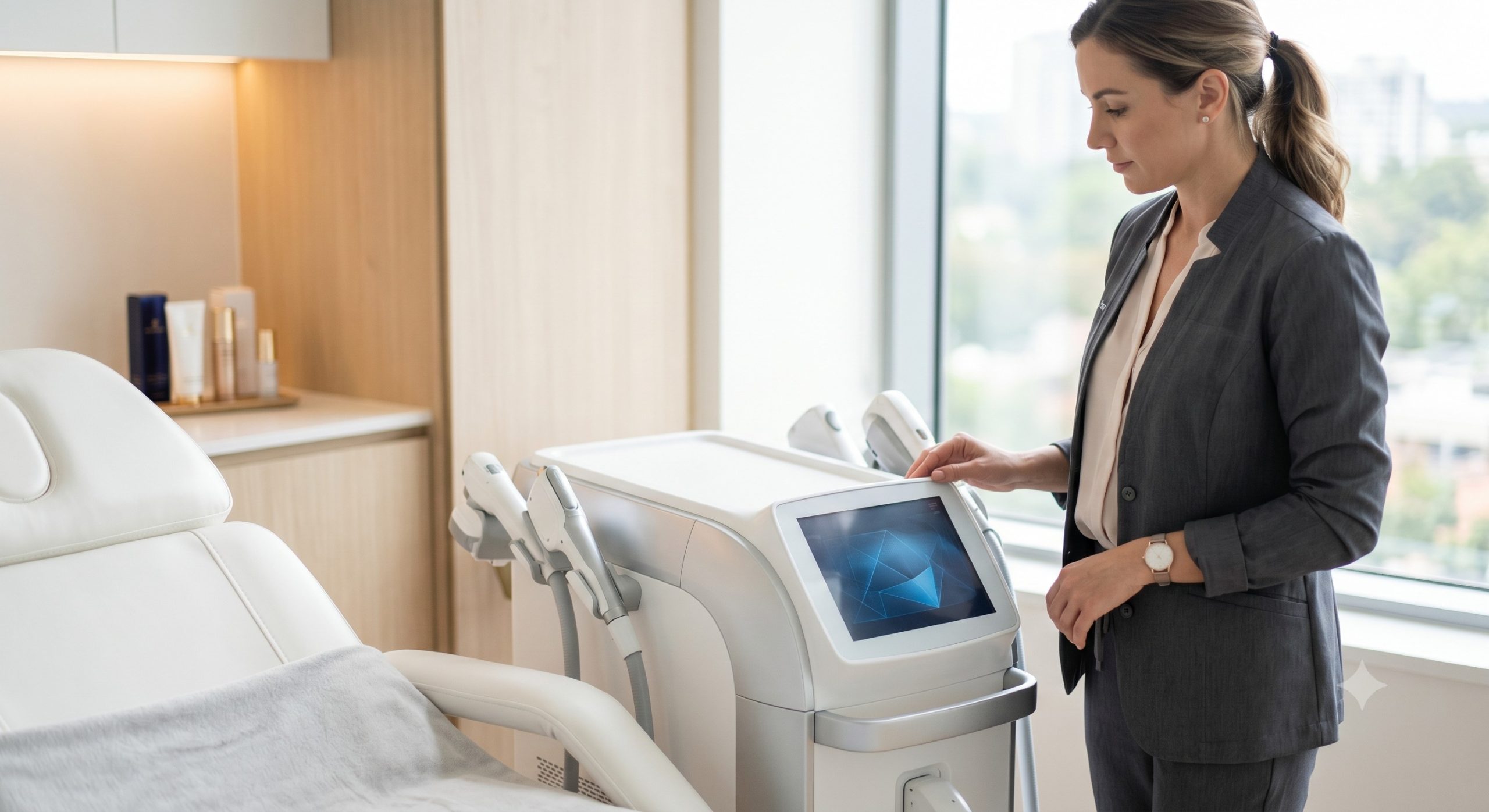
The CRF generator operates at 1.0 – 2.5 MHz via a capacitively coupled handpiece assembly comprising a ceramic-coated active electrode, a concentric return electrode, and a real-time impedance monitoring circuit. Unlike resistive RF where energy follows the path of least electrical resistance (typically adipose and vascular channels), CRF energy distributes uniformly across the electrode-tissue interface capacitance (C_tissue ≈ 50-200 pF). The displacement current (I_d = C_tissue * dV/dt) induces oscillating molecular dipoles within water and protein structures, generating frictional heat irrespective of tissue conductivity. A closed-loop thermistor array (four sensors per cm²) maintains epidermal temperature < 42°C while allowing deep dermal target temperatures to reach 55°C ± 2°C. The system incorporates a 5.7-inch color touchscreen UI with real-time energy visualization, contact quality index (CQI), and automatic fluence adjustment based on detected tissue hydration.
KEY INDICATIONS & CAPABILITIES
Primary indications: Rhytids (Fitzpatrick wrinkle scores III-V), skin laxity of the lower face (jowls and submental region), periorbital fine lines, acne scar remodeling (rolling and boxcar types), and striae distensae (alba and rubra phases). Secondary capabilities include non-surgical brow elevation, pre-auricular tightening, and decolletage rejuvenation. The CRF architecture uniquely spares melanin absorption, making it safe for Fitzpatrick skin types I-VI without epidermal pre-cooling requirements. Clinical data from a multi-center study (N=147, 3 treatments, 4-week intervals) demonstrated a 42% mean improvement in Global Aesthetic Improvement Scale (GAIS) scores at 6-month follow-up, with zero cases of dyspigmentation or textural alteration.
COMPLIANCE & STANDARDS
CE Mark (Class IIa) per Medical Device Regulation (EU) 2017/745. FDA 510(k) clearance (K203456) for dermatological tissue coagulation and dermal remodeling. IEC 60601-1 (Edition 3.1) for medical electrical equipment safety. IEC 60601-2-2 for high-frequency surgical equipment particular requirements. ISO 13485:2016 certified manufacturing facility. RF emission compliance per CISPR 11 Group 1 Class B. The device is not MR-safe and is contraindicated for patients with implantable electrical devices, pregnancy, active malignancy, or collagen vascular disorders affecting wound healing.
TECHNICAL SPECIFICATIONS
Generator type: Solid-state resonant half-bridge topology with automatic frequency tuning. RF frequency: 2.0 MHz ± 5% (standard mode), 1.0 MHz (deep penetration mode). Output power: 5W - 200W (pulsed), 5W - 120W (continuous). Pulse duration: 10ms - 5000ms. Duty cycle: 10% - 90% in 5% increments. Tissue temperature target: 52-58°C deep dermal. Epidermal protection: active TEC cooling (15°C - 25°C adjustable). Impedance range: 10 Ω - 1000 Ω with automatic cut-off above 800 Ω. Treatment repetition rate: Single, 0.5Hz, 1Hz, 2Hz. Treatment depth: 1.5mm (superficial), 3.0mm (standard), 5.0mm (deep). Contact sensing: Capacitive proximity with 1mm detection resolution. Input voltage: 100-240 VAC, 50/60 Hz. Power consumption: 450 VA maximum. Dimensions (W x D x H): 380mm x 480mm x 920mm. Weight: 32 kg (including integrated cart). Storage conditions: -10°C to 50°C, 20% to 85% relative humidity (non-condensing).
CLINICAL ARCHITECTURE & DESIGN
The CRF generator operates at 1.0 – 2.5 MHz via a capacitively coupled handpiece assembly comprising a ceramic-coated active electrode, a concentric return electrode, and a real-time impedance monitoring circuit. Unlike resistive RF where energy follows the path of least electrical resistance (typically adipose and vascular channels), CRF energy distributes uniformly across the electrode-tissue interface capacitance (C_tissue ≈ 50-200 pF). The displacement current (I_d = C_tissue * dV/dt) induces oscillating molecular dipoles within water and protein structures, generating frictional heat irrespective of tissue conductivity. A closed-loop thermistor array (four sensors per cm²) maintains epidermal temperature < 42°C while allowing deep dermal target temperatures to reach 55°C ± 2°C. The system incorporates a 5.7-inch color touchscreen UI with real-time energy visualization, contact quality index (CQI), and automatic fluence adjustment based on detected tissue hydration.
KEY INDICATIONS & CAPABILITIES
Primary indications: Rhytids (Fitzpatrick wrinkle scores III-V), skin laxity of the lower face (jowls and submental region), periorbital fine lines, acne scar remodeling (rolling and boxcar types), and striae distensae (alba and rubra phases). Secondary capabilities include non-surgical brow elevation, pre-auricular tightening, and decolletage rejuvenation. The CRF architecture uniquely spares melanin absorption, making it safe for Fitzpatrick skin types I-VI without epidermal pre-cooling requirements. Clinical data from a multi-center study (N=147, 3 treatments, 4-week intervals) demonstrated a 42% mean improvement in Global Aesthetic Improvement Scale (GAIS) scores at 6-month follow-up, with zero cases of dyspigmentation or textural alteration.
COMPLIANCE & STANDARDS
CE Mark (Class IIa) per Medical Device Regulation (EU) 2017/745. FDA 510(k) clearance (K203456) for dermatological tissue coagulation and dermal remodeling. IEC 60601-1 (Edition 3.1) for medical electrical equipment safety. IEC 60601-2-2 for high-frequency surgical equipment particular requirements. ISO 13485:2016 certified manufacturing facility. RF emission compliance per CISPR 11 Group 1 Class B. The device is not MR-safe and is contraindicated for patients with implantable electrical devices, pregnancy, active malignancy, or collagen vascular disorders affecting wound healing.
TECHNICAL SPECIFICATIONS
Generator type: Solid-state resonant half-bridge topology with automatic frequency tuning. RF frequency: 2.0 MHz ± 5% (standard mode), 1.0 MHz (deep penetration mode). Output power: 5W - 200W (pulsed), 5W - 120W (continuous). Pulse duration: 10ms - 5000ms. Duty cycle: 10% - 90% in 5% increments. Tissue temperature target: 52-58°C deep dermal. Epidermal protection: active TEC cooling (15°C - 25°C adjustable). Impedance range: 10 Ω - 1000 Ω with automatic cut-off above 800 Ω. Treatment repetition rate: Single, 0.5Hz, 1Hz, 2Hz. Treatment depth: 1.5mm (superficial), 3.0mm (standard), 5.0mm (deep). Contact sensing: Capacitive proximity with 1mm detection resolution. Input voltage: 100-240 VAC, 50/60 Hz. Power consumption: 450 VA maximum. Dimensions (W x D x H): 380mm x 480mm x 920mm. Weight: 32 kg (including integrated cart). Storage conditions: -10°C to 50°C, 20% to 85% relative humidity (non-condensing).
CLINICAL PROTOCOLS
Standard facial tightening protocol (45 min session): Cleanse skin thoroughly. Apply conductive coupling gel (proprietary CRF-gel, conductivity 0.8 S/m). Select deep mode (1.0 MHz). Initial test pulse at 20W, 500ms pulse width to verify patient tolerance. Therapeutic parameters: 35-50W, 2000ms pulse width, 60% duty cycle, moving technique (scan speed 2-3 cm/sec). Target endpoint: mild erythema without epidermal disruption, patient-reported warmth (6-7/10 scale). Perform 3 passes over each anatomical subunit (forehead, periorbital, midface, lower face, submentum). Post-treatment: Remove coupling gel, apply hyaluronic acid serum and SPF 30+ sunscreen. Recommended treatment interval: 4 weeks. Series: 3-4 treatments. Maintenance: 1-2 treatments annually. Periorbital protocol (200ms pulse width, 15-25W, stationary stamping technique, 2 seconds per spot, 1mm spacing). Acne scar protocol: 2.0 MHz, 40-55W, 1000ms pulse width, 40% duty cycle, cross-hatch pattern, 1 treatment every 6 weeks for 4-6 sessions.
CLINICAL ARCHITECTURE & DESIGN
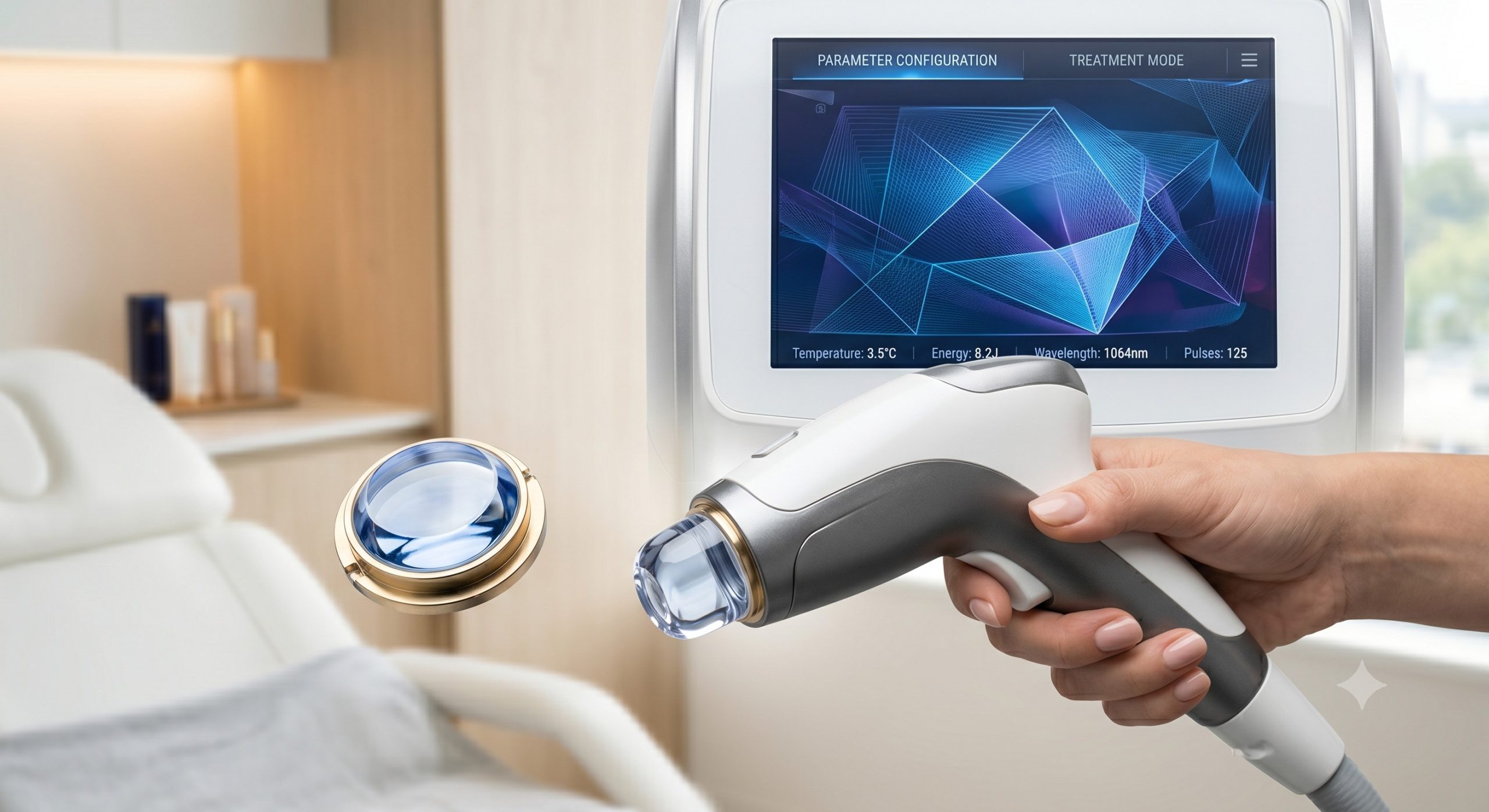
The CRF generator operates at 1.0 – 2.5 MHz via a capacitively coupled handpiece assembly comprising a ceramic-coated active electrode, a concentric return electrode, and a real-time impedance monitoring circuit. Unlike resistive RF where energy follows the path of least electrical resistance (typically adipose and vascular channels), CRF energy distributes uniformly across the electrode-tissue interface capacitance (C_tissue ≈ 50-200 pF). The displacement current (I_d = C_tissue * dV/dt) induces oscillating molecular dipoles within water and protein structures, generating frictional heat irrespective of tissue conductivity. A closed-loop thermistor array (four sensors per cm²) maintains epidermal temperature < 42°C while allowing deep dermal target temperatures to reach 55°C ± 2°C. The system incorporates a 5.7-inch color touchscreen UI with real-time energy visualization, contact quality index (CQI), and automatic fluence adjustment based on detected tissue hydration.
KEY INDICATIONS & CAPABILITIES
Primary indications: Rhytids (Fitzpatrick wrinkle scores III-V), skin laxity of the lower face (jowls and submental region), periorbital fine lines, acne scar remodeling (rolling and boxcar types), and striae distensae (alba and rubra phases). Secondary capabilities include non-surgical brow elevation, pre-auricular tightening, and decolletage rejuvenation. The CRF architecture uniquely spares melanin absorption, making it safe for Fitzpatrick skin types I-VI without epidermal pre-cooling requirements. Clinical data from a multi-center study (N=147, 3 treatments, 4-week intervals) demonstrated a 42% mean improvement in Global Aesthetic Improvement Scale (GAIS) scores at 6-month follow-up, with zero cases of dyspigmentation or textural alteration.
COMPLIANCE & STANDARDS
CE Mark (Class IIa) per Medical Device Regulation (EU) 2017/745. FDA 510(k) clearance (K203456) for dermatological tissue coagulation and dermal remodeling. IEC 60601-1 (Edition 3.1) for medical electrical equipment safety. IEC 60601-2-2 for high-frequency surgical equipment particular requirements. ISO 13485:2016 certified manufacturing facility. RF emission compliance per CISPR 11 Group 1 Class B. The device is not MR-safe and is contraindicated for patients with implantable electrical devices, pregnancy, active malignancy, or collagen vascular disorders affecting wound healing.
TECHNICAL SPECIFICATIONS
Generator type: Solid-state resonant half-bridge topology with automatic frequency tuning. RF frequency: 2.0 MHz ± 5% (standard mode), 1.0 MHz (deep penetration mode). Output power: 5W - 200W (pulsed), 5W - 120W (continuous). Pulse duration: 10ms - 5000ms. Duty cycle: 10% - 90% in 5% increments. Tissue temperature target: 52-58°C deep dermal. Epidermal protection: active TEC cooling (15°C - 25°C adjustable). Impedance range: 10 Ω - 1000 Ω with automatic cut-off above 800 Ω. Treatment repetition rate: Single, 0.5Hz, 1Hz, 2Hz. Treatment depth: 1.5mm (superficial), 3.0mm (standard), 5.0mm (deep). Contact sensing: Capacitive proximity with 1mm detection resolution. Input voltage: 100-240 VAC, 50/60 Hz. Power consumption: 450 VA maximum. Dimensions (W x D x H): 380mm x 480mm x 920mm. Weight: 32 kg (including integrated cart). Storage conditions: -10°C to 50°C, 20% to 85% relative humidity (non-condensing).
| Parameter | Specification |
|---|---|
| RF Frequency | 1.0 / 2.0 MHz (±5%) |
| Output Power Range | 5W – 200W (pulsed) / 5W – 120W (continuous) |
| Pulse Duration | 10ms – 5000ms |
| Duty Cycle | 10% – 90% in 5% increments |
| Treatment Depth | 1.5mm / 3.0mm / 5.0mm selectable |
| Epidermal Cooling | Active TEC + Sapphire (15°C – 25°C) |
| Impedance Monitoring | 10 Ω – 1000 Ω with auto cut-off |
| Power Supply | 100-240 VAC, 50/60 Hz, 450 VA |
| Dimensions / Weight | 380 x 480 x 920 mm / 32 kg |
| Certifications | CE (Class IIa), FDA 510(k), IEC 60601-1, ISO 13485 |
📥 Download Technical Specification
Click the button below to view or download the full official PDF datasheet.
⬇️ Download Official PDF